
Table of Contents
Kinsta vs Nexcess is now a comparison between two very different billing philosophies. Kinsta meters visits and bandwidth, starting at 35 dollars a month for one site with 35,000 visits. Nexcess, rebranded as Liquid Web by Nexcess, advertises unlimited visits from 6 dollars a month and splits every plan into three service tiers. This breakdown covers price, limits, backups, migrations and the uptime wording behind both offers.
Last updated: August 2026. Pricing and specifications on this page were read directly from kinsta.com/plans and the Liquid Web WordPress plan builder in the same week. This page carries affiliate links to Kinsta, and every figure below is reported as the vendor publishes it, including the rows where Nexcess is the better deal.
Kinsta vs Nexcess: The Short Verdict
Nexcess wins on headline price and traffic headroom at every comparable site count, because its plans advertise unlimited visits while Kinsta charges 50 cents for every extra 1,000. Kinsta wins on migrations, per-site isolation and the depth of its managed platform. The deciding question is whether traffic is predictable enough to make metering safe.
Verdict: On price alone Nexcess wins outright, from 6 dollars against 35. Kinsta earns its premium only where expert migrations on every plan, isolated Google Cloud compute and an enterprise SLA are worth roughly 5x the entry price.
Both hosts refund within 30 days, which means this decision is reversible. The rest of this page explains where each host genuinely leads so the trial is spent testing the right thing.
What Are Kinsta and Nexcess?
Kinsta is a managed WordPress host running every site in an isolated container on Google Cloud’s compute-optimised machines, with edge caching and 24/7 support from WordPress engineers. Nexcess is a managed WordPress and WooCommerce host owned by Liquid Web, built on Liquid Web’s own cloud with per-site PHP workers and Cloudflare Enterprise included on every tier.
The two overlap heavily on features and differ mainly on how resources are sold. Kinsta sells a traffic allowance; Nexcess sells PHP workers and storage with the traffic left uncapped.
“WordPress is a web content management system.”
: Wikipedia, WordPress
Both platforms tune their entire stack around that single application, which is why the comparison comes down to commercial terms rather than software support.
Why Does Nexcess Now Say Liquid Web?
Nexcess has been folded into its parent brand and now trades as Liquid Web by Nexcess. Visiting nexcess.net redirects to liquidweb.com, and the managed WordPress plans live there under a new plan builder. Older comparisons quoting Spark at 19 or 21 dollars describe a catalogue that no longer matches what the checkout sells.
- Brand consolidation: The Nexcess name survives as a product line inside Liquid Web rather than as a standalone hosting company, and all marketing now routes through the liquidweb.com domain.
- Plan builder replaces fixed tiers: Plans are selected by site count first, from one site up to 250, then by service level, instead of picking from a short fixed ladder of named packages.
- Three service tiers per size: Launch, Thrive and Elevate sit at every site count, so the same 15 GB single-site container is sold at three prices with different support and backup terms.
- Term discounts published openly: Annual billing removes 17 percent, two years removes 25 percent and three years removes 33 percent, all shown on the plan page rather than hidden at checkout.
- Unlimited visits across the range: Every WordPress tier advertises unlimited visits, moving the metering to storage, bandwidth and PHP workers instead of traffic counts.
The practical effect is that any Nexcess price quoted before this rebrand should be checked against the live plan builder before it is used in a budget.
Two Different Pricing Models, Explained
Kinsta prices a plan by how much traffic it carries, so a busy site climbs the ladder even when it is a single install. Nexcess prices by how many sites are hosted and how much storage and compute they need, leaving visits uncapped. These are opposite bets about which resource runs out first.

- Kinsta Single 35k: One WordPress install with 35,000 monthly visits, 10 GB storage, 125 GB of CDN bandwidth and 14-day backup retention, sold at 35 dollars a month or 350 a year.
- Nexcess Spark Launch: One install with 15 GB storage, 2 TB bandwidth, 10 PHP workers and 7-day backup retention at 6 dollars a month, with visits advertised as unlimited.
- Nexcess Spark Elevate: The same single-site container at 24 dollars a month, adding 20 autoscaled PHP workers, 30-day backup retention and assisted migration handled by staff.
- Kinsta WP 2: Two installs with 40 GB server bandwidth, 250 GB CDN bandwidth and 20 GB storage at 70 dollars a month, the first rung of the multi-site ladder.
- Nexcess Maker Thrive: Five installs with 40 GB storage, 3 TB bandwidth and 20 PHP workers per site at 49 dollars a month, roughly a third of the price of Kinsta’s five-install plan.
Read that way, the models rarely produce a close call. Nexcess is cheaper per site at almost every size, and Kinsta charges for a different kind of guarantee.
Which Is Cheaper, Kinsta or Nexcess?
Nexcess is cheaper at every site count compared here, and the gap widens as sites are added. One site costs 6 to 24 dollars against Kinsta’s 35. Five sites cost 24.50 to 98 dollars against Kinsta’s 115. Ten sites cost 33.75 to 135 dollars against Kinsta’s 225.
Source: kinsta.com/plans and the Liquid Web WordPress plan builder, monthly billing, read July 2026. Prices exclude tax.
In plain terms, a single site costs about six times more on Kinsta at the entry level, and ten sites cost roughly 6.7 times more against the cheapest Nexcess equivalent. Comparing the two top tiers narrows the gap to about 1.7 times at ten sites, which is the fairest like-for-like reading.
Want to know whether the premium is justified for your site?
See Kinsta Plans →Free migration by Kinsta engineers, 30-day money-back guarantee.
What Happens When Traffic Spikes on Each Host?
A traffic spike costs money on Kinsta and costs nothing extra on Nexcess. Kinsta bills 50 cents for every extra 1,000 visits beyond the plan allowance, so 50,000 unplanned visits add 25 dollars. Nexcess advertises unlimited visits, so the same spike changes nothing on the invoice.
- Kinsta visit metering: Each plan carries a monthly visit allowance, and traffic beyond it is billed at 50 cents per 1,000 visits, making viral traffic a variable cost rather than a fixed one.
- Kinsta bandwidth alternative: Plans can be billed on server bandwidth instead of visits, which suits media-heavy sites where a single page view moves far more data than average.
- Nexcess unlimited visits: Every WordPress tier states unlimited visits, moving the practical ceiling to PHP workers and bandwidth allowances rather than a counted number of sessions.
- Nexcess PHP worker limits: Ten workers per site on Spark and 20 on Maker and Designer set the real concurrency ceiling, since queued requests slow a site long before any visit counter matters.
- Nexcess autoscaling on Elevate: The top tier adds 20 to 30 autoscaled PHP workers per site, absorbing bursts that would otherwise queue behind the base worker allocation.
Unlimited visits are not the same as unlimited capacity. On Nexcess the constraint moves from the invoice to the PHP worker pool, which is why the Elevate tier and its autoscaling exist.
Speed: What the Published Specifications Show
Neither host can be declared faster from a spec sheet. Kinsta publishes compute-optimised Google Cloud machines with per-site container isolation. Nexcess publishes per-site PHP workers with autoscaling on Elevate. Both bundle Cloudflare Enterprise edge caching, which means cached pages will be served from similar infrastructure in both cases.
The measurable target is the same either way. Google’s guidance on Largest Contentful Paint is that sites should aim for 2.5 seconds or less, a threshold rather than a vendor ranking, and that is what a real test should be judged against.
“a B2B site that loads in 1 second has a conversion rate 3x higher than a site that loads in 5 seconds”
: HubSpot, page load time and conversion rates
Because uncached requests are where hosting differences appear, the honest test is to run the same site, same plugins and same content on both platforms inside their 30-day windows and compare logged-in and cart pages rather than the cached homepage.
Which Uptime Guarantee Is Stronger?
The two guarantees measure different things. Liquid Web publishes a 100 percent power and network SLA, which covers the data centre layer rather than the availability of an individual WordPress site. Kinsta publishes an SLA-backed uptime guarantee of up to 99.99 percent, which is tied to the hosted site and reaches its highest tier on Enterprise plans.
A 100 percent power and network commitment is a genuinely strong infrastructure promise, but it does not pay out when a site goes down because of a PHP worker exhaustion or a plugin fault. Read both documents before treating either number as a site-level promise.
Backups and Retention Compared
Nexcess retains backups longer on its two upper tiers. Thrive and Elevate keep daily backups for 30 days, while the Launch tier keeps 7 days. Kinsta retains 14 days on its entry plan, so a 12-dollar Nexcess Thrive plan holds more restore history than a 35-dollar Kinsta plan.
Source: kinsta.com/plans and the Liquid Web WordPress plan builder, read July 2026.
Reading down the table, Nexcess leads on price, storage, traffic terms and retention, while Kinsta leads on migrations and the depth of its managed layer. That is an unusually one-sided feature sheet for a page that carries affiliate links to the more expensive host.
Which Host Makes Migration Easier?
Kinsta wins this row clearly. Unlimited free migrations handled by its engineers are included on every plan, including the 35-dollar entry tier. Nexcess reserves assisted migration for the Elevate tier and offers self-serve migration on Launch and Thrive, so the cheapest plans expect the move to be handled in-house.
- Included on every Kinsta plan: Migrations are unlimited and engineer-handled at all price points, which removes the usual trade-off between a cheap plan and a supported move.
- Assisted only on Nexcess Elevate: The top service tier includes assisted migration, so a team wanting hands-on help must budget 24 dollars a month rather than 6 for a single site.
- Self-serve tooling on lower tiers: Launch and Thrive supply migration tooling rather than staff time, which suits developers comfortable moving databases and rewriting URLs themselves.
- Staging as the safety net: Both hosts include free staging, allowing a migrated copy to be tested against the live original before any DNS record changes.
- Refund windows cover the test: Both platforms refund within 30 days, which is long enough to migrate, benchmark under real traffic and reverse the decision at no cost.
For a non-technical owner, that single difference can outweigh several months of price gap, since a botched self-serve migration costs more in downtime than it saves in subscription fees.
Kinsta vs Nexcess for WooCommerce Stores
Stores expose the weakness of both spec sheets, because cart and checkout pages bypass full-page caching and run on raw compute. Kinsta answers this with compute-optimised machines and per-site isolation. Nexcess answers it with per-site PHP workers and autoscaling on Elevate, plus a heritage of WooCommerce-specific tooling from its Liquid Web parent.
A store with steady traffic will usually be cheaper and perfectly well served on Nexcess. A store with heavy seasonal peaks has to weigh unlimited visits against the worker ceiling, since uncapped traffic still queues once workers are saturated.
“Tool spend is only defensible when the outcome it protects is measured, not assumed.”
: Growth Hack Suite, ROI on sales tools
Applied here, that means measuring checkout response times on both platforms before paying a premium for infrastructure that a low-traffic store may never need.
Which Is Better for Agencies and Multiple Sites?
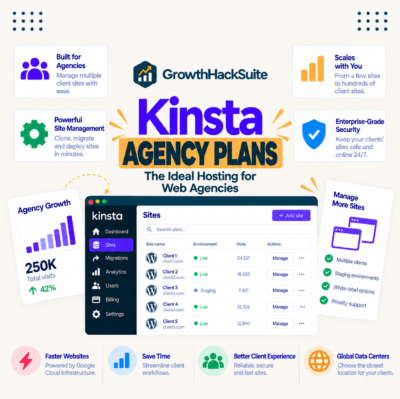
Nexcess is dramatically cheaper per site for agencies. Ten installs cost 33.75 dollars a month on Designer Launch and 135 on Designer Elevate, against 225 for Kinsta’s ten-install plan. Kinsta answers with tooling depth rather than price, including SAML single sign-on, an API and unlimited user seats.
- Cost per site at ten installs: Designer Launch works out at roughly 3.38 dollars per site each month, while Kinsta’s WP 10 plan works out at 22.50 per site before any overage charges.
- Scale beyond ten sites: The Nexcess plan builder continues to 25, 50, 100 and 250 sites, giving large agencies a published ladder rather than a custom quote conversation.
- Access management on Kinsta: Unlimited users, SAML single sign-on and just-in-time provisioning are included on every plan, which matters once client and contractor access must be audited.
- Automation on Kinsta: A published API and a built-in application performance monitoring tool allow site provisioning and diagnostics to be scripted rather than clicked through a dashboard.
- Storage per plan: Designer supplies 60 GB across ten sites and Kinsta’s WP 10 supplies 40 GB, so the cheaper platform also carries the larger disk allocation at that tier.
An agency choosing on spreadsheet economics will land on Nexcess. An agency choosing on governance, provisioning automation and support escalation may still justify Kinsta despite the multiple.
What Neither Host Includes
Both platforms leave the same gaps, which is worth knowing before either budget is signed off. Neither sells mailboxes with a WordPress plan, and neither treats domain registration as part of the hosting subscription. Those costs land somewhere regardless of which host wins.
- Professional email: Neither host bundles mailboxes with these WordPress plans, so a separate provider is required for anything beyond transactional messages sent by the site itself.
- Transactional mail deliverability: WordPress notification email still needs a dedicated sending service to reach inboxes reliably, since shared server mail is routinely filtered by major providers.
- Premium plugin licences: Page builders, form tools and commerce extensions remain separate purchases, and they often cost more annually than the hosting plan itself at the entry tier.
- Content delivery beyond the allowance: Kinsta meters CDN bandwidth at 125 GB on the entry plan, so media-heavy libraries can exceed the included allowance well before the visit limit.
- Guaranteed outcome on speed: Neither vendor promises a Core Web Vitals result, because plugin load, theme quality and third-party scripts dominate the final measurement on most sites.
Adding these to a comparison usually shrinks the perceived gap, because they apply equally and are paid to third parties either way.
When Is Nexcess the Better Pick?
Nexcess is the better pick more often than affiliate content usually admits. Any site where budget is the binding constraint, traffic is unpredictable, or many installs must be hosted cheaply will be better served there, especially on the Thrive tier where 30-day backup retention arrives at 12 dollars.
Source: list prices from kinsta.com/plans and the Liquid Web WordPress plan builder, August 2026, multiplied by twelve. Annual and multi-year terms reduce both columns.
Put simply, the twelve-month gap runs from 132 dollars on a single premium site to 1,890 dollars across ten sites. No performance claim on either vendor page is quantified well enough to justify that spread on paper alone.
When Does Kinsta Still Win?
Kinsta wins on a narrow but real set of cases. Expert migration included at every price point, per-site container isolation on compute-optimised Google Cloud machines, an SLA-backed uptime guarantee reaching 99.99 percent on Enterprise, and enterprise access controls are the four places where the extra spend buys something specific.
- Migration without in-house skills: Engineer-handled moves on every plan remove the single largest risk in switching hosts for owners without a developer on call.
- Regulated or audited environments: SAML single sign-on, just-in-time provisioning and unlimited user seats support access reviews that a shared login cannot satisfy.
- Sites where the invoice must be predictable: Metered visits are unpopular, yet they make capacity explicit, which some finance teams prefer to an unlimited claim with an undocumented ceiling.
- Enterprise uptime commitments: An SLA-backed guarantee of up to 99.99 percent applies to the hosted site rather than only to power and network at the facility level.
- Diagnostics built into the platform: A bundled application performance monitoring tool surfaces slow queries and plugin bottlenecks without adding a third-party subscription.
Outside those cases, the honest reading of the current price sheets favours Nexcess, and this page states that plainly rather than burying it.
Test the premium against your own site before paying for it
See Kinsta Plans →Engineers handle the migration, and the 30-day guarantee covers the test.
How Do You Move a Site From Nexcess to Kinsta?
The move is low-risk because Kinsta performs the migration and the original stays live until the copy is verified. Both hosts refund within 30 days, so the entire exercise can be reversed at no cost if the measured result does not justify the price difference.
- Record the baseline first. Measure Largest Contentful Paint and server response on the busiest uncached page while the site is still on Nexcess, so the comparison has a real starting point.
- Request the migration. Submit the migration form after signing up, since expert migrations are included on every plan and do not need to be purchased separately.
- Verify on the staging copy. Check plugins, checkout, forms and scheduled tasks on the Kinsta staging environment before any DNS record is touched.
- Switch DNS during a quiet window. Lower the record time-to-live in advance, then cut over when traffic is lowest to keep any propagation gap invisible to buyers.
- Re-measure the same pages. Repeat the original test on identical URLs under comparable traffic, because a homepage cached at the edge will not reveal any hosting difference.
- Decide inside the guarantee window. Keep the Nexcess account until the measurement is complete, then cancel the loser while a refund is still available on either side.
Running that sequence answers the question far better than any comparison page can, because it tests the specific combination of theme, plugins and traffic that the site actually carries.
Ready to benchmark Kinsta against Nexcess on your own site?
Start With Kinsta →Unlimited free migrations, staging included, 30-day money-back guarantee.
Kinsta vs Nexcess: Frequently Asked Questions
The 12 most-asked questions about choosing between Kinsta and Nexcess.
Is Kinsta better than Nexcess?
Not on price or plan limits. Nexcess is cheaper at every site count, includes more storage and advertises unlimited visits. Kinsta leads on expert migrations included at every tier, per-site isolation on Google Cloud and enterprise access controls.
Is Nexcess cheaper than Kinsta?
Yes, at every comparable size. One site starts at 6 dollars against 35, five sites start at 24.50 against 115, and ten sites start at 33.75 against 225. Even comparing top tiers, Nexcess remains the cheaper option.
Why does Nexcess redirect to Liquid Web?
Nexcess has been consolidated into its parent brand and now trades as Liquid Web by Nexcess. The managed WordPress plans are sold through a plan builder on liquidweb.com, which replaced the older fixed Spark, Maker and Designer price list.
Does Nexcess really offer unlimited visits?
Every WordPress tier advertises unlimited visits, so traffic itself is not billed. The practical ceiling moves to PHP workers, with 10 per site on Spark and 20 on Maker and Designer, plus autoscaled workers on the Elevate tier.
What do Kinsta overages cost?
Kinsta charges 50 cents for every extra 1,000 visits beyond the plan allowance. A 50,000-visit spike therefore adds 25 dollars to that month’s invoice, on top of the 35-dollar entry plan price.
Which host keeps backups longer?
Nexcess, on its two upper tiers. Thrive and Elevate retain daily backups for 30 days while Launch keeps 7. Kinsta retains 14 days on its entry plan, so a 12-dollar Nexcess plan holds more restore history than a 35-dollar Kinsta plan.
Which uptime guarantee is stronger?
They measure different things. Liquid Web publishes a 100 percent power and network SLA covering the facility layer. Kinsta publishes an SLA-backed uptime guarantee of up to 99.99 percent that applies to the hosted site and peaks on Enterprise plans.
Does Nexcess include free migration like Kinsta?
Only partly. Assisted migration appears on the Elevate tier, while Launch and Thrive provide self-serve migration tooling. Kinsta includes unlimited engineer-handled migrations on every plan, including the entry tier.
Which is faster, Kinsta or Nexcess?
Neither can be declared faster from published specifications. Both bundle Cloudflare-class edge caching, so cached pages behave similarly. Differences appear on uncached pages, where Kinsta cites compute-optimised machines and Nexcess cites per-site PHP workers.
Is Nexcess better for WooCommerce?
Nexcess carries a long WooCommerce heritage through Liquid Web and prices stores far lower. Kinsta counters with per-site isolation and compute-optimised machines, which matter most for stores with sharp seasonal peaks rather than steady order volume.
Which is better for agencies?
Nexcess on cost, at roughly 3.38 dollars per site for ten installs against 22.50 on Kinsta. Kinsta on governance, with SAML single sign-on, just-in-time provisioning, unlimited user seats and a published API for provisioning automation.
Should I switch from Nexcess to Kinsta?
Only where migration support, per-site isolation or enterprise access controls solve a problem that is costing more than the price difference. For a cost-led decision on a stable site, staying on Nexcess is the financially correct answer.
About this comparison
Written by the Growth Hack Suite editorial team. Prices and specifications were read directly from kinsta.com/plans and the Liquid Web WordPress plan builder in August 2026 and are reported as published. This page contains affiliate links to Kinsta, which pay a commission at no extra cost to the reader. Nexcess wins the majority of rows in the comparison above and the page says so.