Table of Contents
The best Cloudways alternatives are chosen for the opposite reason to most hosting migrations. People rarely leave Cloudways to save money, because it is already among the cheapest managed options available anywhere. They leave for a more hands-off experience with less server work, and that upgrade carries a price in both dollars and metering that almost no comparison bothers to state clearly before recommending the move.
Last updated: August 2026. Prices, allowances and billing models were read from each vendor’s own plan pages in the same week, with Kinsta figures taken from Kinsta’s official documentation. This page carries affiliate links to Kinsta, and the two things you give up moving to it are stated in full.
What Is the Best Cloudways Alternative?
Kinsta, for anyone leaving Cloudways because they want to stop thinking about the server. It is a fully managed platform with engineer-level support and no server sizing to configure, which is the specific gap Cloudways users describe. It also costs more and meters traffic, where Cloudways does neither.
Verdict: Cloudways starts at 14 dollars with unlimited visits and a server you size yourself. Kinsta starts at 35 with 35,000 metered visits and nothing to configure. Moving up the management ladder means paying more and accepting a meter Cloudways does not have. That trade is the whole decision.
So the ranking below is not about which host is cheaper or faster. It is about how much more management each one provides, and what that costs against the unmetered, self-sized platform being left behind.
“WordPress is a web content management system.”
: Wikipedia, WordPress
Every host here runs that software equally well, so the difference that matters is operational: how much of the server the customer is responsible for, and what the host charges to take that responsibility away.
Why Do People Leave Cloudways?
For management and support rather than for price, which is what makes this category unusual. Cloudways sits between raw cloud and fully managed hosting, and the reasons to leave almost all point in the direction of more hand-holding, not less cost.
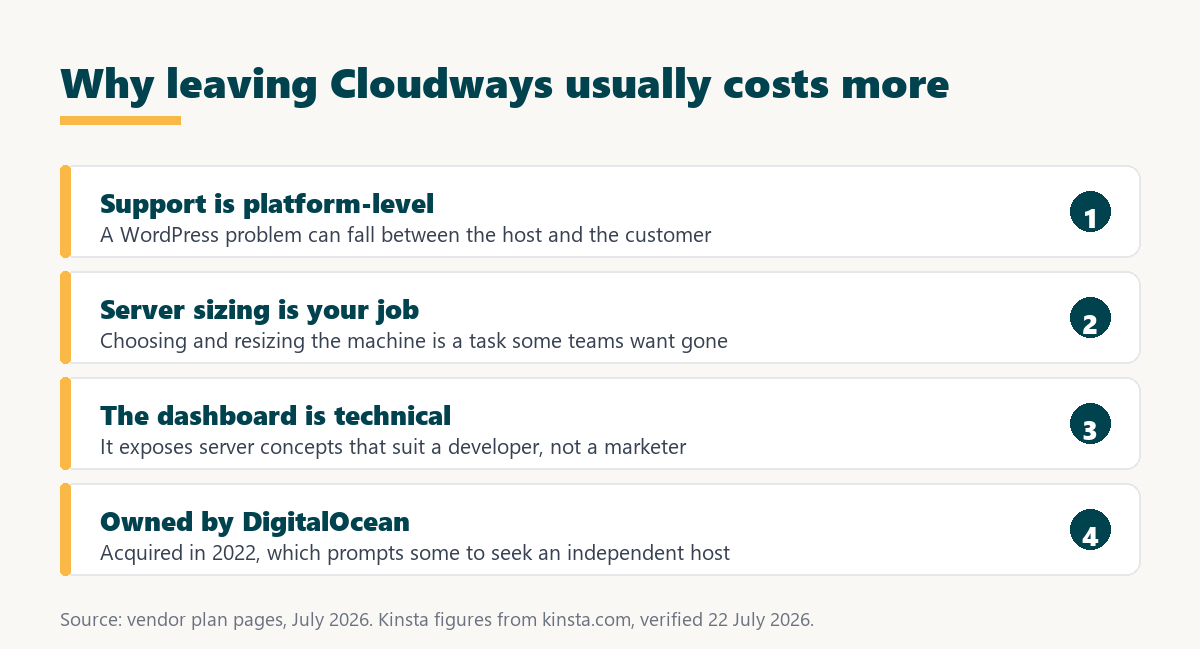
- Support is platform-level, not application-level: Cloudways manages the server, so a WordPress-specific problem can fall between the host and the customer in a way a fully managed platform avoids.
- Server sizing is the customer’s job: Choosing and resizing the underlying server is a task some teams want, and one others would rather never see again.
- The dashboard is technical: The interface exposes server concepts that suit a developer and intimidate a marketer, which is a common reason non-technical owners move on.
- Ownership changed: DigitalOcean acquired Cloudways in 2022, and some customers prefer an independently owned host or a specific alternative cloud.
- Email is absent: Cloudways does not bundle email, so anyone wanting an all-in-one package looks elsewhere, though most managed alternatives do not include it either.
Every one of those is a reason to pay more for less responsibility. Anyone leaving Cloudways to reduce a bill is unusual, and the honest advice for them is often to stay.
What Do You Give Up Leaving Cloudways?
Two things, and both are easy to overlook while focusing on the extra management: unlimited visits and per-server economics. Cloudways does not meter traffic and lets many sites share one server, and most fully managed hosts do neither.
Source: each vendor’s published plan pages, read July 2026, with Kinsta figures from kinsta.com/plans verified in August 2026. Management level describes how much of the server the customer configures, from semi-managed at Cloudways to fully managed elsewhere.
The two columns to read together are visits and management. Rocket.net is the only alternative that adds full management without also adding a meter, which makes it the closest structural replacement.
How Was This Ranking Built?
On how much management each host adds, then on whether it preserves the unmetered model Cloudways offers, then on price. Speed carries no weight, because a Cloudways migration is a decision about operational effort rather than about milliseconds.
Someone leaving Cloudways has usually concluded that managing a server is not their job. Ranking the alternatives by page speed would ignore that entirely, since every host here runs a cached WordPress page at a speed indistinguishable to a visitor.
1. Kinsta: The Fully Managed Upgrade
Kinsta removes the server entirely from the customer’s view, which is the exact thing a departing Cloudways user is buying. There is no machine to size, application performance monitoring is built in, and support is staffed by engineers rather than by a general first line.
- No server sizing exists: Plans are defined by visits and resources rather than by a machine specification, so the resizing task that Cloudways exposes simply disappears.
- Monitoring is built in: Application performance monitoring is included on every plan, which surfaces a slow query or plugin without a third-party tool.
- Support reaches engineers: The support tier is staffed to handle WordPress-level problems, closing the application-versus-server gap that Cloudways users describe.
- Isolation is standard: Each site runs in its own container on Google Cloud, rather than sharing a server’s memory as sites on one Cloudways server do.
- The meter is the cost: Visits above 35,000 are billed at 50 cents per thousand and bandwidth at 50 cents per gigabyte, which is the unmetered model given up in the move.
Two further costs complete the honest picture. Redis object caching is a 100-dollar per site monthly add-on where Cloudways includes it on the stack, and the entry price is two and a half times Cloudways’ own. The management is worth it to many teams, but it is not free.
No server to size, monitor, or resize
See Kinsta Plans →Fully managed with built-in monitoring, at 35 dollars against Cloudways’ 14 and with metered visits.
2. Rocket.net: Managed Without the Meter
Rocket.net is the closest structural match, because it adds full management while keeping unmetered visitors, which is the one thing Kinsta and WP Engine take away. At 30 dollars it removes the server without introducing the traffic ceiling.
It also publishes unlimited PHP workers and a 99.99 percent uptime guarantee, so the managed upgrade does not come with a hidden concurrency limit. For a Cloudways user whose reason to leave is management but who values the unmetered model, this is the ranking’s most consistent answer.
“a B2B site that loads in 1 second has a conversion rate 3x higher than a site that loads in 5 seconds”
: HubSpot, page load time and conversion rates
Worth repeating that a well-configured Cloudways server already delivers that speed, which is why the migration is about who does the configuring rather than about the result.
3. WP Engine: Managed With Agency Tooling
WP Engine adds full management plus tooling aimed at teams: an activity log, advanced user permissions, staging and GitHub Actions deployment. For a Cloudways user who left because several people now touch the site, that operational layer is the draw.
It reintroduces a meter at 25,000 visits with overage at two dollars per thousand, the highest rate here, so the unmetered model is given up more sharply than on Kinsta. The management and tooling are strong, and the traffic ceiling deserves the same attention it would on any metered plan.
4. Nexcess: Managed and Still Unmetered
Nexcess provides fully managed WordPress with unlimited visits from six dollars, which makes it the rare alternative that is both more managed and cheaper than Cloudways. It also publishes PHP worker counts and includes free staging.
Bandwidth is metered at two terabytes on the entry plan, the honest qualifier, and assisted migration sits on higher tiers. For a cost-conscious Cloudways user who still wants less server work, it is the most efficient move on this list, ranked below Rocket.net only on published performance headroom.
5. SiteGround: More Managed, Less Isolated
SiteGround offers a friendlier managed experience with bundled email, which suits a Cloudways user who wanted simplicity and an all-in-one package. It renews near 30 dollars on GrowBig with staging included from that tier.
The trade is that its plans are shared rather than giving each site a dedicated server as Cloudways does. Anyone who valued Cloudways for isolated server resources would be stepping toward a more shared model, so this suits the simplicity motive rather than the performance one.
6. Flywheel: Managed for Designers
Flywheel provides a fully managed, design-focused platform that suits agencies building client sites, with a workflow built around handing finished sites to clients. It is a genuine step away from server management for that specific audience.
It is owned by WP Engine, acquired in 2019, which is worth knowing for anyone whose Cloudways departure was partly about ownership after the DigitalOcean acquisition. Moving from one acquired platform to another may not deliver the independence some customers are seeking.
When Should You Stay on Cloudways?
More often than most alternative lists admit, because the reasons to stay are the same features people undervalue until they price the replacement. Five situations make staying the rational choice.
- Traffic is high or spiky: Unlimited visits are worth real money on a busy site, and giving them up for a metered plan can cost more than the management is worth.
- Several sites share a server: The per-server model is far cheaper for a portfolio than paying per install on a managed host.
- The team is technical: A developer comfortable sizing a server loses little by keeping that control and gains a lower bill.
- The budget is tight: At 14 dollars with no meter, Cloudways is hard to beat on cost, and the managed alternatives start higher.
- Scaling is frequent: Resizing a server on demand without a migration is a genuine advantage that fixed managed plans do not offer.
The honest test is simple: if the complaint is server management, moving makes sense, and if it is anything else, the replacement usually costs more than it solves.
Engineer-level support and monitoring included
Compare Kinsta Tiers →A 30-day money-back guarantee, and free unlimited migrations from Cloudways.
How Much More Does Management Cost?
Between nothing and 21 dollars a month at the entry level, depending on the host, and the cheapest managed option is actually less than Cloudways. The premium is not uniform, so the table below shows it against Cloudways directly.
Source: each vendor’s published entry prices, read July 2026, with Kinsta figures from kinsta.com/plans. The premium is against Cloudways’ 14-dollar Micro plan and excludes any traffic overage, which would widen the gap on the metered hosts during a busy month.
The row worth pausing on is Nexcess, which is cheaper than Cloudways while being more managed, and the two 30-dollar hosts, which cost the same but differ on whether the meter comes back.
Twenty-one dollars more, and no server to run
View Kinsta Pricing →Fully managed on Google Cloud with built-in monitoring, against Cloudways’ self-sized 14-dollar server.
Which Should You Choose?
The right answer depends on which Cloudways feature you are willing to give up, and four paths cover most people.
- Full management, meter accepted: Kinsta removes the server most completely, provided the traffic sits inside the allowance and the budget allows 35 dollars.
- Full management, meter kept: Rocket.net is the closest structural match, adding management while preserving the unmetered model at 30 dollars.
- Cheaper and still managed: Nexcess is both more managed and less expensive than Cloudways, with unlimited visits and a metered bandwidth qualifier.
- Simplicity with email: SiteGround suits a non-technical owner who wants an all-in-one package and accepts shared resources for it.
Name the feature you are prepared to lose, and the shortlist resolves to one host without any need for a benchmark.
“Tool spend is only defensible when the outcome it protects is measured, not assumed.”
: Growth Hack Suite, ROI on sales tools
Here the outcome is the time a team spends on server administration, which is measurable in hours. If those hours cost more than the price difference, the managed upgrade pays for itself, and if they do not, Cloudways was already the right platform.
Best Cloudways Alternatives: Frequently Asked Questions
The 12 most-asked questions about leaving Cloudways.
What is the best Cloudways alternative?
Kinsta for the most complete removal of server management, or Rocket.net if keeping unmetered visits matters. The right choice depends on which Cloudways feature you are willing to give up in exchange for less administration.
Is Cloudways cheaper than the alternatives?
Usually, yes. At 14 dollars with unlimited visits and unlimited sites per server, it undercuts every fully managed host here except Nexcess. Leaving Cloudways to save money is unusual and often the wrong move.
What do I give up by leaving?
Unlimited visits and per-server economics. Cloudways does not meter traffic and lets many sites share one server, and most fully managed hosts do neither, so the upgrade in management comes with a traffic ceiling and a higher per-site cost.
Which alternative keeps unlimited visits?
Rocket.net and Nexcess. Rocket.net publishes unmetered visitors and Nexcess unlimited visits, so both add full management without the traffic meter that Kinsta and WP Engine introduce. That makes them the closest structural matches.
Why does Kinsta rank first if it meters?
Because the ranking is about management depth, and Kinsta removes the server most completely with built-in monitoring and engineer-level support. The meter is stated as the trade, and a reader who values unmetered traffic should choose Rocket.net instead.
Is Nexcess really cheaper and more managed?
Yes, from six dollars with unlimited visits and fully managed WordPress, which makes it the rare alternative that improves on Cloudways in both directions. Bandwidth is metered at two terabytes, and assisted migration sits on higher tiers.
Who owns Cloudways now?
DigitalOcean, which acquired it in 2022. If your reason for leaving is ownership, note that Flywheel is owned by WP Engine, so moving to it swaps one acquired platform for another rather than reaching an independent host.
Does any alternative include email?
SiteGround does, and most managed hosts including Kinsta and WP Engine do not. Cloudways itself does not bundle email either, so this is one area where leaving for SiteGround is a genuine gain rather than a trade.
Is the dashboard simpler on the alternatives?
Generally yes, because fully managed hosts hide the server concepts Cloudways exposes. Kinsta, WP Engine and SiteGround present a WordPress-focused interface rather than a server one, which is the change a non-technical owner is usually after.
Will my site be faster if I leave?
Unlikely, since a well-configured Cloudways server already performs well and every host here caches WordPress adequately. The migration changes who does the configuring, not the speed a visitor experiences.
Does Kinsta migrate my site from Cloudways?
Yes, with free unlimited migrations that move the site into a tested staging copy before switching. That removes the main practical cost of leaving, though the meter and the higher price remain the real considerations.
When should I stay on Cloudways?
When traffic is high or spiky, several sites share a server, the team is technical, or the budget is tight. In all four the unmetered per-server model is worth more than the extra management, and leaving would cost more than it solves.
About this ranking
Written by the Growth Hack Suite editorial team. Prices, allowances and billing models were read from each vendor’s own plan pages in August 2026, with Kinsta figures taken from Kinsta’s official documentation. No speed benchmark is used, because a Cloudways migration is an operational decision about server management rather than a performance one, and every host here caches WordPress adequately. This page carries affiliate links to Kinsta, which ranks first for management depth, so the trade is stated in full: Kinsta costs two and a half times Cloudways’ entry price, meters visits above 35,000 at 50 cents per thousand where Cloudways is unmetered, and charges 100 dollars per site monthly for Redis object caching that Cloudways includes.
Readers whose priority is keeping unmetered traffic are pointed at Rocket.net and Nexcess, and those whose real need is a lower bill are advised to stay on Cloudways. Cloudways is owned by DigitalOcean and Flywheel by WP Engine, both noted because ownership is a stated reason some customers move.