
Table of Contents
The best Bluehost alternatives share one quality the popular lists rarely check: they sit outside the corporate family that owns Bluehost. Several hosts commonly recommended as alternatives are run by the very same parent company, so moving to one of them changes the logo on the invoice without changing the pricing playbook that prompted the search, which is why ownership belongs at the top of this comparison.
Last updated: August 2026. Prices and ownership were read from vendor and corporate pages in the same week, with Kinsta figures taken from Kinsta’s official documentation. This page carries affiliate links to Kinsta, and the honest truth that it is a large jump from a Bluehost plan is stated up front.
What Is the Best Bluehost Alternative?
It depends on how far you want to jump, but the first rule is to choose an independently owned host. Bluehost belongs to Newfold Digital, which also owns HostGator and iPage, so those are not a genuine escape from the same company’s practices.
Verdict: Kinsta is the strongest platform here, but at 35 dollars it is roughly ten times a Bluehost intro plan, so it is the top of the ladder rather than the natural next rung. For most people leaving Bluehost, Hostinger, SiteGround or DreamHost is the right-sized step, and all six alternatives are independent of Newfold Digital.
This ranking is therefore about matching the jump to where a site actually is, not about naming the single most powerful host and ignoring the price gap between it and a beginner’s current plan.
“WordPress is a web content management system.”
: Wikipedia, WordPress
Every host below runs that software, so the differences that matter are ownership, the gap between the sign-up and renewal price, and how large a step up in resources each one represents.
Why Do People Leave Bluehost?
For three recurring reasons: slow performance on crowded shared servers, a renewal price well above the advertised rate, and repeated upsells during signup and use. All three are common to budget shared hosting rather than unique to Bluehost.
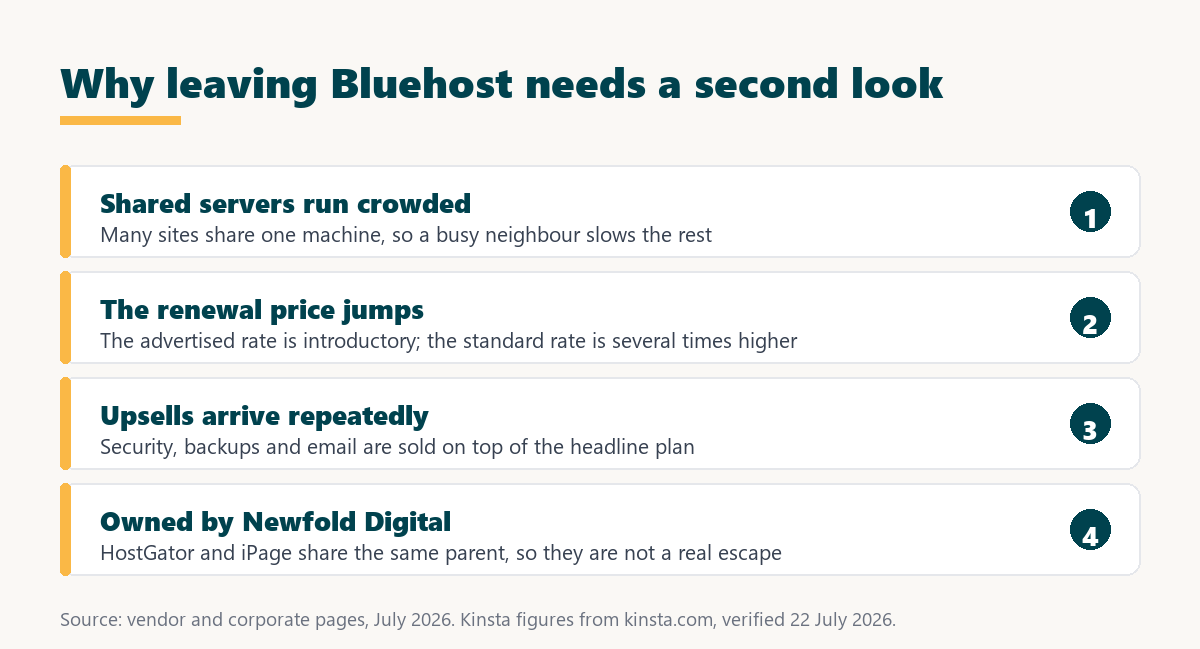
- Shared servers run crowded: Budget plans place many sites on one machine, so a busy neighbour slows the others, which is the performance complaint behind most Bluehost departures.
- The renewal price jumps: The advertised rate is an introductory offer, and the standard rate applied at renewal is several times higher, the same structure across the budget tier.
- Upsells arrive repeatedly: Add-ons for security, backups and email are offered at checkout and afterward, which raises the real cost above the headline plan.
- Resources cap quickly: A growing site meets a limit on a shared plan and is pushed toward an upgrade, which is where the renewal figure climbs again.
- Ownership is a conglomerate: Bluehost is one of many brands under Newfold Digital, so switching within that family keeps the same corporate approach to pricing and support.
The last point is the one that catches people, because a switch to HostGator or iPage feels like leaving Bluehost while staying with the same parent company entirely.
Who Owns These Alternatives?
All six below are independent of Newfold Digital, which is the first thing to verify when leaving Bluehost. The table separates genuine alternatives from same-family brands that are commonly listed as alternatives but are not.
Source: corporate ownership pages, read July 2026. Bluehost, HostGator and iPage are Newfold Digital brands; the hosts above are not, which is why HostGator and iPage are deliberately absent from this list despite appearing on many others.
The absences are as important as the entries. A list that recommends HostGator as a Bluehost alternative is recommending the same company under a different name.
How Was This Ranking Built?
On independence from Newfold Digital first, then on how well the size of the jump matches a typical Bluehost site, then on price. Speed carries no weight, because the difference that matters is shared versus isolated resources rather than a benchmark number.
A Bluehost user is usually on a beginner shared plan, so the useful question is which rung of the ladder to step to, not which host wins an abstract speed test. Every option here caches a small WordPress site quickly regardless.
1. Kinsta: The Top of the Ladder
Kinsta is the strongest platform on this list and the largest jump from Bluehost, at roughly ten times an introductory shared plan. It is the right destination for a site that has genuinely outgrown shared hosting, and an overshoot for one that has not.
- Resources are isolated: Each site runs in its own container on Google Cloud, which is the direct fix for the crowded-server slowness behind most Bluehost complaints.
- Pricing is flat: The 35-dollar rate applies at sign-up and at renewal, with no introductory discount to expire, which removes the renewal-jump surprise entirely.
- No upsells at checkout: Security, a content delivery network and free migrations are included rather than sold as add-ons, so the plan price is the real price.
- Support reaches engineers: The support tier handles WordPress-level problems, a clear step up from budget shared hosting’s general first line.
- The cost is the catch: At 35 dollars it is a large jump, visits above 35,000 are metered, and Redis object caching is a 100-dollar per site monthly add-on.
The honest summary is that Kinsta solves every Bluehost complaint and costs accordingly. A serious site will find it worth the jump, and a first personal blog will not yet.
Isolated resources and no checkout upsells
See Kinsta Plans →Flat 35-dollar pricing with security and migrations included, and metered visits above the allowance.
2. SiteGround: The Natural Next Step
SiteGround is the most natural upgrade from Bluehost, offering better-managed shared hosting with bundled email and stronger support at a renewal near 30 dollars. It stays in a familiar category while improving the parts a Bluehost user complains about.
Its own sign-up-to-renewal gap applies, so the standard rate is the number to compare rather than the teaser. For a beginner who wants a clear improvement without a tenfold price jump, it is the safest single recommendation on this list.
“a B2B site that loads in 1 second has a conversion rate 3x higher than a site that loads in 5 seconds”
: HubSpot, page load time and conversion rates
That relationship is why the crowded-server slowness matters, and why moving off an overloaded shared plan is worthwhile even without reaching for the most expensive host.
3. Hostinger: The Cheaper Like-for-Like
Hostinger is the closest match to Bluehost’s own category at a lower renewal of 10.99 dollars, with staging, object caching, a content delivery network and a free first-year domain. For a Bluehost user whose main issue is cost, it is the largest saving that stays in shared hosting.
It is a lateral move in architecture rather than a step up, since it is also shared and carries its own introductory-to-renewal gap. It solves the price and upsell complaints while leaving the shared-resource limits in place, which suits a small site comfortably.
4. DreamHost: Independent and Isolated
DreamHost’s DreamPress provides isolated managed WordPress at a renewal near 20 dollars, with a small gap from its sign-up rate and bundled email. It is the cheapest genuinely isolated option here, and it is independently owned with a long track record.
For a Bluehost user ready to leave shared hosting but not ready for Kinsta’s price, it occupies the useful middle: real isolation, honest pricing, included email, at roughly double a shared plan rather than ten times it.
5. Cloudways: For the More Technical
Cloudways offers managed cloud from 14 dollars with unlimited visits and no renewal jump, billed hourly. It gives a dedicated server’s performance at a low price, which appeals to a Bluehost user comfortable with a more technical dashboard.
The trade against a shared host is that it exposes server concepts a beginner may not want to see, and it does not bundle email. It is owned by DigitalOcean, independent of Newfold, and it suits a growing site whose owner is willing to learn a little more.
6. WP Engine: The Other Premium Option
WP Engine sits alongside Kinsta as a premium managed host at 30 dollars, with isolated resources, staging and agency tooling. It is a comparable destination for a site that has outgrown shared hosting and wants a team-oriented platform.
Its constraint is a metered visit allowance of 25,000 with overage at two dollars per thousand, the highest rate among these hosts. For a former Bluehost site with modest traffic that ceiling may never bite, and it is worth checking against expected growth before committing.
How Big Is Each Step Up From Bluehost?
From a lateral move to a tenfold jump, and the size of the step is the number most lists leave out. Measured against a Bluehost intro plan of roughly 3 dollars, the alternatives fall into clear tiers.
Source: each vendor’s published entry or renewal prices, read July 2026, with Kinsta figures from kinsta.com/plans. WP Engine sits alongside Kinsta at 30 dollars; the jump size is indicative and shared-host introductory rates vary by term and promotion.
The table makes the overshoot risk visible: three of these are a two-to-tenfold decision, and picking the largest jump by default is how people end up paying for capacity a small site never uses.
The full jump, for a site that is ready for it
View Kinsta Pricing →Isolated resources and flat pricing, at roughly ten times a Bluehost intro plan.
Which Step Up Is Right for You?
Match the rung to the site, because overshooting wastes money and undershooting repeats the problem. Four situations cover most people leaving Bluehost, and each points at a clear choice.
- A small site that just wants cheaper: Hostinger stays in the shared category at a lower renewal, solving the price and upsell complaints without a big change.
- A growing site wanting a real improvement: SiteGround is the natural next step, better managed and supported while remaining affordable and familiar.
- A site ready to leave shared hosting: DreamHost gives genuine isolation at a moderate price, and Cloudways does so for a more technical owner.
- A serious site that has outgrown budget hosting: Kinsta or WP Engine is the destination, with isolation, flat pricing and engineer-level support at a premium price.
The single mistake to avoid is treating every Bluehost departure as a reason to buy the most expensive host, when the right rung is usually one or two steps up rather than all the way to the top.
When your site has truly outgrown shared hosting
Compare Kinsta Tiers →Independent, flat-priced and isolated, with free unlimited migrations from Bluehost.
Which Should You Choose?
Every one of these is independent of the company that owns Bluehost, and each fits a different departure reason.
- Hostinger for cost: A shared plan at a lower renewal that solves the price and upsell complaints while keeping the familiar model a small site is comfortable with.
- SiteGround for the natural step: Better-managed shared hosting with bundled email and stronger support, the safest single upgrade for most Bluehost users.
- DreamHost or Cloudways for isolation: Dedicated resources at roughly double a shared plan, with DreamHost simpler and Cloudways cheaper but more technical.
- Kinsta or WP Engine for a serious site: Premium managed hosting for a site that has genuinely outgrown the budget tier and can justify the tenfold jump.
“Tool spend is only defensible when the outcome it protects is measured, not assumed.”
: Growth Hack Suite, ROI on sales tools
For a site leaving Bluehost the outcome is straightforward: fewer slow afternoons and a predictable bill. Matching the plan to the traffic the site actually has keeps that outcome affordable rather than buying capacity it will not use.
Best Bluehost Alternatives: Frequently Asked Questions
The 12 most-asked questions about leaving Bluehost.
What is the best Bluehost alternative?
It depends on the jump you want. SiteGround is the natural managed step up, Hostinger the cheaper like-for-like, and Kinsta the premium destination for a site that has outgrown shared hosting. All are independent of Bluehost’s owner.
Who owns Bluehost?
Newfold Digital, which also owns HostGator and iPage among other brands. That is why those two are deliberately absent here: switching to them leaves you with the same parent company and the same pricing approach.
Is Kinsta worth it coming from Bluehost?
For a site that has outgrown shared hosting, yes, because it fixes crowded servers, renewal jumps and upsells at once. At roughly ten times a Bluehost intro plan, it is an overshoot for a small personal blog that is not straining its current plan.
Which alternative is closest to Bluehost’s price?
Hostinger, which renews at 10.99 dollars in the same shared category, with staging, object caching and a free first-year domain. It solves the price and upsell complaints while keeping the shared-resource model a small site is fine with.
Is SiteGround better than Bluehost?
On management, support and performance it is generally regarded as a step up, with bundled email and a friendlier managed experience. It has its own renewal jump, so compare the standard rate rather than the introductory one.
Why are HostGator and iPage not on the list?
Because they are owned by Newfold Digital, the same company that owns Bluehost. Recommending them as alternatives would mean pointing someone leaving Bluehost toward the same parent company under a different brand name.
What is the cheapest way to leave shared hosting?
DreamHost’s DreamPress at around 20 dollars provides isolated managed WordPress, and Cloudways does so from 14 dollars for a more technical owner. Both give a dedicated resource rather than a shared one at roughly double a budget plan.
Does leaving Bluehost mean losing my email?
Only if you move to a host that does not include it. SiteGround, DreamHost and Hostinger bundle email, while Kinsta and WP Engine do not, so a premium managed host requires a separate mailbox provider.
Will my site be faster after switching?
Under load, an isolated host holds up better than a crowded shared server, which is the real gain. On a quiet site the difference is small, since every host here caches a small WordPress site adequately.
Does Kinsta charge overage?
Yes, on traffic above the plan, at 50 cents per thousand visits over 35,000 and 50 cents per gigabyte of bandwidth. For a former Bluehost site with modest traffic the flat plan price is usually what applies.
Is the migration difficult?
Usually not, and Kinsta includes free unlimited migrations that move the site into a tested staging copy before switching. Most managed hosts here offer some migration help, so the move is rarely the obstacle people fear.
Should I just stay on Bluehost?
If the site is tiny, the renewal is acceptable and performance is fine, staying is reasonable. The case to leave strengthens when the shared server slows the site, the renewal climbs, or the upsells outweigh the convenience.
About this ranking
Written by the Growth Hack Suite editorial team. Prices and corporate ownership were read from vendor and company pages in August 2026, with Kinsta figures taken from Kinsta’s official documentation. No speed benchmark is used, because the difference that matters for a Bluehost site is shared versus isolated resources rather than a single number, and every host here caches a small WordPress site adequately.
This page carries affiliate links to Kinsta, which ranks first as the strongest platform, so the honesty owed to a Bluehost reader is stated plainly: Kinsta is roughly ten times a Bluehost intro plan, meters visits above 35,000, and charges 100 dollars per site monthly for Redis object caching, which makes it the top of the ladder rather than the natural next step for most people leaving. Hostinger, SiteGround and DreamHost are recommended as right-sized alternatives, and HostGator and iPage are deliberately excluded because Newfold Digital owns them alongside Bluehost.


