

Table of Contents
The best Flywheel alternatives have to answer two questions that most lists never bother to separate: what actually replaces the designer-friendly workflow Flywheel is built around, and whether the alternative is genuinely independent of WP Engine, the company that owns Flywheel. A ranking that puts WP Engine near the top ignores the second question entirely, which is why this comparison starts by asking why you are leaving.
Last updated: August 2026. Prices, features and ownership were read from vendor and corporate pages in the same week, with Kinsta figures taken from Kinsta’s official documentation. This page carries affiliate links to Kinsta, and where a cheaper or more design-focused host fits better, it says so.
What Is the Best Flywheel Alternative?
Kinsta for performance and support, but the honest answer depends on why you are leaving. If the reason is WP Engine ownership, the alternative must be independent of WP Engine, which rules out both WP Engine itself and Flywheel’s sibling brands.
Verdict: Flywheel is owned by WP Engine, so WP Engine is not an escape from it. For a designer or agency leaving over the workflow, Pressable offers the closest client-focused replacement. For performance, Kinsta leads. For a lower bill with more control, Cloudways. The right pick depends entirely on the reason for the move.
That is why this ranking weighs independence and workflow fit above a raw performance score. A designer leaving Flywheel wants a comparable way of working, not just a faster server.
“WordPress is a web content management system.”
: Wikipedia, WordPress
Every host below runs that software, so the real differences are ownership, whether the platform supports an agency’s client-handoff workflow, and the balance of performance against price.
Why Do People Leave Flywheel?
For two main reasons that point in different directions: performance limits on higher-traffic sites, and a preference not to be on a WP Engine-owned platform after the 2019 acquisition. The first calls for a stronger host, the second for an independent one.
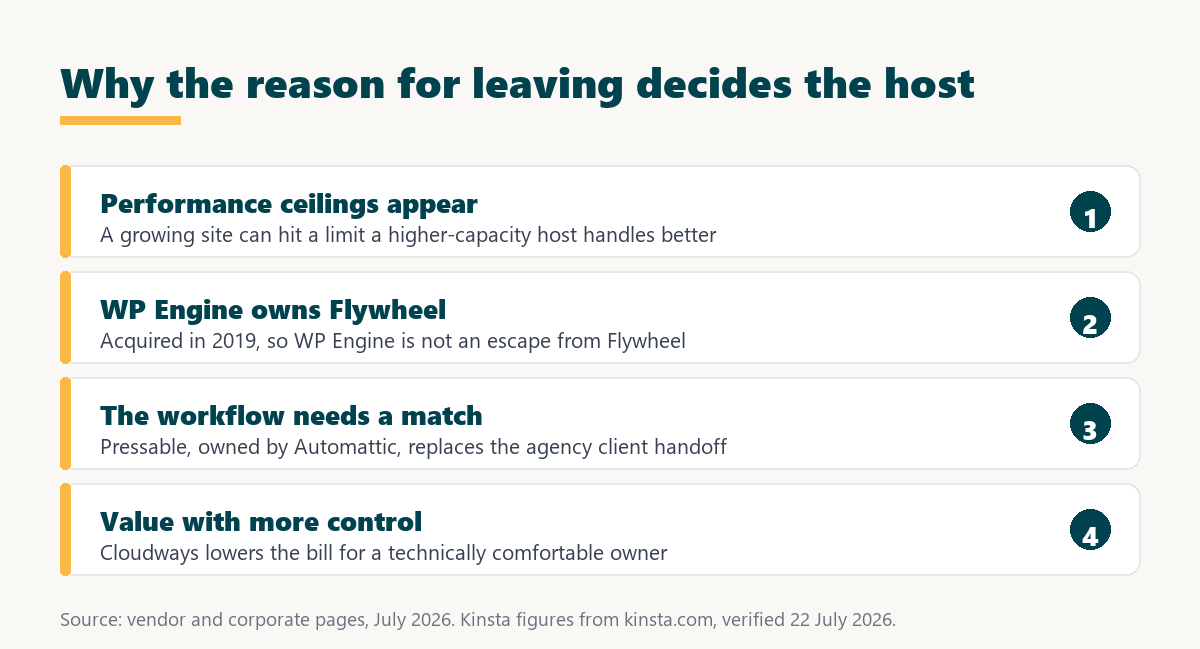
- Performance ceilings appear: Flywheel suits smaller managed sites, so a growing project can reach a limit that a higher-capacity host handles more comfortably.
- WP Engine ownership matters: WP Engine acquired Flywheel in 2019, and some customers prefer an independently owned platform for that reason alone.
- Pricing shifted expectations: Managed pricing across the WP Engine family has moved over time, prompting a search for better value elsewhere.
- The workflow needs a match: Flywheel’s appeal is its designer and agency workflow, so a replacement is judged on how well it supports building and handing over client sites.
- Feature gaps emerge: A team outgrowing Flywheel may want tooling it does not offer, such as deeper staging, monitoring or version control.
Because the two main motives pull toward different hosts, a single winner cannot serve everyone, and the ranking below is read against the reason rather than in isolation.
Which Alternatives Are Independent of WP Engine?
Five of the six below are, and WP Engine is the exception because it owns Flywheel. Anyone leaving specifically to move away from WP Engine needs the independence column, which the table makes explicit.
Source: corporate ownership pages, read July 2026. WP Engine acquired Flywheel in 2019 and Automattic owns Pressable; DigitalOcean acquired Cloudways in 2022. Independence is stated because it is one of the two main reasons people leave Flywheel.
The bottom row is the one to read carefully. WP Engine is a capable platform, but recommending it to someone leaving Flywheel over ownership is recommending the parent company they are trying to leave.
How Was This Ranking Built?
On independence from WP Engine, then on how well each host replaces Flywheel’s agency workflow, then on performance and price. Speed carries no weight as a benchmark, because the platforms here cache a WordPress site at speeds a visitor cannot tell apart.
Flywheel’s identity is a way of working, not a speed number, so a replacement is judged first on whether it fits the same use, particularly the designer and agency handoff that made Flywheel popular in the first place.
1. Kinsta: The Performance Upgrade
Kinsta is the strongest performance step up from Flywheel and fully independent, running each site in its own container on Google Cloud with engineer-level support. For a Flywheel user hitting a capacity ceiling, it is the most capable destination on this list.
- Resources are isolated: Each site has its own container rather than sharing capacity, which is the direct answer to a performance limit on a busy Flywheel site.
- Ownership is independent: Kinsta is not part of the WP Engine family, so it satisfies the ownership motive as well as the performance one.
- Support reaches engineers: The support tier handles WordPress-level problems directly, a step beyond a general managed first line.
- Staging is standard: One-click staging on every plan supports building and testing before a client site goes live.
- The trade is price and metering: At 35 dollars it is more than Flywheel’s entry, visits above 35,000 are metered, and Redis object caching is a 100-dollar per site add-on.
What Kinsta does not replicate is Flywheel’s specific client-billing and handoff tooling, so a pure agency workflow may find Pressable a closer fit even though Kinsta is the stronger platform overall.
Independent, isolated, and built for performance
See Kinsta Plans →Isolated Google Cloud containers with free migrations from Flywheel, and metered visits above the allowance.
2. Pressable: The Closest Workflow Match
Pressable is the nearest replacement for Flywheel’s agency workflow, owned by Automattic, the company behind WordPress.com and WooCommerce. It is built for freelancers and agencies managing multiple client sites, which is exactly the audience Flywheel courts.
Its plans are priced by site count and traffic in a way that suits a portfolio of client sites, and it is independent of WP Engine. For a designer whose reason to leave is ownership rather than performance, it preserves the way of working while changing the parent company, which is the combination this article exists to find.
“a B2B site that loads in 1 second has a conversion rate 3x higher than a site that loads in 5 seconds”
: HubSpot, page load time and conversion rates
Speed still matters for client work, but every managed host here delivers it, so the deciding factor for an agency is the workflow rather than a benchmark that all of them pass.
3. Cloudways: Value and Control
Cloudways offers managed cloud from 14 dollars with unlimited visits and no renewal jump, owned by DigitalOcean and independent of WP Engine. It gives more performance control at a lower price than Flywheel, which suits a technically comfortable user leaving on value.
The trade is a more technical dashboard than Flywheel’s polished designer interface, and no bundled email. For an agency wanting to lower hosting costs across many client sites on one server, the per-server model is often the largest saving available.
4. SiteGround: The Simpler Managed Option
SiteGround provides a friendly managed experience with bundled email and staging at a renewal near 30 dollars, independently owned. It suits a Flywheel user who wanted managed simplicity rather than an agency-specific toolset.
Its plans are shared rather than giving each site a dedicated resource, so it fits a simplicity motive better than a performance one. For a small studio with a handful of low-traffic client sites, it is an affordable and independent choice.
5. Rocket.net: Unmetered Speed
Rocket.net publishes unmetered visitors and unlimited PHP workers on every plan from 30 dollars, independent and edge-cached for speed. For a Flywheel site whose performance ceiling was really a traffic ceiling, the unmetered model removes it directly.
It is more of a performance play than a workflow one, without Flywheel’s designer-specific tooling. For a single high-traffic site rather than a portfolio of client projects, it is a strong and predictable choice with a published no-renewal-increase commitment.
6. WP Engine: Capable, but the Same Owner
WP Engine is a mature, feature-rich managed platform with agency tooling, staging and an activity log, and it is technically a step up from Flywheel. It ranks last here for one reason: it owns Flywheel, so it is not an escape for anyone leaving over ownership.
For a customer whose only reason to leave is a feature gap and who has no objection to the parent company, it is a genuine option, and its 25,000-visit allowance with two-dollar overage is the constraint to weigh. For everyone leaving over ownership, it is the one host on this list to skip.
What Matters Most for an Agency Leaving Flywheel?
The client workflow, because that is what made Flywheel worth choosing in the first place. Raw performance is a smaller factor for a studio building modest client sites than the tools that make handing them over smooth.
- Client handoff and billing: The ability to transfer a finished site and its billing to a client cleanly is Flywheel’s signature feature, and Pressable matches it most closely.
- Managing many sites at once: A portfolio of client sites needs per-site organisation and billing, which per-server hosts like Cloudways and site-count plans handle differently.
- Staging for approvals: Building on staging and sharing a preview for client sign-off is a routine agency need that every managed host here supports.
- Predictable per-site cost: An agency passing hosting to clients needs a cost it can quote, which favours flat pricing over metered plans that vary with traffic.
- Independence if that was the reason: If the move is about leaving WP Engine, the host must sit outside its family, which excludes WP Engine and keeps Pressable, Kinsta and Cloudways in play.
Weighed together, those favour Pressable for a workflow-driven move and Kinsta for a performance-driven one, with WP Engine ruled out whenever ownership is part of the reason.
When performance is the reason you are leaving
Compare Kinsta Tiers →Isolated resources and engineer-level support, independent of the WP Engine family.
How Do the Prices and Fits Compare?
From 14 dollars to 35 dollars at entry, with the right choice set more by fit than by the number. The table pairs each price with the departure reason it serves, which is the comparison that actually decides the move.
Source: each vendor’s published plan pages and corporate ownership, read July 2026, with Kinsta figures from kinsta.com/plans. Pressable prices by site count and traffic rather than a single entry rate; the independence column repeats because it is the deciding factor for an ownership-driven move.
The only row marked no in the last column is WP Engine, which keeps the comparison honest for the reader whose whole reason to leave is the company behind Flywheel.
The independent performance pick on this list
View Kinsta Pricing →Isolated resources and free migrations from Flywheel, with metered visits above the allowance.
Which Should You Choose?
The choice follows directly from the reason for leaving, and four paths cover it.
- Leaving over performance: Kinsta is the strongest independent step up, with isolated resources and engineer-level support for a site that outgrew Flywheel.
- Leaving over the workflow: Pressable is the closest agency replacement, independent of WP Engine and built for managing client sites.
- Leaving over cost: Cloudways lowers the bill with more control, and SiteGround keeps things simple with bundled email.
- Leaving over ownership: Any of the five independent hosts works, and WP Engine is the single option to avoid because it owns Flywheel.
Name the reason and the shortlist narrows to one or two hosts, which is a more useful result than a single winner that suits nobody’s specific situation.
“Tool spend is only defensible when the outcome it protects is measured, not assumed.”
: Growth Hack Suite, ROI on sales tools
For an agency the outcome is the hours saved on client handoff and the sites kept fast enough to keep clients happy. Matching the host to that, rather than to a headline, is what keeps a portfolio profitable.
Best Flywheel Alternatives: Frequently Asked Questions
The 12 most-asked questions about leaving Flywheel.
What is the best Flywheel alternative?
It depends on the reason. Kinsta for performance, Pressable for the agency workflow, and Cloudways for value with more control. All three are independent of WP Engine, which owns Flywheel.
Who owns Flywheel?
WP Engine, which acquired it in 2019. That is why WP Engine ranks last here despite being a capable platform: it is not an escape for anyone leaving Flywheel because of its ownership.
Which alternative matches Flywheel’s agency workflow?
Pressable, owned by Automattic, is built for freelancers and agencies managing multiple client sites, which is Flywheel’s core audience. It preserves the way of working while being independent of WP Engine.
Is Kinsta better than Flywheel?
On performance and support, yes, with isolated resources and engineer-level help. It does not replicate Flywheel’s specific client-handoff tooling, so a pure agency workflow may prefer Pressable even though Kinsta is the stronger platform.
Why does WP Engine rank last?
Because it owns Flywheel, and one of the two main reasons people leave Flywheel is that ownership. As a platform it is capable and feature-rich, but as an escape from the WP Engine family it does not work.
What is the cheapest Flywheel alternative?
Cloudways from 14 dollars with unlimited visits and no renewal jump, especially if several client sites share one server. SiteGround is a simpler managed option with bundled email at a renewal near 30 dollars.
Is Pressable owned by Flywheel’s parent?
No. Pressable is owned by Automattic, the company behind WordPress.com and WooCommerce, which is separate from WP Engine. That independence is part of why it suits an agency leaving Flywheel over ownership.
Will my client sites be faster after moving?
Under load, an isolated or unmetered host holds up better than a capacity-limited plan, which is the real gain. On modest client sites the difference is small, since every host here caches WordPress adequately.
Does Kinsta charge overage?
Yes, on traffic above the plan, at 50 cents per thousand visits over 35,000 and 50 cents per gigabyte of bandwidth. For a portfolio of modest client sites the flat plan price usually applies.
Which alternative keeps unlimited traffic?
Rocket.net publishes unmetered visitors and Cloudways offers unlimited visits per server, both independent of WP Engine. For a single high-traffic site rather than a portfolio, Rocket.net’s unmetered model removes a traffic ceiling directly.
Is the migration from Flywheel difficult?
Usually not, and Kinsta includes free unlimited migrations that move a site into a tested staging copy before switching. Most managed hosts here offer migration help, so the move is rarely the obstacle it seems.
Should I just stay on Flywheel?
If the workflow suits you, performance is adequate and the WP Engine ownership does not bother you, staying is reasonable. The case to leave strengthens when a site hits a ceiling or when independence from WP Engine becomes a priority.
About this ranking
Written by the Growth Hack Suite editorial team. Prices, features and corporate ownership were read from vendor and company pages in August 2026, with Kinsta figures taken from Kinsta’s official documentation. No speed benchmark is used, because Flywheel’s identity is a designer and agency workflow rather than a speed number, and every host here caches WordPress adequately.
This page carries affiliate links to Kinsta, which ranks first for performance, so the honesty owed to a Flywheel reader is stated plainly: Kinsta costs more than Flywheel’s entry, meters visits above 35,000, charges 100 dollars per site monthly for Redis object caching, and does not replicate Flywheel’s client-handoff tooling, which is why Pressable is recommended for a workflow-driven move. WP Engine ranks last deliberately, because it owns Flywheel and is therefore not an escape for anyone leaving over ownership, one of the two most common reasons to go.


