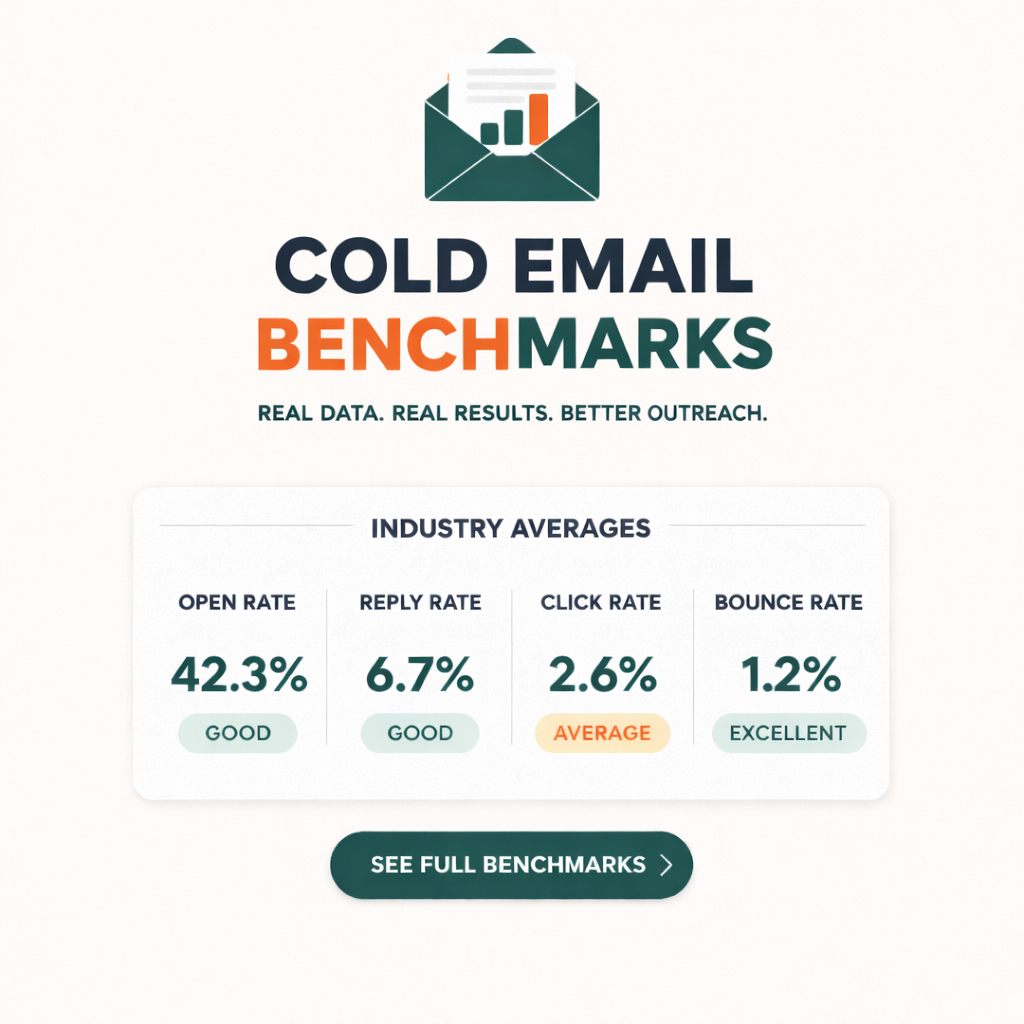
Cold email benchmarks show a 27.7% average open rate, 3.43% reply rate, and 5.1% bounce rate across B2B industries. Top performers exceed 10% reply by combining verified lists, signal-based personalization, and tight ICPs. This guide aggregates data from 10,000+ campaigns to show you exactly where your numbers should sit : and what to fix first when they don’t.
Table of Contents
What Are Cold Email Benchmarks : and Why They Matter More Than Internal Goals
Cold email benchmarks are aggregate performance data : open rates, reply rates, and bounce thresholds : drawn from thousands of real B2B campaigns across industries, list sizes, and team types. They matter more than internal goals because internal goals are typically anchored to what a team has achieved before, not what is actually achievable. A 4% reply rate can look impressive inside a team that has never exceeded 2%, and dangerously weak for a team that should be hitting 8% based on their industry and ICP.
- Budget approval. CFOs and revenue leaders approve investment in cold email tooling when projected performance aligns with verified benchmark data. An internal KPI of 3% reply without benchmark context is a guess; a 3% reply rate benchmarked against a 3.43% industry average is a data-backed projection that survives financial scrutiny.
- Process diagnosis. When reply rate falls below 2%, the cause is almost never the email copy : it is deliverability, list quality, or targeting. Benchmarks force a structured diagnosis: if open rate is low, the issue is subject line or inbox placement. If open rate is high but reply rate is low, the issue is body copy or offer. Without benchmarks, teams optimize the wrong lever.
- Realistic expectations. The global average reply rate is 3.43% (Instantly, 700,000+ businesses analyzed). Top performers exceed 10%. Understanding this distribution prevents teams from either declaring victory prematurely or abandoning a channel that is performing within the normal range.
“Email marketing is described as ‘the act of sending a commercial message…using email,’ making deliverability and engagement measurement central to its effectiveness as a B2B channel.”
: Wikipedia, Email Marketing
Benchmarks aggregate reality from thousands of campaigns. When reply rate sits more than 50% below the industry benchmark, the root cause is almost always infrastructure or list quality : not copy. Fixing the right layer first is the fastest path back to benchmark performance.
The 4 Cold Email Metrics That Actually Matter
Four cold email metrics drive decisions: Open Rate (inflated by Apple Mail Privacy Protection : treat with caution as a standalone KPI), Reply Rate (the true revenue-correlated metric, global average 3.43% per Instantly 2026), Bounce Rate (must stay below 2% to protect domain reputation), and Meeting Booked Rate (1–2% benchmark for B2B SDR teams). Reply rate is the metric that reliably correlates with pipeline and revenue.
Sources: Instantly 2026 (700K+ businesses), Cleanlist 2026, Cleverly 2026. Apple Mail Privacy Protection inflates open rate : weight reply rate and bounce rate more heavily in performance decisions.
“As detailed in our Hunter.io Email Finder review, the Email Verifier uses a 4-step process : syntax, DNS, SMTP, and catch-all detection : that brings bounce rates from 5%+ down to below 2% before a single email is sent.”
: Growth Hack Suite, Hunter.io Email Finder Review
Reply rate is the only cold email metric that reliably predicts pipeline. Open rate is increasingly unreliable due to Apple MPP inflation. Bounce rate above 2% is a domain reputation risk that caps all other performance gains : it must be resolved before optimizing copy or subject lines.
Cold Email Benchmarks by Industry: Where Your Numbers Should Sit
Industry context determines what “good” means in cold email. A 2% reply rate in SaaS is near-average; a 2% reply rate in Legal signals a significant underperformance. The table below aggregates data from 10,000+ B2B campaigns across 8 verticals : use your vertical’s benchmark as your reference point, not the global 3.43% average, which blends high-competition SaaS with lower-competition professional services.
Sources: Instantly 2026, Snov.io 2026, Belkins 2025, Cleverly 2026. Data aggregated across 10,000+ B2B campaigns.
“Analyzing billions of email interactions across more than 700,000 businesses, our 2026 benchmark data shows an average cold email reply rate of 3.43% globally : with top performers consistently exceeding 10% through tighter list curation and intent-based personalization.”
: Instantly, Cold Email Benchmark Report 2026
Industry changes benchmark expectation by 5x : Legal at 10% vs SaaS under 2%. Comparing your performance against your vertical’s benchmark, not the global 3.43%, is the only honest diagnosis. For SaaS teams specifically, a Hunter.io cold email workflow with pre-verified lists and tight ICP filters is the standard starting point for climbing out of the 1.8% industry average.
Why Smaller Lists Win: List Size Predicts Reply Rate Better Than Industry
List size predicts reply rate more reliably than industry vertical. Lists of 50 or fewer recipients average a 5.8% reply rate. Lists of 1,000+ contacts drop to 2.1% : a 2.7x performance gap produced entirely by the discipline of ICP focus, not by copy or subject lines. Belkins analyzed 16.5 million cold emails across their managed client campaigns to establish this relationship. The implication: cutting your list usually returns more ROI than rewriting your copy.
Source: Belkins 2025 : 16.5M cold emails analyzed across managed client campaigns.
Across 16.5 million cold emails, list size predicts reply better than industry or copy. Cutting from 1,000+ contacts to 50 more than doubles reply rate from 2.1% to 5.8%. Reducing email bounce rate before sending to larger lists is the prerequisite : high bounce on a 1,000+ list accelerates domain reputation damage significantly faster than on a list of 200.
Score Your Cold Email Performance: Are You Average, Good, or Elite?
Score yourself on a 5-tier scale. Tier D (open below 30%, reply below 2%, bounce above 5%) signals a broken infrastructure : fix deliverability before rewriting a single subject line. Tier C (30–40% open, 2–4% reply) is where most B2B teams actually sit. Tier B (4–7% reply) is strong. Tier A (7–10%) is a top-quartile performer. Elite tier (10%+ reply) is the top 1% globally, achieved through signals, verified lists, and tight ICP.
Verdict: If reply is below 2%, the issue is rarely copy. Check bounce first. If bounce exceeds 3%, list quality is the bottleneck. Fix verification before touching subject lines or send cadence.
Most B2B teams perform at C-Tier (2–4% reply). The lever to move from C to B is almost always list quality and verification : not copy rewriting. Moving from B to A requires tighter ICP and signal-based personalization. Copy optimization matters most at A-Tier and above, when infrastructure and targeting are already dialed in.
How to Hit Top-Quartile Cold Email Benchmarks: 5 Levers Ranked by Impact
Five levers move cold email performance into top quartile, ranked by impact and speed to result: email verification drops bounce instantly and is the fastest win available to most teams; ICP tightening typically doubles reply rate with no additional cost; signal-based personalization produces the largest absolute lift (5–18% reply on cold accounts per Autobound 2026); follow-up sequences add 42% incremental replies that single-touch campaigns permanently forfeit; domain infrastructure is the prerequisite that determines the ceiling for every other lever.
- Email Verification : verify every address before sending. Bringing bounce rate from 5.1% (industry average) to below 2% is the fastest, highest-ROI improvement available to most teams. Hunter.io’s Email Verifier runs a 4-step validation (syntax, DNS, SMTP, catch-all) and returns a confidence score per address. At 50 free verifications per month on the free plan, most small teams can validate a full campaign list at zero cost. Reply rate improvement from this alone is typically +30% relative to pre-verification performance.
- Tighter ICP : cut your list to 200 or fewer accounts. Moving from a 500-account list to a 200-account list increases average reply rate from 3.2% to 4.5% (Belkins 2025 data). The mechanism is simple: tighter lists force better research and enable more specific personalization. The cost is zero. The operational change is discipline : stopping the instinct to add more contacts to a campaign when reply rate is low, and instead cutting the list and improving fit.
- Signal-Based Personalization : trigger on funding, hiring, tech, and intent signals. Generic cold emails targeting role and company size average 1–3% reply. Signal-based cold emails : triggered by a hiring spike, a tech stack change, a funding round, or a product launch : average 5–18% reply (Autobound 2026). The largest absolute performance lift of any lever. The tradeoff is research time per account, which is why combining signal identification with a tight ICP list (lever 2) is the standard elite-tier approach.
- Follow-up Sequences : send 4–7 touches over 14–21 days. 48% of sales reps never send a second email (Instantly 2026). Adding a 4-touch follow-up sequence generates 42% more total replies than single-send campaigns, with most replies coming on touches 2–4. The sequence does not need to be elaborate : a brief, relevant one-line follow-up on day 3, a value-add touch on day 7, and a breakup message on day 14 outperforms elaborate weekly sequences in response rate.
- Domain Infrastructure : configure SPF, DKIM, DMARC, and warm up sending domains. Authentication failures suppress inbox placement regardless of list quality or copy. Google and Yahoo 2024 enforcement made SPF, DKIM, and DMARC mandatory for bulk senders. A properly warmed sending domain (30 days, gradual volume increase) combined with authentication setup is a one-time configuration that determines the deliverability ceiling for all subsequent campaigns. Without this, every other lever is constrained.
Start with Lever 1 : verify your list before your next send
Verify Emails with Hunter.io Free →50 free verifications per month. No credit card required. Drops bounce below 2% in one campaign cycle.
The five levers compound when applied in sequence. Verification removes the floor on deliverability. ICP tightening removes waste. Signal personalization drives absolute reply lift. Sequences capture the majority of replies that single-send campaigns miss. Infrastructure prevents the ceiling. Teams that apply all five systematically reach Elite Tier (10%+ reply) within 60–90 days of consistent execution.
Frequently Asked Questions: Cold Email Benchmarks
The questions below cover the most common benchmarking concerns from B2B sales teams : from interpreting open rate inflation to diagnosing reply rate drops to understanding what separates top-quartile performance from average.
What is a good cold email reply rate for B2B?
The global average cold email reply rate is 3.43% across B2B industries (Instantly 2026, 700,000+ businesses). A good reply rate is 5–8%, which puts a team in the top quartile. An excellent rate is 10–15%, achieved by the top 10% of B2B campaigns through tight ICP, verified lists, and signal-based personalization. Elite performers at 18%+ typically combine all five levers: verification, ICP tightening, signals, sequences, and domain infrastructure. If your reply rate is consistently below 2%, the issue is almost always deliverability or list quality : not copy.
Bottom line: 3.43% is global average; 5%+ is good; 10%+ is elite. Anything below 2% signals an infrastructure problem to fix before optimizing copy.
Why is my cold email open rate so high but reply rate so low?
Apple Mail Privacy Protection (MPP) pre-loads email content on Apple devices, triggering “open” tracking pixels without the recipient ever reading the message. This inflates open rates by 20–40 percentage points for lists with significant Apple Mail users (estimated 50%+ of US email users). A 60% open rate may reflect a true open rate of 35–40% after MPP inflation is accounted for. If open rate is high but reply is low (below 2%), the likely causes are: poor offer relevance, wrong ICP, or emails landing in promotional tabs rather than primary inbox. Check reply-to-open ratio : elite campaigns see 15–25% of openers reply.
Bottom line: High open + low reply means the audience is opening but not finding the offer relevant. Tighten ICP and sharpen the offer before adjusting subject lines.
What cold email bounce rate is acceptable?
Acceptable bounce rate is below 3%; excellent is below 2%; elite performers maintain below 1%. The industry average is 5.1% (Instantly 2026) : meaning most B2B teams are sending to lists with too many invalid addresses. Sustained bounce above 5% typically leads to ESP warnings or sending suspensions within 2–3 campaign cycles. Bounce above 3% triggers spam filter sensitivity that depresses inbox placement across your entire sending domain, including replies to existing contacts. The fix is email verification before every send : not after the first bounce warning.
Bottom line: Keep bounce below 2% to protect domain reputation. Below 1% is the elite standard. Verify every list before sending : do not rely on ESP-level suppression as a substitute.
How does list size affect cold email performance?
List size is the strongest predictor of cold email reply rate across all variables studied by Belkins (16.5 million emails analyzed). Lists of 50 or fewer contacts average 5.8% reply; lists of 1,000+ drop to 2.1% : a 2.7x performance gap. Smaller lists force tighter ICP qualification and enable more specific personalization at the individual account level. The implication for teams chasing volume: sending to 500 contacts in 10 campaigns of 50 each : with proper research per batch : consistently outperforms one 500-person blast on every reply metric.
Bottom line: Cut your list before your next campaign. Moving from 1,000+ to under 200 typically doubles reply rate with no change to copy or subject lines.
Which industry has the highest cold email reply rates?
Legal services leads B2B cold email reply benchmarks at approximately 10% average reply rate, followed by E-Learning at 7.8% and Chemical/Industrial at 7.3%. These industries benefit from lower outbound competition, professional audiences accustomed to business email, and relatively narrow ICPs that make relevant personalization easier. SaaS B2B has the lowest benchmarks at approximately 1.8% average reply : the result of extreme inbox saturation from a large seller population targeting the same buyer personas simultaneously. Consumer/DTC averages 2% and is generally not well-suited for cold email as a primary channel.
Bottom line: Legal, E-Learning, and Chemical top industry benchmarks. SaaS and Consumer sit at the bottom. Use your vertical’s benchmark, not the global 3.43% average, to evaluate your team’s performance.
What is signal-based personalization in cold email?
Signal-based personalization triggers cold outreach based on a measurable event at the target company : a new funding round, a recent hire in the target department, a tech stack change (installing a competing tool), a job posting that indicates a problem you solve, or a published article or press mention. Generic cold emails targeting role and firmographic data average 1–3% reply. Signal-triggered emails average 5–18% reply (Autobound 2026) because the message references something that happened recently and specifically : making it feel timely and relevant rather than blasted. Tools like Clay, Apollo Signals, and Hunter.io Discover surface these events at scale.
Bottom line: Signal-based outreach averages 5–18% reply vs 1–3% for generic targeting. It is the single largest reply rate lever available to teams with a working verification and ICP foundation.
How many follow-up emails should I send in a cold email sequence?
Research from Instantly 2026 shows that 48% of sales reps never send a second email after a cold outreach : forfeiting 42% of potential replies that come from follow-up touches. The optimal sequence length for B2B cold email is 4–7 touches spread over 14–21 days. Touch structure: initial send on day 1, brief follow-up on day 3, value-add on day 7 (case study, relevant insight, or a specific question), and a final breakup message on day 14–21. Most replies arrive on touches 2–4. Extending beyond 7 touches with the same contact shows diminishing returns and increases unsubscribe risk.
Bottom line: 4–7 touches over 14–21 days is the optimal range. 48% of reps stop at one touch and miss 42% of total possible replies. Always follow up at least 3 times before removing a contact.
Does email authentication (SPF, DKIM, DMARC) affect cold email reply rates?
Yes, directly. Email authentication affects inbox placement rate, which determines whether your email lands in primary inbox, promotions, or spam. Google and Yahoo made SPF, DKIM, and DMARC authentication mandatory for bulk senders in 2024. Campaigns sent from domains missing any of these records have significantly higher spam folder placement rates : suppressing both open rates and reply rates regardless of copy quality. Authentication is a one-time setup per sending domain that takes approximately 30 minutes with DNS access. Domain warm-up (30-day gradual volume increase) is a separate but related prerequisite for new sending domains.
Bottom line: SPF, DKIM, and DMARC are prerequisites : not optimizations. Missing authentication caps inbox placement and suppresses all other performance metrics. Set them before your first send on any new domain.
How do I calculate my cold email ROI against benchmark data?
Cold email ROI calculation: (Meetings booked × average deal value × close rate) minus (tool costs + rep time cost). Benchmark inputs: at 3.43% reply rate and 30% meeting-to-reply conversion, a 200-contact campaign generates approximately 2 meetings. At 5.8% reply (list of <50), the same effort generates proportionally more meetings with lower send volume. Use your vertical’s benchmark reply rate (not the global average) to project realistically. If your current reply rate is at or above your industry benchmark, the highest-ROI improvement is typically the follow-up sequence : not a new tool.
Bottom line: Plug your industry benchmark reply rate into the formula before buying new tools. At 3.43% reply, a 200-contact campaign generates approximately 2 meetings : improving list quality or adding follow-ups is cheaper than a new platform upgrade.
What is the average cold email open rate in 2026?
The reported average cold email open rate across B2B industries is 27.7% (Instantly 2026, aggregated from 700,000+ businesses). However, this figure is significantly inflated by Apple Mail Privacy Protection, which pre-loads email tracking pixels on Apple devices : affecting an estimated 50%+ of US email users. Adjusted open rate estimates that account for MPP inflation typically land between 15–22% for true opens. Because of this, industry analysts recommend treating open rate as a relative trend indicator (improving vs declining) rather than an absolute performance metric. Reply rate is the reliable KPI.
Bottom line: Reported average is 27.7% but Apple MPP inflates this significantly. Treat open rate as a trend metric, not an absolute benchmark. Focus optimization effort on reply rate and bounce rate instead.
When should I change my cold email copy vs fix my list?
Fix the list first when reply rate is below 3% : copy optimization at sub-3% reply almost never moves the needle enough to justify the time investment. The diagnostic: if open rate is below 25%, the inbox placement or subject line is the issue. If open rate is above 30% but reply is below 3%, the audience is reading but not responding : which is an ICP fit or offer relevance problem, not a copy problem. Copy optimization is highest-ROI when reply rate is already at 4–5% and you are trying to push into top-quartile 7%+ territory. At that stage, A/B testing opening lines, call-to-action framing, and email length can produce measurable lift.
Bottom line: At reply below 3%, fix list quality and ICP before rewriting copy. At reply above 4–5%, copy A/B testing produces reliable lift. Sequence depth (lever 4) is always worth adding regardless of where reply rate sits.
How do top 1% cold email performers achieve 18%+ reply rates?
Elite-tier cold email performance (18%+ reply) combines all five levers simultaneously: verified lists with near-zero bounce, ICPs of 25–50 accounts per campaign batch, signal-based personalization triggered by specific account events (funding, hiring, tech install), 5–7 touch sequences, and fully authenticated sending domains with warm-up completed. Research from Autobound (2026) shows that the combination of tight ICP and signal personalization alone produces 5–18% reply on cold accounts : the remaining gap to 18%+ is closed by sequence depth and list hygiene. This level of performance is typically not achievable with generic list purchasing; it requires purpose-built prospecting using tools like Hunter.io Domain Search and Discover for account targeting.
Bottom line: Elite 18%+ reply requires all five levers applied simultaneously : verified lists, tight ICP (25–50 accounts), signals, 5–7 touch sequences, and authenticated infrastructure. No single lever reaches this level independently.
Cold email performance is diagnostic, not binary. Most teams sit at C-Tier (2–4% reply) and can reach B-Tier (4–7%) with list verification and ICP tightening alone : without changing a word of copy. The benchmarks above give you a precise reference point for every metric so that when performance deviates, the root cause is identifiable and the fix is specific.
Start with the fastest benchmark fix.
Email verification drops bounce from 5.1% to below 2% in one campaign cycle. Hunter.io’s verifier is free for 50 addresses per month : enough to test a complete ICP list before committing to a paid plan.
Verify Your List with Hunter.io →Read the full Hunter.io review →
No credit card required. 50 free verifications monthly.