Cold email list building at 5% or higher reply rate depends on three layers: a tight ICP combining firmographic, technographic, and intent signals; tiered segmentation separating best-fit prospects from your broader universe; and a verified source mix that keeps bounce rate below 2%. Data from 16.5M B2B emails shows lists under 50 recipients average 5.8% reply rate versus 2.1% for lists above 1,000. This guide covers strategy first, tools second.
Table of Contents
Why List Quality Beats Copy Every Time (And the Math Behind It)
List size and quality predict reply rate better than industry vertical, copy quality, or send timing. Across 16.5M cold emails analyzed by Belkins in 2025, lists under 50 recipients average 5.8% reply versus 2.1% for lists above 1,000. Verified lists outperform unverified by 2x reply rate and 3x meetings booked. Most teams optimize subject lines and copy first because it feels controllable : the data consistently says start upstream with list quality, then write the message.
“Lead generation is the process of identifying and cultivating potential customers.”
: Wikipedia, Lead generation
List building is the operational expression of lead generation. A tight ICP filters your total addressable market into a workable prospect pool : the quality of that filter determines whether your campaign converts or burns your domain. The teams that consistently hit 5%+ reply rate treat list quality as the primary lever, not an afterthought after copy is written.
List size and quality predict reply rate better than any other variable. Cut list size, verify before send, and tier by fit level before you write a single subject line.
Step 1: Define Your ICP in 3 Layers (Firmographic, Technographic, Intent)
A converting ICP has three layers. Firmographic covers industry, company size, revenue range, and geography : the baseline filter that every B2B campaign starts with. Technographic targets the tech stack your ideal customer already uses, which signals product fit before first contact and lifts reply rate 30-50% over firmographic alone. Intent adds timing by identifying companies actively researching your category, hiring for specific roles, or undergoing triggering events : funding rounds, product launches, leadership changes : that create urgency. Each additional layer compounds the reply rate lift; most lists underperform because they stop at the first layer.
Firmographic alone is the price of entry. Technographic and intent layers separate top-performing outreach from average campaigns. Most B2B lists fail because they stop at layer one and wonder why generic, firmographic-only outreach produces 1-2% reply rates regardless of copy quality.
Step 2: Segment Your 500-Lead List into 3 Tiers (A = 50, B = 150, C = 300)
Three-tier segmentation maximizes ROI per send by matching personalization investment to conversion probability. Tier A targets your top 50 highest-fit prospects with hyper-personalized 1:1 messages : expect 8-15% reply from this segment when personalization is genuine. Tier B covers the next 150 strong-fit prospects with light personalization using 3-5 template variables tied to firmographic or technographic signals : expect 4-7% reply. Tier C handles the remaining 300 ICP-fit-only prospects with a generic template and subject line variant A/B testing : expect 2-3% reply. Run all three sequences in parallel rather than sending one generic message to all 500; blasting one message collapses the aggregate reply rate toward the Tier C floor.
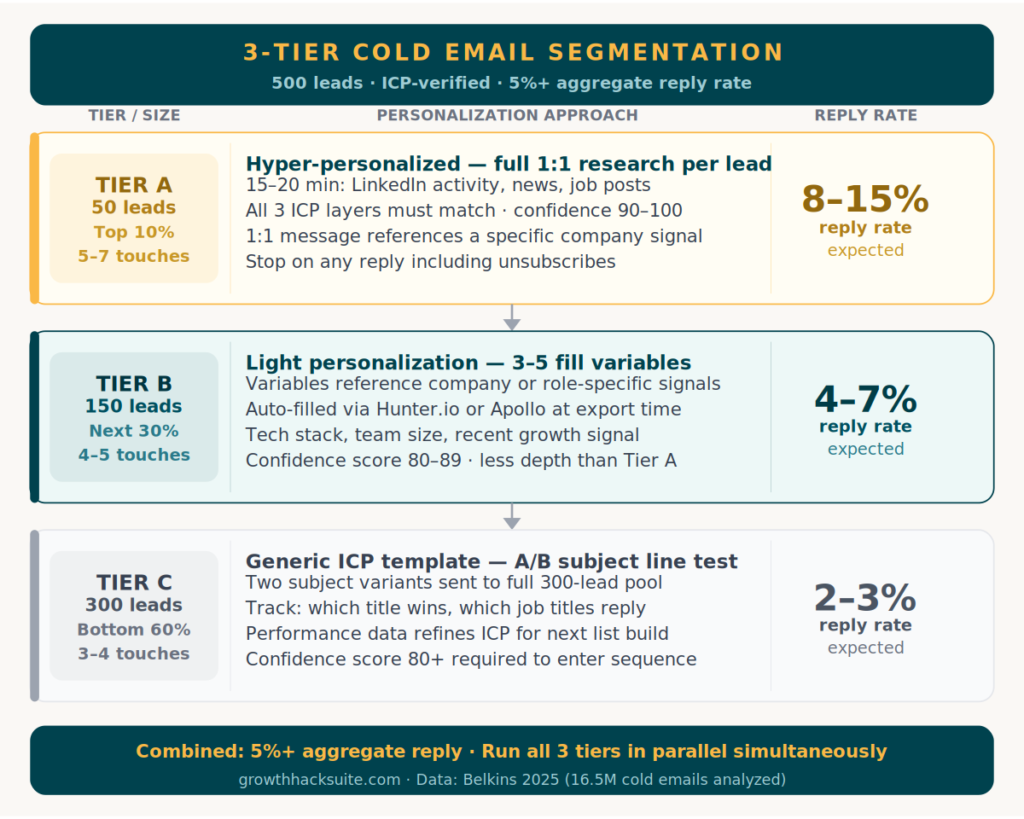
Build your tier assignment with this 4-step scoring process:
- Score each lead against your ICP layers on a 0-10 scale. Award points for firmographic fit (industry, size, geography) and add bonus points for each technographic or intent signal matched. A lead hitting all three ICP layers can score 8-10; a firmographic-only match scores 3-5. This numeric score becomes the basis for tier assignment.
- Sort descending and designate the top 10% as Tier A. These 50 leads receive 1:1 manual research : review LinkedIn activity, company news, recent product updates, and job postings before drafting any message. Budget 15-20 minutes of research per Tier A lead; the reply rate return justifies it.
- The next 30% (150 leads) become Tier B : light personalization with 3-5 enrichment variables. Variables should reference something specific to the company or role (tech stack, team size, recent growth signal) without requiring full manual research per lead. Use enrichment data from Hunter.io or Apollo to populate variables automatically at export time.
- The bottom 60% (300 leads) become Tier C : generic ICP template with subject line A/B testing. Run two subject variants to the 300-lead Tier C pool. Stop sequences after reply, unsubscribe request, or 4-5 touches with no response. Use Tier C performance data : which subject variant wins, which titles respond : to refine your ICP definition for the next list build cycle.
One message for all 500 is the most common reason cold email campaigns underperform. Tiered segmentation concentrates research time where reply rate is highest, and protects sending domain reputation on the generic tier through lower send velocity per day.
Step 3: The Source Mix : Combining Enrichment and Intent Platforms
A 500-lead list pulls from three to four complementary data sources. LinkedIn Sales Navigator provides firmographic targeting and manual prospect exports with high signal precision. Email enrichment tools : Hunter.io, Apollo, and Clearbit : find and verify contact emails at scale using domain and name lookup. Tech-stack platforms like Hunter TechLookup, BuiltWith, and Wappalyzer layer product-fit signals on top of your firmographic base. Intent platforms like Bombora and G2 Buyer Intent add timing by identifying companies actively researching competitor or complementary tools. Single-source lists consistently plateau around 3% reply rate; multi-source enriched lists with SMTP-verified emails routinely reach 8% or higher on Tier A with identical copy quality.
“Smaller, targeted campaigns (50 recipients or fewer) average a 5.8% response rate, compared to 2.1% for larger lists.”
: Belkins 2025, via Mailforge (16.5M emails analyzed)
Multi-source beats single-source because each layer adds a different type of signal: firmographic determines who to target, technographic determines product fit, and intent determines when to reach out. The minimum viable mix is firmographic plus email enrichment plus tech-stack data. Add intent platforms only when budget permits : they are the lever from 5% to 8-10% reply rate, not a prerequisite for achieving the first 5%.
Step 4: Verify and Score Every Lead Before Sending (Below 2% Bounce or Bust)
Verification is the gate, not an optional step. Run every email address through SMTP verification before the first send. Drop addresses with confidence scores below 80. Route catch-all addresses : where the domain accepts all mail regardless of whether the specific address exists : to a separate lower-volume sequence capped at 5-10 sends per day per domain to avoid spam filter triggers. Verified lists deliver 2x reply rate and 3x meetings booked compared to unverified lists per Cleanlist 2026 analysis. Bounce above 2% suppresses your sending domain across every subsequent campaign : full recovery requires weeks of reduced volume and domain warming.
“As detailed in our Hunter.io Email Finder review, Hunter Bulk Email Verifier returns valid, risky, and invalid status plus a 0-100 confidence score on every address, letting you tier sends by safety threshold and protect domain reputation at scale.”
: Growth Hack Suite, Hunter.io Email Finder Review
Apply this confidence score framework when filtering Hunter.io bulk verification results before tier assignment:
Verification is non-negotiable. The 2x reply rate lift on verified lists pays for the verification credits before the first sequence ends : and it protects the sending infrastructure that all future campaigns depend on. For a deeper breakdown of bounce rate management and domain protection, see our guide on reducing email bounce rate with Hunter.io.
The 4-Week Plan: Build Your First 500-Lead Converting List
Building a converting list is a 4-week sprint, not a 4-hour scraping session. Week 1 locks the ICP definition across all three layers. Week 2 pulls from 3-4 sources to build a 750-lead raw pool : this buffer accounts for the 30-35% dropout rate during verification. Week 3 runs SMTP verification on all 750, drops addresses below 80% confidence, and scores the remaining verified leads by ICP fit to land at approximately 500 leads. Week 4 assigns tier labels, sets personalization depth per tier, and launches all three sequences in parallel with stop-on-reply enabled. At the end of the month, you have a list that converts at 5% or higher aggregate across all three tiers. Teams that follow this sprint consistently outperform ad-hoc list builders on both reply rate and deliverability metrics in the following campaign.
- Week 1: ICP Definition Workshop. Document firmographic criteria (industry, headcount, revenue range, geography), technographic criteria (must-have tech stack signals), and intent triggers (events that create buying urgency: funding rounds, executive hires, product launches, competitor churn). Lock criteria in writing before sourcing begins : post-hoc ICP revision invalidates your tier scoring and forces a re-pull.
- Week 2: Source Pull : Target 750 Raw Leads. Pull from LinkedIn Sales Navigator for firmographic targeting. Use Hunter.io TechLookup or BuiltWith to identify companies with matching tech stacks. Export contact data and find emails via Hunter.io Domain Search or Apollo enrichment. Aim for 750 raw leads deliberately : the verification dropout (30-35%) will reduce your pool to approximately 500 verified contacts.
- Week 3: Verify All 750 and Score the Verified List. Run all 750 addresses through Hunter.io Bulk Email Verifier (or equivalent SMTP verifier). Drop confidence below 80. Route catch-all addresses to a separate segment. Score each remaining lead against your ICP layers using the 0-10 framework from Step 2. Sort descending. You should land at 500-600 verified, scored, sortable leads ready for tier assignment.
- Week 4: Tier Assignment, Personalization Depth, and Launch. Top 10% (50 leads) become Tier A: full 1:1 research, personalized message referencing a specific company signal. Next 30% (150 leads) become Tier B: template with 3-5 enrichment variables auto-filled from your source data. Bottom 60% (300 leads) become Tier C: ICP template with two subject line variants. Launch all three sequences simultaneously with stop-on-reply configured. Track reply rate per tier daily for the first week.
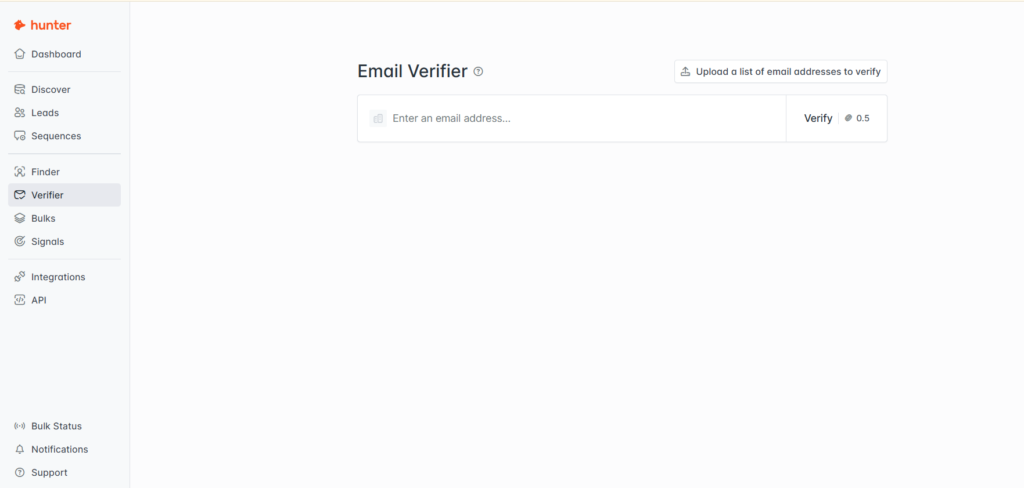
Start Week 3 today: verify your raw list free with Hunter.io
Verify Your List Free →Free plan includes 50 verifications. No credit card required. Full export access.
A converting list takes 4 weeks of disciplined work. The teams that compound results spread work across ICP definition, multi-source pulling, verification, and tiering : in that order, every list build cycle. Once your list is built and verified, see our guide on Hunter.io for cold email outreach for sequencing and send-volume strategies.
Cold Email List Building: Frequently Asked Questions
Common questions on list size, ICP prioritization, data legality, verification cadence, intent data necessity, buying lists, and the most costly mistakes in B2B prospect list building.
What is the ideal cold email list size for B2B?
The sweet spot for conversion is 50-200 leads per micro-segment with corresponding personalization. Lists under 50 recipients average 5.8% reply, while lists above 1,000 average 2.1% per Belkins 2025 analysis of 16.5M emails. For a 500-lead list, segment into three tiers (50/150/300) and run separate sequences rather than one generic blast. The aggregate reply rate on a tiered 500-lead list consistently outperforms any single-message blast to 1,000+ untiered leads.
Bottom line: 50-200 per micro-segment with personalization is the sweet spot. For a 500-lead list, three-tier segmentation (50/150/300) run in parallel outperforms any single-blast approach to the full list.
Which ICP layer should I prioritize if I only have time for one?
Firmographic is mandatory : you cannot build a converting list without defining industry, company size, and geography at minimum. If you have bandwidth for a second layer, technographic consistently beats intent for product-fit campaigns: identifying that a prospect already uses HubSpot, Stripe, or a competitor tool lifts reply rate 30-50% over firmographic alone per Autobound 2026 data. Intent wins as the second layer only for time-sensitive campaigns tied to external triggers (funding announcements, executive hiring signals, product launches). Start with firmographic plus technographic; add intent when budget allows.
Bottom line: Firmographic is mandatory. Technographic is the highest-ROI second layer for product-fit campaigns. Intent is the highest-ROI second layer when timing is the primary conversion lever. Never skip verification regardless of which layers you use.
Is scraping LinkedIn or websites for emails legal?
B2B contact data collection sits in a legal gray area depending on jurisdiction and method. Public business contact information is generally permitted under GDPR’s legitimate interest basis if you document your business purpose, limit data collection to what is necessary, and provide a clear unsubscribe mechanism. However, LinkedIn’s Terms of Service explicitly prohibit automated scraping of their platform : using automation tools against LinkedIn violates their TOS and risks account termination. The safest approach: use GDPR-compliant enrichment APIs like Hunter.io and Apollo that source data responsibly and maintain opt-out records.
Bottom line: Public B2B contact data is generally permitted under GDPR legitimate interest, but LinkedIn TOS prohibits automated scraping. Use compliant enrichment APIs and document your lawful basis for all EU-targeted sends.
How often should I re-verify my cold email list?
Verify before every active outreach send batch. B2B email list freshness decays at 5-10% per month due to job changes, company domain churn, and email format updates : a list that verified clean in January can have 20%+ invalid addresses by April without re-verification. For nurture lists used less frequently, verify quarterly minimum. After any CRM migration, ESP platform switch, or list import from an external source, verify before the first send regardless of what the source claims about data freshness.
Bottom line: Before every active outreach batch. Lists decay 5-10% per month. Quarterly for nurture lists. Always after migration, import, or platform switch regardless of source data freshness claims.
Do I really need intent data for cold email to work?
No. Intent platforms like Bombora and G2 Buyer Intent are meaningful upgrades but not prerequisites for a 5%+ reply rate. Tight firmographic plus technographic plus SMTP-verified emails plus three-tier segmentation consistently reaches 5% or higher without any intent data : this guide’s framework is built on that foundation. Intent is the lever from 5% to 8-10% for teams that have already optimized the core three layers. If your current reply rate is below 3%, intent data will not solve the underlying list quality or personalization problem.
Bottom line: No. The three-layer ICP plus SMTP verification plus tier segmentation gets you to 5%+ reply. Intent data is the upgrade from 5% to 8-10%, not a prerequisite for achieving the first 5%.
What is the most common cold email list-building mistake?
Skipping email verification because the list looks complete and well-researched. A list assembled from LinkedIn exports and manual research can still bounce 8-12% if addresses have not been SMTP-verified : especially for larger companies where email formats change during reorganizations. The second-most common mistake is single-source lists: pulling everything from one tool limits both coverage and signal diversity. Adding one technographic layer to a firmographic-only list lifts reply rate 30-50% with no copy change. The third mistake is treating all 500 leads identically instead of running tiered sequences.
Bottom line: Skipping verification (unverified lists bounce 8-12%), then single-source data (no tech or intent signal), then treating all leads identically (no tier segmentation). Fix in that exact order for the fastest reply rate improvement.
How do I build a cold email list without expensive tools?
A functional cold email list is achievable at minimal cost for small volumes. LinkedIn free tier with manual prospect identification, combined with Hunter.io’s free plan (50 verifications per month, full export access), and BuiltWith’s free tier for basic tech-stack lookup covers the core three-layer ICP framework for lists up to 50 leads per month at near-zero cost. For lists above 50 leads per month, Hunter.io Starter at $34/month handles email finding and verification. LinkedIn free plus Hunter Starter plus BuiltWith free covers the minimum viable source mix for under $35 per month total.
Bottom line: LinkedIn free + Hunter.io free (50 verifications/month) + BuiltWith free covers the minimum viable 3-layer ICP at zero cost for under 50 leads/month. Hunter Starter ($34/month) unlocks scale beyond that threshold.
What is the difference between a prospect list and a lead list in B2B outbound?
In B2B outbound, the terms are often used interchangeably but carry a meaningful distinction in practice. A prospect list is a raw set of companies or contacts that match your ICP criteria : they have not yet expressed any interest in your product or solution. A lead list implies some level of engagement or intent signal: a website visit, content download, webinar attendance, or identification via buying intent data. Cold email list building operates in the prospect universe. All strategies in this guide : ICP layers, tier segmentation, source mix, verification : apply to prospects before any inbound signal exists.
Bottom line: Prospects = ICP-fit but no engagement signal yet. Leads = ICP-fit plus expressed intent or engagement. Cold email list building operates in the prospect universe. This guide’s 4-week framework applies before any inbound signal exists.
How many touchpoints should I send per tier in my cold email sequence?
Tier A (50 highest-fit prospects) warrants 5-7 touches with fully individualized content : the research investment justifies extended follow-up and the high-fit signal makes follow-up less likely to read as spam. Tier B (150 strong-fit) warrants 4-5 touches with lightly personalized template follow-ups at 3-day intervals minimum. Tier C (300 ICP-fit) warrants 3-4 touches with generic template variations. For all tiers, stop the sequence on any reply including unsubscribe requests. Going beyond 7 touches on a no-response cold prospect is rarely productive and increases spam risk on otherwise healthy sending domains.
Bottom line: Tier A: 5-7 touches. Tier B: 4-5 touches. Tier C: 3-4 touches. Stop on any reply. 3 business days minimum between touches for all tiers.
Can I buy a cold email list instead of building one?
You can purchase B2B contact lists from vendors like ZoomInfo, Cognism, or Lusha, but purchased lists rarely outperform self-built lists for cold email because they lack ICP precision and technographic layer depth. Purchased lists also carry higher risk: unknown last-verification dates, potential GDPR exposure if the vendor’s sourcing is non-compliant, and lower deliverability from shared list usage across multiple buyers. The 4-week framework in this guide builds a 500-lead list for under $200 per month in tools : comparable per-lead cost to most vendors, with dramatically higher ICP precision and verified data quality.
Bottom line: Purchased lists underperform self-built lists on reply rate and carry higher GDPR and deliverability risk. The 4-week build framework costs under $200/month in tools with significantly higher ICP precision and fresher verification dates.
How do I add technographic data to a list using Hunter.io?
Hunter.io’s TechLookup feature allows you to filter Domain Search results by the technology stack a company uses. In the TechLookup interface, select from 350+ technology categories : CRM platforms, e-commerce tools, ESPs, analytics tools, payment processors : to find domains using your target tech stack. Combined with Hunter.io Domain Search, TechLookup identifies contacts at companies already using complementary or competitive tools. TechLookup is included in Hunter.io paid plans starting with Starter. The free plan does not include TechLookup access : upgrade to Starter ($34/month) to access this layer.
Bottom line: Use Hunter.io TechLookup (Starter+) to filter prospects by tech stack across 350+ technology categories. Combine with Domain Search for the firmographic plus technographic ICP combination. Free plan does not include TechLookup.
What bounce rate is acceptable for cold email campaigns?
The universally accepted threshold is below 2% bounce rate on any given send batch. Above 2%, most email service providers begin throttling or flagging your sending domain, and Google Postmaster Tools registers a domain reputation drop. Above 5%, you risk active blocklist placement that takes 4-8 weeks to recover from even with a dedicated warming protocol. Proper SMTP verification using Hunter.io or equivalent (confidence 80+, catch-all routed to low-volume sequences) consistently keeps bounce below 1% on well-built B2B lists. If your bounce rate exceeds 2%, pause the campaign immediately, re-verify the remaining list, and resolve the root cause before resuming any sends.
Bottom line: Below 2% is the target. Above 2% triggers ESP throttling. Above 5% risks blocklist placement. Verified lists with 80+ confidence score stay below 1% bounce. Pause and re-verify immediately if you exceed 2% on any batch.
Cold email list building is a 4-week strategy job, not a 1-hour scraping session. Tight ICP across three layers, multi-source data, SMTP verification, and tiered segmentation : applied in sequence : outperforms every shortcut and every volume-over-quality approach in B2B outbound prospecting.
Cut Week 3 from 5 days to 1 hour.
Verify your 750-lead raw list free with Hunter.io. 50 verifications, no credit card, full CSV export included on the free plan.
Start Verifying Free →Free plan: 50 verifications/month. No card required. Full export access included.