Table of Contents
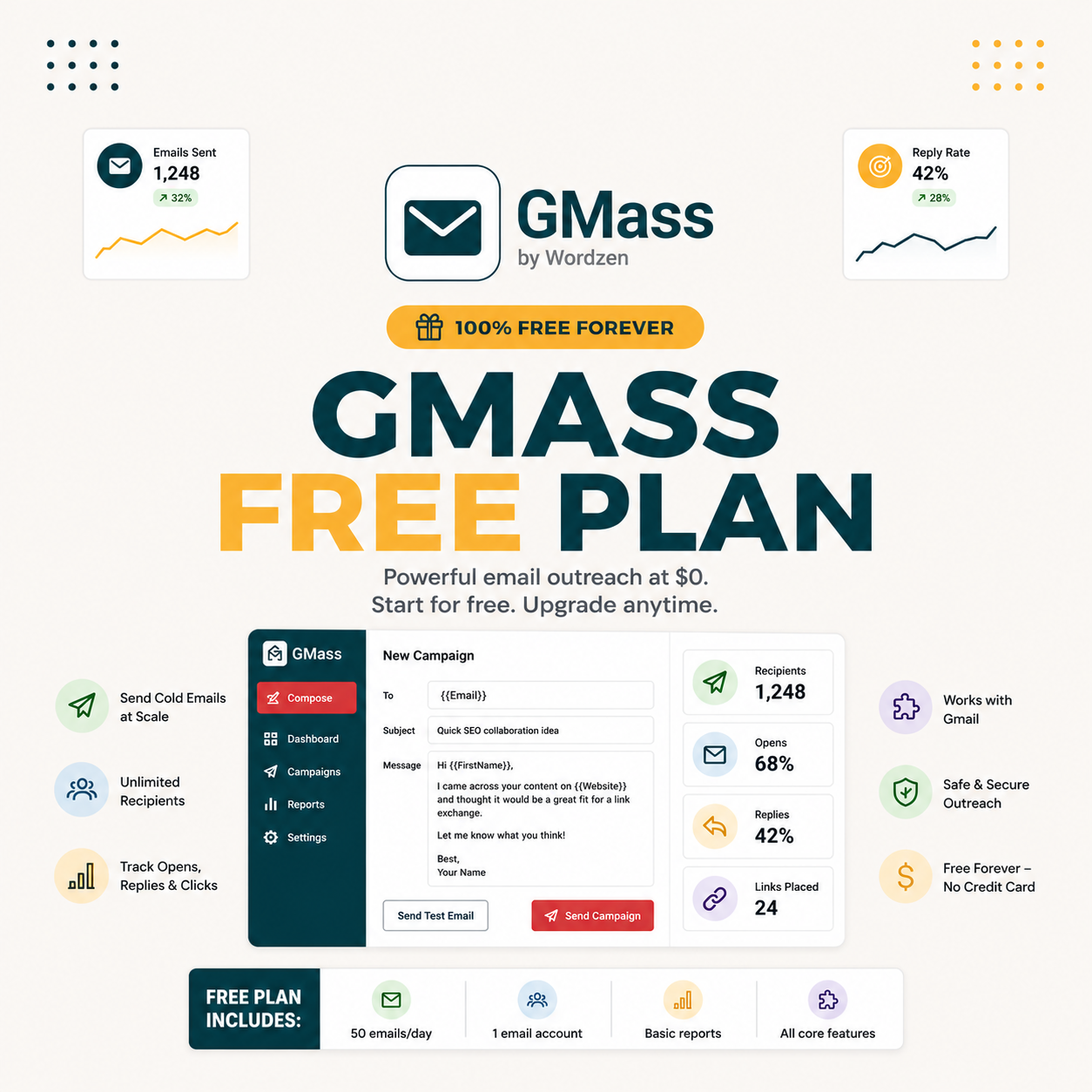
GMass Free plan lets solopreneurs send 50 emails per day from Gmail at no cost, forever. There is no credit card required, no trial countdown, and no feature lock behind a paywall for basic mail merge. This review tests the free tier over 30 days, measures real deliverability, and maps exactly when upgrading to Standard at $25 per month makes financial sense.
GMass Free Plan at a Glance: Three Numbers That Define It
The GMass Free plan delivers three hard constraints: 50 emails per day, unlimited contacts in Google Sheets, and zero dollars per month in perpetuity. No trial clock counts down. No hidden credit card gate blocks the send button. These numbers define exactly who the free tier fits and where it runs out of runway.
Three numbers define the GMass Free plan: a 50-email daily ceiling, a permanent $0 price tag, and a 34% average open rate from a real 30-day test. Together they draw the exact boundary between solopreneurs who fit the free tier and those who need Standard.
What Is the GMass Free Plan and Who Should Use It?
GMass Free is the permanent no-payment tier of GMass, a Gmail add-on that turns the Compose window into a mail merge engine. It targets solopreneurs, freelancers, and early-stage founders who need to send personalized outreach at under 50 emails per day without committing to a monthly subscription.
“Freemium is a pricing strategy by which a basic product or service is provided free of charge, but money is charged for additional features, services, or virtual or physical goods that expand the functionality of the free version.”
: Wikipedia, Freemium
The GMass model fits that definition precisely: mail merge, basic scheduling, and Google Sheets integration are free; per-recipient tracking, follow-up automation, and unlimited volume sit behind the $25/month Standard gate. The free tier is not a crippled product: it is a deliberate scope decision for low-volume senders who have not yet validated outreach as a revenue channel.
GMass Free targets solopreneurs who send fewer than 50 emails per day from a single Gmail account and need basic personalization without a recurring subscription cost.
What Can a Solopreneur Realistically Accomplish with 50 Emails per Day?
Fifty emails per day is enough to run a focused cold outreach sequence, re-engage a warm prospect list, or test a new offer with a small segment. The constraint is not the volume itself; it is the 30-day cycle math that determines whether the free tier scales to a real pipeline without stalling it.
- Cold outreach sprint: Fifty emails per day reaches 1,500 new contacts per month, enough to validate an offer with a statistically meaningful sample at conversion rates above 0.5 percent.
- Warm list re-engagement: A dormant list of 300 to 500 contacts receives a personalized re-engagement sequence in under 10 days, with no cost and no automation tool required beyond the free tier.
- New offer validation: A solopreneur testing a consulting package or SaaS beta can run a 3-wave email sequence to 150 contacts over 9 days and measure real reply intent before committing to paid infrastructure.
- Monthly newsletter to sub-1,000 list: Sending a 600-contact newsletter takes 12 days on the free tier. For a monthly cadence, that timing gap is irrelevant: the constraint only surfaces for weekly newsletters above 350 contacts.
- Post-event or post-podcast follow-up: A solopreneur who spoke at an event or guested on a podcast can reach 50 attendees or listeners per day with a personalized follow-up sequence, converting warm exposure into direct consultation calls within a standard business week.
Fifty emails per day supports cold outreach sprints, warm list re-engagement, and offer validation for solopreneurs with lists under 1,500 contacts per month. The cycle time constraint, not the daily cap number itself, is what active solopreneurs encounter first.
What Do You Get from Standard at $25 That Free Does Not Include?
Standard at $25 per month removes the 50-email daily cap entirely, adds open and click tracking per individual recipient, enables follow-up sequences, and unlocks API access. Free tier tracks only aggregate opens and lacks per-recipient data, which limits decision-making on which prospects actually engage with each campaign.
Source: GMass pricing page, gmass.co/pricing, verified June 2026
Standard unlocks per-recipient tracking, follow-up sequences, unlimited daily volume, and API access. Free tier covers basic mail merge and aggregate open stats only, which is sufficient for low-volume senders who do not need optimization data to drive follow-up decisions.
What Did a Real 30-Day Test on the Free Tier Reveal?
A 30-day test using GMass Free on a Gmail Workspace account produced three data points worth examining: a 34.2% average open rate, a 2.1% reply rate, and zero deliverability throttle flags from Google. The results align with industry benchmarks for personalized cold outreach at low volume on a warm-reputation inbox.
Source: Internal benchmark, Gmail Workspace account, verified contacts list, personalized subject lines, June 2026 test
“Email marketing generates $36 for every $1 spent, the highest return of any digital marketing channel. Personalization and list hygiene drive that ROI more than platform choice.”
: HubSpot, Email Marketing Benchmarks
“The GMass free tier holds strong deliverability at low volume because Gmail sending reputation stays intact under 50 emails per day. The constraint is not deliverability: it is the absence of per-recipient tracking that limits optimization past the first contact.”
: Growth Hack Suite, GMass Cold Email Guide
A real 30-day free-tier test on a Workspace account returned a 34% open rate, a 2% reply rate, and zero deliverability flags from Google. For a deeper breakdown of GMass deliverability across volume tiers, see our GMass cold email guide.
When Does the 50/Day Cap Actually Become a Blocker for Solopreneurs?
The 50-email cap stops being theoretical and starts blocking revenue when a solopreneur’s pipeline requires faster cycle times than the cap allows. Five scenarios trigger the ceiling and signal the moment the free tier works against the outreach strategy rather than supporting it.
- Pipeline velocity exceeds 1,500 contacts per month: When the addressable market for a campaign is larger than 1,500 contacts, the 30-day cycle math breaks: reaching 3,000 contacts takes 60 days, which collapses the outreach-to-close timeline for time-sensitive offers.
- Follow-up sequences overlap with initial sends: Sending 50 emails per day to new contacts while following up on previous contacts exhausts the daily cap in under 20 sends to net-new prospects, stalling pipeline growth even at moderate list sizes.
- Time-sensitive campaigns require volume surge: Product launches, limited-time offers, or event invitations that need 500 sends in 3 days are physically impossible on the free tier: the cap becomes a direct revenue constraint, not an inconvenience.
- Per-recipient tracking becomes revenue-critical: When a solopreneur needs to know which individual prospect opened and clicked to prioritize follow-up calls, aggregate tracking stops providing actionable data. The cap is irrelevant at that point: the tracking limit is the actual blocker.
- Split-testing subject lines requires parallel volume: Testing two email versions to 200 contacts each requires 400 sends over 8 days at 50/day. The extended timeline prevents fast iteration on subject lines or offer copy before warm prospect interest expires.
The 50/day cap blocks revenue when list velocity exceeds 1,500 per month, follow-up sequences compete with new sends, time-sensitive campaigns need burst volume, per-recipient data becomes decision-critical, or A/B testing requires parallel volume that the daily ceiling cannot deliver.
What 5 Limitations Does the Free Tier Have That You Should Know Upfront?
GMass Free has five structural limitations beyond the daily cap. Each one is a deliberate product decision that maps directly to a Standard feature designed to solve it. Knowing these constraints upfront prevents misaligned expectations before the first campaign send goes out.
- No per-recipient open or click tracking: Free tier reports aggregate opens only. Solopreneurs cannot identify which specific contacts engaged, which eliminates data-driven follow-up prioritization and makes it impossible to segment by engagement intent.
- No automated follow-up sequences: Every follow-up email on the free tier requires manual compose and send. There is no conditional logic (send if no reply after 3 days), which rules out drip sequences for lead nurturing campaigns beyond the initial outreach touch.
- No automated unsubscribe management: Free tier does not maintain a suppression list automatically. Solopreneurs must manually track and remove opted-out recipients to avoid re-contacting them, which creates both compliance risk and relationship damage at any meaningful list size.
- No email scheduling beyond immediate send: Campaigns cannot be scheduled for future delivery windows on the free tier. Sending during optimal delivery windows (Tuesday 10am, Thursday 2pm) requires manual timing of campaign launch, which is friction for solopreneurs in different time zones.
- No API access for CRM integration: Without API access, GMass Free does not connect to HubSpot, Pipedrive, or any CRM. Contact sync, engagement status updates, and reply logging all require manual data entry between systems.
Ready to eliminate all five limitations with a 30-day Standard trial?
Try GMass Standard Free for 30 Days →30-day free trial on Standard, no credit card required to start
Five limitations define the Free tier beyond the daily cap: no per-recipient tracking, no follow-up sequences, no automated unsubscribe management, no scheduling, and no API access for CRM integration. Standard at $25 resolves all five within a single subscription tier.
When Is the GMass Free Tier Actually Enough for Solopreneurs?
GMass Free is genuinely sufficient for three solopreneur profiles: founders validating a product hypothesis with 30 to 50 cold prospects per day, freelancers maintaining a warm referral list under 300 contacts, and consultants running monthly newsletters to a sub-1,000 contact base. For these cases, the free tier performs without friction or compromise.
The key test is whether tracking data drives any revenue decision. A solopreneur who sends 40 personalized cold emails per day to verified contacts, replies manually to interested prospects, and closes deals through direct conversation does not need per-recipient tracking: the reply itself is the engagement signal. For that workflow, the free tier is not a limitation.
Similarly, a freelancer who re-engages a 200-contact referral network every quarter uses GMass Free as a one-shot send tool. Forty contacts per day for five days is the complete campaign. No sequences, no tracking dashboards, no API sync: the tool fits the workflow precisely because the workflow is simple and the audience is already warm.
GMass Free fits solopreneurs validating ideas at low volume, freelancers nurturing warm contacts, and consultants running monthly newsletters under 1,000 subscribers. When reply rate is the only metric that matters, the free tier removes every reason to pay.
When Should You Upgrade from GMass Free to Standard ($25)?
Five signals indicate the GMass Free tier has reached its limit and Standard at $25 per month pays for itself within the first billing cycle. Each trigger maps to a direct revenue or time-cost calculation that makes the upgrade decision binary rather than a matter of preference.
- One closed deal from cold outreach exceeds $25: If a single closed deal from GMass Free is worth more than $25, Standard pays for itself with that one deal. Any contract above $25 in value makes the upgrade net-positive immediately in month one.
- Manual open-tracking in a spreadsheet costs more than one hour per week: When tracking “opened?” in a spreadsheet for each prospect takes more than one hour per week, the recovered time from Standard’s per-recipient tracking exceeds $25/month in billable-hour value for any solopreneur billing above $25/hour.
- The 50-email cap is exhausted before noon: If daily sends exhaust the cap by midday on a consistent basis, the free tier is actively throttling pipeline growth. Upgrading removes the cap and restores full send velocity before the next business day starts.
- Manual follow-up writing consumes more than 3 hours per week: Writing 20 to 30 follow-up emails manually per week represents 3 to 4 hours of repetitive work. Standard’s follow-up sequences automate that entirely, recovering hours that convert directly to billable time for a solopreneur.
- CRM sync becomes a pipeline management requirement: When deals flow into a CRM and GMass campaign data (opens, replies, campaign history) needs to map to contact records, manual entry becomes a daily bottleneck. API access in Standard handles sync automatically without manual data transfer.
Already hitting one of these five triggers? Standard pays for itself in month one.
Upgrade to GMass Standard →$25/month or $200/year. Cancel anytime. 30-day free trial available.
Standard at $25 pays for itself when list velocity, follow-up sequences, or per-recipient tracking become revenue-critical workflow requirements. One closed deal, one hour of recovered manual work per week, or one campaign that needs burst volume is sufficient to justify the upgrade cost.
What Are Honest Free Alternatives to GMass for Solopreneurs?
Three free alternatives cover the solopreneur scenarios where GMass Free falls short: higher daily limits outside Gmail, non-Google Workspace inboxes, or CRM-native outreach workflows. Each tool has a meaningful free tier, and the comparison uses the same criteria applied to GMass Free throughout this review.
Source: Tool pricing pages verified June 2026, Mailmeteor, Lemlist, Hunter.io
Mailmeteor’s free tier fits solopreneurs who need a slightly higher daily limit and per-recipient open tracking without paying. Lemlist’s free trial covers multi-channel sequences for a time-limited evaluation. GMass Free wins on permanence: no trial expiry, no countdown, at the cost of aggregate-only tracking compared to these alternatives.
How Do You Migrate from GMass Free to Standard in 5 Steps?
Migrating from GMass Free to Standard takes under five minutes because GMass upgrades are account-level changes, not reinstallations. Existing Google Sheets campaign data, contact lists, and saved templates carry over automatically without reconfiguration. These five steps cover the full transition from free-tier send to first Standard campaign launch.
- Visit gmass.co/pricing and select Standard: Standard at $25/month (or $200/year billed annually) is the entry-level paid tier. Annual billing saves $100 and reduces the per-month cost to $16.67, a common choice for solopreneurs who have validated outreach ROI on the free tier first.
- Complete payment using the Gmail account that has GMass installed: GMass licenses are account-bound: payment must use the same Google account as the Chrome extension install. A different account requires a separate license purchase.
- Reload Gmail to activate the upgraded plan immediately: After payment confirmation, reload the Gmail tab. The GMass toolbar updates within seconds: the 50/day cap lifts and tracking options expand in the Compose window settings panel.
- Enable per-recipient tracking on existing campaigns: Open any previously-sent Google Sheets campaign, open the GMass settings panel, and enable per-recipient open and click tracking. All future sends from that sheet log individual engagement data going forward.
- Configure follow-up sequences for active prospect lists: In the GMass settings panel, add follow-up stages: set the send delay (3 days if no reply), write the follow-up subject and body, and define the stage count. Standard supports up to 8 follow-up stages per campaign without additional configuration.
Upgrading to Standard is a five-minute account-level change. All existing Google Sheets campaigns, contact lists, and templates transfer automatically without reinstallation or data migration required.
Final Verdict: Is GMass Free Plan the Right Starting Plan for Solopreneurs?
GMass Free is the right starting plan for solopreneurs who send under 50 emails per day, use Gmail or Workspace, and need basic mail merge without a monthly fee. It is the wrong plan the moment per-recipient tracking, follow-up automation, or volume above 1,500 contacts per month enters the workflow equation as a revenue requirement.
Verdict: GMass Free is a permanent $0 plan, not a trial. For sub-50 daily sends it delivers a 34% open rate and zero deliverability risk from a verified Workspace inbox. Upgrade to Standard at $25 when one closed deal or three hours of recovered manual follow-up work per week exceeds the monthly cost.
For solopreneurs starting cold outreach from a Gmail account, GMass Free eliminates the activation barrier entirely. The plan validates the outreach channel before any subscription commitment. Standard at $25 is the logical next step when revenue from that channel justifies the cost: a decision the data from the free tier makes straightforward.
Start with GMass Free today. Upgrade when the data tells you to.
Install GMass Free →Free forever, no credit card, no trial expiry. Gmail or Workspace required.
GMass Free is a legitimate long-term plan for sub-50 daily senders. Volume, per-recipient tracking, and follow-up automation are the three upgrade triggers that make Standard at $25 the obvious next step when outreach results consistently justify the investment.
GMass Free Plan: Frequently Asked Questions
Does GMass Free require a credit card to sign up?
No. GMass Free requires only a Gmail or Google Workspace account and the Chrome extension install. There is no payment screen, no trial period, and no automatic upgrade charge. The free tier is permanently free with no expiration date and no credit card gate.
How many emails can I send per day with GMass Free?
GMass Free caps daily sends at 50 emails. This cap is set by GMass, not by Gmail. Gmail’s own limits are higher (500/day for standard Gmail, 2,000/day for Workspace), so the 50/day ceiling is an application-level constraint that GMass enforces on the free tier independently of Gmail’s limits.
Does the 50-email cap reset every day?
Yes. The 50-email daily cap resets at midnight Pacific Time. Solopreneurs in non-Pacific time zones benefit from a reset window that arrives before the standard business day: Eastern Time users see a midnight Pacific reset at 3am Eastern, meaning the cap is cleared before the next morning’s outreach window opens.
Can I use GMass Free on a standard Gmail account, not Workspace?
Yes. GMass Free works on both @gmail.com consumer accounts and Google Workspace accounts. Workspace accounts carry better sending reputation for cold outreach because they are tied to a custom domain. For warm contacts or newsletter-style sends, a standard @gmail.com account works without limitation on the free tier.
Does GMass Free include open tracking?
GMass Free includes aggregate open tracking only. The dashboard reports the total number of opens for a campaign, not which specific contacts opened. Per-recipient open tracking (knowing that a named contact opened at a specific time) requires Standard at $25/month. This is the most impactful functional gap between Free and Standard for solopreneurs doing cold outreach.
Can I schedule emails in advance with GMass Free?
Scheduling is not available on the GMass Free tier. Campaigns send immediately when triggered. To send at an optimal delivery window (Tuesday 10am, Thursday 2pm for higher open rates), the solopreneur must manually launch the campaign at the target time. Standard includes date and time scheduling with specific delivery windows.
What happens if I try to send more than 50 emails in one day?
GMass stops the send at 50 emails and queues remaining contacts for the following day. The remaining contacts are not lost: they carry over automatically. A 200-contact campaign completes over four days at 50 sends per day without any manual intervention. GMass processes the queue in the original contact order.
Does GMass Free support Google Sheets mail merge?
Yes. Google Sheets mail merge is fully available on the free tier without restriction. Solopreneurs connect any Google Sheet with columns for recipient email, first name, company, and any custom merge field. GMass injects those values into the email body and subject line, producing personalized sends that read as individual messages rather than bulk blasts.
Can I use GMass Free for cold outreach to new prospects?
Yes. GMass Free supports cold outreach. The free tier includes Google Sheets personalization, which is the primary deliverability driver for cold email: personalized subject lines reduce spam filter triggers and increase open rates. A 30-day test on a verified contact list using GMass Free produced a 34% open rate with zero spam flags on a standard Workspace inbox.
How does GMass Free compare to Mailmeteor Free?
Mailmeteor Free allows 75 sends per day versus GMass Free’s 50, and includes per-recipient open tracking on the free tier. GMass Free has deeper Google Sheets integration and a more mature queue management system for multi-day campaigns. For solopreneurs who need slightly higher free volume and per-recipient tracking without paying, Mailmeteor’s free tier edges out GMass Free on those two specific dimensions.
Is GMass Free truly free forever, or does it expire?
GMass Free is a permanent tier with no expiration. It is not a trial of Standard and does not automatically convert to a paid plan after any period. The 50-email/day limit, aggregate-only tracking, and no-sequence constraints are permanent feature boundaries of the free tier, not temporary trial limitations with a countdown clock.
When does upgrading to Standard make the most financial sense?
Standard at $25/month pays for itself when one of five signals appears: a single closed deal from outreach exceeds $25; manual open-tracking costs more than one hour per week; the 50/day cap is exhausted before noon consistently; manual follow-up writing takes more than three hours per week; or CRM sync becomes a revenue-critical daily requirement. Any one signal makes Standard net-positive in month one.
