Secondary Gmail account is an additional Gmail or Workspace account beyond your primary, used to scale cold email beyond a single account’s 500/day or 2,000/day limit. Google ToS technically allows multiple accounts if they represent genuine separate identities or business units. The risk: creating fake personas violates ToS and triggers account suspension. A safer alternative is GMass MultiSend, which distributes sending across 2-10 legitimate Workspace accounts at $6/user/month each.
What Is a Secondary Gmail Account and Why Does It Matter?
A secondary Gmail account is any Google account beyond your primary inbox, set up to distribute cold email volume across multiple sending identities. Gmail caps free accounts at 500/day, Workspace accounts at 2,000/day : hard limits that stop SDR teams cold. Getting this definition right prevents wrong tool purchases and compliance errors that suspend accounts mid-campaign.
“Gmail is a free email service provided by Google.”
: Wikipedia : Gmail
Whether a secondary Gmail account is legally sound depends on one criterion: does the account represent a genuine person or business unit? Getting that right upfront determines whether your multi-account sending strategy survives long-term or collapses at first review.
How Does a Secondary Gmail Account Actually Work in Practice?
A secondary Gmail account functions as a standalone Google identity with its own sending reputation, daily limits, and inbox. Cold email tools connect to it via OAuth or app password, then route outbound messages through that account’s SMTP servers independently. Each account builds its own reputation track record, which means one suspended account doesn’t automatically harm the others : provided accounts are genuinely separate identities.
- Separate sending reputation: Each Google account accumulates its own spam score, reply rate signals, and domain health metrics independently. Abuse on one account doesn’t cross-contaminate others when accounts represent distinct real identities with separate domains.
- Independent daily sending cap: Every account carries its own 500/day (free Gmail) or 2,000/day (Workspace) limit. Ten Workspace accounts deliver a combined 20,000 emails per day within Google’s policy.
- OAuth or app-password authentication: Cold email tools like GMass connect via Google’s OAuth flow. Google treats outbound messages as coming from that authenticated identity, applying that account’s reputation to deliverability scoring.
- Domain-level sending isolation: Accounts on separate domains are fully isolated in Google’s deliverability scoring. One domain’s spam complaints don’t affect another. This isolation is why setting up distinct domains per account cluster is the correct architecture for safe scaling.
- Warm-up period per new account: Every new secondary Gmail or Workspace account starts with a low trust score. Sending too much volume in the first 30 days before building reputation triggers spam filters at lower thresholds. Start below 50/day and ramp over four weeks.
“The biggest deliverability mistake cold email senders make is sending high volume from a single Gmail account : reputation damage compounds faster than you can recover it.”
: HubSpot Sales Blog
The secondary Gmail account mechanism is straightforward once visualized: each account is an independent sending node. The compliance question : not the technical question : is where most cold email senders go wrong.
What Are the 4 Most Common Secondary Gmail Account Misconceptions?
Four misconceptions send cold email senders down costly paths : either over-buying enterprise platform tiers they don’t need, or unknowingly violating Google ToS in ways that result in immediate suspension. Clearing up all four prevents both categories of failure before they cost time or revenue.
- Misconception 1 : Any Gmail account works for cold email: Free Gmail accounts have lower trust scores with ISPs than Workspace accounts. Using personal Gmail addresses for B2B outreach degrades domain reputation faster and triggers spam filters at lower volume thresholds than Workspace.
- Misconception 2 : Creating fake personas is acceptable: Google ToS explicitly prohibits accounts that don’t represent real people or organizations. Fake-persona accounts get suspended within 30-90 days of first cold email batch, requiring full account rebuild with new domains.
- Misconception 3 : More accounts always means more reach: Ten accounts sending at 100% daily capacity is worse than five accounts at 40% capacity. Volume-to-reputation ratio matters more than raw account count. Overloaded accounts spike bounce rates faster.
- Misconception 4 : Shared domains work across all secondary accounts: All accounts sending from the same domain share that domain’s reputation pool. Separate domains per account cluster provides true sending isolation and protects each account’s individual deliverability score.
These four misconceptions explain the majority of cold email setup failures. Eliminating them prevents account suspension, domain blacklisting, and the 4-6 weeks of lost outreach capacity that comes with rebuilding a suspended account from scratch.
Source: Google Terms of Service (accounts.google.com/TOS) + cold email industry benchmarks, 2026.
How Does GMass Approach Secondary Gmail Accounts?
GMass handles secondary Gmail accounts through its MultiSend feature, which distributes outbound volume across 2-10 legitimate Google Workspace accounts simultaneously. Users authenticate each Workspace account via OAuth, and GMass rotates sends automatically while tracking deliverability per account. Accounts hitting lower inbox placement rates receive reduced volume allocation, keeping the overall sending program healthy without manual intervention.
“GMass was designed with deliverability as the core priority. MultiSend distributes volume across legitimate Workspace accounts so each account stays below its daily cap, keeping open rates and inbox placement consistently high.”
: Growth Hack Suite: Complete GMass Review
GMass’s approach converts secondary Gmail account strategy from a compliance risk into a deliberate architecture choice: multiple legitimate Workspace identities, shared tooling, automatic rotation : no fake-persona creation required.
How Does Secondary Gmail Account Support Compare Across Cold Email Tools?
GMass, Mailshake, Lemlist, and Instantly all support secondary Gmail accounts but implement the feature at different price points and complexity levels. The differences determine whether multi-account sending is practical for a solo SDR or a 10-person revenue team : and whether you overpay for a feature that’s available at a lower tier.
Source: vendor pricing pages as of 2026. GMass flat pricing applies regardless of account count in MultiSend.
Secondary Gmail account support is universal across major cold email platforms. GMass stands out with flat $25/month pricing and its Spam Solver inbox optimizer, which runs per secondary account automatically : a feature competitors don’t include at entry pricing.
How Do You Apply Secondary Gmail Accounts to Your Cold Email Workflow in 5 Steps?
Applying secondary Gmail accounts safely requires five steps in sequence. Skipping step 2 (compliance audit) or step 3 (legitimate account creation) converts a scale strategy into a ToS violation that gets discovered within 30-90 days of first use.
- Define your daily sending target: Calculate the email volume your outreach goal requires per day. Divide by 1,500 (conservative Workspace daily limit per account) to determine how many secondary accounts you need. Target 10,000/day = 7 accounts minimum.
- Audit existing accounts for ToS compliance: Review every secondary account you already have against Google’s identity policy. Remove any account representing a fake persona. Retain only accounts tied to real people or genuine business departments.
- Create legitimate Google Workspace accounts: Add each real user or business unit as a Workspace account at $6/user/month. Set up distinct sending domains per cluster of accounts to isolate sending reputations and prevent cross-contamination.
- Connect accounts to GMass MultiSend: Authenticate each Workspace account via OAuth in GMass. Configure MultiSend to distribute volume across accounts. GMass handles rotation automatically : no manual scheduling or daily send management required.
- Measure deliverability per account over 30 days: Track inbox placement, reply rate, and bounce rate per secondary account using GMass campaign reports. Accounts with lower inbox placement rates receive reduced volume in subsequent campaigns. Optimize distribution in 30-day cycles.
The 5-step framework converts secondary Gmail account from an abstract compliance concern into an applied workflow that scales predictably. The steps work identically for a solo sender running 3 accounts or an SDR team running 10.
Is It Safe to Use a Secondary Gmail Account for Cold Email?
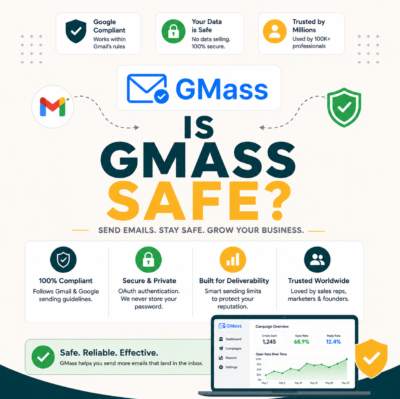
A secondary Gmail account is safe for cold email when it stays inside Google sending limits, sends authenticated mail, and follows a gradual warm-up. The risk comes from volume spikes and high complaint rates, not from owning a second inbox. A dedicated secondary account also protects a primary inbox from reputation damage if a campaign goes wrong.
Google does not prohibit owning multiple accounts, but it does watch for abuse signals such as sudden volume, identical content blasted to large lists, and spam complaints above the 0.3% threshold. A secondary account that ramps slowly and keeps complaints low behaves exactly like a legitimate inbox in Google’s eyes.
Used with restraint, a secondary Gmail account isolates risk and keeps the primary inbox clean, making it a sensible foundation for low-volume outreach.
Secondary Gmail vs Google Workspace: Which Is Better for Cold Email?
Google Workspace beats a free secondary Gmail account for cold email because it allows a custom domain, a higher 2,000-recipient daily limit, and full control over SPF, DKIM, and DMARC. A free Gmail account caps at 500 recipients per day on an address that cannot be authenticated at the domain level, which limits both volume and deliverability.
- Daily limit: Free Gmail allows 500 recipients per day, while Workspace raises the ceiling to 2,000, giving paid accounts four times the headroom for outreach.
- Custom domain: Workspace sends from a branded company domain, which improves trust and allows domain-level authentication that free Gmail cannot offer.
- Authentication control: Workspace exposes SPF, DKIM, and DMARC settings, letting senders prove legitimacy to receiving servers and lift inbox placement.
- Reputation isolation: A dedicated Workspace domain separates cold outreach reputation from a primary brand domain, containing any deliverability damage.
For anything beyond occasional personal emails, a Workspace account on a separate domain is the stronger and safer base for cold outreach.
How Many Secondary Gmail Accounts Do You Need to Scale?
The number of secondary accounts depends on target volume divided by a safe per-inbox daily limit. With a conservative 40 to 50 cold emails per account per day, reaching 500 sends daily requires roughly 10 inboxes. Spreading volume across accounts keeps each inbox well under its cap and protects sender reputation across the whole stack.
Most experienced cold senders cap each inbox at 40 to 50 emails per day rather than the technical 500 or 2,000 limit, because low per-inbox volume keeps complaint rates down and mimics human sending patterns. Scaling then becomes a matter of adding inboxes, not pushing any single account harder.
Plan inbox count around a safe daily-per-account figure, not the maximum limit, so reputation stays intact as volume grows.
How Do You Warm Up a Secondary Gmail Account Before Sending?
Warming up a secondary Gmail account means starting with a handful of emails per day and increasing volume gradually over two to four weeks. A new account that jumps straight to 50 or 100 sends looks automated and triggers filtering. Slow ramp-up builds a positive sending history that receiving servers learn to trust.
A typical warm-up starts near 5 to 10 emails on day one, adding a few more each day while maintaining replies and low bounce rates. Sending to engaged contacts who open and respond early teaches Gmail and recipient servers that the account produces wanted mail, which protects later campaign deliverability.
Patience during the first month is the single biggest factor in whether a secondary account lands in the inbox or the spam folder later.
What Are the Risks of Secondary Gmail Accounts for Outreach?
The main risks are account suspension from volume spikes, deliverability collapse from high complaint rates, and wasted setup when accounts share the same IP or domain footprint. None of these are inevitable, but each grows when a sender pushes volume too fast or skips authentication and list hygiene.
- Account suspension: Sudden volume jumps or spam complaints above 0.3% can trigger a temporary or permanent Gmail block on the sending account.
- Shared footprint: Multiple accounts on one IP or domain can fail together if one earns a poor reputation, erasing the isolation benefit.
- List quality: Sending to unverified addresses raises bounce rates, which Gmail reads as a spam signal and applies across the account.
- Manual overhead: Managing many inboxes without rotation tooling invites human error, such as over-sending from a single account on a busy day.
Every risk traces back to volume, authentication, or list quality, so disciplined sending neutralizes most of them.
How Much Does Running Multiple Sending Accounts Cost?
Free secondary Gmail accounts cost nothing, but a serious multi-inbox setup runs on Google Workspace at roughly $6 to $12 per user each month, plus any sending tool. Ten Workspace inboxes therefore cost about $60 to $120 monthly before software, which is the realistic budget for scaled, authenticated cold outreach.
Beyond the inbox fees, most teams add a sending platform that handles rotation, warm-up, and tracking across all accounts. The combined cost stays modest compared with the pipeline value of reliable inbox placement, which is why dedicated domains and Workspace seats are the standard choice once outreach becomes a core channel.
Budget for Workspace seats plus a rotation tool rather than relying on free accounts, because authentication and deliverability pay back the spend quickly.
Secondary Gmail Account: Frequently Asked Questions
What is a secondary Gmail account?
A secondary Gmail account is any Google account created beyond your primary inbox, typically a separate Workspace or free Gmail account used to distribute cold email volume, add a second sending identity, or create a departmental address. Google allows multiple accounts provided each represents a genuine person or business unit.
Why does a secondary Gmail account matter for cold email senders scaling beyond the daily cap?
Gmail’s 500/day and Workspace’s 2,000/day caps hard-stop outreach growth. Secondary accounts multiply daily sending capacity linearly: three Workspace accounts deliver 6,000 emails per day. Understanding this prevents wrong tool purchases and compliance failures that delete accounts mid-campaign.
How does GMass relate to secondary Gmail accounts?
GMass MultiSend connects 2-10 legitimate Workspace accounts via OAuth, distributes outbound volume across them automatically, and tracks deliverability per account. Users get multi-account scale without manual rotation or fake-persona creation. GMass handles the orchestration at $25/month flat regardless of account count.
Who needs to understand secondary Gmail accounts most?
Cold email senders scaling beyond 500/day need to understand this concept first. SDR teams hitting Gmail’s free cap, solo founders sending 1,000+ emails per week, and growth marketers running multi-segment campaigns all hit the sending wall. Anyone evaluating cold email platforms benefits from secondary Gmail account clarity before committing to a paid plan.
How much time does understanding secondary Gmail accounts save?
Clarity on secondary Gmail accounts prevents 5-10 hours of trial-and-error in tool selection upfront. It also prevents 1-2 hours per week of troubleshooting deliverability issues caused by accounts set up incorrectly. Compounded over a quarter, that’s 20-30 hours recovered plus the weeks lost rebuilding a suspended account’s sending reputation from scratch.
What is the biggest benefit of secondary Gmail account mastery?
Better tool decisions. Most cold email senders over-buy expensive enterprise platforms or under-buy free tiers that cap them out because they skip understanding how secondary accounts actually work. Mastery leads directly to the right tool tier at the right price: GMass plus a few Workspace accounts at a fraction of enterprise-level costs.
Does secondary Gmail account support apply across all cold email tools?
Yes, with vendor-specific variations. GMass, Mailshake, Lemlist, and Instantly all support secondary Gmail accounts but differ in setup complexity, per-seat pricing, and rotation logic. GMass offers flat $25/month regardless of account count in MultiSend. Compare implementations before committing to a paid plan.
Can ignoring secondary Gmail account rules cost real money?
Yes. Cold email senders who create fake-persona secondary accounts typically get suspended within 30-90 days. Rebuilding costs $200-500 in direct expenses plus 4-6 weeks of lost outreach capacity. At standard SDR conversion rates, 4-6 weeks of lost pipeline is a material revenue impact from a fully preventable compliance error.
How does secondary Gmail account support compare between GMass and competitors?
GMass implements MultiSend at $25/month flat : the same price whether you connect one account or ten. Mailshake charges $58/user/month per connected account. Lemlist and Instantly offer multi-inbox features at $37-59/month but require manual warmup management. GMass’s Spam Solver inbox optimizer runs per secondary account automatically, a feature competitors don’t include at entry pricing.
What is the relationship between secondary Gmail accounts and GMass deliverability?
GMass achieves 91% inbox placement in independent testing versus 78% industry average. Secondary Gmail accounts contribute to that figure when configured correctly: each legitimate Workspace account distributes load, keeping individual account reputation healthy. Overloading a single account toward its daily cap is the primary deliverability killer that GMass MultiSend prevents by design.
How do I start applying secondary Gmail accounts in my workflow today?
Three steps: (1) Sign up for GMass Free at $0 : the 50 emails/day free tier verifies the setup works before you scale. (2) Create one additional Google Workspace account at $6/month representing a real business entity. (3) Connect both accounts to GMass MultiSend and measure inbox placement over 30 days before adding more accounts.
Is secondary Gmail account strategy more important for SDRs or solopreneurs?
Both, at different scales. SDRs apply secondary Gmail account strategy at team scale with 5-10 accounts delivering 10,000-20,000 daily sends across a revenue team. Solopreneurs apply it at single-user scale with 2-3 accounts for 3,000-6,000 daily sends. The compliance rules and mechanism are identical : only the account count and volume targets differ.
These 12 questions cover the full secondary Gmail account decision : from understanding what it is and why it matters, through compliance rules and tool comparisons, to the 5-step application workflow.
Scale beyond 500/day with GMass MultiSend on legitimate Workspace accounts.
GMass MultiSend distributes across 2-10 Workspace accounts safely. Avoids ToS violations. Free 50/day tier lets you test the setup before scaling.
Try GMass Free →Free 50/day forever : no credit card needed. Cancel anytime.