Table of Contents
The Smartlead free trial gives 14 days of full sending with unlimited mailboxes and warmup, and no credit card is required to start. This guide explains exactly what the trial includes, what can realistically be tested in two weeks, how it compares to the Instantly and Lemlist trials, the honest limits, and how to start and move to an annual plan if early placement looks strong.
Yes, Smartlead has a 14-day free trial, no card required.
What it unlocks: unlimited mailboxes, automated warmup, sequencing and the unified inbox.
Enough to: test real deliverability before paying.
Bottom line: there is no permanent free plan, so the trial is the free way to evaluate it.
Start the Smartlead free trial. 14 days, no card required.
Start Smartlead Free Trial →Unlimited mailboxes · no credit card · no auto-renewal
Does Smartlead Have a Free Trial?
Yes, the Smartlead free trial runs for 14 days with no credit card required. It unlocks full sending, unlimited mailboxes and automated warmup, so a real campaign can be tested before any payment. There is no permanent free plan beyond the trial, because a platform running ongoing sending infrastructure cannot sustain unlimited free sending.
The trial is the free way to evaluate Smartlead, and 14 days is enough to judge the one thing that matters most: deliverability on real domains.
What Do You Get on the Smartlead Free Trial?
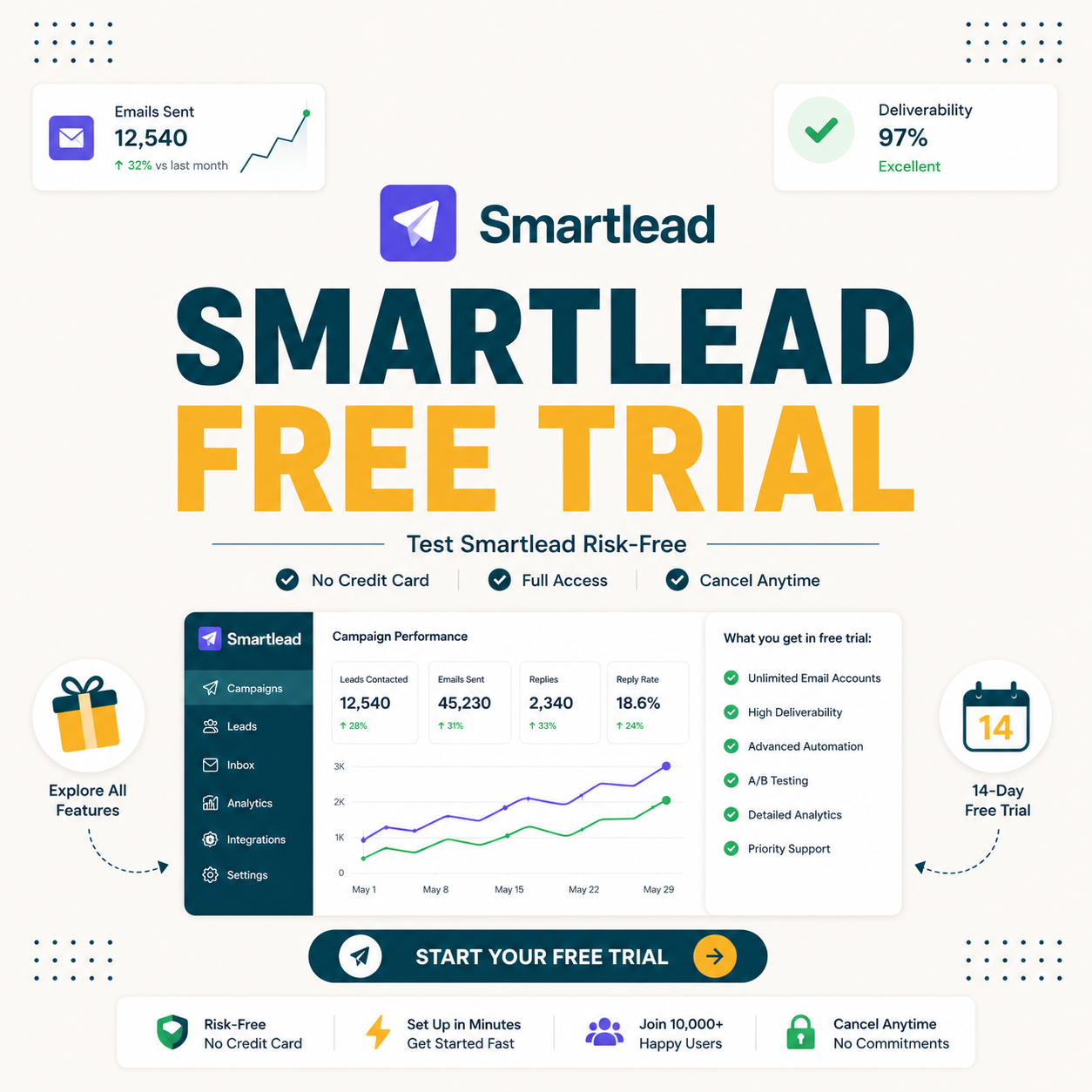
The trial includes the core platform: unlimited mailboxes, automated warmup, sequencing and the unified inbox. A real campaign can run at limited volume, which is enough to measure early inbox placement. The list below shows exactly what the 14-day trial unlocks.
- Unlimited mailboxes: multiple sending accounts can be connected and warmed during the trial, just as on a paid plan.
- Automated warmup: warmup runs from day one to build sender reputation before any real cold send begins.
- Sequencing: multi-step campaigns can be built and launched to a small verified list to test real placement.
- Unified inbox: replies land in the master inbox so reply handling can be evaluated alongside sending.
- No card and no auto-renewal: the trial starts without billing details, so nothing is charged unless a plan is chosen.
How Long Is the Smartlead Free Trial?
The Smartlead free trial lasts 14 days from signup. That window is enough to connect mailboxes, run a short warmup and send a small test campaign that shows early inbox placement. It is shorter than a full warmup ramp, so the trial measures direction rather than the long-term reputation a paid account builds over weeks.
Two weeks is the standard length, and the best use of it is to start warmup immediately so placement data is ready before the trial ends.
Do You Need a Credit Card for the Trial?
No credit card is required to start the Smartlead free trial, so there is no risk of an accidental charge. Billing details are only entered when a paid plan is chosen after the trial, and because the trial does not auto-renew, the account simply pauses if no plan is selected. That makes it a genuinely risk-free way to evaluate the platform.
The no-card start removes the most common friction in tool evaluation, so the only commitment during the trial is time, not money.
What Can You Realistically Test in 14 Days?
In two weeks a sender can verify a list, connect and begin warming mailboxes, send a small campaign and measure early inbox placement. The table below lays out a realistic 14-day test plan so the trial produces decision-grade data rather than a rushed send on the final day.
Source: internal trial test plan based on standard warmup cadence, June 2026.
“Sender reputation builds over weeks, so early warmup data signals direction, not a final score.”
— HubSpot, on email deliverability
How Do You Make the Most of the Free Trial?
To get the most from the trial, verify the list first, start warmup on day one, authenticate every domain, then send a small batch and watch placement. Front-loading setup leaves time for warmup to work, which is what makes the trial data trustworthy. The steps below turn 14 days into a clear yes or no.
- Verify the list: clean contacts with a dedicated verifier before import so bounce stays low on fresh mailboxes.
- Start warmup day one: turn on warmup immediately so reputation has the full window to build before sending.
- Authenticate domains: set SPF, DKIM and DMARC on every sending domain so receivers treat the sender as legitimate.
- Send a small test: launch a low-volume campaign to a verified segment near the end of warmup to read placement.
- Measure by provider: track inbox placement across Gmail and Outlook so the result reflects the real audience mix.
What Happens When the Smartlead Trial Ends?
When the 14 days end, a paid plan keeps sending active, or the account pauses. Nothing is charged automatically because no card is on file, so there is no surprise bill. Campaign data and warmup progress remain in the account, so picking up on a paid plan continues from where the trial left off rather than starting over.
The clean end with no auto-charge is what makes the trial low-risk: the only decision at day 14 is whether the placement results justify a plan.
Does Smartlead Have a Free Plan, or Only a Trial?
Smartlead offers a trial, not a permanent free plan. A platform running ongoing sending infrastructure and warmup cannot sustain unlimited free sending, so the 14-day trial is the free route to evaluate it. Tools that advertise a permanent free cold email plan usually cap deliverability instead, which defeats the purpose. The trade-offs of free-versus-paid models are covered in this guide to free and lifetime SaaS deals.
The honest read is that a funded subscription protects placement in a way a permanent free plan cannot, so the trial plus a paid plan is the right path for real outbound.
How Does the Trial Compare to Instantly and Lemlist Trials?
Compared to rivals, the Smartlead trial stands out for unlocking unlimited mailboxes and warmup without a card. Instantly also offers a 14-day no-card trial with unlimited mailboxes, while Lemlist’s 14-day trial limits sending accounts to its per-seat allowance. The table compares the three on the points that decide how much can be tested.
Source: vendor sites and help centers (smartlead.ai, instantly.ai, lemlist.com), verified June 2026. Trial terms change; confirm at signup.
“In our testing, the trials worth using are the ones that unlock real sending, not a watered-down demo.”
— Growth Hack Suite, cold email tools comparison
What Are the Limits of the Free Trial?
The trial has honest limits worth knowing before signup. Fourteen days is shorter than a full warmup ramp, sending volume is capped, and long-term reputation cannot be judged in two weeks. Naming these limits is what makes the rest of this guide trustworthy, since no trial is a perfect proxy for months of real sending.
- Shorter than full warmup: 14 days covers early warmup, so placement is still improving when the trial ends rather than fully settled.
- Capped sending volume: trial limits prevent a full-scale send, so the test measures direction on a small batch rather than peak throughput.
- No long-term reputation read: two weeks cannot show how domains hold up over months of sustained sending.
- Learning curve included: part of the window goes to learning the platform, which is realistic but shortens pure testing time.
- White-label not included: agency features such as white-label sit on higher plans, so they cannot be fully evaluated during the trial.
Is the Free Trial Enough to Decide?
For most buyers the trial is enough to decide, because it proves deliverability on real domains, which is the deciding factor. If early placement is strong and the workflow fits, the choice is clear. The list below covers what the trial reliably reveals, so the decision rests on measured results rather than marketing claims.
- Tests real deliverability: sending from actual domains shows early inbox placement, the single biggest driver of cold email results.
- Confirms setup effort: connecting mailboxes and authenticating domains reveals how much ongoing work the platform requires.
- Reveals workflow fit: running a campaign shows whether the interface and sequencing match how the team works.
- Shows persona fit: the trial makes clear whether the platform suits an agency, an SDR team or a solo founder.
- Surfaces real costs: using the features clarifies which paid tier the workflow actually needs after the trial.
Ready to test deliverability? Start the 14-day trial with no card.
Start Smartlead Free Trial →No credit card · no auto-renewal
How Do You Start the Smartlead Free Trial?
Starting takes minutes: sign up without a card, connect a mailbox, turn on warmup, and load a verified list. From there a small campaign can launch and placement can be watched. Spreading volume across mailboxes also helps stay within Gmail’s sending limits for any Google-based accounts.
- Sign up free: create the account without billing details to start the 14-day trial immediately.
- Connect a mailbox: link a Google, Outlook or SMTP account and authenticate the domain with SPF, DKIM and DMARC.
- Turn on warmup: enable warmup on every connected mailbox so reputation builds across the full window.
- Load a verified list: import a cleaned segment so the test send goes only to valid addresses.
- Launch a verified test: send a small campaign near the end of warmup and measure inbox placement by provider.
Should You Go Annual After the Trial?
If the trial shows strong placement, going annual after it locks the standing discount and lowers cost per mailbox. Monthly is the safer choice only while domains are still being tested beyond the trial. The deciding factor is confidence: once the trial confirms deliverability, annual billing turns a proven setup into the lowest ongoing cost.
“A free trial is a period of free access before a purchase decision.”
— Wikipedia, Free trial
Growth Hack Suite Editorial — Outbound Tools Team
Trial terms checked against Smartlead’s official site and help center. We track outbound tool trials and pricing for B2B senders.
Last updated: June 2026. Trial length, card requirement and features verified against smartlead.ai.
Affiliate disclosure: this page contains affiliate links. If you start a plan through them, Growth Hack Suite may earn a commission at no extra cost to you. It does not change our analysis.
Test deliverability on your own domains. Start Smartlead free for 14 days.
Start Smartlead Free Trial →Unlimited mailboxes · no credit card · no auto-renewal
Related Tools in the Outbound Stack
Two other tools in the Growth Hack Suite stack make the most of a Smartlead trial, one before sending and one for the Gmail-native route.
- Hunter Email Verifier: verifying the trial list before import keeps bounce low and protects the new mailboxes — see verifier accuracy.
- GMass: the Gmail-native alternative for low-volume senders who want no separate trial — read the GMass review.
- Gmail tools comparison: the Gmail-scoped breakdown for senders weighing platform versus extension — compare the Gmail tools.
Smartlead Free Trial FAQ
The 12 most-asked questions about the Smartlead free trial.
Does Smartlead have a free trial?
Yes, Smartlead offers a 14-day free trial with no credit card required. It unlocks full sending, unlimited mailboxes and warmup, so a real campaign can be tested before paying. There is no permanent free plan beyond the trial.
How long is the Smartlead free trial?
The Smartlead free trial lasts 14 days from signup. That window is enough to connect mailboxes, run a short warmup and send a small test campaign that shows early inbox placement, though it is shorter than a full warmup ramp.
Do you need a credit card for the Smartlead trial?
No, the Smartlead free trial does not require a credit card, so there is no risk of an accidental charge. Billing details are only entered when a paid plan is chosen, and the trial does not auto-renew, so the account simply pauses if no plan is selected.
What do you get on the Smartlead free trial?
The trial includes unlimited mailboxes, automated warmup, sequencing and the unified inbox. A real campaign can run at limited volume, which is enough to measure early inbox placement on real domains before choosing a paid plan.
Does Smartlead have a free plan?
Smartlead offers a 14-day trial, not a permanent free plan. A platform running ongoing sending infrastructure cannot sustain unlimited free sending, so the trial is the free way to evaluate it. Tools advertising permanent free cold sending usually cap deliverability instead.
What can you test in the Smartlead trial?
In two weeks a sender can verify a list, connect and begin warming mailboxes, send a small campaign and measure early inbox placement. Starting warmup on day one leaves enough time for placement data to be ready before the trial ends.
What happens when the Smartlead trial ends?
When the 14 days end, a paid plan keeps sending active, or the account pauses. Nothing is charged automatically because no card is on file. Campaign data and warmup progress remain, so a paid plan continues from where the trial left off.
Is the Smartlead trial enough to decide?
For most buyers the trial is enough, because it proves deliverability on real domains, which is the deciding factor. If early placement is strong and the workflow fits, the choice is clear, though long-term reputation still builds over the first months on a paid plan.
How do you start the Smartlead free trial?
Sign up without a card, connect a mailbox, turn on warmup and load a verified list, then launch a small campaign and watch placement. Front-loading setup leaves the most time for warmup to build reputation before the test send.
Can you extend the Smartlead free trial?
The standard Smartlead trial runs 14 days. If more time is needed to evaluate, contacting support is the route to ask, but the better approach is to use the window efficiently by starting warmup on day one so placement data is ready in time.
Is the Smartlead trial limited?
Yes, the trial has honest limits: 14 days is shorter than a full warmup ramp, sending volume is capped, and long-term reputation cannot be judged in two weeks. White-label and other higher-plan features also sit outside the trial.
Should you go annual after the trial?
If the trial shows strong placement, going annual locks the standing discount and lowers cost per mailbox. Stay monthly only if domains are still being tested. Once the trial confirms deliverability, annual billing turns a proven setup into the lowest ongoing cost.