Table of Contents
Domain reputation is the trust score mailbox providers assign to your sending domain based on its history, and it largely decides whether cold email reaches the inbox or the spam folder. This guide explains what domain reputation is, how it differs from sender reputation, what damages it, how to build and check it, and how to recover a domain that has been harmed.
Domain reputation is the trust score on your sending domain that largely decides inbox placement.
Best for: understanding why cold email lands in inbox or spam.
Caveat: one bad, unverified campaign can damage it quickly.
Bottom line: build it with authentication, warmup and clean lists.
Put this into practice. Try Smartlead free for 14 days.
Start Smartlead Free Trial →Unlimited mailboxes · no credit card · 14-day trial
What Is Domain Reputation?
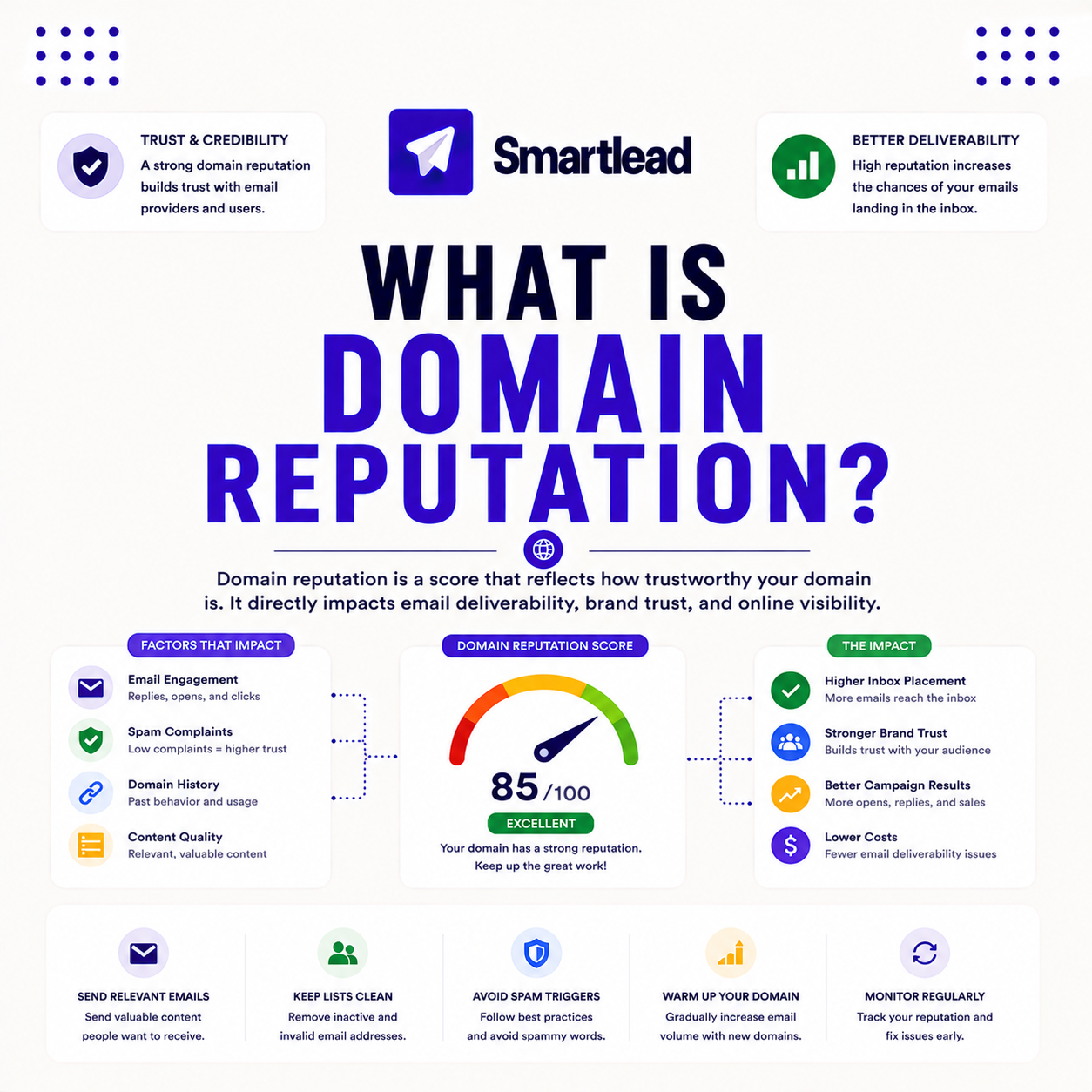
Domain reputation is a trust score mailbox providers assign to your sending domain based on its history, authentication and how recipients react to its mail. It travels with the domain wherever it sends. The deciding factor is that this score largely determines inbox placement. The list below covers what feeds it.
- Sending history: past behavior, from volume to complaints, shapes the domain’s score.
- Authentication: SPF, DKIM and DMARC records are foundational to a trusted domain.
- Recipient reactions: opens, replies, spam complaints and deletions all feed the score.
- Follows the domain: the reputation attaches to the domain and moves with it everywhere.
- Decides placement: a strong score reaches the inbox, a weak one lands in spam.
“Domain reputation is the score that quietly decides whether cold email ever reaches a reader.”
— Growth Hack Suite, on domain reputation
How Is Domain Reputation Different From Sender Reputation?
Domain reputation attaches to your domain and follows it across every mailbox, while sender reputation is often tied to a specific mailbox or IP. The two overlap but are not identical. The deciding factor is that domain reputation is the broader, more portable score. The list below draws the distinction.
- Domain reputation: the trust score on the domain itself, carried across all its mailboxes.
- Sender reputation: often tied to a specific mailbox or sending IP rather than the domain.
- Overlapping signals: both are shaped by engagement, complaints and authentication.
- Domain is portable: the domain’s score follows it, so one bad mailbox can affect the whole domain.
- Both matter: healthy cold email needs a good score at the domain and the mailbox level.
“A sending domain’s reputation is what most determines whether cold email reaches the inbox.”
— Validity, on deliverability
Why Does Domain Reputation Matter for Cold Email?
Domain reputation matters because cold email sends to people who never opted in, so providers scrutinize the domain harder than they would a subscribed list. A weak reputation means spam placement regardless of the copy. The deciding factor is that reputation, not content, is the first gate. The list below covers why it is decisive for cold email.
- Higher scrutiny: cold email to non-opted-in recipients is judged more strictly by providers.
- Reputation is the first gate: a weak domain lands in spam no matter how good the copy is.
- Compounds over time: good sending builds the score, while bad sending erodes it fast.
- Protects the whole program: a strong domain keeps every campaign reaching the inbox.
- Hard to rebuild: once damaged, a domain’s reputation takes weeks of clean sending to recover.
What Damages Domain Reputation?
High bounce rates, spam complaints, sending to traps, sudden volume spikes and missing authentication all damage domain reputation. Each tells providers the domain is a risky sender. The deciding factor is that a single bad campaign can undo weeks of careful sending. The table below maps the common causes to their effect.
Source: common reputation-damage causes from standard cold email practice, mid-2026. Directional, not a measured benchmark.
How Do You Build Domain Reputation?
Build domain reputation by authenticating the domain, warming mailboxes, verifying lists and ramping volume gradually. Each step adds a positive signal and removes a risk. The ordered steps below build reputation the right way.
- Authenticate: publish SPF, DKIM and DMARC so the domain passes the basic trust check.
- Warm up: run warmup on every mailbox to build a positive engagement history.
- Verify lists: clean every list before sending so bounce stays low from the first send.
- Ramp gradually: increase volume slowly rather than spiking, which looks risky to providers.
- Stay relevant: send targeted, relevant mail so complaints stay low and engagement stays high.
Why Use a Separate Domain for Cold Email?
Use a separate sending domain so cold email cannot harm your main company domain’s reputation if a campaign goes wrong. Isolation keeps the business’s primary email safe. The deciding factor is that cold outreach carries risk the main domain should never bear. The honest read is that a dedicated sending domain is standard practice for exactly this reason.
The practical point is to run cold email from a domain apart from the one that handles business correspondence, so a reputation hit never touches the company’s main inbox.
How Do You Check Domain Reputation?
Check domain reputation with provider tools like Google Postmaster Tools, blocklist checkers and seed inbox tests that show where mail lands. Regular checks catch a decline before it hurts campaigns. The deciding factor is that reputation should be monitored, not assumed. The table below positions monitoring against a typical rival.
Source: reputation-tooling positioning, mid-2026. Verify current features on smartlead.ai and use external tools like Google Postmaster.
Protect your domain reputation. Test Smartlead free for 14 days.
Start Smartlead Free Trial →No credit card · unlimited mailboxes
How Do You Recover a Damaged Domain?
Recover a damaged domain by pausing heavy sending, fixing authentication, cleaning the list, re-warming and ramping volume back up slowly. Recovery is essentially rebuilding trust from a lower base. The deciding factor is patience: providers restore trust only through sustained clean sending. The honest read is that recovery takes weeks, which is why prevention beats repair.
The practical guidance is to stop the harmful sending immediately, correct the root cause, and rebuild slowly with warmup and verified lists rather than pushing volume.
Who Gets the Most Value From Domain Reputation?
Agencies and scale senders get the most value from protecting domain reputation, since a single damaged domain can affect many clients or campaigns. A solo sender benefits too, but the stakes rise with the number of domains in play. The deciding factor is how much sending depends on each domain staying healthy. The honest read is that the more a sender scales, the more reputation discipline pays back.
The practical point is that the same reputation rules apply at any size, but the cost of a damaged domain is largest for agencies running client volume.
How Do You Get Started Today?
Start on the 14-day free trial, connect a mailbox on a separate sending domain, authenticate it, warm it and verify a small list. Doing the reputation work from day one builds a strong domain before any real campaign. The trial needs no card, so the only cost is setup time. By the end of warmup, the domain has a healthy foundation to send from.
Does Authentication Affect Domain Reputation?
Yes, SPF, DKIM and DMARC are foundational to domain reputation. A domain that fails authentication is distrusted from the start, no matter how good its other signals are. The deciding factor is that authentication is the baseline every trusted domain clears. The honest read is that without the three records, a domain cannot build a strong reputation at all.
The practical point is to authenticate every sending domain before warming it, since authentication is the floor that all other reputation-building rests on.
How Long Does It Take to Build Domain Reputation?
Building domain reputation takes weeks of consistent, clean sending, starting with warmup and a gradual volume ramp. There is no shortcut to a trusted history. The deciding factor is that reputation is earned over time through steady positive behavior. The honest read is that the weeks of patience up front are what protect every campaign that follows.
“Email deliverability is the ability to deliver emails to subscribers’ inboxes.”
— Wikipedia, Email deliverability
Domain Reputation: The Final Verdict
The final verdict is that domain reputation is the trust score that largely decides whether cold email reaches the inbox, built through authentication, warmup, clean lists and gradual, relevant sending. It is easy to damage and slow to rebuild, so protect it with a separate sending domain and steady good behavior. Get the reputation right, and deliverability follows.
Growth Hack Suite Editorial — Outbound Tools Team
This guide explains domain reputation based on standard cold email deliverability practice plus hands-on testing of Smartlead’s warmup, rotation and authentication features. Behavior varies by provider; verify current features on smartlead.ai and monitor with tools like Google Postmaster. We review outbound tools for B2B senders.
Last updated: June 2026. Confirm current features on smartlead.ai.
Affiliate disclosure: this page contains affiliate links. If you start a plan through them, Growth Hack Suite may earn a commission at no extra cost to you. It does not change our guidance.
Build a strong sending domain. Start Smartlead free for 14 days.
Start Smartlead Free Trial →Unlimited mailboxes · no credit card · cancel anytime
Related Tools in the Outbound Stack
Two other tools in the Growth Hack Suite stack protect domain reputation before sending.
- Hunter Email Verifier: verifying lists keeps bounce low, which protects the domain’s reputation — see verifier accuracy.
- GMass: the Gmail-native option for a sender on a single Gmail sending domain — read the GMass review.
- Gmail tools comparison: the Gmail-scoped breakdown for senders weighing platform versus extension — compare the Gmail tools.
Domain Reputation FAQ
The 12 most-asked questions about domain reputation.
What is domain reputation?
Domain reputation is a trust score mailbox providers assign to your sending domain based on its history, authentication and how recipients react to its mail. It largely decides inbox placement.
How is domain reputation different from sender reputation?
Domain reputation attaches to your domain and follows it across every mailbox, while sender reputation is often tied to a specific mailbox or IP. The two overlap but are not identical.
Why does domain reputation matter for cold email?
Cold email sends to people who never opted in, so providers scrutinize the domain harder. A weak reputation means spam placement regardless of the copy, since reputation is the first gate.
What damages domain reputation?
High bounce rates, spam complaints, sending to traps, sudden volume spikes and missing authentication all damage it. A single bad campaign can undo weeks of careful sending.
How do I build domain reputation?
Authenticate the domain, warm mailboxes, verify lists and ramp volume gradually. Each step adds a positive signal and removes a risk, and consistent relevant sending keeps the score healthy.
How do I check my domain reputation?
Use provider tools like Google Postmaster Tools, blocklist checkers and seed inbox tests that show where mail lands. Regular checks catch a decline before it hurts campaigns.
Should I use a separate domain for cold email?
Yes, so cold email cannot harm your main company domain’s reputation if a campaign goes wrong. A dedicated sending domain keeps the business’s primary email safe from outreach risk.
How do I recover a damaged domain?
Pause heavy sending, fix authentication, clean the list, re-warm and ramp volume back up slowly. Recovery takes weeks of sustained clean sending, which is why prevention beats repair.
Does authentication affect domain reputation?
Yes, SPF, DKIM and DMARC are foundational. A domain that fails authentication is distrusted from the start, no matter how good its other signals are, so authenticate before warming.
How long does it take to build domain reputation?
Weeks of consistent, clean sending, starting with warmup and a gradual volume ramp. There is no shortcut to a trusted history; reputation is earned over time through steady positive behavior.
Can one bad campaign ruin domain reputation?
A single campaign to a bad, unverified list with high bounce and complaints can seriously damage a domain. That is why verifying lists and ramping volume carefully matter so much.
Does Smartlead help protect domain reputation?
Yes, through warmup, sender rotation, authentication support and gradual sending that all help protect a domain’s reputation. Pair it with external monitoring like Google Postmaster Tools.