Table of Contents
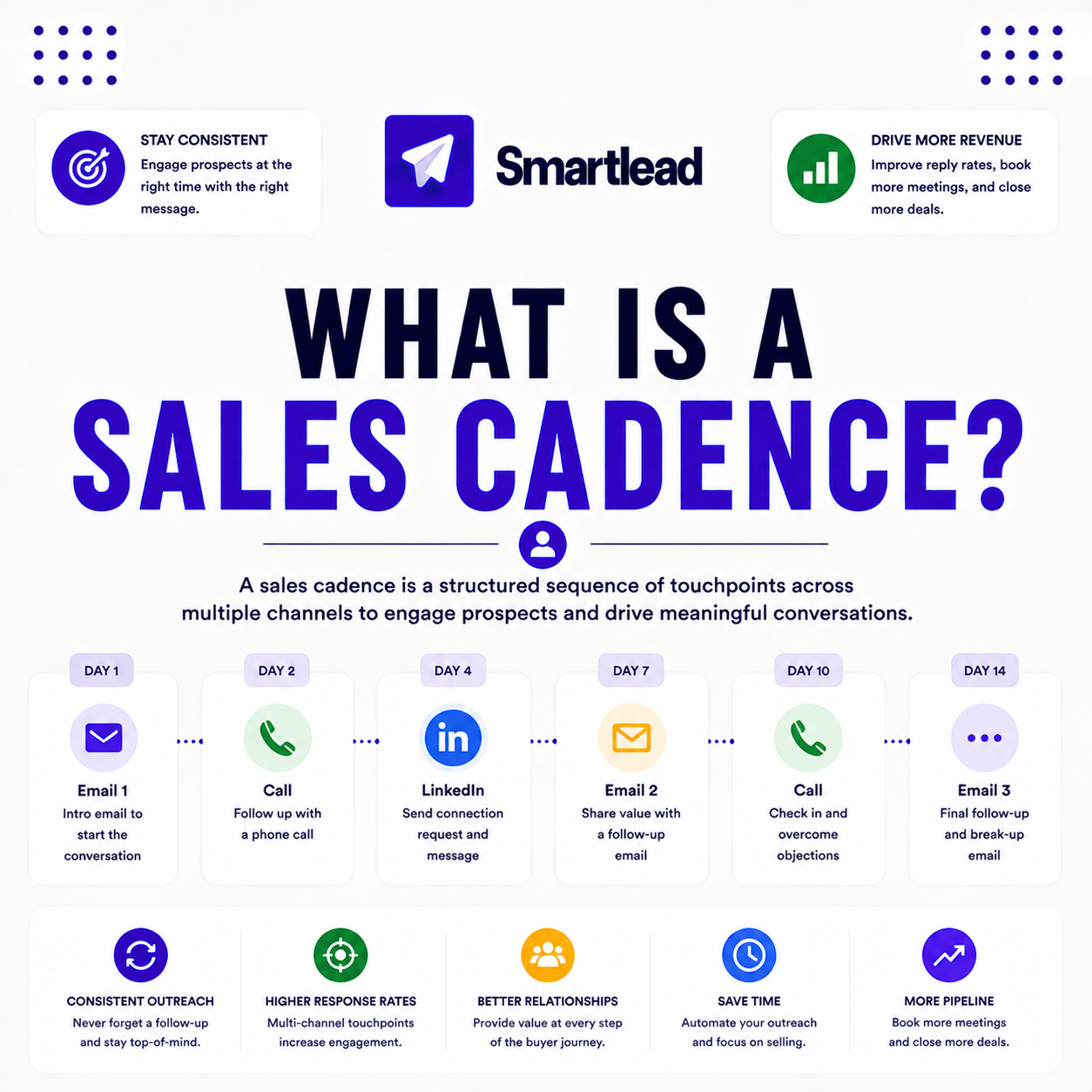
A sales cadence is a planned sequence of outreach touches across channels, email, calls and social, spaced over time to engage a prospect systematically rather than at random. This guide explains what a sales cadence is, how it works, why it improves results, what a good cadence looks like, how to build one, how many touches to use, and how it differs from a sequence.
A sales cadence is a planned sequence of outreach touches across email, calls and social, spaced over time.
Best for: teams running consistent, multi-touch B2B outreach.
Caveat: too many touches overwhelm, so keep it disciplined.
Bottom line: a defined cadence beats scattered, random touches.
Put this into practice. Try Smartlead free for 14 days.
Start Smartlead Free Trial →Unlimited mailboxes · no credit card · 14-day trial
What Is a Sales Cadence?
A sales cadence is a planned series of outreach touches, across email, phone and social, spaced over time to engage a prospect systematically. It replaces random follow-up with a defined rhythm. The deciding factor is that the touches are planned, not improvised. The list below covers the parts.
- Planned touches: each step is defined in advance, not ad hoc.
- Multiple channels: email, call and social are combined in one plan.
- Spaced over time: touches are timed across days and weeks.
- Systematic engagement: the rhythm keeps outreach consistent.
- Pauses on reply: a response ends the cadence for that prospect.
“A planned rhythm of touches connects far more often than scattered, random follow-up.”
— Growth Hack Suite, on cold outreach tools
How Does a Sales Cadence Work?
A cadence works by laying out each touch and its timing, such as email on day one, a call on day three, and a social touch on day five, repeating until a response or the end. The steps run on a defined schedule. The deciding factor is that timing and channel are planned per step. The list below covers the flow.
- Define each touch: every step names its channel and message.
- Set the timing: touches are spaced across specific days.
- Run the schedule: steps fire in order until a reply or the end.
- Pause on response: a reply on any channel stops the cadence.
- Pairs with basics: the email steps still need warmup and verification.
“Most replies and meetings come from persistent follow-up, not the first outreach touch.”
— HubSpot, on follow-up cadence
Why Does a Sales Cadence Improve Results?
A cadence improves results because consistent multi-touch outreach connects more often than a single email or random touches. Most replies and meetings come from persistent follow-up. The deciding factor is that consistency, not intensity, drives the gain. The list below covers why.
- Consistent touches: a planned rhythm reaches prospects more reliably.
- Follow-up wins: most replies come from later touches, not the first.
- Best for scale: the effect compounds across many prospects.
- Caveat: low-volume senders with simple lists gain less from it.
- Multi-channel lift: mixing channels catches more of the audience.
What Does a Good Sales Cadence Look Like?
A good cadence usually spans one to three weeks with a handful of touches across email and at least one other channel, spaced to be persistent without being annoying. The mix depends on the audience. The deciding factor is a steady rhythm over a short window. The list below covers the shape.
- One to three weeks: the typical span for a cold outreach cadence.
- Multi-channel: email plus calls or social, not email alone.
- Spaced touches: steps sit far enough apart to avoid crowding.
- Consistent message: each touch reinforces the same offer.
- Clean exit: a final step closes the loop if no reply comes.
How Do You Build a Sales Cadence?
Build a cadence by mapping channels and timing, writing each touch, then automating what can be automated while keeping calls human. Starting from the prospect’s likely behavior makes the rhythm fit. The ordered steps below make building it repeatable.
- Map channels and timing: decide which channels fire on which days.
- Write each touch: draft the message for every step in the cadence.
- Automate the email steps: let the platform run the email touches.
- Keep calls human: reserve live calls and personal social for people.
- Measure and refine: track replies and adjust timing and touches.
Building a cadence? Test Smartlead free for 14 days.
Start Smartlead Free Trial →No credit card · unlimited mailboxes
What Is the Difference Between a Cadence and a Sequence?
A sequence usually means a series of emails, while a cadence spans multiple channels, email, calls and social. A cadence is the broader multichannel plan, and an email sequence is the email portion of it. The deciding factor is scope: one channel versus several. The table below draws the distinction.
Source: standard outreach terminology, mid-2026. Directional, not a measured benchmark.
How Many Touches Should a Cadence Have?
A cadence typically has six to twelve touches across channels over its span, enough to be persistent without overwhelming. Too few misses prospects; too many annoys them. The deciding factor is persistence balanced against fatigue. The table below positions the feature against a typical rival.
Source: vendor sites plus internal review, mid-2026. Verify current features on smartlead.ai.
Does Smartlead Support Sales Cadences?
Yes, Smartlead supports cadences by combining automated email sequences with SmartDialer calling, so a multichannel cadence runs from one platform. This keeps email and calls coordinated. The deciding factor is that the cadence lives in one tool rather than several. The honest read is that a built-in dialer covers the core email-plus-call cadence, with social handled alongside.
The practical point is to run the email and call touches in Smartlead and add social steps alongside. Verify current features on smartlead.ai.
Who Gets the Most Value From a Sales Cadence?
Agencies and scale teams get the most value, since a cadence compounds across many prospects and reps. Low-volume senders with simple lists may do fine with a shorter email flow. The deciding factor is how much persistent, coordinated follow-up the motion needs. The honest read is that the more prospects a team works, the more a defined cadence pays back.
The practical point is that a high-volume outbound team gains most, while a niche list may convert on a simple email cadence.
How Do You Get Started Today?
Start on the 14-day free trial, connect a mailbox, warm it, verify a small list and build a short email-plus-call cadence. Testing the cadence on your own list before committing is the lowest-risk way to begin. The trial needs no card, so the only cost is setup time. By launch, a defined cadence runs across email and calls.
Is a Sales Cadence the Same as a Drip Campaign?
Related but different: a drip campaign is usually automated email on a schedule, while a sales cadence spans channels and blends automation with human touches like calls. A cadence is broader and more multichannel. The deciding factor is single-channel automation versus a multichannel plan. The honest read is that a drip campaign is one automated slice of what a full cadence covers.
The practical point is to treat a drip campaign as the automated email portion within a wider, multichannel sales cadence.
Should a Cadence Include Phone Calls?
For high-value B2B outreach, yes, since calls reach prospects who ignore email and accelerate deals. The strongest cadences blend email, calls and social rather than relying on one. The deciding factor is deal value and how much a conversation helps. The honest read is that adding a call to a cadence is the highest-leverage upgrade for high-value prospects.
“Sales is the activity of selling goods or services in exchange for money.”
— Wikipedia, Sales
Sales Cadence: The Final Verdict
The final verdict is that a sales cadence is a planned sequence of outreach touches across email, calls and social, spaced over time so persistence is systematic, not random. A defined cadence beats scattered follow-up, and adding a call to an email-led cadence is the biggest upgrade. Keep it to one to three weeks and a disciplined set of touches, and let a reply pause the rest.
Growth Hack Suite Editorial — Outbound Tools Team
This guide explains sales cadences based on standard outbound practice plus hands-on testing of Smartlead. Behavior varies; verify current features on smartlead.ai. We review outbound tools for B2B senders.
Last updated: June 2026. Touch counts and spans are directional, not measured figures.
Affiliate disclosure: this page contains affiliate links. If you start a plan through them, Growth Hack Suite may earn a commission at no extra cost to you. It does not change our guidance.
Run a coordinated cadence. Start Smartlead free for 14 days.
Start Smartlead Free Trial →Unlimited mailboxes · no credit card · cancel anytime
Related Tools in the Outbound Stack
Two other tools in the Growth Hack Suite stack pair with a sales cadence.
- Hunter Email Verifier: verifying the list keeps the email touches in a cadence deliverable — see verifier accuracy.
- GMass: the Gmail-native option for the email side of a lighter cadence — read the GMass review.
- Gmail tools comparison: the Gmail-scoped breakdown for senders weighing platform versus extension — compare the Gmail tools.
Sales Cadence FAQ
The 12 most-asked questions about sales cadences.
What is a sales cadence?
A sales cadence is a planned series of outreach touches across email, phone and social, spaced over time to engage a prospect systematically. It replaces random follow-up with a defined rhythm.
How does a sales cadence work?
It lays out each touch and its timing, such as email on day one, a call on day three, social on day five, repeating until a response or the end. The steps run on a defined schedule.
Why does a sales cadence improve results?
Consistent multi-touch outreach connects more often than a single email or random touches. Most replies and meetings come from persistent follow-up, which a cadence makes systematic.
What does a good sales cadence look like?
Usually one to three weeks with a handful of touches across email and at least one other channel, spaced to be persistent without being annoying. The mix depends on the audience.
How do I build a sales cadence?
Map channels and timing, write each touch, then automate what you can while keeping calls human. Starting from the prospect’s likely behavior makes the rhythm fit.
What is the difference between a cadence and a sequence?
A sequence usually means a series of emails, while a cadence spans multiple channels, email, calls and social. A cadence is the broader multichannel plan; a sequence is the email portion.
How many touches should a cadence have?
Typically six to twelve touches across channels over its span, enough to be persistent without overwhelming. Too few misses prospects; too many annoys them.
Does Smartlead support sales cadences?
Yes, Smartlead combines automated email sequences with SmartDialer calling, so a multichannel cadence runs from one platform. This keeps email and calls coordinated in one place.
Is a sales cadence the same as a drip campaign?
Related but different: a drip campaign is usually automated email on a schedule, while a sales cadence spans channels and blends automation with human touches. A cadence is broader.
How long should a sales cadence run?
Usually one to three weeks, long enough to catch prospects at different moments without dragging on. Auto-pause ends it early when a prospect replies.
Should a cadence include phone calls?
For high-value B2B outreach, yes, since calls reach prospects who ignore email and accelerate deals. The strongest cadences blend email, calls and social rather than relying on one.
Can I automate a sales cadence?
You can automate the email steps and reminders, while calls and personalized social touches stay human. Integrated platforms run the automated parts and prompt the manual ones.