

Table of Contents
White label hosting lets an agency provide hosting to clients under its own brand, hiding the underlying provider. The agency manages the client relationship and billing while the infrastructure runs on a third-party host. This lets agencies add a recurring revenue stream and a seamless branded experience without operating servers themselves, and this guide explains how it works and how it differs from reseller hosting.
Last updated: August 2026. Written by the Growth Hack Suite editorial team, with details cross-checked against provider documentation. This page carries affiliate links to Kinsta.
What Is White Label Hosting?
White label hosting is an arrangement where an agency provides web hosting to clients under its own brand, while the actual infrastructure runs on a third-party provider whose identity stays hidden. Clients experience the agency as their host, even though another company runs the servers.
“A white-label product is made by one company and rebranded by another.”
— Wikipedia, White-label product
Applied to hosting, that rebranded product is a hosting service the agency sells as its own, with the real provider kept out of sight.
How Does White Label Hosting Work?
White label hosting works by an agency reselling a provider’s hosting with the provider’s branding removed. The agency handles client billing, support presentation and the relationship, while the underlying host supplies and maintains the servers behind the scenes, so the technical work stays with the provider.
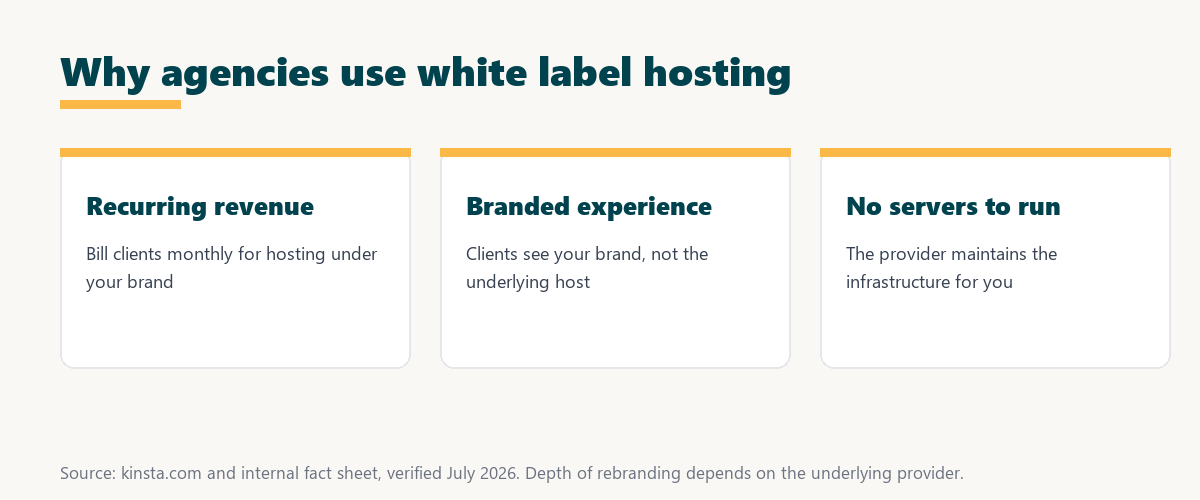
The practical split is that the agency owns the brand and the client, while the provider owns the infrastructure and its upkeep.
White Label Hosting vs Reseller Hosting
White label hosting emphasizes full rebranding so the provider is invisible, while reseller hosting is the broader model of selling another host’s service. White label is essentially reseller hosting with complete brand control over the client experience, so every white label setup is a reseller setup, but not the reverse.
The distinction that matters is branding depth: reselling can still show the provider, while white label hides it entirely.
What Can Be White Labeled in Hosting?
In hosting, the control panel, client dashboards, invoices, support presentation and documentation can be white labeled, so clients see only the agency’s brand. The depth of rebranding available depends on the underlying provider’s white label features, so it varies from host to host.
Source: provider documentation, verified August 2026. White label is reseller hosting with full brand control.
Comparing branding, control and client experience shows white label offers a fully single-brand experience, while plain reselling can leave the provider visible in places.
See how Kinsta supports agencies on Google Cloud
Try Kinsta →Multi-site management, with a 30-day money-back guarantee.
Who Uses White Label Hosting?
Web design agencies, developers and marketing firms use white label hosting to offer hosting as part of their services. They can present a complete branded solution and keep clients within their ecosystem rather than sending them elsewhere, which strengthens the overall relationship.
The common thread is that these businesses already own the client relationship, so adding hosting under their brand is a natural extension.
Benefits of Branded Hosting for Agencies
White label hosting benefits agencies with recurring revenue, stronger client retention, a seamless branded experience and no need to operate servers. Agencies add a profitable service while relying on a provider for the technical infrastructure, so the upside comes without the operational burden.
- Recurring revenue: Monthly hosting fees add a predictable income stream on top of one-off project work.
- Client retention: Managing a client’s hosting keeps them in the agency’s ecosystem and deepens the relationship.
- Branded experience: Clients see a single, consistent brand rather than a patchwork of third-party logins.
- No server operations: The underlying provider maintains the infrastructure, so the agency avoids running hardware.
- Bundling power: Hosting pairs naturally with design and maintenance retainers, raising the value of each account.
“The first five seconds of page-load time have the highest impact on conversion rates.”
— HubSpot, page load time and conversion rates
Because a fast, reliable branded experience is what keeps clients happy, the quality of the underlying host directly shapes the retention white label hosting is meant to deliver.
Challenges and Risks for Agencies
Challenges of white label hosting include depending on the provider’s reliability, handling client support yourself and margins that depend on your pricing. Choosing a dependable underlying host is critical to protecting your brand’s reputation, since any outage lands on the agency, not the hidden provider.
The honest point is that white label hosting transfers the provider’s reliability, good or bad, straight onto the agency’s brand.
How to Choose a White Label Hosting Provider
Choose a white label hosting provider by weighing the reliability of its infrastructure, the depth of rebranding, multi-site management tools and support. Your clients’ experience and your brand depend on the host you build on, so reliability should outweigh a marginally lower price.
Source: provider documentation, verified August 2026. How much can be rebranded depends on the provider.
Listing the control panel, invoices, support and documentation shows the client-facing pieces a white label setup rebrands, with the provider’s features setting the limit. Agencies weighing how tied they become to one host can read our note on SaaS vendor lock-in.
How Kinsta Supports Agencies
Kinsta supports agencies with multi-site management in MyKinsta, client and team roles, agency-friendly analytics and reliable Google Cloud infrastructure. Agencies can manage many client sites and present professional results, though MyKinsta itself is Kinsta-branded, so it is agency-friendly managed hosting rather than a fully white-labeled panel.
Manage every client site on one reliable platform
Start With Kinsta →Free migration and a 30-day money-back guarantee.
Building an Agency Hosting Offer
You build an agency hosting offer by choosing a reliable managed host, deciding your pricing and support model, and presenting hosting as part of your services. You add recurring revenue while the host handles the infrastructure, so the offer scales without you taking on server operations.
“A tool is only worth its premium when the hours or revenue it protects exceed the invoice.”
— Growth Hack Suite, on tool ROI
Applied to an agency offer, a reliable managed host earns its cost when the recurring revenue and retention it enables exceed what you pay per site.
How Branded Hosting Improves Client Retention
White label hosting improves client retention because managing a client’s hosting keeps them within your ecosystem and creates an ongoing relationship. Bundling hosting with design or maintenance makes clients less likely to leave for another provider, since switching would mean unwinding several services at once.
The practical effect is that hosting turns a one-off project into a recurring account, which is where retention and lifetime value grow.
Making the Model Work for Your Agency
You make white label hosting work for your agency by pairing a dependable managed host with clear pricing and responsive support. The host keeps sites fast and online while your brand owns the relationship, so clients get a seamless experience and you earn recurring revenue on top of project work.
The honest summary is that success depends on the reliability you build on, so the host choice is the decision that most shapes the offer.
Try Kinsta risk-free for your agency’s client sites
Try Kinsta Risk-Free →Multi-site management and free migration, with a 30-day money-back guarantee.
Frequently Asked Questions for Agencies
The 12 most-asked questions about white label hosting.
What is white label hosting in simple terms?
White label hosting lets an agency provide hosting to clients under its own brand while a third-party provider runs the infrastructure invisibly, so clients experience the agency as their host.
How does white label hosting work?
White label hosting works by an agency reselling a provider’s hosting with the provider’s branding removed, so the agency handles billing and the relationship while the host maintains the servers.
What is the difference between white label and reseller hosting?
White label hosting emphasizes full rebranding so the provider is invisible, while reseller hosting is the broader model of selling another host’s service, making white label reseller hosting with complete brand control.
Who uses white label hosting?
Web design agencies, developers and marketing firms use white label hosting to offer hosting under their brand, presenting a complete solution and keeping clients within their ecosystem.
What are the benefits of white label hosting?
White label hosting gives agencies recurring revenue, stronger client retention, a branded experience and no need to run servers, adding a profitable service on a provider’s infrastructure.
What can be white labeled in hosting?
The control panel, client dashboards, invoices, support presentation and documentation can be white labeled, though how much depends on the underlying provider’s rebranding features.
Is white label hosting profitable?
White label hosting can be profitable through recurring client fees, with margins depending on your pricing versus the underlying cost, and it also strengthens retention of design or maintenance clients.
What are the challenges of white label hosting?
Challenges include depending on the provider’s reliability, handling client support yourself and managing margins, so choosing a dependable host is critical to protecting your brand.
Do I need to run my own servers for white label hosting?
No, white label hosting means the underlying provider runs and maintains the servers, so you manage the client relationship and branding without operating infrastructure yourself.
How do I choose a white label hosting provider?
Choose based on the reliability of the infrastructure, depth of rebranding, multi-site management tools and support quality, since your clients’ experience and brand depend on the host.
Does Kinsta offer white label features?
Kinsta offers agency-friendly tools including multi-site management, client and team roles, and analytics you can share, though MyKinsta is Kinsta-branded, so it is agency-friendly rather than a fully white-labeled panel.
Is white label hosting good for small agencies?
Yes, white label hosting suits small agencies because it adds recurring revenue and retention without the cost and expertise of running servers, relying instead on a managed provider.
About this guide
Written by the Growth Hack Suite editorial team, drawing on hands-on experience working with agencies. Details were cross-checked against provider documentation. This page carries affiliate links to Kinsta, so the position is stated plainly: white label hosting lets an agency resell hosting under its own brand while a provider runs the infrastructure, it is reseller hosting with full brand control, and reliability is the decisive factor. Kinsta is agency-friendly managed hosting with multi-site management, though MyKinsta itself is Kinsta-branded rather than fully white label.