Table of Contents
NVMe storage is a high-speed interface for solid-state drives that connects them directly over PCIe, delivering far faster data access than older SATA SSDs. For web hosting, NVMe speeds up database queries and file reads, so sites and stores that rely on fast data access benefit from hosting built on NVMe storage. This guide explains how it works, how it compares to SATA, and why it matters for hosting.
Last updated: August 2026. Written by the Growth Hack Suite editorial team, with details cross-checked against provider documentation. This page carries affiliate links to Kinsta.
What Is NVMe Storage?
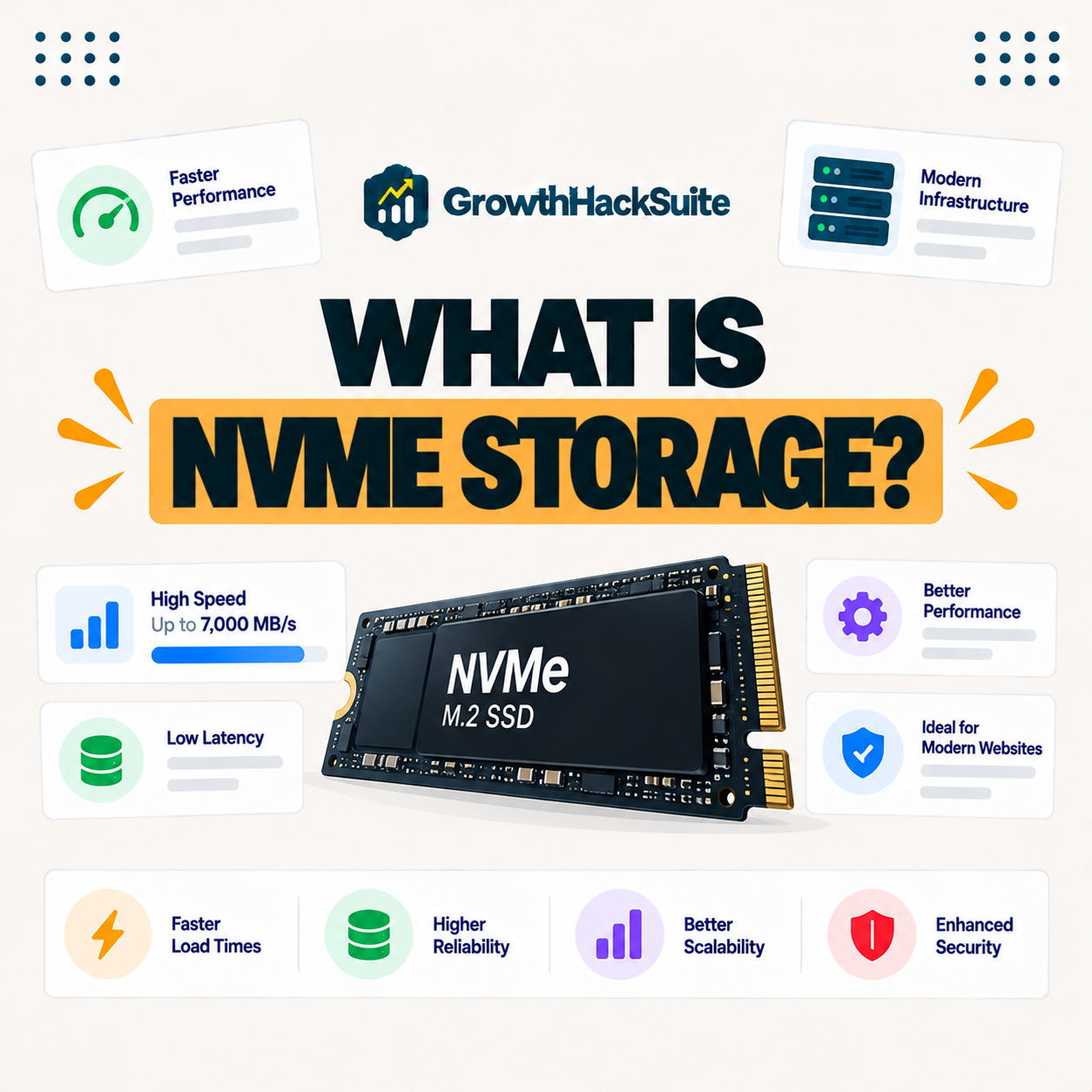
NVMe storage, short for Non-Volatile Memory Express, is a high-speed interface for solid-state drives that connects them directly to the system over PCIe. It delivers much faster data access and throughput than older SATA-based SSDs, so the same flash memory performs far better.
“NVM Express is an open, logical-device interface specification for accessing non-volatile storage media.”
— Wikipedia, NVM Express
In practical terms, NVMe is the modern way to connect an SSD so it runs at full speed rather than being held back by an older interface.
How Does NVMe Storage Work?
NVMe storage works by using the PCIe bus and a streamlined protocol designed for flash memory. It supports many parallel operations with low latency, letting the drive read and write data far faster than drives limited by the older SATA interface, especially under heavy load.
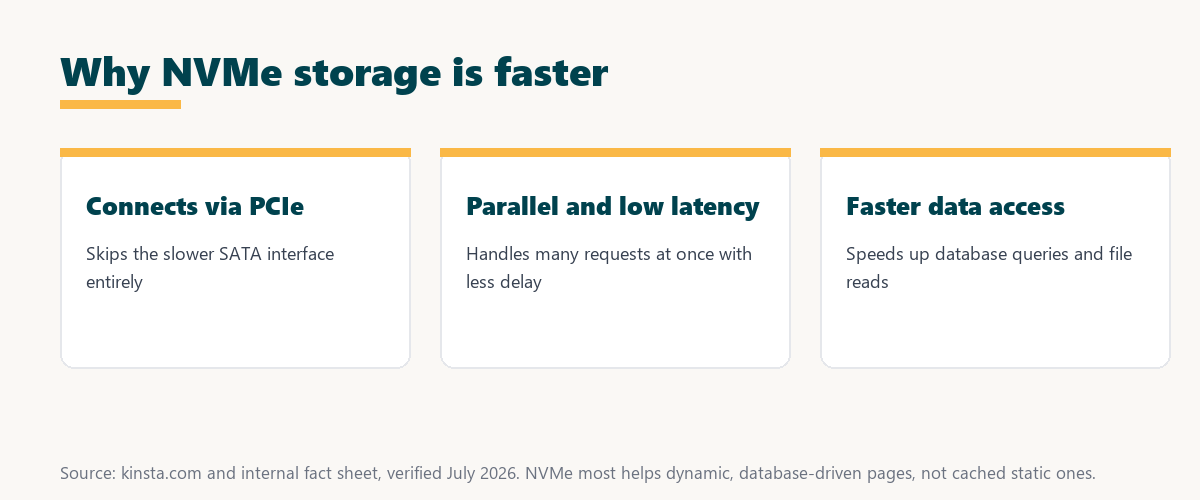
The key mechanism is PCIe plus a flash-native protocol, which together remove the bottlenecks that limited earlier storage interfaces.
NVMe vs SATA SSD vs HDD
NVMe drives are much faster than SATA SSDs, which are in turn far faster than traditional spinning hard drives. The progression from HDD to SATA SSD to NVMe represents large jumps in speed, with NVMe being the fastest common storage in use today.
Source: provider documentation, verified August 2026. Relative, not exact, speeds; actual figures vary by drive.
Comparing interface and relative speed shows a clear ladder: HDD to SATA SSD to NVMe, with each step a large jump and NVMe on top for everyday storage.
See how Kinsta uses fast storage on Google Cloud
Try Kinsta →Premium infrastructure with a 30-day money-back guarantee.
Why NVMe Is Faster Than Older Storage
NVMe is faster because it connects over PCIe with a protocol built for flash, avoiding the bandwidth and command-queue limits of SATA. It moves far more data with lower latency, especially under the many simultaneous requests a busy server handles, where SATA drives would bottleneck.
The core reason is architectural: NVMe was designed for flash and parallelism, while SATA was designed for slower spinning disks.
How NVMe Storage Affects Websites
NVMe storage affects websites by speeding up database queries and file reads. Pages that depend on retrieving data, like dynamic WordPress and WooCommerce pages, load faster when the underlying storage is NVMe rather than slower drives, since the data comes back sooner.
- Database queries: Faster reads and writes cut the time each query takes, which speeds up dynamic page generation.
- File reads: Assets and files load from disk more quickly, helping pages that pull many resources.
- Dynamic pages: Carts, checkouts and search rely on live data, so they gain the most from fast storage.
- Busy sites: Under heavy traffic, low-latency storage keeps many simultaneous requests moving.
- Large databases: Big WooCommerce or membership databases benefit as query volume and size grow.
The honest takeaway is that NVMe helps most where a site reads and writes live data, which is exactly where caching alone cannot help.
Why NVMe Matters for Databases
NVMe matters for databases because database-driven sites make many read and write operations per page. Faster storage reduces query time, which is especially valuable for dynamic, uncacheable pages like carts, checkouts and search, where every millisecond of query time reaches the visitor.
“The first five seconds of page-load time have the highest impact on conversion rates.”
— HubSpot, page load time and conversion rates
Because dynamic database pages are often the slowest part of a site, faster storage protects those early seconds precisely where caching cannot reach.
Does NVMe Storage Improve Site Speed?
NVMe storage improves site speed for data-intensive operations by cutting the time to read and write data. While caching handles static pages, NVMe accelerates the dynamic database work that caching cannot cover, so the two work together on different parts of the page.
The honest qualifier is that NVMe speeds data access, not everything, so it helps dynamic pages most and cached static pages least.
How to Get NVMe-Backed Hosting
You get NVMe-backed hosting by choosing a host whose infrastructure uses NVMe or equivalent high-speed storage. Storage type influences database and file performance, particularly for busy or dynamic sites, so it is worth checking what a host runs beneath the marketing claims.
Source: provider documentation, verified August 2026. Fast storage helps live data most, cached pages least.
Listing database queries, file reads and dynamic pages against how NVMe helps shows where fast storage pays off. Because a host is a long-term commitment, it is worth reading our note on SaaS vendor lock-in before choosing.
How Kinsta Uses Fast Storage on Google Cloud
Kinsta runs on Google Cloud’s premium infrastructure with fast solid-state storage and compute-optimized machines. Database queries and file reads are quick, which helps dynamic WordPress and WooCommerce pages perform well, since the heavy data work runs on high-performance hardware.
Run your dynamic site on premium Google Cloud storage
Start With Kinsta →Free migration and a 30-day money-back guarantee.
Getting Fast Storage Performance for Your Site
You get fast storage performance by hosting on premium infrastructure, pairing quick storage with caching and compute-optimized machines. Both static and dynamic pages then load quickly, so the whole stack works together rather than leaning on one component to carry the speed.
“A tool is only worth its premium when the hours or revenue it protects exceed the invoice.”
— Growth Hack Suite, on tool ROI
Applied to storage, premium infrastructure earns its cost when the faster dynamic pages and higher conversions it enables exceed the price of the plan.
NVMe and Overall Hosting Performance
NVMe contributes to overall hosting performance alongside CPU, memory, caching and network. Fast storage is one piece of a fast stack, so premium hosts combine it with compute-optimized servers and caching for the best results, rather than relying on storage alone.
The honest point is that no single component makes a site fast, so NVMe matters most as part of a balanced, well-built stack.
Choosing Fast Storage for a Data-Driven Site
You choose fast storage for a data-driven site by favoring a host with NVMe or equivalent high-speed storage, caching and compute-optimized machines. For stores, membership sites and busy dynamic pages, that combination keeps queries quick, so the site stays responsive even as its database grows.
The honest summary is that data-driven sites gain most from fast storage, so it belongs high on the checklist when the pages rely on live data.
Try Kinsta risk-free for your data-driven site
Try Kinsta Risk-Free →Premium storage and free migration, with a 30-day money-back guarantee.
NVMe Storage: Frequently Asked Questions
The 12 most-asked questions about NVMe storage.
What is NVMe storage in simple terms?
NVMe storage is a high-speed interface for solid-state drives that connects directly over PCIe, delivering much faster data access than older SATA SSDs, which speeds up data-intensive tasks.
How does NVMe storage work?
NVMe storage works by using the PCIe bus and a protocol built for flash memory, supporting many parallel low-latency operations so the drive reads and writes far faster than SATA drives.
What is the difference between NVMe and SATA SSD?
NVMe drives connect over PCIe with a flash-optimized protocol, while SATA SSDs use the older, slower SATA interface, so NVMe delivers much higher speed and lower latency.
Why is NVMe faster than older storage?
NVMe is faster because it uses PCIe and a streamlined protocol, avoiding SATA’s bandwidth and command-queue limits, so it moves more data with lower latency under heavy load.
Does NVMe storage improve website speed?
NVMe improves speed for data-intensive operations by cutting read and write times, so it accelerates dynamic database work like carts and search that caching cannot cover.
Why does NVMe matter for databases?
NVMe matters for databases because database-driven sites perform many read and write operations per page, so faster storage reduces query time, especially for dynamic, uncacheable pages.
Is NVMe better than an SSD?
NVMe is a type of SSD that uses a faster interface, so an NVMe SSD is faster than a traditional SATA SSD, making NVMe the higher-performance choice among solid-state drives.
Does storage type affect hosting performance?
Yes, storage type affects performance, since faster NVMe storage speeds database and file operations, which is especially valuable for busy or dynamic sites like stores.
How do I get NVMe hosting?
You get NVMe or fast-storage hosting by choosing a provider whose infrastructure uses high-speed solid-state storage, since storage type influences database and file performance.
Does NVMe help static pages?
NVMe helps most with dynamic, data-intensive pages, while static pages benefit mainly from caching, so NVMe complements caching by accelerating the database work caching cannot handle.
Is NVMe storage worth it for hosting?
NVMe storage is worth it for data-driven sites and stores, because faster reads and writes reduce query times, improving the dynamic pages that determine a busy site’s real-world speed.
What storage does Kinsta use?
Kinsta runs on Google Cloud’s premium infrastructure with fast solid-state storage and compute-optimized machines, so database queries and file reads are quick for dynamic WordPress sites.
About this guide
Written by the Growth Hack Suite editorial team, drawing on hands-on experience running data-driven sites. Details were cross-checked against provider documentation. This page carries affiliate links to Kinsta, so the position is stated plainly: NVMe storage connects SSDs over PCIe for far faster data access, it helps dynamic database pages most and cached static pages least, and it is one piece of a fast stack. Kinsta runs on Google Cloud premium infrastructure with fast solid-state storage and compute-optimized machines.