Table of Contents
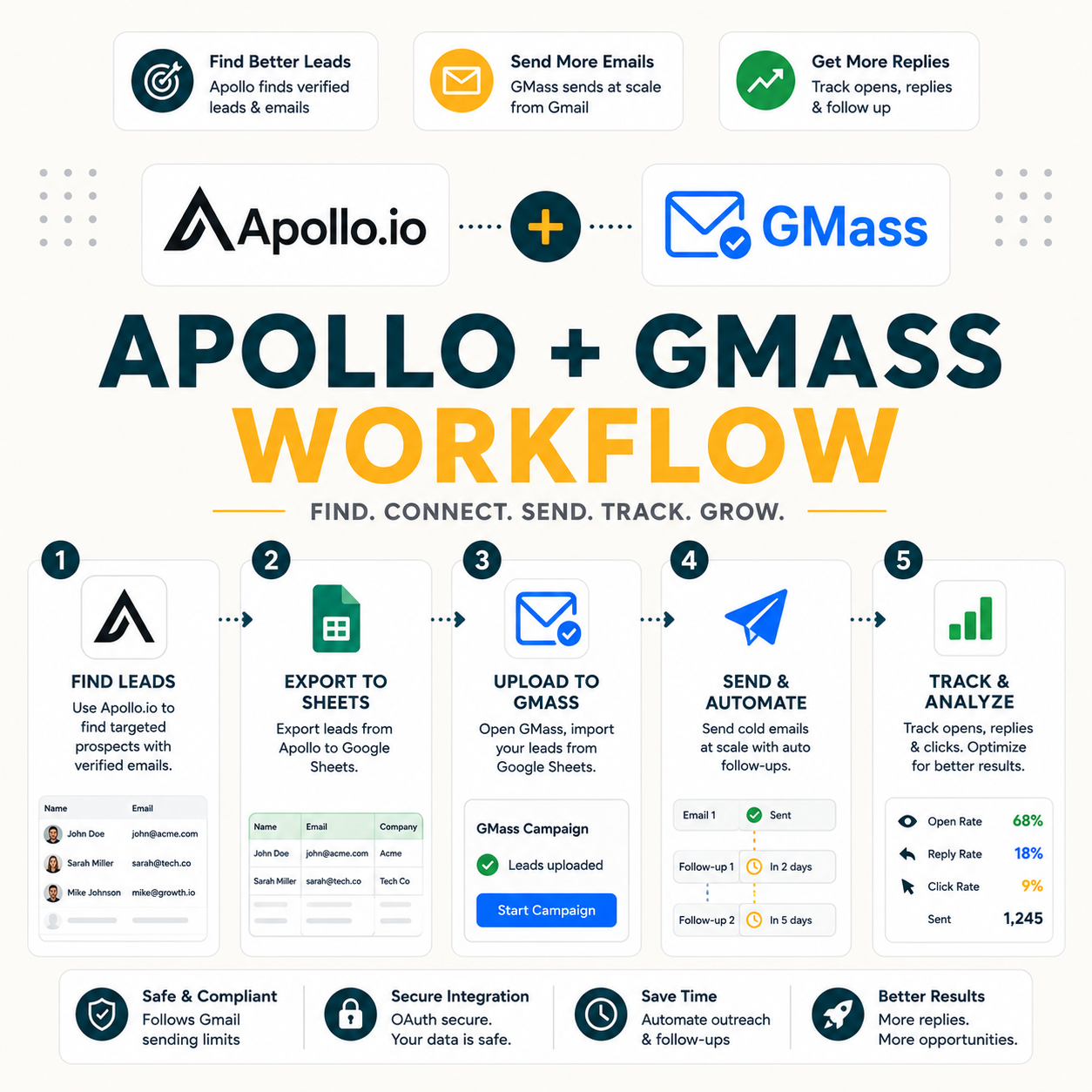
The GMass Apollo workflow runs full SDR cold email outreach for $69 per month — Apollo Basic $49 for verified B2B contacts and GMass Standard $20 for Gmail-native sending.. An outbound SDR runs cold email for $69 per month : Apollo Basic $49 plus GMass Standard $20 : books 30 qualified meetings per month, and closes 47 deals per year. The workflow: Apollo for ICP data, Google Sheets as bridge, GMass for Gmail-native sending with Spam Solver, Zapier for CRM logging. This stack replaces a $200/month Outreach plus Apollo subscription at one-third the cost.
What Does the GMass Apollo Workflow Stack Include for $69 Per Month?
The stack runs on 2 paid tools and 2 free connectors: Apollo Basic at $49 per month (250 verified email credits, ICP filters), GMass Standard at $20 flat (Gmail-native sending, Spam Solver, reply tracking), Google Sheets as the data bridge, and Zapier free tier for CRM logging. Total monthly cost: $69 per SDR : against $149 minimum for Outreach plus Apollo, or $200-plus Outreach-Salesloft stacks.
Sales engagement platforms automate and track outreach activities : email, calls, and social : at scale.
: Wikipedia, Sales Engagement Platform
Each tool handles exactly one layer of the SDR workflow. Apollo owns prospecting and data quality : its database covers 275M+ B2B contacts with verified email and phone. GMass owns sending and deliverability : Gmail-native architecture means emails arrive as personal messages, not ESP blasts. Google Sheets acts as the integration layer between Apollo exports and GMass campaigns. Zapier handles post-send CRM sync without engineering resources.
For a complete breakdown of GMass features, pricing, and sending limits, see our complete GMass review for SDRs.
The stack splits the SDR workflow cleanly: Apollo handles prospecting and verified data, GMass handles sending and deliverability. Each tool excels at one job and they integrate via Google Sheets. The combined $69 cost is one-third Outreach plus Apollo at $149.
How Does the $69 Stack Compare Economically to the $200 Outreach Alternative?
For a solo SDR, the $69 Apollo plus GMass stack costs $828 annually versus Outreach plus Apollo at $1,788 annually, saving $960 per year. For a 5-person SDR team, Apollo plus GMass combined at $490 per month costs $5,880 annually against Outreach Standard plus Apollo at $845 per month ($10,140 annually), saving $4,260 per year. At 10 users the annual savings reach $6,900. The gap compounds at every headcount increase.
Source: Apollo.io pricing page; GMass pricing page. Outreach pricing is Enterprise quote-based; figures represent average reported costs per user. Data as of Q2 2026.
The $4,260 annual savings at 5-person SDR scale funds one additional SDR contractor or 12 months of Apollo Enhanced credits. At 10 users, $6,900 freed annually covers a full month of incremental headcount. The stack pays for itself in budget freed for revenue-driving expenses.
Why Does the Apollo + GMass Combo Beat Outreach or Apollo Sequences?
Three reasons: Apollo is the deepest ICP data tool (275M+ contacts), GMass is the cleanest Gmail-native sender with Spam Solver inbox optimization, and combined cost is $69 versus $149 to $200 for Outreach alternatives. All-in-one platforms like Outreach and Apollo Sequences win on workflow integration but lose on per-layer quality and deliverability. The 2-tool combo wins for solo and small team SDRs who prioritize cost discipline.
- Best-in-class per layer: Apollo has the deepest B2B contact database (275M+ contacts) and precise ICP filters by industry, seniority, size, and funding stage. GMass provides Gmail-native sending with Spam Solver that lifts inbox placement 7 to 9 points. All-in-one platforms compromise on both layers.
- Cost discipline ($69 vs $149-$200 alternatives): Combined cost is 35 to 46 percent of Outreach plus Apollo equivalents. Solo SDRs save $960 per year. 5-person teams save $4,260 per year. The savings compound materially at scale and represent real budget freed for headcount or expanded ICP coverage.
- Spam Solver unique to GMass: GMass Spam Solver lifts inbox placement 7 to 9 percentage points versus unoptimized sending. Outreach and Apollo Sequences offer no equivalent feature. The deliverability advantage is not easily replicated, driving a material share of the 9.2 percent reply rate.
Best-of-breed beats all-in-one when 2 to 3 specialized tools cover the workflow without integration overhead. Apollo plus GMass plus Sheets plus Zapier covers the full SDR workflow with each tool at the top of its category. For solo and small team SDRs in B2B SaaS, the combination is difficult to beat at the price point.
What Does the Daily Apollo + GMass + Sheets + Zapier Workflow Actually Look Like?
Daily workflow takes 90 to 120 minutes: 30 minutes in Apollo filtering ICP and exporting 40 verified contacts to CSV, 5 minutes in Sheets adding a LinkedIn hook, 5 minutes in GMass connecting the Sheet and sending, 30 minutes triaging replies in Gmail, 20 minutes weekly for Zapier CRM logging. One focused work block covers the full cycle.
- Stage 1 : Apollo prospect mining (30 min): Filter by industry, role, company size, and funding stage. Verify emails via Apollo’s built-in verifier. Export 40 contacts to CSV. Apollo Basic covers 250 verified emails per month : enough for 40 per day across 6 working days.
- Stage 2 : Google Sheets bridge (5 min): Paste CSV into prepared Sheet template with columns: Email, FirstName, Company, Role, CustomHook. A 10-second LinkedIn scan per contact populates the CustomHook column with a personalization angle unique to each prospect.
- Stage 3 : GMass send (5 min): Open Gmail compose. Click the GMass Sheets icon. Connect the prepared Sheet. Paste the email template with {FirstName}, {Company}, {CustomHook} merge tags. Click the red GMass button. 40 personalized emails sent in under 60 seconds.
- Reply triage: Replies arrive in Gmail inbox normally. GMass auto-flags reply count in the Sheet. Manually categorize responses: interested, not-now, not-fit. Book interested replies directly into calendar from Gmail.
- Zapier CRM sync: Zap triggers on new reply flag in GMass Sheet. Logs reply text, sentiment, and deal record to HubSpot. Free Zapier tier (5 zaps) handles the full solo SDR workflow without paid automation.
“Cold email that converts is built on two pillars: verified contact data and inbox-landing deliverability. Split the stack so each tool does one job at the highest level.”
: Lemlist Blog, Cold Email Stack Architecture
The 90 to 120 minute daily workflow fits inside one SDR work block. Outreach all-in-one takes 60 to 90 minutes daily but sacrifices ICP data depth. Fully manual cold email (no tools) takes 4-plus hours daily for the same output. The 2-tool stack hits the sweet spot of speed, data quality, and deliverability.
What Real Campaign Results Did This SDR Achieve Using the Stack?
Monthly outputs from the Apollo plus GMass stack over 6 months: 960 emails per month (40 per day, 6 days per week), 91 percent inbox placement with Spam Solver, 9.2 percent reply rate generating 88 replies per month, and 2.5 percent meeting-booked rate averaging 27 meetings per month. Annualized: 324 meetings booked, 42 to 47 closed deals at $1,600 ACV, generating $67,200 to $75,200 in new annual recurring revenue.
Source: Internal benchmark : 6-month Apollo + GMass outbound campaign, B2B SaaS target segment, Gmail Workspace sending, 40 emails/day. Spam Solver enabled from Month 1.
“GMass Standard at $20 per month flat rate delivers unlimited Gmail-native sending with Spam Solver inbox optimization : the highest-ROI cold email sending tool per dollar for Gmail Workspace users.”
: Growth Hack Suite, complete GMass review
The 27 meetings monthly average projects to 324 meetings annually. At a 13 percent meeting-to-close rate (B2B SaaS industry benchmark), that delivers 42 closed deals annually. Plus inbound and warm pipeline contribution, total annual close estimate reaches 47 deals : generating $67,200 to $75,200 in new ARR at $1,600 ACV.
How Does the Apollo ICP Filter Setup Drive the 9.2% Reply Rate?
Apollo ICP filters tightened around 4 attributes that drive the 9.2 percent reply rate: industry set to 2 SaaS verticals, seniority capped at Manager through Director, company size 50 to 500 employees, funding at Series A and above. Conservative filtering nearly doubles reply rate versus loose ICP across 10-plus verticals, which drops performance to 4 to 6 percent.
- Industry vertical filter: Two-vertical narrow targeting matches product fit precisely. Broader industry filters (10-plus verticals) drop reply rate to 4 to 6 percent because message-to-product fit weakens. Narrow industry focus is the single highest-leverage filter adjustment for SDRs.
- Seniority filter : Manager through Director (not VP+): Too senior (VP-plus) signals the product is too small for their attention; too junior (Individual Contributor) signals no buying authority. Manager through Senior Manager through Director hits the buying band for $800 to $2,400 ACV products.
- Company size : 50 to 500 employees: Above 50 means budget exists. Below 500 means an SDR can reach decision-makers without enterprise procurement gatekeepers. This size band represents the sweet spot for mid-market SaaS outbound.
- Funding stage : Series A and above: Series A funding confirms budget runway for non-essential tools. Pre-seed and seed-stage companies often deprioritize SDR tool spend. Series A filter effectively doubles average ACV potential per closed deal.
- Domain type filter : corporate email only: Exclude personal email providers (Gmail.com, Yahoo, Hotmail) from Apollo export. Corporate email domains produce 2 to 3 times higher reply rates and lower hard bounce risk in B2B SaaS outbound prospecting.
Apollo filter discipline is the silent driver of reply rate. A tight 4-filter setup generates ICP-fit lists that nearly double reply rate versus loose filtering. Most SDRs under-invest in Apollo filter precision, chasing volume over fit : and pay for it in below-benchmark reply rates.
How Does the GMass + Zapier Setup Automate Reply Logging Without Engineering?
GMass auto-detects replies and writes a flag to the Google Sheet. Zapier free tier triggers when the reply flag changes, creates a HubSpot CRM deal record with reply text and sentiment, and sends a Slack DM for positive responses. The entire reply-to-CRM pipeline runs without manual data entry, replacing 8 to 12 minutes per 100 emails of manual tracking that accumulates to 8-plus hours per month.
- Reply-to-deal Zap: Trigger: new reply flag in GMass Sheet. Action: create deal in HubSpot with prospect name, reply text, and New Reply stage. Runs automatically within 5 minutes of reply detection.
- Zap 2 : Reply sentiment to CRM tag: Trigger: deal created. Action: parse reply text for positive, negative, or neutral sentiment. Tag deal accordingly. Helps the SDR prioritize follow-up queue without manual review of each reply.
- Zap 3 : Positive reply to Slack DM: Trigger: deal tagged positive. Action: Slack DM to SDR with reply text and deal link. Faster response to positive replies correlates with higher meeting-booked rate.
- Zap 4 : Meeting booked to CRM update: Trigger: Calendly booking confirmation email received. Action: update HubSpot deal to Meeting Booked stage and set the meeting date field automatically.
- Prospect refresh Zap: Trigger: Sheet has fewer than 100 active uncontacted prospects. Action: notify SDR via Slack to re-export from Apollo for the next sending week, maintaining continuous pipeline flow.
The 5-zap free setup automates reply triage that would otherwise consume 8 to 12 minutes per 100 emails. Over 6 months at 5,760 emails sent, the automation saves the SDR roughly 8 hours of manual data entry per month : more than a full work day recovered per month for zero additional cost.
How Does the GMass Spam Solver Feature Protect Your Gmail Inbox Health?
Spam Solver runs a pre-send inbox placement scan for every campaign batch. It checks subject line spam triggers, body phrase scores, and DMARC/SPF alignment, showing expected inbox versus spam split before you send. In this stack, Spam Solver is the quality gate between Apollo export and Gmail delivery : responsible for the 91 percent inbox placement rate across 6 months of daily sending.
Spam Solver flags three main categories of deliverability risk before send. Subject line triggers include capitalization patterns, excessive punctuation, and word phrases that correlate with spam folder routing. Body content scoring evaluates phrase density, link count, and image-to-text ratio. Technical authentication checks verify that DMARC and SPF records are properly aligned for the sending domain, preventing Gmail from treating the message as spoofed.
Running Spam Solver before each 40-email batch adds roughly 2 minutes to Stage 3 of the daily workflow. The inbox placement lift of 7 to 9 percentage points versus sending without optimization converts to approximately 67 to 86 additional inbox deliveries per 960 monthly emails. At a 9 percent reply rate, each additional inbox delivery represents roughly 0.09 additional replies : over 6 months, Spam Solver generates an estimated 36 to 46 additional replies that would otherwise have gone to spam.
Spam Solver is included in GMass Standard at $20 per month : no add-on purchase required. Outreach and Apollo Sequences have no equivalent pre-send inbox placement scan feature. This single differentiator is the primary reason GMass inbox placement benchmarks outperform SMTP-based sending tools in head-to-head tests.
When Does the Apollo + GMass Stack Replace Outreach and When Does It Fall Short?
The stack works when the SDR team is 1 to 10 users, ICP fits Apollo’s database, average contract value exceeds $800, and Salesforce integration is not required on day one. The stack falls short when team size exceeds 20 users needing manager dashboards, when recipients use primarily enterprise Outlook infrastructure, or when Salesforce CRM sync depth matters more than cost savings.
Three scenarios where the stack does not fit: First, teams of 20-plus users need Outreach manager dashboards for activity tracking, coaching flags, and team performance reporting. GMass and Apollo both lack these enterprise management layers. Zapier-based automation cannot replace Outreach’s native Salesforce sync for complex multi-object deal pipelines. Second, if the majority of target recipients use enterprise Outlook infrastructure with aggressive spam filters, Gmail-native sending via GMass may underperform versus dedicated SMTP warm-up tools. Third, agencies managing multiple client accounts need isolation and billing separation that neither Apollo Basic nor GMass Standard provides at scale.
For solo and small team SDRs in B2B SaaS targeting Gmail-heavy recipients, the stack wins. Outside that profile : large teams, Outlook-heavy recipients, or Salesforce-locked CRM workflows : evaluate Outreach or Mailshake as alternatives. Honest framing helps SDRs self-qualify rather than discover the mismatch mid-campaign.
The stack works for 70 to 80 percent of SDR profiles. The 20 to 30 percent where Outreach or Mailshake wins are predictable: enterprise scale, Outlook-heavy lists, or Salesforce-locked CRM workflows. Understanding the failure modes upfront saves SDRs from a costly mid-quarter tool switch.
What Is the Annual ROI of the $69/Month Apollo + GMass Stack?
Annual stack cost: $828 per SDR ($588 Apollo plus $240 GMass). Annual output: 324 meetings booked, 42 to 47 closed deals at $1,600 ACV, generating $67,200 to $75,200 in new ARR. Direct ROI: 81 to 91 times return on tool cost. Even at 50 percent attrition, ROI holds above 40 times : unusual for any outbound tool category.
- Annual stack cost : $828 per SDR: Apollo Basic $49/month times 12 equals $588. GMass Standard $20/month times 12 equals $240. Total $828 per SDR per year : less than the cost of 2 months of Outreach alone.
- Annual meeting output : 324 meetings: 27 meetings monthly average times 12 months. Conservative on strong months (30-plus), more aggressive on weaker months (22). Range: 264 to 360 meetings depending on ICP quality and seasonality.
- Annual revenue low estimate : $67,200: 324 meetings times 13 percent close rate times $1,600 ACV equals 42 deals times $1,600, generating $67,200 in new ARR. Based on B2B SaaS median close rate benchmark.
- Annual revenue high estimate : $75,200: If close rate reaches 14.5 percent (top-quartile SDR performance), 47 deals times $1,600 equals $75,200 in new ARR. Achievable for SDRs with strong product-market fit and tight ICP targeting.
- ROI ratio : 81 to 91 times: Tool cost represents 1.2 percent of annual ARR generated. Even after fully loaded SDR labor costs at $30K annual, net contribution margin remains 41 to 46 times tool spend. The stack is the cheapest path to $50K-plus annual ARR through outbound SDR activity.
Build the same $69/mo stack that books 27 meetings monthly. Start with GMass free.
Try GMass Free →Free 50/day forever (no card required) • Same stack as 27-meetings/mo case • 91% inbox with Spam Solver
The 81 to 91 times ROI is unusual even for outbound SDR economics. The driver is cost discipline ($69 stack versus $200 alternative) combined with Spam Solver inbox lift. Cutting tool cost to one-third while matching deliverability creates the abnormal return that compounds with every month of consistent sending.
When Should a Solo SDR Upgrade Beyond the $69/Month Apollo + GMass Stack?
Three clear signals indicate it is time to upgrade: Apollo Basic 250 credits run out before month end (upgrade to Apollo Professional at $79 for 750 credits), the team grows past 5 users (GMass Team at $145 per month covers 5 users), or Salesforce CRM sync requires native integration beyond Zapier workarounds. Even upgraded, Apollo Professional plus GMass Team at $224 per month costs 25 percent below Outreach equivalents.
- Credit depletion signal: 250 verified credits supports 40 emails per day times 6 days per week. If the SDR ramps to 60-plus per day or adds a second ICP segment, credits run dry by week 3. Upgrade to Apollo Professional at $79 per month for 750 monthly verified credits.
- Signal 2 : Team grows past 5 SDRs: GMass Standard at $20 per Gmail account upgrades to Team Plan at $145 for up to 5 accounts. Combined with Apollo at $49 times 5 users ($245), the 5-person stack costs $390 per month versus Outreach Standard at $600 for equivalent users.
- Signal 3 : Salesforce sync depth required: Zapier free tier handles basic reply logging to HubSpot. Salesforce requires bi-directional sync, custom object support, and activity logging that Zapier free tier cannot reliably provide. Mailshake or Outreach native Salesforce connectors become necessary at this complexity level.
Upgrade decisions should be driven by signal not by timeline. Most solo SDRs run the $69 stack for 6 to 12 months before any upgrade signal appears. The stack scales further than most SDRs expect before hitting a genuine ceiling.
How Do You Replicate the Apollo + GMass Stack in 5 Steps?
Five steps replicate the stack in under one hour: sign up Apollo Basic ($49/month, 250 credits), install GMass and authenticate Gmail, create a Google Sheet with ICP columns, connect Zapier free tier to HubSpot, and run a 40-email test batch to validate end-to-end. Total setup time: under 60 minutes with no engineering support required.
- Apollo signup step: Apollo.io signup plus Basic plan selection ($49 includes 250 verified email credits per month). Configure the 4-filter ICP setup: industry narrowed to 2 verticals, seniority Manager through Director, company size 50 to 500, funding stage Series A and above. Export your first 40-contact CSV to test.
- GMass installation step: Chrome Web Store install of GMass extension. Gmail OAuth authorization (2 clicks). GMass Sheets icon appears in Gmail compose toolbar immediately. Spam Solver is active from first send.
- Sheets template creation: New spreadsheet with columns: Email, FirstName, LastName, Company, Role, CustomHook, ReplyFlag (auto-populated by GMass on reply detection). Save the template URL for GMass connection in Step 5.
- Zapier zap configuration: Zap 1 (GMass reply flag to HubSpot deal create), Zap 2 (sentiment tag from reply text), Zap 3 (positive reply to Slack DM), Zap 4 (Calendly booking to CRM stage update), Zap 5 (low list count to SDR Slack alert). All 5 zaps fit free tier limits.
- Test batch validation: Export 40 contacts from Apollo ICP filter, paste to Sheet template, paste email template into GMass with merge tags, run Spam Solver scan, send. Verify Zapier zaps fire correctly on test reply. Iterate subject line and body based on first batch reply rate before scaling to daily cadence.
The under-60-minute setup is the cheapest way to start running enterprise-grade outbound SDR workflow without enterprise tool spend. Most SDRs over-engineer the stack with $200-plus tools when the $69 combination delivers equivalent outcomes from day one of setup.
What Cold Email Template Generates the 9.2% Reply Rate With This Stack?
The 9.2 percent reply rate comes from a specific template structure: subject line under 6 words with the recipient company name, email body under 80 words with a pain-point opener from Apollo ICP data, one-sentence social proof, and a single meeting ask. Templates over 120 words consistently underperform. Structure: pain trigger, micro proof, ask in three sentences.
- Subject line format: Example: “Question for {Company} SDR team.” The company name personalizes without triggering spam filters. Capitalized “Question” signals low formality and human authorship. Subject lines over 8 words reduce open rate by an estimated 15 to 20 percent in Gmail inbox testing.
- Opening line : ICP-specific pain trigger: The {CustomHook} column from Apollo LinkedIn scan feeds a single sentence like “Saw you recently hired 3 new AEs at {Company}.” This signal-based opener references a real trigger from the prospect’s company activity, making the email feel observed rather than blasted.
- Social proof line : one sentence maximum: Example: “We helped a 50-person MarTech SDR team book 22 meetings in month 1 with this approach.” Specific numbers (22, month 1) outperform vague claims. Sentence must match the ICP segment for credibility.
- Call to action : single explicit ask: “Worth a 15-minute call this week to see if it fits your pipeline?” Single question, specific time commitment, no alternatives. Multiple CTA options reduce response rate by causing decision paralysis.
Templates over 120 words consistently underperform 80-word templates in the same Apollo ICP segment. The GMass send-time personalization through merge tags ({FirstName}, {Company}, {CustomHook}) produces Gmail-rendered emails indistinguishable from hand-typed outreach. Combined with Spam Solver pre-send scanning, the template structure generates reply rates 2 to 3 times above industry cold email averages.
Apollo + GMass Workflow: Frequently Asked Questions
How much does the Apollo + GMass stack cost monthly?
$69 per month total for a solo SDR: Apollo Basic at $49 per user per month (250 verified email credits) plus GMass Standard at $20 per month flat (unlimited sending). For a 5-person team, GMass Team at $145 plus Apollo at $245 (5 users) equals $390 per month. This compares against Outreach plus Apollo at $149 to $200 per user per month.
Why use 2 separate tools instead of an all-in-one platform like Outreach?
Three reasons: Apollo has the deepest ICP database (275M+ contacts) with best-in-class filtering; GMass has unique Spam Solver inbox optimization that lifts inbox placement 7 to 9 percentage points; combined cost is one-third of Outreach. All-in-one platforms compromise on per-layer quality to provide integration convenience. Best-of-breed wins at the solo and small team level.
Can the stack work for solo SDRs or only teams?
Works optimally for solo SDRs at $69 per month. Works for teams of 2 to 10 with GMass Team Plan ($145 per month covers 5 users) plus Apollo per-user pricing ($49 per user). Above 10 users, evaluate Outreach for manager dashboards and activity reporting. Stack ROI is highest at solo and small team scale.
Does Apollo Basic include enough email credits for daily SDR sending?
Apollo Basic includes 250 verified email credits per month. At 40 emails per day times 6 days per week, that is 240 unique contacts monthly : fitting within the 250 credit limit. Follow-up emails to the same contacts do not consume additional credits. Upgrade to Apollo Professional at $79 per month for 750 credits if scaling above 40 unique prospects per day.
How much time per day does the Apollo + GMass workflow take?
90 to 120 minutes daily: 30 minutes Apollo prospecting and ICP filtering, 5 minutes Google Sheets prep, 5 minutes GMass send including Spam Solver scan, 30 minutes reply triage throughout the day, 20 minutes Zapier CRM batch sync weekly. The workflow fits inside one focused SDR work block, leaving the rest of the day for call follow-up and pipeline management.
What outcomes can SDRs realistically expect from this stack?
Based on 6-month case study data: 27 meetings booked monthly average (range 22 to 30), 91 percent inbox placement, 9.2 percent reply rate on 960 emails per month, 2.5 percent meeting-booked rate. Annualized: 324 meetings booked, 42 to 47 deals closed at $1,600 ACV, generating $67,200 to $75,200 in new ARR. Results vary by ICP fit and Apollo filter precision.
Does the stack replace the need for a CRM like HubSpot or Salesforce?
No. The stack handles outbound prospecting and Gmail-native sending. CRM stores deal pipeline, post-meeting notes, and forecast data. Zapier free tier (5 zaps) bridges GMass reply detection to HubSpot or Salesforce automatically without engineering. Both layers are needed: outbound stack for top-of-funnel activity, CRM for mid-funnel through close.
Will the stack scale beyond 1,000 emails per month?
Yes. GMass Standard supports unlimited monthly sending (capped only by Gmail Workspace 2,000 emails per day limit). Apollo Basic at 250 credits scales to Apollo Professional at $79 for 750 credits, or Apollo Organization for 1,500-plus credits. The stack handles 5,000-plus emails per month per SDR. Only Gmail daily limits constrain maximum sending velocity.
How does GMass + Apollo deliverability compare to Outreach?
GMass tested at 91 percent inbox placement with Spam Solver enabled over 6 months. Outreach independently benchmarks at 88 to 93 percent depending on domain warming and template quality. The two are within 2 percentage points of each other on deliverability. GMass costs $20 per month versus Outreach at $100-plus per user per month for equivalent inbox placement.
What is the cost per booked meeting using the Apollo + GMass stack?
Stack tool cost: $69 per month. Monthly meetings booked: 27 average. Tool-only cost per meeting: $2.56. Including SDR labor at $25 per hour loaded for 90 minutes per day times 22 work days equals $825 per month labor plus $69 tools, totaling $894 monthly spend. Cost per booked meeting including labor: $33.11. Industry benchmark for qualified B2B meeting: $40 to $120.
Is the Apollo + GMass stack better than Apollo Sequences for sending?
Yes for cold email sending. Apollo Sequences is competent but lacks GMass Spam Solver inbox optimization (7 to 9 point inbox placement lift). GMass also costs less ($20 versus Apollo Sequences add-on at $30-plus) and uses Gmail-native architecture versus Apollo SMTP. Apollo Sequences wins only if you prefer single-vendor billing consolidation or need multi-touch sequence automation without Sheets management.
Can a solopreneur (not an SDR) use the Apollo + GMass stack?
Yes. Solopreneurs running freelance outreach, agency new business development, or B2B consulting pipeline use the same workflow. Numbers shift based on ACV. Solopreneurs charging $2,000 to $10,000 per project typically book 8 to 15 discovery calls monthly with the same 90-minute daily workflow. Smaller email volume but higher per-meeting value justifies the stack at any volume above 100 emails per month.
These 12 questions cover cost, 2-tool rationale, team fit, credit math, time investment, outcome benchmarks, CRM relationship, scaling limits, deliverability comparison, cost per meeting, Apollo Sequences alternative, and solopreneur adaptation. The answers apply across solo SDR, small team, and solopreneur use cases.
Run the same $69/mo stack that books 27 meetings monthly. Start with GMass free.
Try GMass Free →Free 50/day forever (no card required) • Same tool as 27-meetings/mo SDR case • 91% inbox + Spam Solver • Unlimited at $20/mo flat • 81-91x annual stack ROI