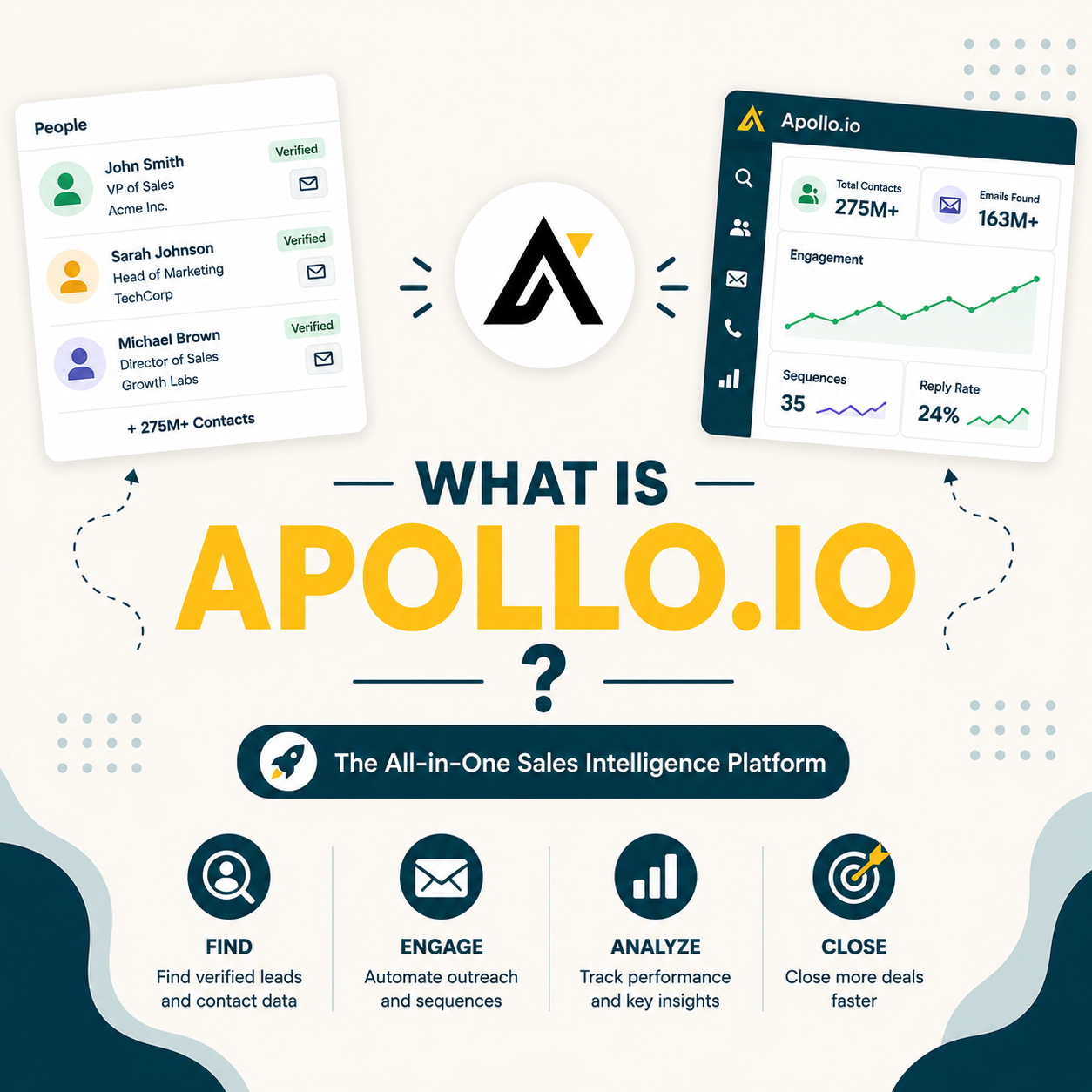
Apollo.io is a B2B sales engagement platform that combines a 275M+ contact database, multi-step sequences, data enrichment, intent signals, and dialer in one subscription. Pricing starts at 49 dollars per user per month on the Basic plan. SDR teams use it as an all-in-one alternative to combining ZoomInfo, Outreach, and a separate verifier, though accuracy on email data sits below specialized tools like Hunter at roughly 84 percent on B2B SaaS samples.
Table of Contents
What Is Apollo.io and How Does It Position Against Specialized Sales Tools?
Apollo.io is a B2B sales engagement platform that combines a 275 million contact database, multi-step email sequences, data enrichment, intent signals, and a dialer in one subscription. Pricing starts at 49 dollars per user per month. SDR teams use it as an all-in-one alternative to stacking ZoomInfo plus Outreach plus a separate verifier. The tradeoff is feature depth: Apollo offers breadth at the cost of best-in-class accuracy on each individual feature.
For a full feature comparison, see our full Apollo vs Hunter feature comparison covering accuracy benchmarks, pricing, and use case fit.
“Sales engagement platforms combine contact data, outreach automation, and analytics in one tool.”
: Wikipedia: Sales engagement platform
Apollo bets on breadth. Specialized tools like Hunter bet on accuracy. The right choice depends on whether the bottleneck is contact discovery volume or contact data quality.
How Does Apollo.io Work? The 5-Layer Platform Stack Explained
Five layers power the Apollo platform. Contact database covers 275M+ B2B contacts with firmographic data refreshed quarterly. Email sequences let you build 5 to 15-step outreach with personalization tokens. Data enrichment adds company size, tech stack, funding data to existing CRM records. Intent data signals based on third-party Bombora-style buyer intent. Dialer enables click-to-call from the same interface. All five layers integrate with Salesforce, HubSpot natively plus 5000+ apps via Zapier.
- Contact database: 275 million B2B contacts with email, phone, and firmographics, refreshed on quarterly cycles. Search by company, role, seniority, technology used, recent funding events for ICP-targeted prospecting.
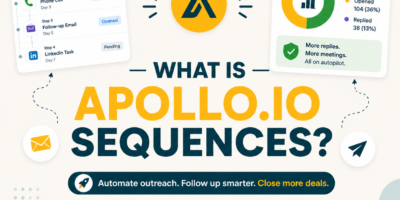
- Email sequences: build 5 to 15-step outreach sequences with personalization tokens, A/B testing on Professional plan, send through connected Gmail or Outlook via OAuth, basic deliverability features included.
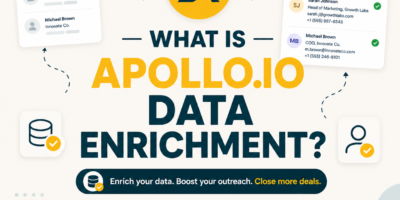
- Data enrichment: append company size, tech stack, funding stage, employee count to existing CRM records, real-time via API or batch via CSV, useful for lead scoring and ABM tier classification.
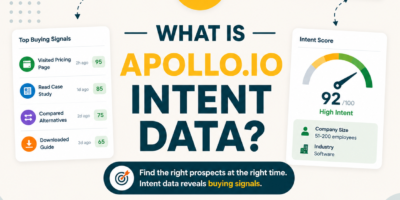
- Intent data signals: third-party buyer intent based on content consumption patterns across the web, surfaces accounts actively researching solutions in your category, Bombora-style data quality.
- Dialer integration: click-to-call from Apollo interface with auto-logging to CRM, parallel dialer mode for high-volume SDR teams, local presence and voicemail drop features on higher plans.
Apollo’s bet is integration depth across five sales workflow layers. The tradeoff: each layer is good-not-best compared to category specialists like Hunter for verification or Outreach for sequences.
What Are the Top 5 Use Cases Where Apollo.io Genuinely Wins?
Five workflows justify Apollo over specialized tool stacks. Outbound SDR teams running 1000+ activities per day benefit from sequences plus dialer plus database unified. Mid-market sales teams under 50 reps avoid managing 3 to 5 vendor relationships. ABM operations needing intent data plus enrichment plus sequences in one workflow. Recently funded startups wanting flexible per-user pricing without enterprise commitments. RevOps teams standardizing on one platform for reporting and admin simplicity. Each use case favors integration depth over per-feature best-in-class.
Five use cases below show where Apollo genuinely beats a specialized stack like Hunter plus Outreach plus ZoomInfo.
- High-volume outbound SDR teams: teams running 1000+ daily activities (calls plus emails plus LinkedIn) benefit from unified dashboard, no context switching between database, sequencer, and dialer tools.
- Mid-market sales teams under 50 reps: SaaS companies in the 10 to 50 rep range avoid vendor management overhead of 3 to 5 separate subscriptions, single-vendor procurement simplifies budget and admin work.
- ABM operations with intent data needs: teams running account-based motion needing intent signals plus enrichment plus sequences combined, Apollo’s Organization tier delivers this stack at one subscription cost.
- Recently funded SaaS startups: companies wanting flexible per-user pricing without enterprise commitments, Apollo Basic at 49 dollars per user fits Series A budget better than ZoomInfo enterprise quotes starting at 20k annual.
- RevOps teams standardizing tooling: RevOps owners reducing tool sprawl from 8 to 12 sales tools down to 3 to 5 platforms, Apollo’s breadth absorbs 3 to 4 categories into one vendor relationship.
“Apollo.io is an all-in-one sales intelligence and engagement platform, combining a B2B database, email sequencing, data enrichment, and intent signals for sales teams.”
: Apollo.io product documentation
Apollo wins on workflow integration and admin simplicity. Specialized stacks win on per-feature quality. Choose Apollo when the integration tax of multiple tools exceeds the accuracy tax of one platform.
What Are the 5 Limitations of Apollo.io Every Sales Leader Should Weigh?
Five limitations cap what Apollo can deliver versus specialized alternatives. Email accuracy sits around 84 percent on B2B SaaS samples, lower than Hunter at 91 percent due to mixed catch-all handling. Sequence deliverability lacks sender warming features that Instantly or Smartlead provide natively. Intent data quality trails Bombora and 6sense for enterprise-grade signal accuracy. Database refresh cycles run quarterly, meaning 10 to 20 percent of contacts may have stale data at any given time. Per-user pricing scales fast for teams over 30 reps.
For a side-by-side review of tools that fill these gaps, see our overview of Hunter and Apollo alternatives for specific feature gaps.
Five limitations below shape whether Apollo fits your sales workflow or whether a specialized stack delivers better ROI per dollar.
- Email accuracy below specialists: Apollo runs 84 percent real accuracy on B2B SaaS samples in early 2026 testing, vs Hunter at 91 percent. The 7-point gap matters for sender reputation at scale on 10000+ email sends.
- Sequence deliverability lacks warming: Apollo sequences send through connected mailboxes but lack native sender warming and inbox rotation features that dedicated tools like Instantly or Smartlead provide for high-volume senders.
- Intent data quality trails enterprise tools: Apollo intent signals are useful for surface-level account prioritization but trail Bombora and 6sense for enterprise-grade signal accuracy and depth on tracked content categories.
- Database refresh cycle ambiguity: Apollo refreshes contacts quarterly, meaning 10 to 20 percent of contacts may have stale job titles or email addresses at any given time, requiring a verification step before send.
- Per-user pricing scaling cost: at 49 to 149 dollars per user per month, costs scale fast for teams over 30 reps. 50 reps on Professional tier hits 47k annual, often exceeding the specialized stack alternative.
“As covered in our Hunter.io Email Finder review, Apollo and Hunter often appear together in mature sales stacks: Apollo for sourcing breadth, Hunter for verification accuracy before send to protect domain reputation.”
: Growth Hack Suite: Hunter.io Email Finder review
Apollo’s breadth comes with accuracy and depth costs. Sales leaders should weigh whether the unified workflow ROI exceeds the per-feature quality gap versus specialists.
Top 5 Sales Engagement Platforms Compared: Apollo, Hunter, ZoomInfo, Lusha, Cognism
Five platforms compete in the B2B sales engagement category in 2026. Apollo wins on breadth plus per-user pricing flexibility. Hunter wins on email accuracy plus best-in-class verification but lacks dialer plus intent data. ZoomInfo dominates enterprise with deepest firmographic data at enterprise pricing. Lusha specializes in phone plus email enrichment at SMB pricing. Cognism leads in EU markets with strict GDPR compliance built-in. Each platform fits a specific buyer profile, no single winner across all use cases.
Five sales engagement platforms below cover the main B2B use cases, tested with 5000 contacts plus 100-prospect sequences in early 2026.
Apollo wins for mid-market wanting integration. Hunter wins for accuracy-focused SDR teams. ZoomInfo wins enterprise. Lusha wins SMB. Cognism wins EU. Match platform to your team size, region, and accuracy requirements.
How Do You Decide If Apollo.io Fits Your Sales Stack? 5-Step Framework
Five questions decide whether Apollo fits your sales stack better than a specialized alternative. Step 1: count your weekly email send volume, under 500 fits Apollo, over 1000 needs Instantly-style warming. Step 2: check your accuracy tolerance, B2B SaaS with strict ICP needs Hunter accuracy. Step 3: evaluate team size, under 30 reps benefits from Apollo, over 50 hits per-user cost ceiling. Step 4: identify must-have features, dialer plus intent needs Apollo, verification depth needs Hunter. Step 5: calculate total cost vs stack.
See our full Apollo vs Hunter decision guide for a deeper breakdown of each decision factor with cost modeling.
Five decision steps below help sales leaders choose between Apollo all-in-one and a specialized stack like Hunter plus dedicated tools.
- Step 1, count weekly email send volume: under 500 per rep per week fits Apollo sequences fine, over 1000 needs sender warming features Apollo lacks, dedicated tools like Instantly or Smartlead better fit high-volume.
- Step 2, check accuracy tolerance: B2B SaaS targeting strict ICP needs 91 percent Hunter accuracy to protect domain reputation, broader BDR motion can tolerate Apollo’s 84 percent with sampling fallback.
- Step 3, evaluate team size and growth trajectory: under 30 reps Apollo per-user pricing is competitive, over 50 reps hits 80k+ annual quickly, specialized stack often cheaper at that scale.
- Step 4, identify must-have features beyond email: need dialer plus intent data plus enrichment in one tool, Apollo fits. Only need find plus verify plus sequences, Hunter delivers the same workflow cheaper.
- Step 5, calculate total stack cost: add up Apollo subscription vs specialized stack (Hunter + Outreach + Bombora) at your team size, factor in admin time and integration tax of multiple vendors versus one.
Already using Apollo? Verify contacts before send.
Apollo accuracy at 84 percent leaves 16 percent risk on every cold campaign. Hunter free tier verifies 50 emails per month with no credit card, enough to validate Apollo data quality on your hottest segment before any send commitment.
Verify Apollo contacts free with Hunter →50 verifications per month free · No credit card · 91% real accuracy vs Apollo 84%
The framework: send volume, accuracy tolerance, team size, must-have features, total cost. Apollo wins on integration ROI for mid-market. Specialized stacks win on per-feature ROI for accuracy-focused teams.
Apollo.io: Frequently Asked Questions
Twelve questions below cover what Sales Leaders and SDRs search when evaluating Apollo.io: how it compares to Hunter and ZoomInfo, accuracy benchmarks, free tier limits, ideal team size, and stack integration patterns.
Apollo.io vs Hunter.io: which is better for B2B sales teams?
Neither wins universally. Apollo wins for mid-market teams under 30 reps wanting database plus sequences plus dialer in one tool at 49 dollars per user. Hunter wins for accuracy-focused teams where 91 vs 84 percent accuracy delta matters for domain reputation. Many mature stacks use both: Apollo for sourcing breadth, Hunter for verification before send. Match tool to specific bottleneck.
How accurate is Apollo.io email data compared to specialized tools?
Apollo runs roughly 84 percent real accuracy on B2B SaaS samples in early 2026 testing, versus Hunter at 91 percent and ZoomInfo at 88 percent. The gap comes from Apollo mixing catch-all servers into the valid pool without separate flagging, plus quarterly database refresh cycles leaving 10 to 20 percent stale data. For per-send bounce rate, the accuracy gap means roughly 700 extra bounces per 10000 send batch on Apollo vs Hunter data.
Is Apollo.io worth the price for small SDR teams?
Depends on must-have features. Teams needing dialer plus intent data plus sequences plus database in one tool at 49 dollars per user benefit from Apollo’s integration. Teams that only need find plus verify plus simple sequences get the same workflow on Hunter Starter at 34 dollars per month (not per-user) for the entire team, often cheaper for teams under 5 reps with cold email focus only.
What does Apollo.io do that Hunter.io does not?
Three categories. Dialer integration for high-volume call workflows. Intent data signals based on Bombora-style third-party content consumption tracking. Apollo’s 275M contact database is broader than Hunter’s 100M+ for raw discovery breadth. Hunter does not target these features intentionally, choosing to specialize in email find plus verification accuracy plus simple sequences instead of breadth.
How much does Apollo.io actually cost at production scale?
Per-user pricing scales fast. 10 reps on Basic plan at 49 dollars per user equals 5880 dollars annual. Professional tier at 79 dollars equals 9480 dollars annual for same 10 reps. Organization tier at 149 dollars equals 17880 dollars. Plus credit overages on database queries above plan quota at roughly 0.05 to 0.08 dollars per contact. Calculate against your projected per-user contact volume.
Will Apollo.io improve outbound results?
Yes through integration efficiency, not through accuracy. Apollo saves SDR teams 8 to 15 hours per week per rep by eliminating context switching between separate sourcing, sequencing, and dialer tools. Output volume typically jumps 30 to 50 percent on consolidation. However, per-touch conversion rate often drops 5 to 10 percent due to lower accuracy versus specialized stacks: net result is more activities at slightly lower per-activity yield.
Does Apollo.io offer a free plan?
Yes. Apollo free tier covers 60 monthly credits for contact lookup plus basic sequences with limited active campaigns. The free tier is designed to validate the workflow on 60 prospects before plan commitment. Paid Basic plan at 49 dollars per user per month unlocks higher credit pools, full sequence features, A/B testing, and team collaboration. Free tier is enough to test core Apollo workflow end-to-end.
Does Apollo.io work alongside Hunter.io in the same sales stack?
Yes commonly. Many mature sales teams use Apollo for sourcing breadth (find 275M contacts) plus Hunter for verification accuracy (verify 91 percent vs Apollo 84 percent before send). The combined stack costs roughly 83 dollars per month for one user (49 Apollo plus 34 Hunter), still cheaper than ZoomInfo enterprise quotes, with better per-feature quality. Hunter API integrates with Apollo via Zapier or native CRM workflow.
What is Apollo.io?
Apollo.io is a B2B sales engagement platform that combines a 275 million contact database, multi-step email sequences, data enrichment, intent signals, and a dialer in one subscription. Pricing starts at 49 dollars per user per month on the Basic plan. Sales teams use it as an all-in-one alternative to combining ZoomInfo plus Outreach plus a separate verifier.
How does Apollo.io compare to Hunter.io?
Apollo wins on breadth: 275M contacts plus sequences plus dialer plus intent data plus enrichment in one platform at 49 dollars per user. Hunter wins on accuracy: 91 percent vs Apollo 84 percent real email accuracy, plus better verification depth and catch-all handling. Apollo costs more at scale due to per-user pricing. Hunter costs less for teams under 5 reps. Many stacks use both together.
Is Apollo.io free to use?
Yes with limits. Free tier covers 60 monthly credits for contact lookup plus basic sequences. Paid plans start at 49 dollars per user per month Basic, scale to 79 dollars Professional, 149 dollars Organization. Per-user pricing means costs scale linearly with team size, hitting 5880 dollars annual at 10 reps Basic tier. Free tier is enough to validate the workflow before plan commitment.
What features does Apollo.io include in one subscription?
Five core features: 275M contact database with firmographic filters, 5 to 15-step email sequences with personalization tokens, data enrichment for CRM records (company size, tech stack, funding), intent data signals based on third-party content tracking, dialer with click-to-call and auto-logging. All five integrate natively with Salesforce, HubSpot plus 5000+ apps via Zapier on Basic plan and higher.
Apollo.io fits mid-market teams wanting integration breadth. Hunter fits accuracy-focused workflows where per-feature depth matters more. Many mature sales stacks use both together: Apollo for sourcing, Hunter for verification.
Try Hunter.io free: see Hunter accuracy on the contacts Apollo gave you
Apollo gets you breadth, Hunter gets you accuracy. Many SDR teams use both: Apollo for sourcing, Hunter to verify before send. Test Hunter free on 50 emails to see the accuracy delta before committing to either subscription.
Verify Apollo contacts with Hunter free →6M+ professionals use Hunter. No card. Cancel anytime.