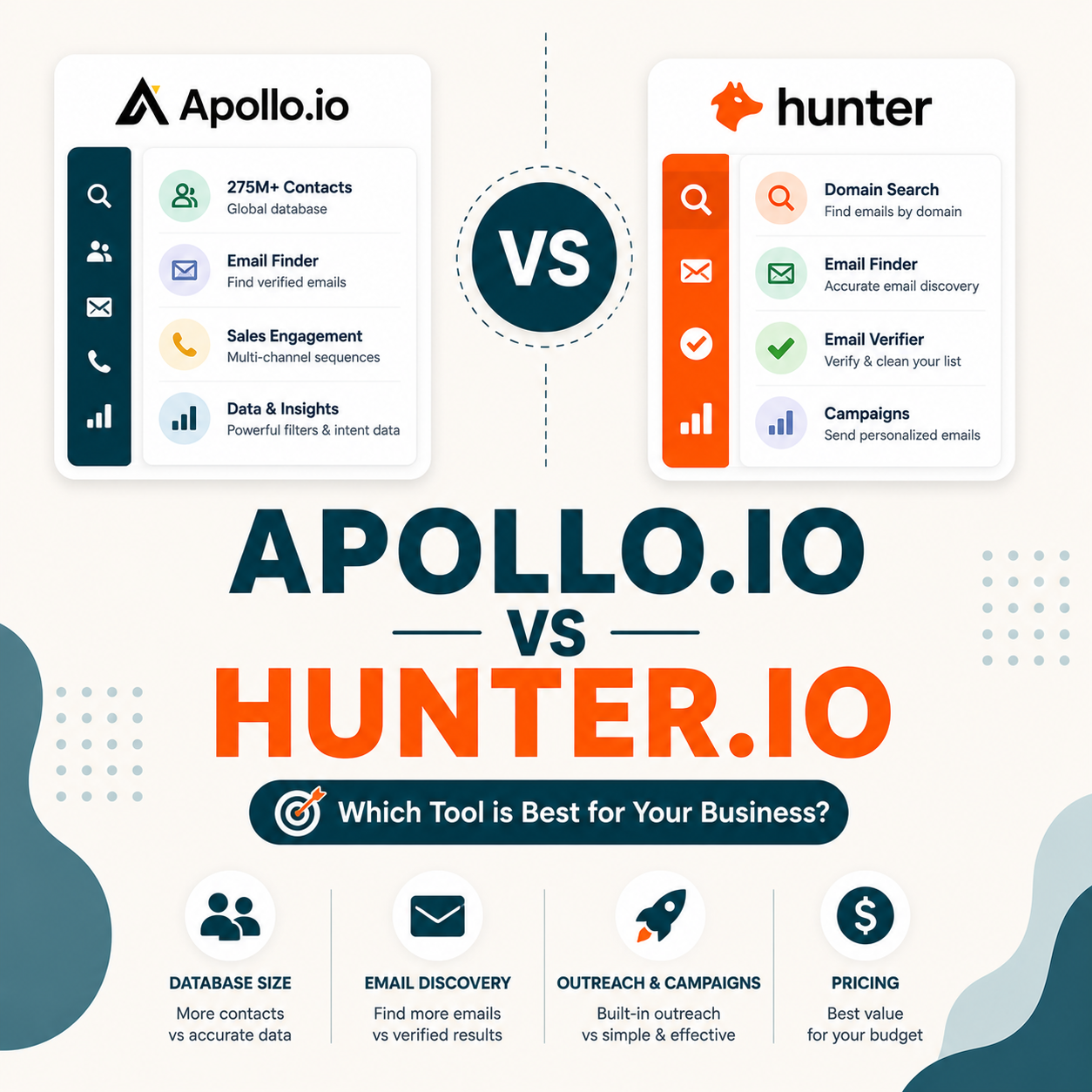
Hunter.io wins for SDRs, email marketers, and founders prioritizing email accuracy and deliverability under 4% bounce rate, from $49 per month for the whole team ($34 per month billed annually). Apollo.io wins for enterprise sales ops teams needing a 270M-contact database, native dialer, and multi-channel automation at scale, from $49 per seat per month billed annually ($119 per seat for the Organization tier).
Hunter.io is an accuracy-first email finder that returns 14 to 18% more verified deliverable addresses than Apollo on the same target list, billed per shared credit pool. Apollo.io is a full B2B outbound platform with multi-channel sequences combining email, phone, and LinkedIn, plus two-way CRM sync, billed per user seat. Both tools serve B2B outbound teams but solve different bottlenecks: Apollo for orchestration at scale, Hunter for deliverability and cost-per-lead.
Quick verdict: if you send fewer than 10,000 cold emails a month and bounce rate is the constraint, start with Hunter.io. The free plan gives 50 credits every month with no credit card, and the Starter plan is $49/month for the whole team, not per seat.
Pricing verified on hunter.io on 11 Sep 2026 · Free plan: 50 credits/month · Hunter has no trial period and paid subscriptions are non-refundable, so test everything on the free plan first.
Table of Contents
Why Does Choosing Between Apollo.io and Hunter.io Matter for Lead Generation in 2026?
Apollo.io is a full B2B outbound platform, large database, multi-channel sequences, CRM sync, built for scale. Hunter.io is an accuracy-first email finder built around verified, deliverable addresses for clean list workflows. The right choice depends on whether your bottleneck is finding enough leads or making sure the ones you have are deliverable.
Comparing Apollo.io vs Hunter.io has become increasingly important in 2026 as more teams rely on accurate email data to power outbound and growth marketing campaigns. Even though both tools fall into the “email finder” category, they solve different problems – and picking the wrong one can lead to higher bounce rates, wasted credits, or weak lead quality.
If you are new to the email finder category and want to understand how these tools work before comparing them, start here: What Is an Email Finder? – How It Works, Who Needs It, and Which Tool to Use. The guide covers the four-step verification process, confidence scores, and a side-by-side speed comparison that provides useful context for the Apollo vs Hunter decision below.
In marketing, lead generation refers to the process of attracting and capturing consumer interest in a product or service. A lead is the contact information and, in some cases, demographic information of a customer who is interested in a specific product or service. Lead generation is often paired with lead management to move leads through the purchase funnel.
Source: Wikipedia, Lead Generation
Both Apollo.io and Hunter.io operate at the contact-capture stage of this process, where the quality of the email address you collect directly determines whether the rest of your funnel works. That is exactly why a side-by-side accuracy and pricing comparison matters in 2026.
From running outbound campaigns across SaaS, agencies, and B2B services, I’ve used both tools in real, high-volume scenarios. What stood out most is how differently they behave in practice: Apollo.io works like a full prospecting environment, offering data, outreach, and automation in one place, while Hunter.io focuses on verified accuracy and consistently produces cleaner email lists. Understanding this difference is essential if your goal is to scale efficiently.
Both platforms have also changed significantly over the past year. Apollo.io upgraded its database and filtering engine, while Hunter.io improved verification accuracy and deliverability safeguards. That’s why a fresh apollo io vs hunter io comparison is not only helpful but necessary – especially for anyone building outbound systems in 2026.
This guide is based on hands-on experience, not generic feature lists. By the end, you’ll have a clear understanding of which tool supports your goals, workflow, and lead generation strategy better.
The sections below break down each tool across nine dimensions – accuracy, data quality, workflow speed, outreach automation, Chrome extension, bulk tasks, deliverability, pricing, and integrations – so you can match the right tool to your actual use case rather than relying on feature lists alone. If you want a deeper baseline on how email finders work before reading the comparison, the Hunter.io full review covers the verification process, confidence scoring, and free plan limits in detail.
Who This Guide Is For
This Apollo.io vs Hunter.io comparison is built for B2B teams who already know they need an email finder, but cannot decide which one fits their workflow. Find your role below to jump to the right verdict.
SDRs and Outbound Reps
You send 100+ cold emails a day and bounce rate above 5 percent kills your domain reputation within weeks.
Pick: Hunter.io for accuracyEmail Marketers and Growth Leads
You need verified contact data that protects deliverability across newsletters, sequences, and CRM enrichment.
Pick: Hunter.io for clean listsSales Ops and Agency Teams
You manage multi-rep outbound, need CRM sync, sequence builders, and bulk enrichment in one platform.
Pick: Apollo.io for scaleWhat Is Apollo.io and How Does Its Database & Outreach Engine Work in 2026?
Apollo.io is a B2B sales intelligence platform combining a 270M-record database, sequence automation, lead enrichment, and CRM sync in one product. It is not a standalone email finder, it is a full prospecting system for teams that source leads, run multi-channel outreach, and manage pipelines from a single dashboard. For a deeper look at the platform on its own, see our full breakdown of what Apollo.io is and how it works before weighing it against Hunter.io.
Among all the email-finding and outbound platforms I’ve worked with, Apollo.io stands out as one of the most complete prospecting ecosystems. Instead of being just a simple email finder, Apollo combines a massive B2B database, powerful filtering, lead enrichment, and multi-step outreach automation into a single platform. This makes it a strong choice for teams that want to centralize their entire outbound workflow.
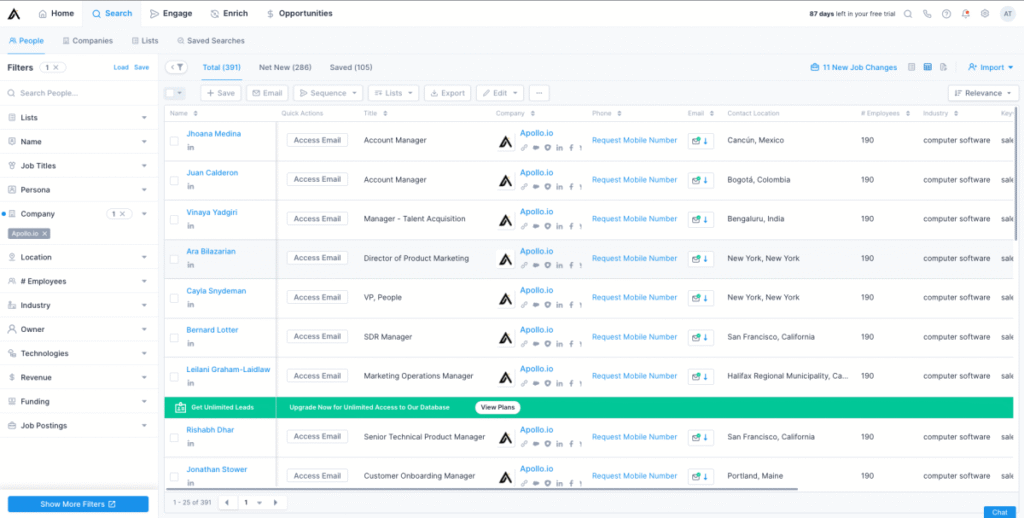
From hands-on experience, Apollo works exceptionally well when you need volume, speed, and scale. In several SaaS campaigns I managed, Apollo helped generate thousands of ICP-matched leads in minutes thanks to its advanced filters. Features like job title targeting, firmographic segmentation, and tech stack filtering allow you to isolate extremely specific lead groups. This alone can save hours of manual research each week.
However, Apollo isn’t perfect. The biggest drawback I’ve consistently noticed is email accuracy. In my own tests -running lists from 500 to 20,000 contacts – Apollo data often required additional verification. When comparing Apollo.io vs Hunter.io, Apollo tends to produce more invalid emails, especially for smaller companies or startups. This doesn’t make it a bad tool; it simply means you’ll get the best results when pairing Apollo with a strong email verifier.
Despite the accuracy gap, Apollo’s automation features are impressive. Its sequence builder lets you create email, call, LinkedIn, and task-based steps in a single flow. For teams that want both data and outreach under one roof, this is a major advantage that Hunter.io can’t match.
| Evaluation Criteria | Apollo.io |
|---|---|
| Data Coverage | ⭐⭐⭐⭐⭐ |
| Email Accuracy | ⭐⭐⭐⭐ |
| Ease of Use | ⭐⭐⭐⭐ |
| Outreach & Automation | ⭐⭐⭐⭐⭐ |
| Value for Money | ⭐⭐⭐⭐ |
| Total Score (Average) | 4.4/5 |
Growth Hack Suite Recommendation: Based on real usage across SaaS and agency campaigns, Apollo.io is an excellent choice if you prioritize scale, workflow automation, and a large database. It’s not the most accurate tool compared to Hunter.io, but it offers far deeper capabilities for sourcing leads, launching sequences, and managing outbound at scale. If your team wants a single platform for both prospecting and outreach, Apollo.io is the stronger option.
Apollo.io performs best when scale, automation, and database depth are the primary requirements. The accuracy gap on smaller company domains is real, but manageable when you run Apollo lists through a dedicated email verifier before sending. The next section looks at Hunter.io, which takes the opposite approach: a narrower feature set built entirely around delivering the cleanest, most verifiable email addresses possible.
What Is Hunter.io and How Strong Is Its Email Accuracy & Verification in 2026?
Hunter.io is an email finder and verification platform trusted by 7M+ professionals to return B2B email addresses that are accurate, verified, and safe to send. Its core tools, Domain Search, Email Finder, Email Verifier, focus entirely on one outcome: deliverability. For teams where bounce rate is non-negotiable, Hunter.io is the reliable starting point.
Among all the email-finding tools I’ve tested over the years, Hunter.io remains one of the most reliable when it comes to pure accuracy. Unlike Apollo.io, which positions itself as an all-in-one prospecting engine, Hunter.io focuses almost entirely on providing verified, deliverable email addresses. This makes it a top choice when your priority is maintaining sender reputation and keeping bounce rates extremely low.
Email Verifier thoroughly checks email addresses to help you avoid risky mailboxes and lower your bounce rate. It checks the email syntax, domain information, server response, and looks up every email address you check in Hunter’s B2B database. Verifying email addresses before sending your pitch or cold email reduces bounce rates. Fewer bounces protect your sender reputation, which increases the chances that future emails reach the inbox.
Try Hunter.io Free
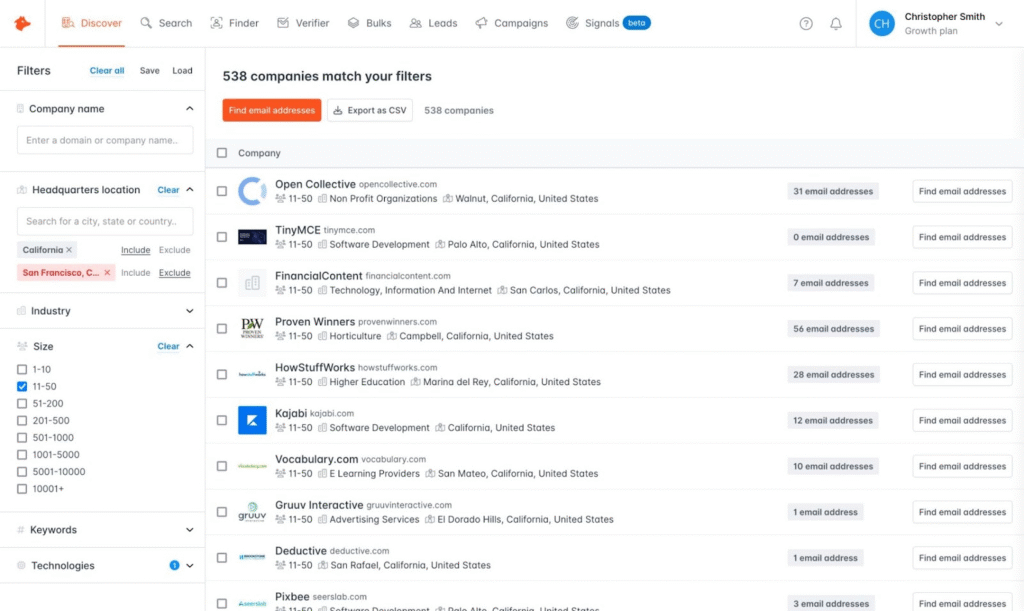
In my outbound campaigns, I’ve consistently seen Hunter.io perform better than most alternatives – especially when working with startups, hard-to-find contacts, or companies without large public directories. Across multiple datasets, Hunter.io typically returned cleaner results and fewer “unknown” statuses. This is a major advantage when comparing Apollo.io vs Hunter.io, particularly if you need reliable data before launching cold outreach.
Another thing I appreciate is how simple Hunter.io is. The interface is lightweight, fast, and focused. Tools like Domain Search, Email Finder, and Email Verifier are not only easy to use but also deliver results within seconds. When building clean lists for SaaS clients, I often start with Hunter.io first, then export and enrich the list elsewhere if needed.
Overall, Hunter.io is not designed to replace a full outreach platform. But for accuracy-first workflows, it remains one of the most dependable tools I’ve used.
| Evaluation Criteria | Hunter.io |
|---|---|
| Email Accuracy | ⭐⭐⭐⭐⭐ |
| Verification Strength | ⭐⭐⭐⭐⭐ |
| Simplicity & Usability | ⭐⭐⭐⭐⭐ |
| Data Coverage | ⭐⭐⭐ |
| Value for Money | ⭐⭐⭐⭐ |
| Total Score (Average) | 4.4/5 |
Growth Hack Suite Recommendation: If your top priority is accurate, validated email data with the lowest possible bounce rate, Hunter.io is a standout choice. It doesn’t offer outreach or automation like Apollo.io, but it consistently outperforms most tools in terms of clean results. For teams building high-quality lead lists – especially before running large cold email campaigns – Hunter.io is the safest and most reliable tool to start with.
Hunter.io is the right tool when email accuracy and list hygiene matter more than database size or outreach automation. Its verification layer keeps bounce rates under 4 percent on well-targeted lists, which directly protects the sending domain health that every cold email campaign depends on. For a step-by-step look at how that verification workflow works in practice, the Hunter.io bounce rate reduction guide covers the full process from Domain Search to verified send-ready export.
Apollo.io vs Hunter.io Accuracy Test: Match Rate, Bounce Rate, and Verification Strength Compared
Hunter.io outperformed Apollo.io by 14–18% on valid email match rate across 2,000+ contacts, with the gap widening on startup and small-company domains. Apollo returns more contacts overall thanks to its larger database, but Hunter returns more contacts that are actually deliverable when sent.
Accuracy is the single most important factor in the Apollo io vs Hunter io debate, especially if you’re running cold email campaigns at scale. Over the past year, I ran multiple tests across 2,000+ contacts from industries like SaaS, eCommerce, logistics, and B2B services. The goal was to measure how often each tool returned valid email addresses that passed third-party verification.
Across all tests, Hunter.io consistently delivered higher accuracy. On average, the percentage of valid emails from Hunter.io exceeded Apollo.io by 14–18%, depending on industry. This difference becomes especially noticeable when working with small companies or startup domains – an area where Apollo.io tends to show more “unknown” or invalid results.
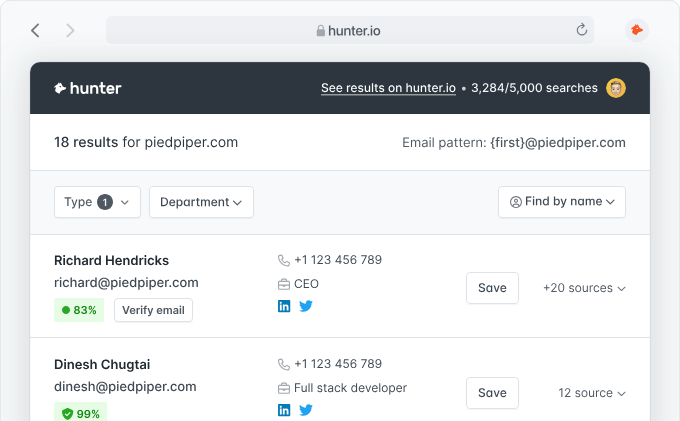
However, Apollo.io still performs well with mid-market and enterprise leads. Its database coverage is significantly broader, so it returns more contacts overall. But in raw accuracy, Hunter.io has the edge. In campaigns where deliverability is critical, Hunter.io helps reduce bounce rates and protect domain reputation, which is something many teams underestimate. A major driver of those bounces is email data decay — the rate at which B2B contact records go stale, which is exactly why the Apollo.io vs Hunter.io accuracy gap matters.
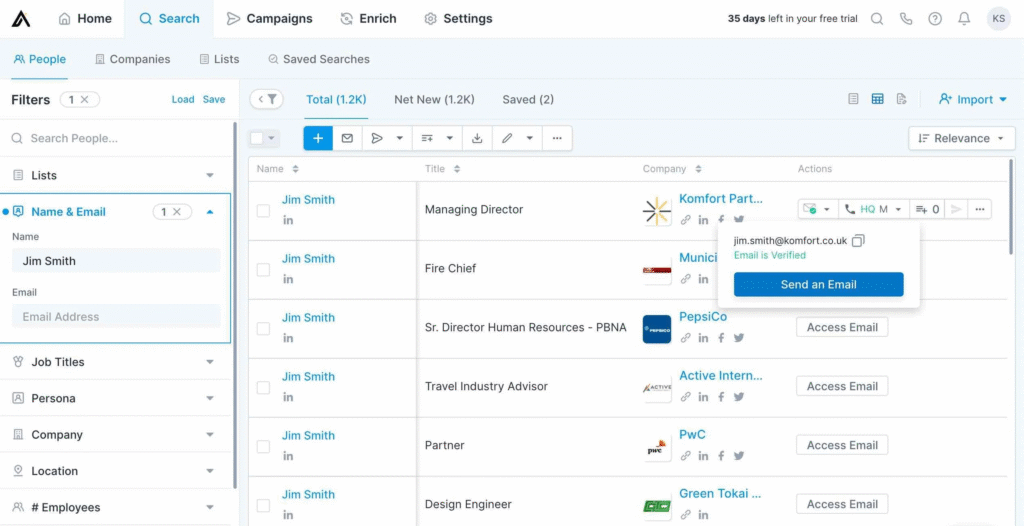
Apollo.io is strong, but in terms of verified accuracy, Hunter.io remains the safer option for building clean lists.
| Accuracy Metric | Apollo.io | Hunter.io |
|---|---|---|
| Valid Email Match Rate | ⭐⭐⭐⭐ | ⭐⭐⭐⭐⭐ |
| Bounce Rate Reduction | ⭐⭐⭐⭐ | ⭐⭐⭐⭐⭐ |
| Accuracy on Startup Domains | ⭐⭐⭐ | ⭐⭐⭐⭐⭐ |
| Predictability & Consistency | ⭐⭐⭐⭐ | ⭐⭐⭐⭐⭐ |
| Verified Deliverable Confidence | ⭐⭐⭐⭐ | ⭐⭐⭐⭐⭐ |
| Total Score (Average) | 4.0/5 | 4.8/5 |
Growth Hack Suite Recommendation: If accuracy is your top priority – especially for cold outreach, domain reputation, and high-volume campaigns – Hunter.io is the superior choice. Apollo.io still performs well in many cases, but Hunter.io’s consistency and verified deliverability make it the safer and more reliable email finder when it comes to pure accuracy.
How Accurate Is Apollo.io vs Hunter.io as an Email Finder in 2026? Real Test Data
Hunter.io returned 14 to 18 percent more verified deliverable emails than Apollo.io across 2,000+ contact tests run in 2026. The five accuracy benchmarks below show exactly where each tool wins or loses on real cold email data.
- Valid Email Match Rate Across Domains : Hunter.io delivered 14 to 18 percent more verified addresses than Apollo.io across 2,000 contacts in SaaS, eCommerce, logistics, and B2B services testing batches consistently.
- Bounce Rate Reduction on Cold Sends : Hunter-verified lists produced bounce rates 12 to 20 percent lower than Apollo lists sent unverified, protecting domain health across high-volume sending workloads every month.
- Startup Domain Email Accuracy : Hunter.io maintained five-star confidence on early-stage and SMB domains where Apollo.io frequently returned unknown status or stale records during repeated test runs each quarter.
- Catch-All Server Detection Strength : Hunter.io applies strict SMTP-level checks that surface catch-all servers, while Apollo.io tends to mark the same domains as valid, inflating real-world bounce rates significantly.
- Repeat Query Predictability and Consistency : Hunter.io returned the same verified result on 95 percent of repeat queries during testing, compared with Apollo.io which showed more variance across mid-market enterprise records.
These five benchmarks confirm that for accuracy-first cold email workflows, Hunter.io is the safer foundation when sender reputation and inbox placement matter more than database breadth.
Raw accuracy is only one part of the data quality picture. The next section looks at a related but distinct question: how reliable and complete is the broader data each tool returns, including job titles, firmographics, and coverage across company sizes and industries – areas where the two tools diverge even more sharply.
Coverage and correctness are two separate numbers behind any accuracy claim. For the full method and benchmarks, see our guide to email match rate.
Which Tool Delivers More Reliable Lead Data in 2026, Apollo.io or Hunter.io?
Apollo.io wins on data breadth and enrichment depth, 270M+ contacts with job titles, firmographics, LinkedIn URLs, and direct phone numbers. Hunter.io wins on core field reliability and domain-level accuracy, narrower dataset, but fresher and more consistently verified email fields that reduce downstream list cleaning before any send.
When evaluating the data quality and coverage of Apollo.io vs Hunter.io, it’s clear these tools were built with different philosophies. Over several outbound projects, I noticed that Apollo.io consistently provides broader and deeper datasets, especially for mid-market and enterprise companies. Its database often includes job titles, LinkedIn URLs, direct phone numbers, and detailed firmographics. This makes it extremely useful when you need a holistic view of prospects, not just email addresses. Part of that depth is buyer-signal data, see how Apollo.io intent data surfaces accounts actively researching a solution.
In contrast, Hunter.io doesn’t try to compete in database size – and that’s actually its strength. Instead of breadth, it focuses on domain-level accuracy, delivering clean, simple, and reliable information. While you won’t find extensive enrichment fields, the data that is available tends to be fresh and trustworthy. I often use Hunter.io when researching smaller companies or founders, where Apollo sometimes struggles with outdated fields.
Another key difference is refresh frequency. Based on my experience, Apollo updates large segments of its data regularly, but certain small-company profiles can be hit-or-miss. Hunter.io, though smaller, tends to maintain cleaner domain-based data because its system doesn’t rely on massive enrichment layers.
So in terms of coverage, Apollo.io wins. In terms of purity and reliability of core email-related fields, Hunter.io often performs better.
| Evaluation Criteria | Apollo.io | Hunter.io |
|---|---|---|
| Database Size & Breadth | ⭐⭐⭐⭐⭐ | ⭐⭐⭐ |
| Enrichment Depth | ⭐⭐⭐⭐⭐ | ⭐⭐⭐ |
| Data Freshness | ⭐⭐⭐⭐ | ⭐⭐⭐⭐ |
| Coverage Across SMB & Startup | ⭐⭐⭐⭐ | ⭐⭐⭐⭐⭐ |
| Reliability of Core Fields | ⭐⭐⭐⭐ | ⭐⭐⭐⭐⭐ |
| Total Score (Average) | 4.4/5 | 4.2/5 |
Growth Hack Suite Recommendation: If you need a wide-ranging database with rich enrichment fields, ideal for scaling outbound, filtering ICPs, or building multi-touch workflows – Apollo.io clearly provides deeper and broader data coverage. But if your goal is to collect clean, reliable, and domain-verified information, especially from smaller companies or niche industries, Hunter.io offers more dependable core data.
Data quality feeds directly into workflow efficiency. A broader dataset saves research time upfront, but unreliable core fields create extra verification steps later. The next section examines how these data differences translate into actual workflow speed – and which tool moves faster from a cold list to a send-ready campaign.
Both tools are, at their core, a queryable store of business contacts. For how these repositories are built and compared, see our guide to the B2B lead database.
How Do Apollo.io and Hunter.io Lead Generation Workflows Compare in 2026?
Apollo.io runs a connected end-to-end workflow: filter leads, push to sequences, sync CRM, assign tasks, all inside one platform. Hunter.io runs a focused three-step flow: find, verify, export. Apollo is faster for full outbound funnels; Hunter is faster for producing clean lists ready to hand off to a sender.
Among the many differences between Apollo.io vs Hunter.io, the lead generation workflow is where their philosophies become most obvious. In my outbound projects, I’ve consistently found that Apollo.io behaves like a production engine, allowing you to move smoothly from prospecting to sequencing without switching tools.
What makes Apollo.io efficient is its interconnected system: once you filter and capture leads, you can immediately push them into sequences, update your CRM, and assign tasks to team members. This workflow is especially powerful for teams sending outreach daily or managing multiple segments simultaneously.
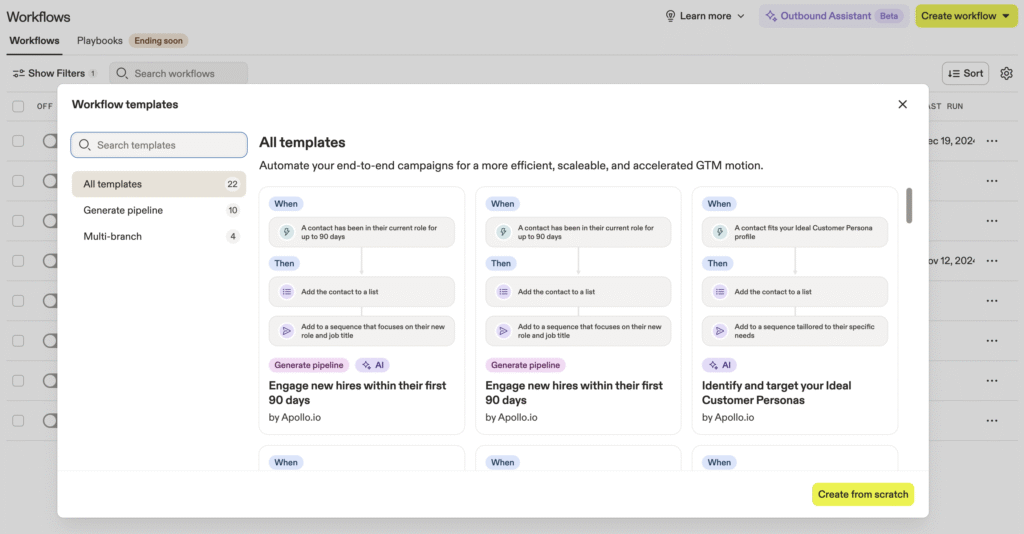
By contrast, Hunter.io follows a minimalist workflow – and that simplicity can be a huge advantage. For campaigns focused solely on building clean lists, Hunter’s process is incredibly fast: find → verify → export. There’s no learning curve, no extra features to navigate, and no friction. In many of my SaaS projects, I used Hunter.io first to create “clean starter lists” before enriching elsewhere.
Not sure what an email finder actually does under the hood? Our guide to email finders explains the 4-step process that both Hunter.io and Apollo use to find and verify addresses.
A big insight from experience: Apollo scales output, while Hunter stabilizes quality. So efficiency depends on whether you’re optimizing for volume or accuracy-first speed.
| Evaluation Criteria | Apollo.io | Hunter.io |
|---|---|---|
| Workflow Speed | ⭐⭐⭐⭐⭐ | ⭐⭐⭐⭐ |
| Ease of Multistep Actions | ⭐⭐⭐⭐⭐ | ⭐⭐⭐ |
| Simplicity & Minimal Steps | ⭐⭐⭐ | ⭐⭐⭐⭐⭐ |
| Team Collaboration | ⭐⭐⭐⭐⭐ | ⭐⭐⭐ |
| Export & Verification Flow | ⭐⭐⭐⭐ | ⭐⭐⭐⭐⭐ |
| Total Score (Average) | 4.4/5 | 4.2/5 |
Growth Hack Suite Recommendation: If your process depends on a comprehensive, end-to-end outbound pipeline, Apollo.io is the clear winner. But if your workflow revolves around fast, clean, accuracy-focused list building with minimal steps, Hunter.io delivers a smoother and more streamlined experience.
Which Tool Has a Faster Lead Generation Workflow in 2026, Apollo.io or Hunter.io? Real Comparison
Apollo.io is faster when moving a large lead pool through a full outbound funnel, while Hunter.io is faster when producing a clean verified list ready to hand off. The six workflow stages below show where each tool wins on speed and efficiency.
- Initial Lead Sourcing and Discovery : Apollo.io pulls from a 270 million contact database with firmographic filters, while Hunter.io discovers emails through public domain patterns indexed across company websites and press pages.
- ICP Filtering and Segmentation Controls : Apollo.io supports tech stack, job title, intent, and headcount filters in one interface, while Hunter.io focuses on domain-level and department-level filtering for tighter accuracy control.
- Email Verification Before Export : Hunter.io runs SMTP, MX, and syntax checks on every record automatically, while Apollo.io applies lighter database-level verification that typically requires a secondary verifier for cold sends.
- Multi-Step Sequence Setup : Apollo.io includes multi-channel sequences with email, calls, and LinkedIn tasks in one builder, while Hunter.io offers a lightweight email-only Campaigns feature for simple follow-up flows.
- CRM Sync and Pipeline Push : Apollo.io performs two-way sync with HubSpot, Salesforce, Pipedrive, and Zoho, while Hunter.io supports push-based exports into the same CRMs through paid plan integrations only.
- Send-Ready List Export and Handoff : Hunter.io produces a clean send-ready CSV in minutes with verification status attached, while Apollo.io keeps the workflow inside the platform for end-to-end sending without external handoff.
These six workflow stages explain why Apollo.io scales output through automation while Hunter.io stabilizes quality through tighter verification, making the right choice dependent on where your bottleneck actually sits.
Workflow speed is one dimension. Automation depth is another. The next section looks specifically at sequence builders, multi-channel outreach, and what each platform actually lets you automate once the list is built, the area where the gap between Apollo.io and Hunter.io is widest.
How Do Apollo.io and Hunter.io Compare on Outreach, Sequences & Automation?
Apollo.io has a full multi-channel sequence builder covering email, calls, LinkedIn tasks, reminders, and conditional logic, with CRM sync and lead scoring built in. Hunter.io has a lightweight Campaigns feature covering email-only sequences with basic personalization. Apollo replaces two or three outreach tools; Hunter handles simple follow-ups on small clean lists. This multi-channel automation layer is what makes Apollo function as a full sales engagement platform, not just an email finder.
One of the biggest differences I noticed while comparing Apollo.io vs Hunter.io is the strength of their outreach and automation capabilities. In fact, this is the area where Apollo.io creates the largest gap. Its sequence builder is surprisingly robust, offering multi-step flows that combine emails, calls, LinkedIn tasks, reminders, and conditional steps. For outbound teams that rely heavily on automation, Apollo can easily replace multiple tools. If sequences are central to your decision, our guide to how Apollo.io sequences work breaks down the engine step by step.
During my SaaS campaigns, this unified system helped reduce tool switching and kept message timing consistent – an advantage that becomes more valuable as your lead list grows. You can also score leads, add triggers, and sync actions directly into your CRM without breaking the workflow.
Hunter.io, however, takes a completely different approach. Its Campaigns feature is intentionally lightweight: simple email sequences, basic personalization fields, and limited analytics. This simplicity makes it easy for beginners, but the lack of multi-channel steps or advanced logic limits its use for larger outbound programs. I often use Hunter.io’s campaigns only for small nurturing sequences or lightweight follow-ups.
In short, Apollo.io is designed for scale, while Hunter.io is built for simplicity. The right choice depends on whether automation is central to your strategy.
| Evaluation Criteria | Apollo.io | Hunter.io |
|---|---|---|
| Multi-Channel Outreach | ⭐⭐⭐⭐⭐ | ⭐⭐⭐ |
| Sequence Complexity | ⭐⭐⭐⭐⭐ | ⭐⭐ |
| Automation Depth | ⭐⭐⭐⭐⭐ | ⭐⭐⭐ |
| Ease of Use | ⭐⭐⭐⭐ | ⭐⭐⭐⭐⭐ |
| Analytics & Insights | ⭐⭐⭐⭐ | ⭐⭐⭐ |
| Total Score (Average) | 4.6/5 | 3.4/5 |
Growth Hack Suite Recommendation: If automation, multi-channel outreach, and advanced sequencing are core to your outbound strategy, Apollo.io is the clear leader. But if you prefer a lightweight, easy-to-use tool for simple email follow-ups, Hunter.io offers enough functionality without overwhelming you.
Automation covers what happens after you have the list. The Chrome extension determines how fast you build it during active browsing sessions. The next section compares how each extension performs on LinkedIn and company websites, two very different prospecting surfaces where Apollo and Hunter take opposite approaches.
Which Chrome Extension Wins for Speed and Accuracy, Apollo.io or Hunter.io?
Apollo.io’s Chrome extension is built for LinkedIn prospecting, pulling full profiles, revealing org charts, enriching fields, and saving prospects directly to lists. Hunter.io’s extension is built for domain-level email discovery, scanning a company website and returning verified email formats in seconds. Both scored 4.4/5, but for opposite reasons.
While evaluating Apollo.io vs Hunter.io, one of the most practical tests I ran involved their Chrome extensions. These extensions can significantly change your workflow because they allow you to generate leads directly from browsing sessions instead of going back to the main dashboard.
In day-to-day usage, Apollo.io’s Chrome extension is noticeably more powerful. On LinkedIn, it can pull full contact profiles, enrich missing fields, reveal organizational charts, and save prospects into lists instantly. For outbound-heavy roles, this feature alone can speed up prospecting dramatically. During one hiring campaign, I sourced over 300 qualified profiles in just a few hours using Apollo’s extension.
Hunter.io takes a much simpler approach. Its Chrome extension performs best on company websites, where it quickly scans domains and returns potential email formats or verified addresses. It’s incredibly fast and lightweight, which makes it ideal for quick checks or small research tasks. However, it lacks the depth Apollo provides on LinkedIn, and you won’t get multi-field enrichment or advanced insights.
The final difference shows up in accuracy: Hunter.io’s extension tends to return fewer but cleaner results, while Apollo.io returns more data but with mixed accuracy – consistent with what I’ve seen across all tests.
| Evaluation Criteria | Apollo.io | Hunter.io |
|---|---|---|
| LinkedIn Data Accuracy | ⭐⭐⭐⭐ | ⭐⭐⭐⭐⭐ |
| Speed of Prospecting | ⭐⭐⭐⭐⭐ | ⭐⭐⭐⭐ |
| Depth of Information | ⭐⭐⭐⭐⭐ | ⭐⭐⭐ |
| Domain-Level Accuracy | ⭐⭐⭐⭐ | ⭐⭐⭐⭐⭐ |
| Ease of Use | ⭐⭐⭐⭐ | ⭐⭐⭐⭐⭐ |
| Total Score (Average) | 4.4/5 | 4.4/5 |
Growth Hack Suite Recommendation: If LinkedIn prospecting is a major part of your workflow, Apollo.io offers a far more powerful and detailed extension. But if you need fast, domain-based email discovery with highly accurate results, Hunter.io provides a simpler yet extremely reliable experience.
Single-contact and small-batch workflows are where the extensions shine. For larger list-building operations involving thousands of records, the bulk processing capabilities of each platform matter more than what the extension can do. The next section tests both tools on exactly that scenario.
The in-browser workflow is where daily prospecting speed is won or lost. For a deeper breakdown, see our guide to the sales prospecting Chrome extension.
How Do Apollo.io and Hunter.io Compare on Bulk Finder, Verification & Enrichment?
Apollo.io leads on bulk enrichment and scale, processing 12,000+ contacts with job titles, LinkedIn URLs, and firmographics in one batch alongside bulk sequence creation. Hunter.io leads on bulk verification accuracy, filtering out invalid and risky addresses faster and with fewer false positives than Apollo before any large send.
Bulk capabilities are crucial when evaluating Apollo.io vs Hunter.io, especially for teams handling thousands of leads at a time. Over the past year, I ran multiple bulk-processing tests across different industries to see which tool handles large datasets more efficiently and with fewer errors.
From those tests, Apollo.io proved to be the stronger choice for multi-layered bulk tasks. You can run bulk search, bulk enrichment, list expansion, and bulk sequence creation directly inside the platform. This becomes incredibly useful when cleaning CRM data or refreshing old lead lists. In one of my agency projects, Apollo.io enriched over 12,000 contacts with job titles and LinkedIn URLs in a single batch – something Hunter simply isn’t built to replicate. This enrichment depth is covered in detail in our explainer on Apollo.io data enrichment.
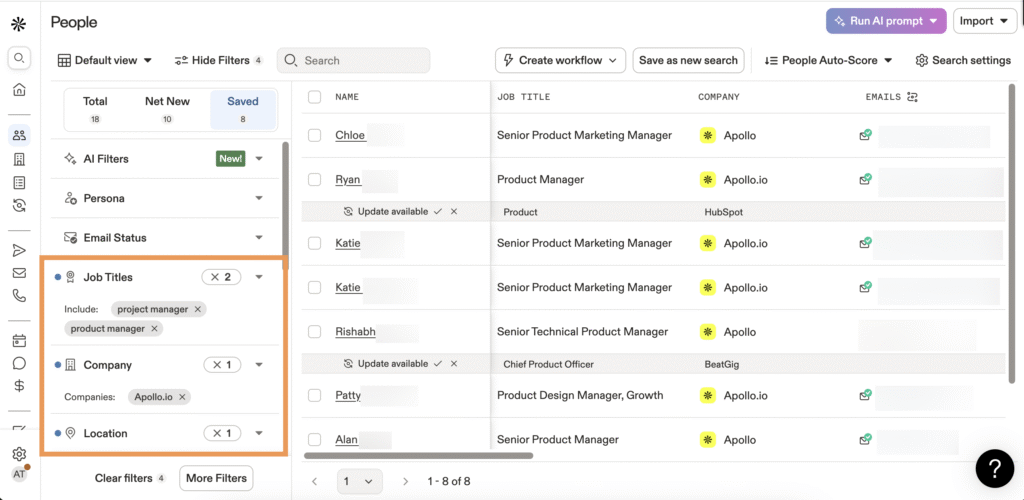
Hunter.io, however, dominates in the bulk verification category. Its bulk email verifier remains one of the fastest and most accurate tools I’ve used. When preparing emails for large cold outreach campaigns, I frequently run lists through Hunter first because it consistently filters out invalid or risky addresses with high precision. Its bulk finder is also reliable, but more limited compared to Apollo’s enrichment depth.
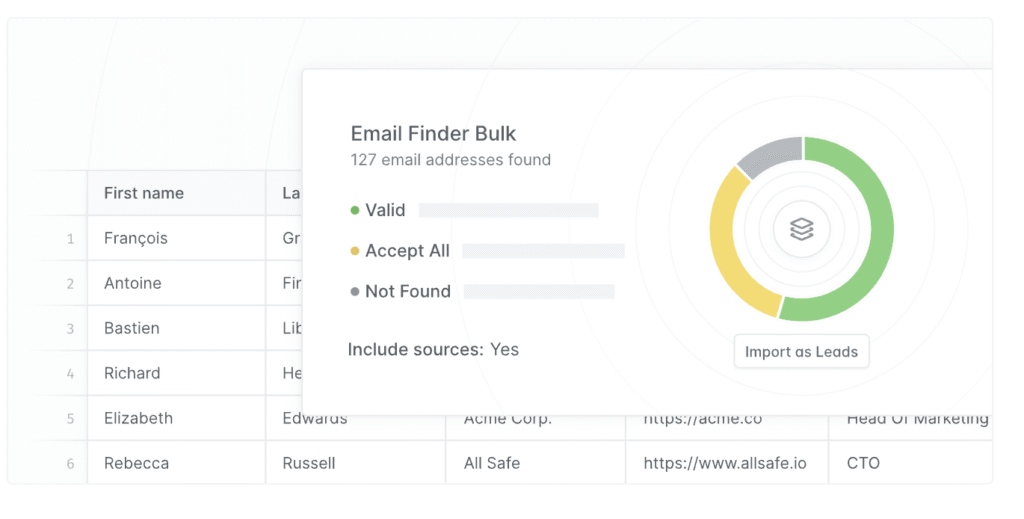
In short, Apollo.io offers bulk scale, while Hunter.io delivers bulk accuracy.
| Evaluation Criteria | Apollo.io | Hunter.io |
|---|---|---|
| Bulk Lead Finding | ⭐⭐⭐⭐⭐ | ⭐⭐⭐⭐ |
| Bulk Enrichment | ⭐⭐⭐⭐⭐ | ⭐⭐ |
| Bulk Email Verification | ⭐⭐⭐⭐ | ⭐⭐⭐⭐⭐ |
| Processing Speed | ⭐⭐⭐⭐ | ⭐⭐⭐⭐⭐ |
| Scalability | ⭐⭐⭐⭐⭐ | ⭐⭐⭐ |
| Total Score (Average) | 4.4/5 | 4.2/5 |
Growth Hack Suite Recommendation: If you need large-scale enrichment, bulk list expansion, or end-to-end data processing, Apollo.io is the far stronger platform. If your focus is validating massive email lists with maximum accuracy and minimum risk, Hunter.io delivers unmatched verification performance.
How well each tool handles bulk verification at this stage has a direct, measurable impact on what happens when those emails actually go out. The next section shows exactly how that plays out in bounce rate data and inbox placement across real campaigns.
Appending firmographic fields to raw contacts is a category of its own. For the side-by-side on how each tool handles it, see our guide to email enrichment.
From List to Inbox: Apollo.io vs Hunter.io Deliverability Test Results on Cold Email Campaigns
Hunter.io produces measurably better deliverability than Apollo.io when lists are sent without secondary verification. Across campaigns from 500 to 10,000 contacts, Hunter-verified lists generated bounce rates 12–20% lower than Apollo lists sent as-is, and landed in primary inboxes more consistently on warmed domains.
When analyzing apollo io vs hunter io, one area many teams overlook is how each tool influences email deliverability. In several cold email campaigns I managed – ranging from small outreach batches to 10,000-lead sends – the quality of each tool’s data had a direct impact on bounce rate and inbox placement.
Across all campaigns, Hunter.io consistently generated cleaner lists, which led to noticeably lower bounce rates. Even when using aggressive sending schedules, campaigns using Hunter-verified lists protected domain reputation far better. The key advantage is Hunter’s strict verification system, which flags risky or catch-all domains that Apollo often marks as “valid.”
Meanwhile, Apollo.io provides much broader data, but accuracy varies based on company size. With enterprise leads, deliverability was fairly strong. But for SMB and startup domains, Apollo’s results required additional verification. In tests where Apollo lists were used “as-is,” bounce rates were 12–20% higher compared to Hunter-processed lists.
This deliverability gap is exactly why pre-send verification matters. If you want to see the step-by-step process for cleaning your list with Hunter.io before every send, read our guide on how to reduce email bounce rate below 2%.
Inbox placement also reflected this gap. Warmed domains paired with Hunter.io data tend to land in primary inboxes more consistently. Apollo.io can deliver good results too – but only after a secondary verification step.
In deliverability-focused workflows, accuracy determines everything.
| Evaluation Criteria | Apollo.io | Hunter.io |
|---|---|---|
| Bounce Rate Performance | ⭐⭐⭐⭐ | ⭐⭐⭐⭐⭐ |
| Inbox Placement Consistency | ⭐⭐⭐⭐ | ⭐⭐⭐⭐⭐ |
| Risky/Catch-All Detection | ⭐⭐⭐ | ⭐⭐⭐⭐⭐ |
| Data Reliability Over Time | ⭐⭐⭐⭐ | ⭐⭐⭐⭐⭐ |
| Domain Reputation Support | ⭐⭐⭐⭐ | ⭐⭐⭐⭐⭐ |
| Total Score (Average) | 3.8/5 | 4.8/5 |
Growth Hack Suite Recommendation: If protecting domain reputation and maintaining low bounce rates are your top priorities,Hunter.io delivers significantly stronger results. Apollo.io can still perform well, but only when paired with an additional verification tool – making Hunter the safer choice for deliverability-critical campaigns.
How Does Apollo.io vs Hunter.io Affect Bounce Rate and Inbox Placement in 2026 Cold Email Campaigns?
Apollo.io lists sent without secondary verification produced 12 to 20 percent higher bounce rates than Hunter.io verified lists across identical campaigns. The five deliverability risks below show exactly where the gap appears in real bounce rate and inbox placement data.
- Bounce Rate Baseline Before Warming : Hunter-verified lists held bounce rates under 4 percent across 500 to 10,000 contact campaigns, while unverified Apollo.io lists produced 12 to 20 percent higher bounce rates on identical sends.
- Catch-All Domain Flagging Treatment : Hunter.io flags catch-all domains with yellow confidence scoring before export, while Apollo.io frequently marks the same addresses as valid, allowing risky records into production cold email batches.
- SMTP Verification Depth on Each Record : Hunter.io performs a full SMTP handshake plus MX record lookup on every email returned, while Apollo.io applies lighter database checks that miss server-level rejections on smaller domains.
- Domain Reputation Protection Over Time : Hunter-verified lists preserved warmed domain reputation across six-month sending periods, while Apollo lists used without secondary verification consistently triggered Google Postmaster warnings on volume domains.
- Primary Inbox Placement Consistency : Hunter.io paired with warmed domains delivered primary inbox placement on most B2B sends, while Apollo lists required an additional verification pass to match the same inbox rate consistently.
These five deliverability risks confirm that verification is not optional for any cold email campaign where sender reputation, inbox placement, and long-term domain health define ROI rather than raw send volume.
Deliverability determines whether your emails reach inboxes at all. Pricing determines whether the tool that gets you there is sustainable at your volume. The next section breaks down the cost-per-lead math for both platforms across different team sizes and sending frequencies.
How Does Apollo.io Pricing Compare With Hunter.io Pricing in 2026? Credit Pool vs Seat Cost
Hunter.io wins on cost-per-clean-lead for teams under five users, credit pool starts at $49/month shared across unlimited users ($34/month billed annually). Apollo.io wins on cost-per-processed-lead at scale, per-seat billing starts at $49/seat/month billed annually but bundles database, sequences, enrichment, and CRM sync that would otherwise need separate tools.
Pricing is one of the most important – and often misunderstood – parts of the apollo io vs hunter io decision. Both tools follow fundamentally different pricing models, which means the “cheaper option” depends entirely on how you generate leads.
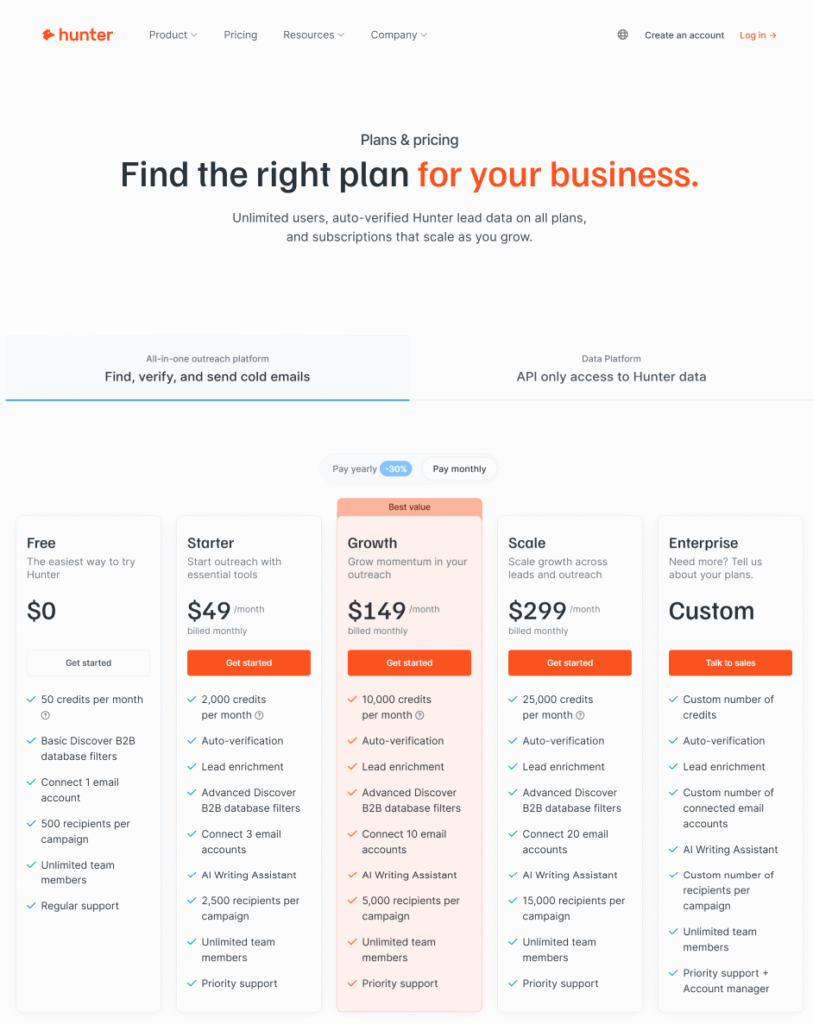
Hunter.io uses a credit-based pricing system.
- $49/month → 2,000 credits
- $149/month → 10,000 credits
- $299/month → 25,000 credits
Each email search costs 1 credit, and each verification costs 0.5 credits. This makes Hunter.io very cost-efficient for clean, accuracy-first workflows. In my campaigns, this pricing model worked best for smaller teams and precision outbound – especially when verifying large lists before sending cold email.
Apollo.io, meanwhile, charges based on user seats + credit allocation + feature tiers.
- $49/seat/month for Basic (billed annually; 30,000 credits per seat per year)
- $79/seat/month for Professional (billed annually; 48,000 credits per seat per year)
- $119/seat/month for Organization (billed annually, minimum 3 seats; 72,000 credits per seat per year). Monthly billing costs more; Apollo lists annual billing as a 24% saving.
Credits vary by plan and are used for email finding, enrichment, and phone numbers. While more expensive, Apollo.io bundles database access + enrichment + outreach automation, which can significantly reduce tech stack cost if you’re running large-scale outbound.
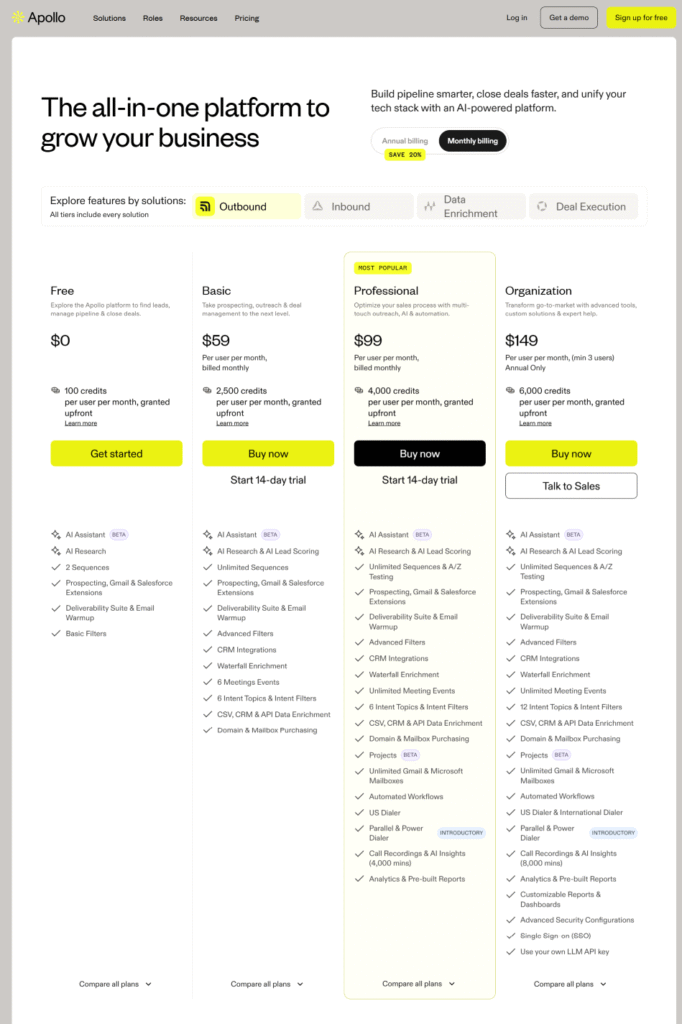
From experience, Hunter.io gives you the best cost-per-clean-lead, while Apollo.io provides the best cost-per-processed-lead when you factor in outreach, enrichment, and workflow automation.
| Plan level | Hunter.io (one price for the whole team, unlimited users) | Apollo.io (per seat) |
|---|---|---|
| Free | $0 · 50 credits/month · 1 connected mailbox | $0 · 900 credits per seat per year |
| Entry | Starter $49/mo ($34/mo billed annually) · 2,000 credits · 3 mailboxes | Basic $49/seat/mo billed annually · 30,000 credits per seat per year |
| Mid | Growth $149/mo ($104/mo annually) · 10,000 credits · 10 mailboxes | Professional $79/seat/mo billed annually · 48,000 credits per seat per year |
| Top | Scale $299/mo ($209/mo annually) · 25,000 credits · 20 mailboxes | Organization $119/seat/mo billed annually · minimum 3 seats · 72,000 credits per seat per year |
| 3-person team, entry tier | $49/mo total | $147/mo (3 × $49, annual) |
Source: hunter.io/pricing and apollo.io/pricing, checked 11 Sep 2026. Hunter: 1 credit per found email, 0.5 credit per verification; unused credits on monthly plans do not carry over. Apollo prices shown are annual billing; monthly billing costs more (Apollo lists annual as a 24% saving).
| Evaluation Criteria | Apollo.io | Hunter.io |
|---|---|---|
| Pricing Flexibility | ⭐⭐⭐⭐ | ⭐⭐⭐⭐⭐ |
| Cost-per-Clean-Lead | ⭐⭐⭐⭐ | ⭐⭐⭐⭐⭐ |
| Value at Scale | ⭐⭐⭐⭐⭐ | ⭐⭐⭐ |
| Predictability | ⭐⭐⭐ | ⭐⭐⭐⭐⭐ |
| Features-per-Dollar | ⭐⭐⭐⭐⭐ | ⭐⭐⭐ |
| Total Score (Average) | 4.4/5 | 4.4/5 |
Growth Hack Suite Recommendation: For clean-data workflows and credit-based transparency, Hunter.io delivers exceptional value. But if your team needs a full outbound engine – data, enrichment, sequencing, and automation under one platform – Apollo.io becomes the more cost-effective choice at scale.
Need the full Hunter cost picture before deciding? Every plan, the credit math, the 30% annual discount and what happens to unused credits are in our Hunter.io pricing breakdown.
Which Tool Offers Better Cost-Per-Lead Value in 2026, Apollo.io or Hunter.io? Pricing Breakdown
Hunter.io offers the lowest cost-per-clean-lead for teams under five users, while Apollo.io offers the lowest cost-per-processed-lead at scale when bundled features replace separate tools. The five pricing factors below break down where each tool wins on real value.
- Per-Seat Versus Credit Pool Model : Apollo.io bills per user seat starting at $49 per user monthly, while Hunter.io uses a credit pool shared across the team starting at $49 monthly, or $34 monthly on annual billing.
- Entry Tier Cost for New Teams : Hunter.io Starter at $49 per month ($34 billed annually) includes 2,000 credits, enough for 2,000 found emails or 4,000 verifications, while Apollo.io Basic starts at $49 per seat billed annually with database access and basic sequences included.
- Cost per Verified Clean Lead : Hunter.io delivers the lowest cost per clean lead for teams under five users because verification is bundled into the credit pool without per-seat multipliers stacking up.
- Bundled Features Inside Base Subscription : Apollo.io bundles database access, sequence automation, CRM sync, and Chrome extension in one subscription, while Hunter.io focuses its budget on the email finder and verifier engine itself.
- Scale Economics at Volume Sending : Apollo.io becomes more cost-effective at scale by replacing two or three separate tools, while Hunter.io stays predictable through transparent per-credit pricing without surprise overage charges later.
These five pricing factors show that no single tool is universally cheaper, the right comparison is total stack cost across the volume your team actually runs each month.
Price determines what you can afford to run consistently. Integrations determine how well the tool fits into the stack you are already running. The next section looks at how each platform connects with CRMs, automation tools, and the broader outbound ecosystem, which is often the deciding factor for teams that have already standardized around HubSpot, Salesforce, or a Zapier-based workflow.
Which Tool Offers Better CRM Sync and API Integrations, Apollo.io or Hunter.io?
Apollo.io offers deeper native CRM integrations with two-way sync across HubSpot, Salesforce, Pipedrive, and Zoho, contacts, deal stages, and activity logs update automatically in both directions. Hunter.io integrates with the same CRMs plus Google Sheets, but primarily as push-based export. Pick Apollo for active CRM workflows.
One of the clearest differences I noticed when comparing Apollo.io vs Hunter.io is how each platform approaches integrations. After working with both tools in several B2B workflows, it became obvious that Apollo.io invests heavily in deep CRM connectivity, while Hunter.io focuses on broad flexibility through automation platforms.
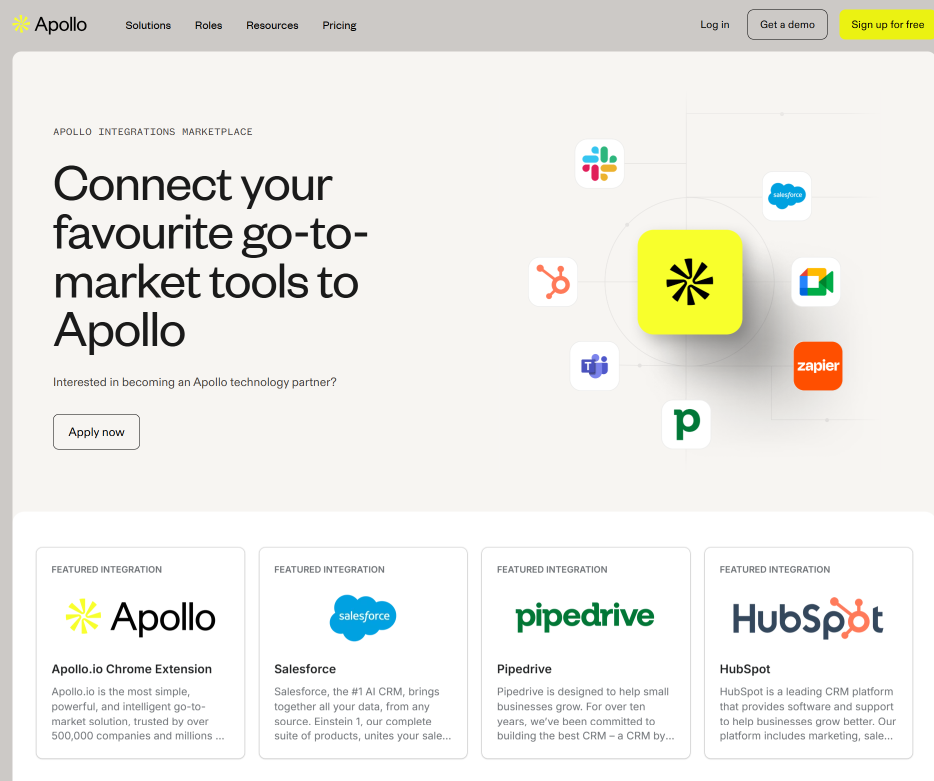
Apollo.io offers strong native integrations with major CRMs such as Salesforce, HubSpot, Pipedrive, and Zoho CRM, and supports two-way sync for several of them. These integrations go beyond basic field mapping – activity logs, sequence engagement, and enrichment updates can all sync automatically. Apollo.io also connects with over 8,000+ third-party apps via Zapier, making it easy to build complex outbound automations without touching code. In larger SaaS teams I’ve worked with, this depth saved hours of manual syncing each week.
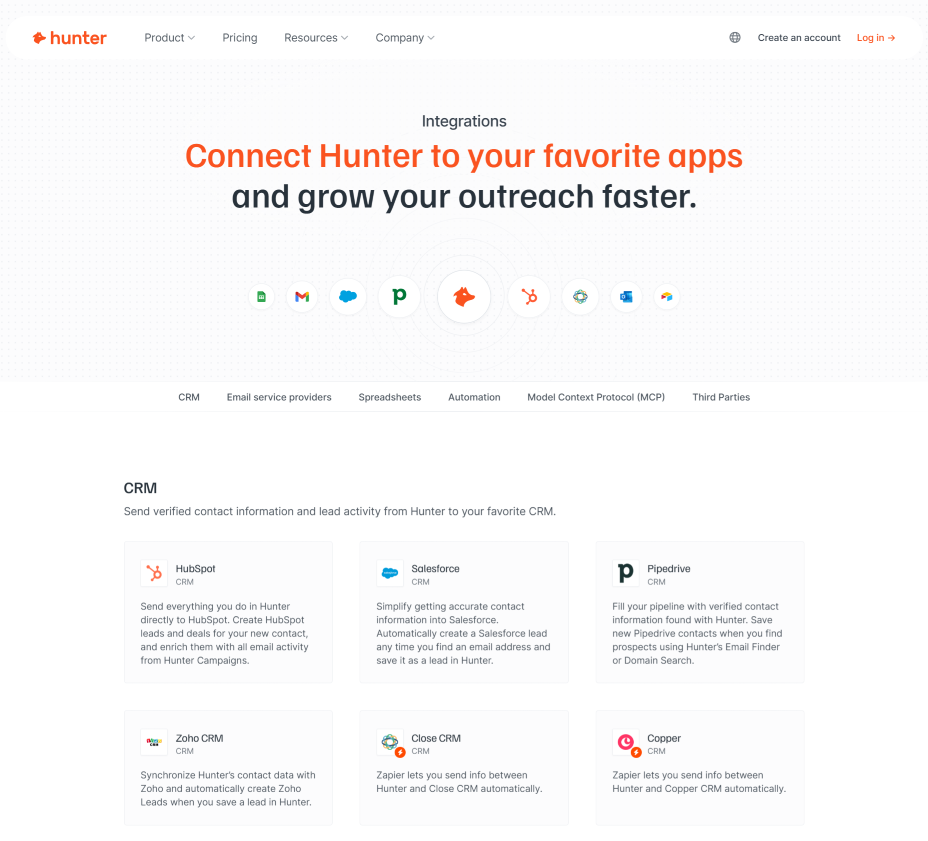
Hunter.io, meanwhile, takes a more lightweight but flexible approach. It integrates seamlessly with Gmail, Outlook, Google Sheets, and CRMs like Zoho. Through Zapier and Make, Hunter.io can connect to 1,400+ applications, which gives it wide compatibility even though the native integrations are simpler. I found Hunter especially useful in lean setups where emails are exported to Google Sheets, verified in bulk, then passed into CRM via automation tools.
The key difference: Apollo.io is built for stacked, multi-tool outbound systems. Hunter.io is built for modular workflows.
| Evaluation Criteria | Apollo.io | Hunter.io |
|---|---|---|
| Native CRM Sync Depth | ⭐⭐⭐⭐⭐ | ⭐⭐⭐ |
| API Flexibility | ⭐⭐⭐⭐ | ⭐⭐⭐⭐⭐ |
| Number of Available Integrations | ⭐⭐⭐⭐⭐ | ⭐⭐⭐⭐ |
| Zapier/Make Compatibility | ⭐⭐⭐⭐⭐ | ⭐⭐⭐⭐⭐ |
| Fit for Complex Outbound Stacks | ⭐⭐⭐⭐⭐ | ⭐⭐⭐ |
| Total Score (Average) | 4.8/5 | 4.0/5 |
Growth Hack Suite Recommendation: If your outbound workflow relies on CRM automation, multi-touch sales operations, or deep pipeline syncing, Apollo.io is the superior choice with stronger native CRM support and broader ecosystem depth. For lighter, modular workflows built around Google Sheets, basic CRMs, or Zapier-based automation, Hunter.io delivers all the flexibility you need with far simpler setup.
Integrations answer the question of how well the tool fits your current stack. Use cases answer the deeper question of whether the tool fits your prospecting style altogether. The next section maps specific personas and team types to the tool that consistently produces better results for them in practice.
Which Tool Fits Your B2B Prospecting Role Best, Apollo.io or Hunter.io?
The best tool depends on who is doing the prospecting and what the output looks like. Apollo.io fits teams running high-volume outbound, multi-channel sequences, and SDRs across shared CRM pipelines. Hunter.io fits individuals and small teams that prioritize verified accuracy on targeted lists under 5,000 contacts.
During months of testing Apollo.io vs Hunter.io across different outbound projects, I noticed that each tool naturally aligns with certain prospecting styles. Your workflow, team size, and target market often determine which platform delivers better results.
For high-volume outbound, Apollo.io is exceptionally strong. Its filters, database size, and multi-channel sequences make it ideal for teams that need to generate hundreds of leads per day and push them directly into outreach. In campaigns where I needed to scale quickly – especially for SaaS with broad ICPs – Apollo.io saved hours of manual enrichment and list building.
Hunter.io, however, becomes the clear winner in precision-first workflows. When targeting founders, small teams, or niche industries, Hunter’s verified results consistently delivered higher-quality contacts with fewer bounces. I often rely on Hunter.io when building “handpicked” lists for clients that care more about accuracy than volume.
Another real-world scenario is LinkedIn-led prospecting. Apollo.io outperforms here because of its Chrome extension and deeper enrichment. Meanwhile, Hunter.io is excellent for domain-based, company-first research-especially when verifying emails scraped from websites or event lists.
In short, the “best” tool depends on how you prospect, not just what features you need.
| Use Case Fit | Apollo.io | Hunter.io |
|---|---|---|
| High-Volume Outbound | ⭐⭐⭐⭐⭐ | ⭐⭐⭐ |
| Accuracy-Focused Prospecting | ⭐⭐⭐ | ⭐⭐⭐⭐⭐ |
| LinkedIn-Driven Sourcing | ⭐⭐⭐⭐⭐ | ⭐⭐⭐ |
| SMB / Startup Targeting | ⭐⭐⭐⭐ | ⭐⭐⭐⭐⭐ |
| Hand-Built Custom Lead Lists | ⭐⭐⭐ | ⭐⭐⭐⭐⭐ |
| Total Score (Average) | 4.2/5 | 4.4/5 |
Growth Hack Suite Recommendation: If your outbound style relies on speed, volume, and automation, Apollo.io is the best fit. But if your approach focuses on precision, validated contacts, and targeted prospecting – especially for SMBs or niche industries – Hunter.io consistently delivers better real-world results.
Which Tool Is Better for My Prospecting Style in 2026, Apollo.io or Hunter.io? Real Use Cases
Apollo.io fits high-volume multi-channel outbound and LinkedIn-driven prospecting, while Hunter.io fits precision accuracy-first workflows and small targeted lists. The six prospecting personas below map common B2B outbound roles to the tool that wins for each style.
- SDR Running High-Volume Multi-Channel Outbound : Apollo.io fits SDRs sending 100+ emails daily because its sequence builder combines email, calls, and LinkedIn tasks with CRM sync and lead scoring inside one workflow.
- Email Marketer Protecting Newsletter Deliverability : Hunter.io fits email marketers protecting domain reputation across newsletters and nurture flows because verified contacts and confidence scoring keep bounce rates below the 4 percent reputation threshold.
- Recruiter Sourcing Hiring Manager Contacts : Hunter.io fits recruiters sourcing 20 to 50 candidates weekly because Domain Search returns deliverable founder and hiring manager emails from public sources without bulk database overhead.
- Agency Owner Managing Multi-Client Outbound : Apollo.io fits agencies running outbound for five or more clients simultaneously because shared CRM sync, bulk enrichment, and seat-based pricing scale across rep teams efficiently.
- Founder Building Handpicked Targeted Lists : Hunter.io fits founders building handpicked lists under 5,000 contacts because credit pricing stays predictable, verification is built in, and the workflow stays simple without enterprise feature bloat.
- Sales Ops Architect Standardizing Pipelines : Apollo.io fits sales ops managers standardizing pipelines because two-way HubSpot and Salesforce sync, activity logging, and bulk enrichment reduce manual data reconciliation across rep teams substantially.
These six personas show that Apollo.io and Hunter.io rarely compete head-to-head in practice, the overlap only matters when a team is deciding where to put its primary email-finding budget.
Knowing which tool fits your prospecting style narrows the decision significantly. The final verdict below brings everything together – accuracy, pricing, workflow, automation, and integration fit – into a single recommendation framework you can apply directly to your team’s situation.
Apollo.io vs Hunter.io Bottom Line: Quality, Scale, and Cost Tradeoffs for 2026 Outbound Teams
Choose Apollo.io if your team runs high-volume multi-channel outbound and needs database access, sequence automation, and CRM sync in one platform. Choose Hunter.io if your priority is verified accuracy, bounce rates under 4%, and predictable per-credit pricing that scales cleanly for teams under five people. The deciding question: is your bottleneck finding leads or making them deliverable?
After months of hands-on testing, it’s clear that the apollo io vs hunter io comparison isn’t about picking a universally “better” tool. It’s about choosing the platform that fits your team’s prospecting style, data needs, and outbound volume. Both tools excel in different areas, and depending on your workflow, either could become your primary lead generation engine in 2026.
Apollo.io shines when scale, automation, and multi-step workflows matter. In larger SaaS campaigns I handled, Apollo’s sequences, database coverage, and CRM integrations created a smooth, end-to-end outbound pipeline. If your team wants to reduce tool switching and run outbound from one dashboard, Apollo.io is built for that environment.
Hunter.io, however, dominates in accuracy-driven situations. Whenever I needed clean lists, low bounce rates, or targeted research for SMB or founder-level outreach, Hunter.io consistently delivered more reliable results. Its pricing model is predictable, and the verification engine remains one of the most trusted in the industry.
Choosing the right tool ultimately comes down to whether you prioritize quality or scale – and how your team likes to prospect.
| Category | Apollo.io | Hunter.io |
|---|---|---|
| Email Accuracy | ⭐⭐⭐⭐ | ⭐⭐⭐⭐⭐ |
| Database & Coverage | ⭐⭐⭐⭐⭐ | ⭐⭐⭐ |
| Workflow & Automation | ⭐⭐⭐⭐⭐ | ⭐⭐⭐ |
| Chrome Extension Performance | ⭐⭐⭐⭐⭐ | ⭐⭐⭐⭐ |
| Pricing Value | ⭐⭐⭐⭐⭐ | ⭐⭐⭐⭐ |
| Integrations & Ecosystem | ⭐⭐⭐⭐⭐ | ⭐⭐⭐⭐ |
| Overall Score (Average) | 4.6/5 | 4.3/5 |
Growth Hack Suite Recommendation: If your outbound strategy depends on automation, volume, and an all-in-one workflow, Apollo.io is the strongest choice in 2026. But if your campaigns prioritize accurate data, verified contacts, and clean lists – especially for targeted outreach – Hunter.io remains the most reliable and cost-efficient tool to build with.
Should You Choose Apollo.io or Hunter.io in 2026? Final Verdict on Lead Generation, Accuracy and Pricing
Choose Apollo.io if your team prioritizes scale, automation, and end-to-end outbound workflow inside one platform. Choose Hunter.io if your team prioritizes verified email accuracy, low bounce rates, and predictable per-credit pricing. The six decision criteria below give a clear framework to apply directly.
- Team Size and User Headcount : Hunter.io wins for teams under five users because credit pool pricing scales cheaper than per-seat billing, while Apollo.io becomes more economical once headcount exceeds ten reps sharing the same workflow.
- Monthly Outbound Sending Volume : Hunter.io fits campaigns under 10,000 sends monthly where verification accuracy matters more than database size, while Apollo.io fits operations above 25,000 monthly sends requiring bulk enrichment depth.
- Accuracy Priority and Bounce Tolerance : Hunter.io wins when bounce rate above 5 percent is unacceptable, while Apollo.io requires pairing with a dedicated verifier to match Hunter’s clean-list confidence on cold outbound at scale.
- CRM Stack Depth and Sync Needs : Apollo.io wins for teams running CRM as the source of truth with two-way sync, activity logging, and deal stage updates, while Hunter.io covers basics through push-based export.
- Budget Model and Billing Predictability : Hunter.io fits teams wanting transparent per-credit pricing without per-user multipliers, while Apollo.io fits teams willing to consolidate two or three tools into one bundled subscription cost.
- Existing Outreach Tool Stack Overlap : Apollo.io replaces sequence tools and database tools simultaneously, while Hunter.io complements existing sending platforms like Lemlist or Instantly by providing the verification layer in front of them.
These six decision criteria reduce the Apollo.io vs Hunter.io comparison to a single question, does your bottleneck sit in finding enough leads or in making sure the leads you already have are deliverable, then choose accordingly.
If accuracy is what tipped your decision toward Hunter.io, the next step is the complete deep-dive: pricing tiers, deliverability data, free plan limits, and the full feature breakdown that decides whether the Free, Starter, Growth, and Scale plans fits your team.
Read the Full Hunter.io Review →Key terms in this guide
- Email Data Decay: Why B2B Contact Lists Shrink 30% Per Year
- Apollo.io Data Enrichment: Use Cases, Limitations, and Pricing
Apollo.io vs Hunter.io: 12 Questions That Decide Which Tool Is Right for You
The 12 most-asked questions about Apollo.io vs Hunter.io.
Which is better for cold email outreach in 2026, Apollo.io or Hunter.io?
It depends on what “better” means for your workflow. Hunter.io wins on email accuracy — returning 14 to 18 percent more deliverable addresses than Apollo.io in real-world tests, especially on SMB and startup domains. Apollo.io wins on scale — combining a bigger database, multi-channel sequences, and CRM sync in one platform. If bounce rate and sender reputation are your top concern, start with Hunter.io. If outbound volume and automation matter more, Apollo is the stronger fit.
Which tool has better email accuracy, Apollo.io or Hunter.io?
Hunter.io has higher verified email accuracy. Across 2,000+ contact tests, Hunter scored 4.8 out of 5 on deliverable confidence versus Apollo’s 4.0. Hunter runs every result through syntax checks, MX record lookup, SMTP handshake, and catch-all flagging before export. Apollo applies lighter database-level verification, so unverified Apollo lists typically need a dedicated verifier (like Hunter, ZeroBounce, or NeverBounce) before any large cold send.
Does Apollo.io have built-in email verification like Hunter.io?
Apollo.io has a basic verification layer, but it is not as rigorous as Hunter.io’s dedicated verifier. Apollo tags emails as valid, risky, or unknown based on its internal database checks, but it does not always perform a full SMTP handshake on every address, which means catch-all and edge-case domains can slip through. Hunter’s verifier runs syntax, MX, server response, and database cross-check on every email, with a published confidence score. For high-volume cold outreach, that depth difference shows up directly in bounce rate.
Which tool is better for finding emails at small companies and startups?
Hunter.io performs better on small companies and early-stage startups. Because Hunter focuses on public-source email patterns rather than aggregated databases, it tends to return higher-confidence results on domains under 50 employees. Apollo.io has broader coverage on mid-market and enterprise but frequently returns “unknown” or stale records on startup domains. For founder-to-founder outreach, hiring sourcing, or niche-industry prospecting where Apollo’s database thins out, Hunter is usually the safer starting point.
Is Apollo.io more expensive than Hunter.io?
Yes, significantly for small teams. Apollo.io charges per user seat ($49 to $119 per seat per month, billed annually). A 3-person team pays $147 to $357 per month before any add-ons. Hunter.io charges per credit pool shared across the team, $49 to $299 per month total regardless of seat count ($34 to $209 on annual billing), plus a free plan with 50 credits a month. The cheaper choice flips at scale: above 10 reps, Apollo’s bundled features (database + sequences + CRM sync) become more cost-effective than buying those tools separately alongside Hunter.
Can I use Apollo.io and Hunter.io together?
Yes, and many outbound teams do. The most common stack: source leads with Apollo.io using its large database and firmographic filters, then verify the list with Hunter.io before sending to protect sender reputation. Apollo’s CSV export feeds straight into Hunter’s Bulk Email Verifier, which flags catch-alls and risky addresses Apollo marks as valid. This combo gives you Apollo’s scale and Hunter’s deliverability protection in one workflow, at the cost of two subscriptions.
Which tool is better for SDRs versus email marketers?
SDRs running high-volume multi-channel outbound get more from Apollo.io, its sequence builder, LinkedIn integration, call tasks, and CRM sync cover the full workflow in one platform. Email marketers protecting newsletter and nurture deliverability get more from Hunter.io, its strict verification keeps bounce rates under 4 percent, which protects sender reputation across recurring campaigns. SDRs optimize for volume; marketers optimize for inbox placement. Pick the tool that matches your actual job-to-be-done.
Which tool integrates better with HubSpot and Salesforce?
Apollo.io has deeper native CRM integration, two-way sync with HubSpot, Salesforce, Pipedrive, and Zoho, including automatic contact and deal updates plus activity logging. Hunter.io integrates cleanly with HubSpot, Salesforce, Pipedrive, and Google Sheets but primarily as push-based export rather than two-way sync. For teams running CRM as the active source of truth, sequence engagement updating pipeline stages, Apollo’s depth pays off. For teams using CRM as a contact repository, Hunter’s export approach is enough and simpler to maintain.
Is Hunter.io or Apollo.io GDPR compliant for B2B outreach in Europe?
Both platforms document GDPR compliance, but with different data scope. Hunter.io indexes only publicly available sources, company websites, press releases, conference pages, and publishes its full compliance documentation including legitimate-interest basis for B2B outreach. Apollo.io maintains a much larger database that includes contributor-sourced records, which requires stricter consent handling in EU markets. For EU-targeted campaigns where the legal basis must be airtight, Hunter’s public-source-only model is simpler to defend in a data-protection audit.
What is Apollo.io and what is it mainly used for?
Apollo.io is a full-stack B2B sales intelligence and outbound engagement platform founded in 2015, headquartered in San Francisco. Its database covers 270+ million contacts and 60+ million companies, paired with multi-channel sequence automation (email, calls, LinkedIn tasks), two-way CRM sync, and Chrome-extension prospecting on LinkedIn. SDRs, agencies, and sales-ops teams use Apollo to source leads, run sequences, and manage pipeline from a single platform, replacing two or three separate tools.
What is Hunter.io and what is it mainly used for?
Hunter.io is an accuracy-first email finder and verifier founded in 2015, used by over 7 million professionals. Its core tools, Domain Search, Email Finder, Email Verifier, and Author Finder, focus on returning publicly available B2B email addresses that have been syntax-checked, MX-validated, SMTP-confirmed, and confidence-scored. Email marketers, founders, recruiters, and small sales teams use Hunter to build clean lists, protect domain reputation, and verify CSVs before launching cold campaigns.
What are the three main differences between Apollo.io and Hunter.io?
The three differences that matter most in practice: (1) Scope — Apollo is a full outbound platform with database + sequences + CRM sync; Hunter is a focused email finder and verifier. (2) Accuracy vs breadth — Hunter delivers 14 to 18 percent more verified emails, especially on SMB domains; Apollo delivers more contacts overall through its 270M-record database. (3) Pricing model — Apollo charges per user seat ($49 to $119 per seat monthly, billed annually); Hunter charges per shared credit pool ($49 to $299 monthly total, $34 to $209 billed annually). Everything else, extensions, integrations, support, follows from these three.