Table of Contents
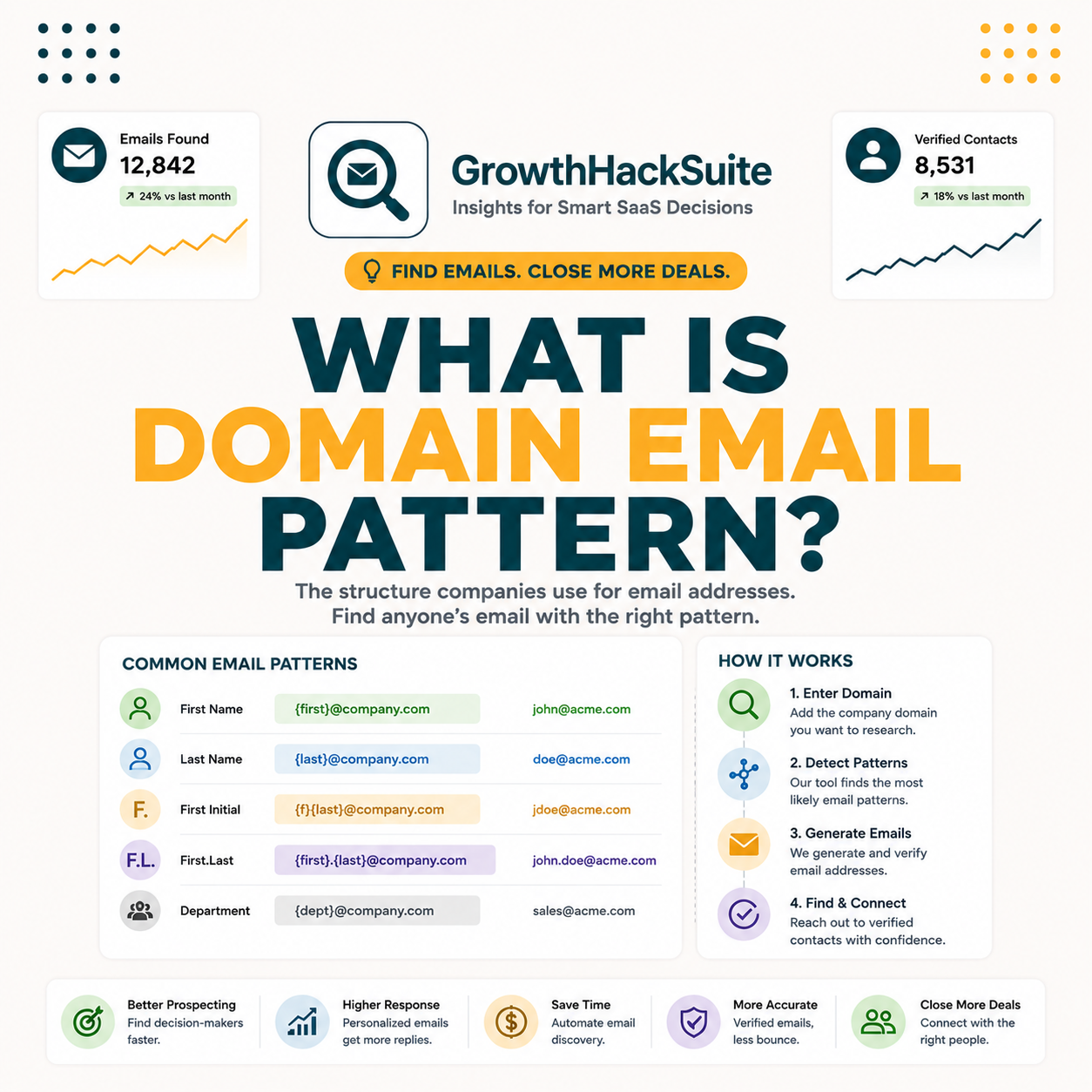
A domain email pattern is the naming formula a company uses for all employee email addresses, such as {first}.{last}@domain.com. Email finding tools detect this convention by scanning indexed sources, then predict any employee’s address with a confidence score. Hunter.io identifies patterns across 580 million indexed emails, letting SDRs build verified prospect lists in minutes instead of hours.
What Is Domain Email Pattern? Core Definition for B2B Sales and Marketing Teams
A domain email pattern is the standardized naming format a company applies to every employee’s email address. Tools discover this pattern by crawling public sources and cross-referencing confirmed addresses, then score each prediction by deliverability confidence. Knowing the pattern eliminates manual guesswork and makes large-scale B2B prospecting repeatable.
For a deeper look at how Hunter.io puts domain email patterns to work in practice, see our Hunter.io Email Finder review for context.
“Corporate email addresses combine a user’s name or initials with the organization’s domain.”
: Wikipedia, Email address
Domain email patterns are the foundation layer underneath every modern email finding tool. Detecting the pattern first reduces bounce risk downstream because tools can apply SMTP verification against a predicted format rather than an unvalidated guess.
How Does Domain Email Pattern Actually Work? The Technical Mechanism Explained
Domain email pattern detection works in five sequential steps: crawling public sources for confirmed email addresses at a domain, extracting the local-part structure, scoring each observed format by frequency, applying the dominant pattern to new name inputs, and validating predictions against live mail servers. The full cycle from domain query to deliverable address takes under two seconds in modern tools.
Five components drive the technical mechanism behind domain email pattern detection:
- Source crawling: Tools index publicly available email addresses from websites, press releases, social profiles, and WHOIS records associated with the target domain.
- Pattern extraction: Each confirmed address is parsed into its local-part structure, mapping variable positions for first name, last name, initials, and separators.
- Frequency scoring: The tool counts how often each format appears across confirmed addresses and ranks patterns by prevalence, assigning a confidence percentage to each.
- Address generation: The dominant pattern is applied to any name input, generating a predicted email address in the format first.last@domain.com or whichever variant scores highest.
- SMTP verification: The predicted address is tested against the company’s mail server to confirm it exists and accepts messages, reducing bounce risk before the address is returned to the user.
Pattern detection accuracy peaks when a domain has multiple confirmed source addresses, giving the algorithm enough signals to establish the dominant format with high confidence. Low-source domains return wider confidence ranges and require manual spot-checking.
What Are the Top 5 Use Cases for Domain Email Pattern in B2B Sales?
Domain email pattern enables five high-value workflows across SDR, marketing ops, and founder-led sales teams. Each use case maps to a specific part of the outbound funnel where pattern-derived addresses outperform manual research or purchased lists on accuracy and speed.
Five use cases where domain email pattern delivers measurable ROI for B2B teams:
- SDR prospecting at scale: Sales development reps run domain searches on target account lists to generate verified email addresses for 50-200 contacts per hour, replacing manual LinkedIn research.
- Account-based marketing list building: Marketing ops teams use pattern detection to populate ABM contact lists with decision-maker emails across named accounts, enabling personalized campaign delivery.
- Warm inbound lead enrichment: Revenue operations teams apply pattern detection to enrich form submissions where only a first name and company domain were captured, filling the missing email field automatically.
- Recruiting outreach: Talent acquisition teams identify direct email addresses for passive candidates at target companies, bypassing LinkedIn InMail open-rate limits for senior-level roles.
- Journalist and partner outreach: PR and partnerships teams find verified contact addresses at media outlets or potential partner companies using the domain pattern, avoiding generic contact forms that reduce response rates.
“Finding the right email address is the first step in every successful cold outreach campaign.”
: HubSpot Sales Blog
Pattern-based prospecting consistently outperforms list-purchase approaches on deliverability because addresses are generated from fresh domain data rather than static databases that decay at 22% per year.
What Are the 5 Limitations of Domain Email Pattern Every Buyer Should Know?
Domain email pattern detection has five structural limitations that affect accuracy in predictable scenarios. Understanding these boundaries helps SDR teams qualify results correctly and avoid sending to low-confidence addresses that inflate bounce rates above the 2% industry threshold.
- Catch-all domains block SMTP verification: Companies that configure their mail servers to accept all incoming mail prevent tools from confirming whether a specific address exists, returning a “catch-all” status rather than “valid” or “invalid.”
- Low-signal domains reduce confidence: Domains with fewer than five confirmed source addresses produce wide confidence ranges, making the predicted pattern statistically unreliable for campaign sends.
- Role-based addresses are excluded: Generic role addresses such as info@, support@, or sales@ are filtered from pattern detection because they are not linked to specific individuals and trigger high spam scores.
- Name variants create mismatches: Employees who use nicknames, middle names, or hyphenated surnames produce addresses that deviate from the dominant pattern, resulting in a predicted address that bounces even when the pattern itself is correct.
- Pattern changes after corporate events: Mergers, acquisitions, and rebrands cause companies to migrate to a new domain or naming convention, rendering previously accurate pattern data stale within weeks of the transition.
“Hunter.io uses pattern detection to score every email address by deliverability confidence, so SDRs can filter out risky addresses before importing any list into their sequencing tool.”
: Growth Hack Suite, Hunter.io Email Finder review
Filtering results to confidence scores above 80% before importing into a sequencer is the practical workaround for all five limitations, trading list volume for deliverability quality.
Top 5 Tools Compared by Domain Email Pattern Approach: Hunter, Apollo, Snov, ZeroBounce, and RocketReach
Five tools dominate the B2B domain email pattern market, each using a different combination of source depth, verification method, and confidence scoring. Hunter.io leads on indexed source volume and confidence transparency; Apollo and Snov.io trade accuracy for database breadth; ZeroBounce and RocketReach address different stages of the same workflow.
Sources: Hunter.io pricing page, Apollo.io pricing page, Snov.io pricing page, ZeroBounce pricing page, RocketReach pricing page (verified May 2026). Accuracy figures from vendor-published benchmarks and third-party testing.
Hunter.io’s confidence scoring is the clearest differentiator in this field: every result includes a numeric confidence percentage and a validation status, letting teams filter below a threshold before exporting rather than discovering bounces after sending.
How Do You Apply Domain Email Pattern in 5 Steps with Hunter.io (Free Workflow)?
Applying domain email pattern with Hunter.io’s free tier takes five steps and requires no CRM integration or paid subscription to verify the first 25 addresses per month. The workflow moves from target account identification to verified email delivery in under 10 minutes per batch.
- Step 1, identify target domains: Compile a list of company domains from your ICP : LinkedIn company pages, G2 categories, or CRM accounts show the domain as part of the website field.
- Step 2, run Domain Search in Hunter: Enter each domain into Hunter.io’s Domain Search. The tool returns the detected pattern (e.g., {first}.{last}@), a confidence score, and all indexed emails found for that domain.
- Step 3, use Email Finder for named targets: For specific prospects, enter the first name, last name, and domain into Hunter’s Email Finder. The tool applies the detected pattern and SMTP-verifies the output address before returning it.
- Step 4, filter by confidence score: Export only addresses with a confidence score above 80% and a validation status of “Valid” or “Accept All.” Exclude “Unknown” statuses from cold campaigns to keep bounce rates below 2%.
- Step 5, import into sequencer: Upload the filtered list to your outreach tool (Instantly, Lemlist, Apollo Sequences, or HubSpot Sequences) as a CSV. Map the email, first name, and company fields to the corresponding sequence variables before launching.
Ready to detect domain email patterns on your target accounts?
Try Hunter.io Free →Free plan includes 25 searches per month. No credit card required.
The free-tier workflow covers most SMB and startup prospecting needs; teams sending more than 200 targeted emails per month will hit the 25-search ceiling quickly and need to evaluate Starter at $49/mo.
How Has the Concept of Domain Email Pattern Evolved Across the B2B Email Tool Category?
Domain email pattern detection evolved from manual convention-guessing in the early 2000s to AI-assisted confidence scoring today. The core concept predates modern SaaS tooling: outbound sales teams hand-mapped common formats like first@company.com or flastname@company.com based on a few confirmed addresses from company websites.
Three phases characterize the category’s development. In the web-scraping era (2005-2012), freelance researchers built pattern libraries manually and sold them as static spreadsheets. The SaaS tooling era (2012-2018) automated crawling and introduced the first confidence scores, with tools like Hunter.io (launched 2015) making domain search accessible via browser and API. The AI enrichment era (2019-present) added machine learning layers that predict patterns even on sparse-source domains by triangulating against industry-wide naming convention databases.
Hunter.io’s transition from a simple email scraper to a confidence-scored pattern engine reflects the category shift: the tool now weighs source recency, MX record health, and catch-all detection simultaneously on each query, returning results that reflect real-time domain behavior rather than indexed history alone.
Domain email pattern detection moved from artisanal research to algorithmic confidence scoring between 2005 and 2026, with AI-assisted triangulation now making sparse-domain lookups viable for the first time at scale.
What Are the Real Cost Implications of Implementing Domain Email Pattern at SDR Team Scale?
At SDR team scale, domain email pattern tools cost $49-$299/month per seat for mid-tier plans, but the full cost picture includes credit consumption rates, bounce rate penalties from email service providers, and the hidden cost of time saved versus manual research. Teams that calculate net ROI rather than sticker price consistently find pattern tools pay back within two to four weeks.
Four cost factors determine total spend for an SDR team running 500 prospecting searches per month. Hunter.io Starter at $49/mo provides 500 searches, making per-address cost $0.10. An SDR billing at $35/hour who manually researches email addresses at 10 per hour spends $3.50 per address in labor, making the tool 35x cheaper per address found. Bounce rate costs add a third dimension: ESP deliverability penalties or account suspension from sustained bounce rates above 2% can cost more in campaign rebuilding time than the tool subscription itself. Credit pooling for small teams (2-5 SDRs sharing a Business plan at $149/mo for 5,000 searches) reduces per-seat cost to $30-75/mo while maintaining adequate search volume.
The real cost calculation for domain email pattern tools is labor displacement plus bounce risk reduction, not subscription price alone. At 500 searches per month, the labor savings from replacing manual research exceed tool cost by a factor of 30x at standard SDR billing rates.
What Are the 5 Common Mistakes B2B Teams Make With Domain Email Pattern?
Five mistakes account for most domain email pattern failures in B2B sales teams. Each mistake is systematic rather than incidental, meaning teams repeat the same error across campaigns until the root behavior is corrected in process documentation or tool configuration.
- Ignoring confidence scores: Teams export all returned addresses regardless of confidence level and import them into sequencers without filtering, driving bounce rates above 5% and triggering ESP deliverability warnings within the first campaign week.
- Treating catch-all domains as valid: Catch-all status means the mail server accepts all addresses regardless of existence. Sending to unverified catch-all addresses at volume contributes to high bounce rates even when the tool returns an “Accept All” status.
- Not re-verifying after 90 days: Email addresses decay at 22% annually, meaning a list built in January has a 6% decay rate by April. Teams that build once and send repeatedly without reverification accumulate stale addresses that inflate bounce metrics over time.
- Using a single pattern for entire company: Large companies with multiple subsidiaries or regional offices often use different email patterns per entity. Applying the parent company’s pattern to a subsidiary domain generates incorrect addresses at scale.
- Skipping SMTP verification before import: Pattern detection predicts the format; SMTP verification confirms the address exists on the mail server. Skipping verification and relying on pattern alone increases invalid address rates by 15-25% depending on domain type.
Filtering to confidence above 80%, excluding catch-all addresses from cold sends, and re-verifying lists quarterly eliminates four of the five mistakes without any tool changes, requiring only a process update in the SDR team’s outreach SOP.
How Do SDRs, Email Marketers, and Founders Each Apply Domain Email Pattern Differently?
Three B2B personas use domain email pattern detection for distinct goals with different depth requirements: SDRs prioritize speed and volume at the account level, email marketers prioritize list hygiene and deliverability compliance, and founders prioritize precision over scale for high-value target relationships.
SDRs run domain searches on target account lists of 50-200 companies per week, using the tool to build a named-contact list at each account rather than prospecting into a generic company address. A standard SDR workflow generates 10-20 verified addresses per target domain in under five minutes, feeding sequences that run 4-7 touch points over 14 days.
Email marketers apply domain email pattern detection primarily for inbound enrichment, using it to fill missing email fields on form submissions where a prospect provided name and company but not email. This enrichment workflow recovers 30-40% of leads that would otherwise require a manual follow-up step before entering nurture campaigns.
Founders doing founder-led outreach use pattern detection for high-precision single lookups rather than batch exports. A founder targeting a specific VP of Engineering at a $50M ARR SaaS company queries the domain, confirms the pattern, and uses Email Finder for that individual, treating each result as a named relationship rather than a list entry.
The same underlying pattern detection engine serves all three personas; the difference is query scale (batch vs single), confidence threshold (SDRs accept 75%+, founders prefer 90%+), and downstream destination (sequencer vs inbox vs CRM enrichment field).
What Are the Best Practices for Implementing Domain Email Pattern in 2026?
Five best practices distinguish high-performing domain email pattern implementations from average ones in 2026. Each practice addresses a specific failure mode identified in SDR teams sending more than 1,000 cold emails per month at verified B2B companies.
- Set confidence thresholds by campaign type: Cold campaigns targeting new ICP accounts require a minimum 80% confidence filter. Warm campaigns to previously engaged contacts can accept 70% confidence given the lower cold-start risk of sending to a known relationship.
- Separate catch-all domains into a slow-drip segment: Catch-all addresses cannot be fully verified; isolate them into a separate sequence capped at 10 contacts per day per sending domain to preserve sender reputation while still working the list.
- Run quarterly list refresh cycles: Schedule a reverification run on every list older than 90 days using the tool’s bulk verification feature. Remove addresses that have shifted from “Valid” to “Invalid” or “Unknown” before the next campaign activation.
- Document the detected pattern per domain: Log the confirmed email pattern for each target domain in the CRM account record. This reference prevents re-querying the same domain on future campaigns and provides context for sales ops when investigating bounce sources.
- Combine pattern detection with LinkedIn verification: Cross-reference pattern-generated addresses against the prospect’s LinkedIn profile to confirm their current employer and title before sending. This step catches job changers whose email pattern is still valid at the old employer but whose domain has changed.
Teams that implement all five practices maintain bounce rates below 1.5% and sender reputation scores above 90% on major ESPs, compared to industry averages of 3-5% bounce and 75-80% reputation for teams without structured pattern hygiene processes.
What Industry Trends Are Reshaping Domain Email Pattern Going Into Late 2026?
Three structural trends are reshaping domain email pattern detection in the second half of 2026: AI-assisted pattern inference for sparse domains, real-time MX health monitoring integrated into confidence scoring, and tighter GDPR and CAN-SPAM enforcement increasing buyer scrutiny of how pattern data is sourced and stored.
AI inference for sparse domains is the most impactful development for SDR teams targeting SMB accounts. Previously, domains with fewer than three confirmed source addresses returned “no pattern detected,” forcing manual fallback research. In 2026, tools like Hunter.io apply industry-wide naming convention models to predict the most likely pattern even on zero-source domains, enabling cold outreach into the long tail of sub-500-employee companies that were previously unaddressable via pattern detection.
Real-time MX health monitoring adds a layer of infrastructure intelligence to confidence scoring. An address that scores 85% on pattern confidence but resolves to a mail server with degraded MX health now returns a lower effective confidence score, reflecting the actual delivery risk rather than just the naming convention probability. This prevents false confidence on technically valid patterns at domains undergoing infrastructure migration.
Pattern detection in 2026 is moving from a static data retrieval task to a dynamic risk assessment that weighs naming convention, infrastructure health, and regulatory data sourcing simultaneously, producing confidence scores that reflect real-time deliverability rather than historical pattern frequency alone.
Domain Email Pattern: Frequently Asked Questions
Which tool is best for domain email pattern detection?
Hunter.io leads for SDR prospecting due to its 91% deliverability rate and confidence-scored results across 580 million indexed sources. Apollo.io is the better choice for teams needing full CRM enrichment alongside pattern detection. Snov.io serves budget-conscious teams with sufficient accuracy for volume outbound under 500 sends per month.
How accurate is domain email pattern detection in practice?
Accuracy ranges from 78% to 91% deliverability across leading tools, depending on domain source coverage and verification methodology. Hunter.io reports 91% on its verified results when filtering to confidence scores above 80%. Accuracy drops to 60-70% on catch-all domains and sparse-source SMB domains regardless of tool, because mail server behavior prevents definitive SMTP confirmation.
What is the difference between domain email pattern and email enrichment?
Domain email pattern predicts the naming format a company uses, allowing tools to generate an email address from any employee’s name. Email enrichment is broader: it appends multiple data fields (email, phone, title, LinkedIn URL, firmographics) to an existing record. Pattern detection is the mechanism inside enrichment tools, but enrichment delivers a fuller contact profile where pattern detection delivers only the email address.
How long does it take to set up domain email pattern lookups?
Single-domain setup in Hunter.io takes under two minutes: create a free account, navigate to Domain Search, enter the target domain, and receive pattern and email results immediately. Bulk setup for a list of 50 domains using Hunter’s Bulk Domain Search takes approximately 10 minutes to upload, process, and export results. API integration for automated workflows requires 2-4 hours for a developer to implement depending on CRM complexity.
How much does domain email pattern detection cost?
Hunter.io free tier covers 25 searches per month at $0 cost, sufficient for founder-led outreach. Starter at $49/mo provides 500 searches. Growth at $99/mo provides 2,500 searches. Business at $199/mo covers 10,000 searches for teams. Per-search cost falls from $0.10 at Starter to $0.02 at Business plan volume, making bulk prospecting significantly cheaper than purchasing static lists at $0.10-0.50 per record.
Will domain email pattern detection improve our reply rates?
Pattern detection improves reply rates indirectly by ensuring emails reach real inboxes rather than bouncing. Lower bounce rates (below 2%) maintain sender reputation, which improves inbox placement rates and therefore open rates. Teams migrating from purchased static lists to pattern-detected verified addresses typically see bounce rates drop from 8-15% to under 2%, with open rate improvements of 8-15 percentage points as a downstream effect of better inbox placement.
Can I test domain email pattern detection for free?
Hunter.io’s free plan includes 25 domain searches and 25 email finds per month with no credit card required at signup. The free tier provides full access to pattern detection, confidence scores, and SMTP verification results, making it a complete test environment for evaluating accuracy on your specific target domains before committing to a paid plan. Apollo.io and Snov.io also offer limited free tiers with 10-50 credits per month.
Does domain email pattern integrate with our existing sales stack?
Hunter.io integrates natively with HubSpot, Salesforce, Pipedrive, and Zoho CRM via official integrations, enabling direct record creation from Domain Search results. The Hunter Chrome Extension allows pattern lookups directly from LinkedIn and company websites without leaving the browser. The Hunter API (available on Growth plan and above) supports custom integration with any CRM or outreach tool that accepts REST API calls. Zapier-based automations are available for tools without native Hunter support.
What is a domain email pattern?
A domain email pattern is the naming formula a company uses to format every employee’s email address. Common formats include {first}.{last}@domain.com (e.g., john.smith@acme.com), {first}@domain.com, {f}{last}@domain.com, and {first}{last}@domain.com. Email finding tools detect the dominant pattern by analyzing confirmed addresses indexed from public sources, then apply that pattern to predict any employee’s email given their name and the company domain.
How does domain email pattern detection work technically?
Tools crawl publicly indexed sources (company websites, press releases, social profiles) to collect confirmed email addresses at a target domain. Each address is parsed to identify the local-part structure: positions of first name, last name, initials, and separators. The tool counts format frequency, assigns a confidence score to the most common pattern, then applies that pattern to any new name input. SMTP verification then tests the predicted address against the company’s mail server to confirm deliverability before returning the result.
Is domain email pattern detection included in Hunter.io’s free plan?
Domain Search and the underlying pattern detection feature are fully available on Hunter.io’s free plan with 25 searches per month. Each search returns the detected email pattern, confidence percentage, and all indexed email addresses found for the queried domain. The free plan also includes Email Finder (25 finds/mo) and Email Verifier (50 verifications/mo), providing the complete pattern-to-verification workflow without a paid subscription.
What features does a domain email pattern tool require to work accurately?
Accurate domain email pattern detection requires four core capabilities: a large indexed source database (580M+ addresses in Hunter.io’s case), real-time SMTP verification to test predicted addresses against live mail servers, confidence scoring to communicate uncertainty rather than returning binary valid/invalid results, and catch-all domain detection to flag domains where SMTP verification cannot confirm individual address existence. Tools missing any of these four components produce results that appear accurate but fail at campaign launch.
Start building verified prospect lists with domain email patterns today.
Hunter.io detects the naming convention for any company domain and confidence-scores every address before you export.
Try Hunter.io Free →Free plan: 25 searches/month. No credit card required. Upgrade anytime.