Table of Contents
What is a gibberish email? It is an address with a random or nonsensical local part, like asdfjkl@domain.com, usually created by bots, fake signups, or heavy typos. These addresses rarely belong to a real person and almost always bounce. This guide explains what a gibberish email is, why it appears, and how verifiers flag the random and typo addresses that quietly damage deliverability.
Catch gibberish signups free — verify your list with Hunter at no cost.
Verify Your List Free →Free plan included · No credit card · Full status and scoring
What Is a Gibberish Email Address?
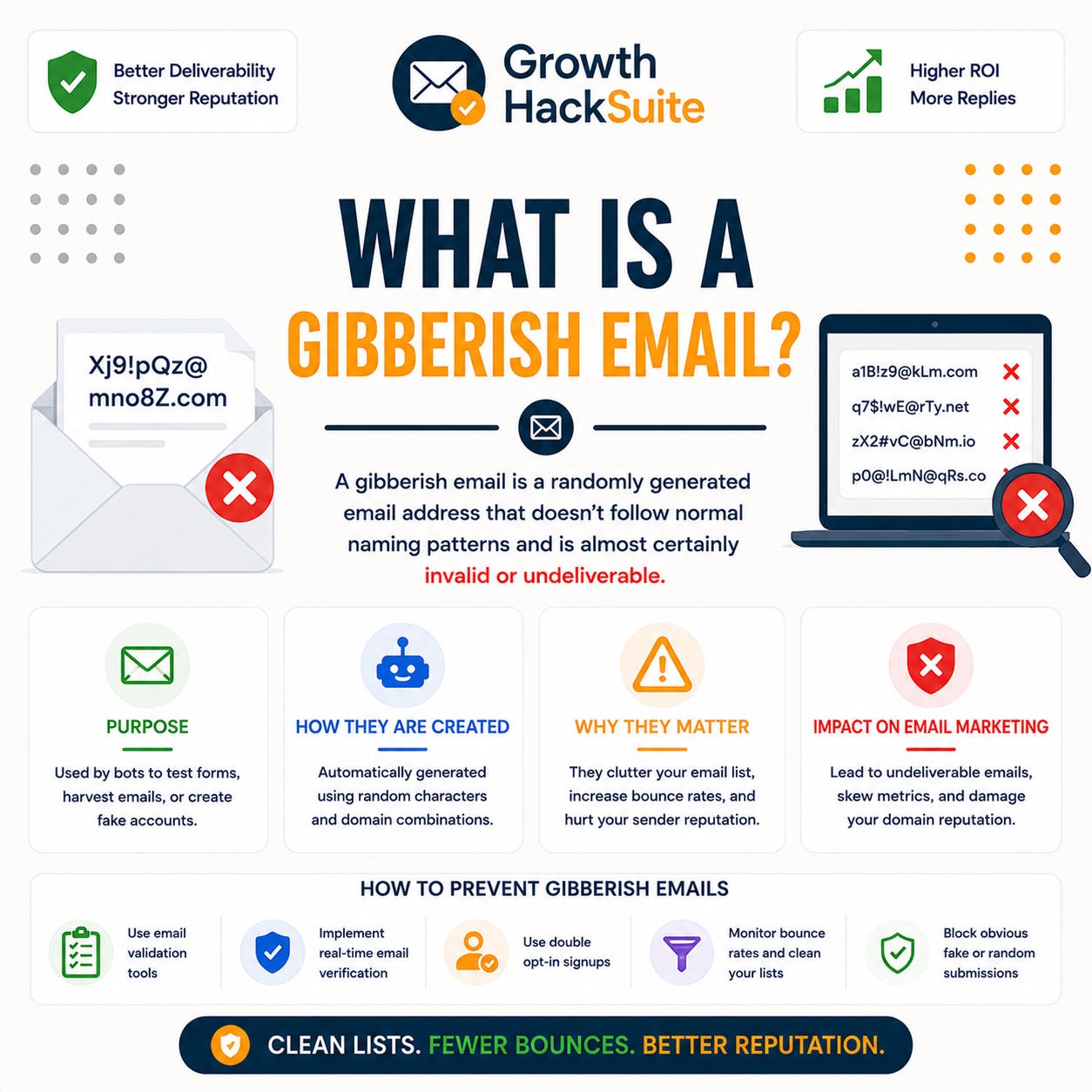
A gibberish email is an address whose local part is random or nonsensical, such as a string of unrelated letters and numbers, rather than a recognizable name or word. These addresses are usually produced by bots, fake signups, or severe typos, and they rarely belong to a real, reachable person. A gibberish email is therefore a strong signal of low-quality data on a list.
- Random local part: The portion before the @ reads as unrelated characters, like xkqz8j2@domain.com, with no name, word, or pattern a human would naturally choose for a working inbox.
- Bot or typo origin: Automated scripts and mistyped entries generate most of these addresses, so a gibberish email signals either machine activity or a fat-fingered form submission rather than a genuine subscriber.
- Rarely a real person: Almost no gibberish address maps to an active mailbox, which means messages sent to it bounce, drag down deliverability metrics, and inflate list size with dead records.
- No engagement value: A gibberish address never opens, clicks, or replies, so it adds cost and risk to a campaign while contributing nothing to revenue, reach, or measurable audience interest.
- Common on free lists: Public lead magnets and gated downloads collect the most gibberish, because visitors and bots can submit junk text without facing any verification barrier at the form.
A gibberish email is a random-looking address, usually bot-made or mistyped, and almost never real or reachable.
How Do Verifiers Recognize Gibberish?
Verifiers detect a gibberish email by analyzing the local part for patterns: random character sequences, a lack of pronounceable structure, and signatures typical of machine-generated strings. Combined with syntax and SMTP checks, this analysis flags addresses unlikely to belong to a human before any campaign reaches them, turning pattern recognition into a deliverability safeguard.
- Pattern analysis: Detection engines score the local part for vowel distribution, character entropy, and pronounceability, identifying strings that read like noise rather than a name or recognizable word.
- Random-string signals: Keyboard runs, long digit blocks, and high-entropy character mixes mark machine-generated addresses, separating likely bot output from the structured local parts genuine subscribers create.
- Syntax screening: A first pass rejects malformed addresses with illegal characters or broken structure, removing obvious junk before deeper pattern and mailbox checks spend resources on clearly unusable entries.
- Domain validation: The engine confirms the domain exists and accepts mail through its records, filtering out gibberish paired with fake or non-routable domains that could never receive a message.
- Combined with SMTP: Pattern flags pair with a mailbox-level deliverability check, so a suspicious address is confirmed undeliverable rather than rejected on appearance alone, reducing false negatives.
Verifiers spot a gibberish email by analyzing the local part for machine-like randomness, then confirm the verdict with an SMTP check.
Why Do Gibberish Emails Appear on Lists?
Gibberish addresses come from bots filling forms, users entering fake data to bypass a signup, and bad typos. Forms without verification or bot protection collect them readily, so a gibberish email clusters on lead magnets and unprotected signup pages where the barrier to a junk entry is lowest and automated traffic is highest.
- Bot signups: Automated scripts submit forms at scale using randomly generated local parts, flooding lead-capture pages with addresses that no human ever owned and exist only to complete a field.
- Fake entries: Visitors wanting a gated download without sharing a real inbox type random characters to pass the form, leaving a junk record that counts as a lead but never engages.
- Severe typos: Rushed or mobile users mangle an address so badly that the local part becomes effectively random, producing a gibberish email that looks bot-made yet started as a genuine attempt.
- Form abuse: Competitors, scrapers, and spammers seed random addresses to test a form, exhaust resources, or pollute a database, leaving gibberish behind as a side effect of deliberate misuse.
- Missing safeguards: Pages without real-time verification or a bot challenge accept every submission, so junk text passes straight into the list where it accumulates unnoticed until a campaign bounces.
Bots and form abuse routinely inject invalid or random addresses into unprotected signup lists.
— Hunter, Email Verifier API documentation
A gibberish email enters via bots, fake entries, and typos, clustering on unprotected signup forms where junk data faces no barrier.
Are All Gibberish Emails Fake?
Almost, but not entirely. Most gibberish addresses are bot-generated or fake and will bounce, but a few are legitimate random-looking system addresses or aliases. So verifiers treat a gibberish email as a strong risk signal confirmed by the deliverability check, not an automatic invalid, preventing the rare real address from being wrongly discarded.
- Mostly fake: The large majority of random-looking local parts trace to bots or fake form entries, so the default expectation for a gibberish email is a bounce and removal from any active sending list.
- Rare legitimate ones: Some systems issue random aliases or auto-generated addresses for privacy or routing, meaning a small fraction of gibberish-looking addresses are deliverable and belong to a real recipient or service.
A gibberish email is a strong risk signal, not an automatic invalid, because the SMTP check still confirms whether the rare one is real.
What Do Gibberish Emails Do to Your List?
Gibberish addresses bounce, inflate signup counts with fake records, and distort conversion analytics. Left unchecked, a gibberish email raises bounce rate, wastes sending budget, and erodes sender reputation with mailbox providers. Catching these addresses, ideally at signup, keeps both deliverability and reporting accurate for every campaign that follows.
- Bounce damage: Each undeliverable send raises the hard-bounce rate, a metric mailbox providers watch closely, so accumulated gibberish addresses push a sending domain toward throttling or spam-folder placement.
- Inflated counts: Fake records swell total subscriber numbers without adding real reach, making list growth and audience size look healthier than the actual deliverable, engaged population behind the report.
- Distorted analytics: Open and click rates calculated against a list padded with junk addresses understate true engagement, leading teams to misread campaign performance and make decisions on skewed denominators.
Removing undeliverable addresses before sending is the most direct way to protect bounce rate and sender reputation.
— Growth Hack Suite, reduce email bounce rate with Hunter
A gibberish email bounces and fakes signup numbers, so catching it protects both deliverability and the accuracy of campaign analytics.
How Common Are Gibberish Signups?
Gibberish spikes on forms targeted by bots or offering high-value freebies without protection. A form with no verification or bot defense can collect a notable share of gibberish, which is why real-time verification and bot protection matter most on public lead-gen pages where automated traffic concentrates and a gibberish email slips in easily.
- Spike on unprotected forms: Signup pages lacking verification or a bot challenge accumulate junk entries fastest, since automated submissions face no friction and a single script can register many gibberish addresses in minutes.
- High-value freebies: Gated downloads, discount codes, and giveaways attract visitors willing to enter fake data, raising the proportion of gibberish among signups on any page promising an immediate reward.
A gibberish email spikes on unprotected, high-incentive forms, which is exactly where real-time checks and bot defenses pay off most.
Gibberish vs Invalid: What Is the Difference?
Gibberish describes the look of the address, a random local part; invalid describes its deliverability, that it bounces. Most gibberish is invalid, but the two labels answer different questions: one is a pattern flag, the other a delivery verdict. The table below contrasts a gibberish email with a confirmed invalid result and what proves each.
Source: Hunter Email Verifier API documentation (hunter.io/api-documentation/v2), reviewed 2026-06-29; definitions reflect standard email-verification terminology.
A gibberish email is a pattern flag and invalid is a delivery verdict, and most gibberish turns out invalid once the SMTP check runs.
Can Gibberish Detection Make Mistakes?
Yes, occasionally. Some legitimate addresses use random-looking aliases or system-generated strings, so pattern detection can over-flag a gibberish email that is actually real. Good verifiers treat the pattern as one signal and confirm it with the deliverability check, avoiding false rejections of unusual but valid addresses that merely resemble machine output.
- Random-looking aliases: Privacy services and automated systems issue real addresses with high-entropy local parts, so an alias can resemble a gibberish email while still routing to an active, deliverable mailbox.
- Confirmed by SMTP: Pairing the pattern flag with a mailbox-level check resolves ambiguity, keeping a deliverable but odd-looking address rather than discarding it on appearance, which protects legitimate contacts from accidental removal.
Pattern detection can over-flag a random-looking real alias, so the SMTP confirmation step keeps gibberish detection honest and accurate.
How Do You Handle Gibberish Emails?
Block gibberish at signup with real-time verification and bot protection, and bulk-verify existing lists to remove addresses already collected. Treat a gibberish email flagged invalid as removable, but investigate the rare gibberish address that verifies as deliverable before deleting it, so genuine contacts behind unusual aliases are not lost in the cleanup.
- Block at signup: Real-time verification at the form rejects random local parts and bot submissions before they enter the database, stopping a gibberish email at the source rather than cleaning later.
- Add bot protection: A challenge or honeypot on public forms stops automated scripts from mass-submitting random addresses, cutting the volume of gibberish that ever reaches the verification step or the list.
- Bulk-clean existing: Running the current list through a verifier identifies and segments gibberish already collected, removing undeliverable junk so historical signups no longer drag down bounce rate.
- Segment the risky: Addresses flagged as accept-all or low-confidence move to a separate group for monitoring, keeping uncertain records out of primary sends without deleting potentially valid contacts outright.
- Confirm before deleting: Checking that a flagged address truly bounces before removal protects the rare deliverable alias, ensuring cleanup targets dead records without discarding legitimate but unusual contacts.
Verify your list free to remove gibberish addresses before they bounce.
Verify Your List Free →Free plan · No credit card · Pattern and deliverability checks
Block a gibberish email at the form, bulk-clean the rest, and confirm the rare deliverable one before deleting it from the list.
What Tools Detect Gibberish Emails?
Verifiers with pattern analysis plus SMTP checks catch gibberish best, while basic validators miss random-but-valid-format addresses. Hunter combines pattern and deliverability checks with a free tier, so a gibberish email is flagged on appearance and confirmed by mailbox response. The table compares how detection methods differ across verification approaches.
Source: Hunter Email Verifier API documentation (hunter.io/api-documentation/v2), reviewed 2026-06-29; rows describe detection method categories rather than specific vendor benchmarks.
Pattern analysis plus an SMTP check is what catches a gibberish email, while syntax-only tools let random-but-valid-format addresses through.
Verdict: What to Do About Gibberish Emails
A gibberish email is a random-looking address, usually bot-made or mistyped, that almost always bounces. Block it at signup with real-time verification and bot protection, bulk-clean existing lists, and confirm the rare deliverable one before deleting. Handling gibberish well protects both deliverability and clean reporting across every campaign a sender runs.
Verdict: A gibberish email has a random local part, is mostly fake, and almost always bounces. Block it at signup, bulk-clean what is already collected, and confirm the rare deliverable one by SMTP before deleting.
An email address identifies a mailbox to which messages are delivered.
— Wikipedia, Email address
Verify your list free and catch gibberish signups before they cost you.
Verify Your List Free →Free plan · No credit card · Clean lists, accurate reporting
A Gibberish Email at a Glance
The signals of a gibberish email cluster around three traits: a random local part, a bot or typo origin, and a near-certain bounce. Seeing them together explains why verifiers treat the pattern as a risk flag and why catching these addresses early keeps a list deliverable and its analytics trustworthy.
Three Traits of a Gibberish Email
Recognizing these three traits together is the fastest way to spot a gibberish email and decide whether to block, clean, or confirm it.
Related Tools in the Hunter Stack
A gibberish email ties directly to signup verification and to confirming invalid addresses. The Hunter verifier overview covers how detection works, and the verification basics guide covers blocking junk at entry, so both extend what this definition introduces.
- Hunter Email Verifier: The validation layer that flags gibberish and confirms deliverability — start with what the Hunter Email Verifier is.
- Email verification basics: The underlying check that catches gibberish before a send — read what email verification is for the fundamentals.
- Bounce-rate workflow: The payoff of removing junk addresses — see how to reduce email bounce rate with Hunter across a full list.
Gibberish Email Addresses: Frequently Asked Questions
The 12 most-asked questions about gibberish email addresses.
What is a gibberish email address?
A gibberish email is an address whose local part is random or nonsensical, like asdfjkl@domain.com, rather than a recognizable name or word. These addresses are usually generated by bots, entered as fake data, or produced by severe typos, and they rarely belong to a real, reachable person.
How do verifiers recognize gibberish?
Verifiers analyze the local part for random character sequences, low pronounceability, and high entropy that signals machine-generated strings. They pair this pattern analysis with syntax and SMTP checks, so an address that looks like noise is confirmed as undeliverable rather than rejected on appearance alone.
Why do gibberish emails appear on lists?
They come from bots filling forms at scale, users entering fake data to bypass a gated signup, and bad typos that mangle a real address into random characters. Forms without verification or bot protection collect them most, especially on lead magnets and public signup pages.
Are all gibberish emails fake?
Almost, but not entirely. The large majority are bot-generated or fake and will bounce, yet a small fraction are legitimate random-looking aliases or system-generated addresses that do deliver. Verifiers therefore treat gibberish as a strong risk signal confirmed by a deliverability check, not an automatic invalid.
What do gibberish emails do to my list?
They bounce, inflate signup counts with fake records, and distort conversion analytics by padding the denominator behind open and click rates. Left unchecked, gibberish raises the hard-bounce rate, wastes sending budget, and erodes sender reputation with mailbox providers over time.
How common are gibberish signups?
Gibberish spikes on forms targeted by bots or offering high-value freebies without protection. A page with no verification or bot defense can collect a notable share of junk addresses, which is why real-time verification matters most on public lead-gen forms where automated traffic concentrates.
Gibberish vs invalid — what is the difference?
Gibberish describes the appearance of the address, a random local part, while invalid describes its deliverability, that it bounces. Most gibberish is invalid, but the labels answer different questions: one is a pattern flag found by text analysis, the other a delivery verdict confirmed by an SMTP check.
Can gibberish detection make mistakes?
Yes, occasionally. Some legitimate addresses use random-looking aliases or system-generated strings, so pattern detection can over-flag a real address as gibberish. Good verifiers treat the pattern as one signal and confirm it with a deliverability check, avoiding false rejections of unusual but valid contacts.
How do I handle gibberish emails?
Block them at signup with real-time verification and bot protection, then bulk-verify existing lists to remove addresses already collected. Treat gibberish flagged invalid as removable, but confirm the rare gibberish that verifies as deliverable before deleting it so a genuine alias is not lost.
What tools detect gibberish emails?
Verifiers that combine pattern analysis with an SMTP check catch gibberish best, while syntax-only validators miss random-but-valid-format addresses. Hunter pairs pattern detection with deliverability checking and offers a recurring free tier, so junk is both flagged on appearance and confirmed by mailbox response.
Do gibberish emails bounce?
Almost always. Because the local part is random and rarely maps to a real mailbox, a gibberish email typically returns a hard bounce when a campaign sends to it. That bounce raises the domain’s bounce rate, a metric mailbox providers watch when deciding placement, which is why removing gibberish early matters.
Should I block gibberish at signup?
Yes, blocking at signup is the most effective defense. Real-time verification and bot protection at the form reject random local parts before they enter the database, stopping a gibberish email at the source. That prevents bounces, keeps counts honest, and reduces the cleanup needed on existing lists later.