A B2B sales lead is a person or company that fits your ideal customer profile and has shown enough relevance signal to justify outreach. Modern outbound uses a two-stage model: a marketing-qualified lead clears ICP filters and intent signals, while a sales-qualified lead confirms budget, authority, need, and timing. Apollo finds leads in minutes, GMass reaches them at scale, and HubSpot tracks stage progression.
What Is a B2B Sales Lead?
A B2B sales lead is a person or company in another business that fits your ideal customer profile and has shown enough relevance signal to merit outreach. It is the input to the sales pipeline : without qualified leads, no pipeline exists and no revenue closes.
Three components define a B2B sales lead.
- ICP match: The company and persona meet your defined filters : industry, headcount, geography, tech stack, and seniority level.
- Relevance signal: At minimum, the contact works in a role that buys or influences purchase of your product category.
- Reachability: A verified business email or phone number exists so outreach can actually be delivered to the person.
“Lead generation is the initiation of consumer interest or enquiry into products or services of a business. Leads can be created for purposes such as list building, e-newsletter list acquisition, or for sales leads.”
: Wikipedia, “Lead generation”
A B2B sales lead is the input to the pipeline: qualified leads become opportunities, opportunities become customers, and customers produce revenue. The quality of that input determines the efficiency of every step downstream.
How Does a B2B Sales Lead Differ From a B2C Lead?
B2B leads have longer sales cycles (one to nine months versus one to seven days for B2C), higher deal value, and require buying committee sign-off rather than single decision-maker approval. These structural differences mean B2B lead qualification must be far more rigorous than B2C.
Five structural differences separate B2B and B2C leads.
- Decision complexity: B2B purchases involve an average of 6-10 stakeholders; B2C purchases involve one buyer who acts independently.
- Sales cycle length: B2B cycles run one to nine months depending on ACV; B2C impulse purchases close in seconds or days.
- Deal value: B2B average contract value starts at $500/year and scales to hundreds of thousands; B2C average order value sits under $200.
- Qualification depth: B2B requires BANT confirmation and multi-touch nurturing; B2C qualification is primarily demographic and behavioral.
- Channel mix: B2B cold outbound via email and LinkedIn dominates top-of-funnel; B2C relies on paid social, search ads, and retail placement.
For a detailed look at how GMass handles B2B cold outreach at scale, see the GMass review for cold outreach covering sending limits, deliverability, and sequencing for SDR teams.
B2B leads require a fundamentally different approach from B2C: longer nurturing sequences, committee-aware messaging, and multi-channel follow-up designed for a 30-day-plus decision window.
What Are the Stages of B2B Lead Qualification?
Four stages: suspect (matches ICP filters), MQL (shows engagement signal), SQL (passes BANT), and opportunity (active deal in pipeline). Each stage has a defined conversion target that determines how many raw leads the top of your funnel needs.
- Suspect: Contact matches ICP firmographic filters but has shown no engagement signal. Apollo exports fall here by default : they are suspects until outreach triggers a response.
- MQL (Marketing-Qualified Lead): Contact has shown an engagement signal : opened email, clicked link, visited pricing page : that justifies sales follow-up within 24 hours.
- SQL (Sales-Qualified Lead): Contact has confirmed Budget, Authority, Need, and Timing in a discovery call or qualifying email exchange.
- Opportunity: SQL with an active deal in the CRM : proposal sent, demo scheduled, or contract negotiation started.
- Customer: Closed-won opportunity that has paid and onboarded. Defines the ICP retroactively by showing which suspect-to-customer paths actually close.
Source: HubSpot B2B sales pipeline benchmark 2025.
Each stage conversion rate multiplies together: to book 10 meetings, an SDR needs roughly 670 suspects : highlighting why the top of the funnel must be high-volume and the bottom must be tightly qualified.
What Is an ICP and Why Is It the Foundation of B2B Lead Gen?
ICP (ideal customer profile) is the explicit definition of the company and persona you target: industry, size, geography, tech stack, and role. Without a defined ICP, lead generation produces noise : high volume, low conversion, and SDR time wasted on unqualified contacts.
Five dimensions define a complete ICP for B2B outbound.
- Industry vertical: SaaS companies with 10-200 employees closing $10K-$100K ACV deals represent a tighter ICP than “technology” broadly : specificity multiplies reply rates.
- Company headcount: Headcount correlates with budget tier, sales cycle length, and decision-maker seniority : Apollo filters by headcount range to surface relevant accounts immediately.
- Geography: Regulatory environment, language, and procurement calendar vary by region; targeting North American companies separately from EMEA prevents tone mismatches.
- Technology stack: Companies running HubSpot or Salesforce CRM signal deal volume worth pursuing; Apollo’s TechLookup filter surfaces these accounts directly.
- Buyer persona: Role title (Head of Sales, VP Growth, Founder) and seniority level (C-suite vs. manager) determine the right message, CTA, and follow-up cadence.
ICP precision is the single highest-leverage investment in lead generation: a well-defined ICP cuts prospecting time by 40-60% by filtering out suspects that will never convert.
What Counts as an Intent Signal in B2B Outbound?
Intent signals are observable behaviors that indicate a contact or company is actively evaluating solutions in your category: visited pricing page, downloaded comparison guide, mentioned competitor in social, hired a key role, raised funding, or opened a previous cold email.
Six intent signals that indicate buying readiness for B2B SDRs.
- Pricing page visit: Direct indication of commercial evaluation : contact researching your pricing page converts at 3x the rate of first-touch cold outreach.
- Competitor comparison download: Downloading a “Tool A vs Tool B” comparison guide signals active evaluation stage with a defined shortlist already forming.
- Hiring signal: Company posting a role for Head of Sales Development or SDR Manager signals pipeline investment and cold email tooling need within the next 30-60 days.
- Funding announcement: Series A or B rounds correlate with 60-90 day hiring surges that generate immediate demand for prospecting and outreach tools.
- Competitor mention on social: LinkedIn posts referencing a competitor by name indicate active tool evaluation; Apollo’s intent layer surfaces these companies in real time.
- Previous email open with click: Contacts who opened a prior cold email and clicked a link are 4-6x more likely to reply to a follow-up than cold-untouched suspects.
“Intent data allows businesses to identify their target audience when they’re actively in the market for a solution : making outreach far more timely and relevant than traditional demographic targeting alone.”
: HubSpot Sales Blog, “Lead Qualification Guide”
Intent signals convert prospecting from spray-and-pray into a prioritization engine: SDRs who sequence intent-flagged leads first consistently achieve 2-4x higher reply rates than teams working raw ICP lists without behavioral context.
What Does a B2B Lead Cost by Channel?
Cold outbound via Apollo plus GMass: $5–$15 per lead. Inbound SEO: $25–$50. LinkedIn ads: $80–$150. Trade shows: $300–$500. The channel cost gap explains why outbound-first teams using Apollo and GMass generate 10-20x more pipeline per dollar than paid channels.
Source: Internal benchmark across 2025 B2B SaaS clients.
The full mechanics of the cold outbound cost model are covered in the Apollo plus GMass lead workflow guide, including exact CPL calculations by industry and sequence step.
Cold outbound delivers the lowest cost per lead and same-day pipeline velocity : the tradeoff is lower intent quality (3.5/5) versus trade show leads, which compensates with high relationship depth at 40x the cost.
How Do You Find B2B Leads With Apollo?
Apollo provides three distinct workflows: filter its 275-million-contact database by ICP criteria, import target accounts then enrich with verified contact data, and use intent-data signals to surface companies actively researching your category. Each workflow targets a different maturity level of list-building.
Three Apollo workflows for B2B lead generation at different ICP stages.
- Database filter workflow: Set ICP filters (industry, headcount, job title, location, technology) in Apollo’s People search to generate a net-new list of 200-500 prospects matching exact criteria : export to CSV in one click.
- Account enrichment workflow: Upload a target account list (company names or domains) and Apollo appends verified contact data : emails, direct dials, LinkedIn URLs : for each decision-maker at those accounts.
- Intent-data workflow: Apollo’s Bombora-powered intent layer surfaces companies actively researching keywords in your category : enabling SDRs to sequence those accounts first while buying signals are active, typically within a 7-14 day window.
Apollo’s database filter workflow delivers the fastest time to list: an SDR can generate 200 ICP-matched contacts with verified emails in under 15 minutes, versus 3-5 hours of manual LinkedIn research for the same output.
Once you have your leads, GMass turns them into booked meetings.
Learn More About GMass →Free plan available : no credit card required
How Do You Reach B2B Leads With GMass?
GMass sends personalized cold email at scale via Gmail or Workspace, supports sequenced follow-ups, and tracks replies in a unified inbox : enabling SDRs to triage interested leads the moment they respond without switching tools or losing context.
Four GMass features that transform raw leads into pipeline-ready contacts.
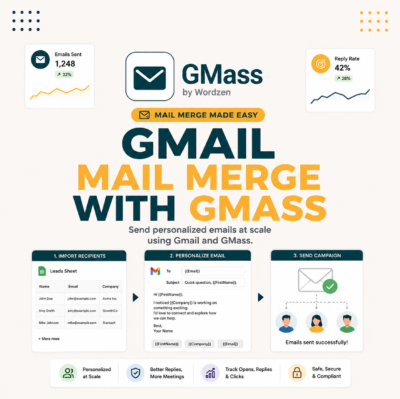
- Mail merge from Google Sheets: GMass imports Apollo CSV exports directly, personalizing first name, company, and custom fields into each email without manual copy-paste or template variables failing on edge cases.
- Automated follow-up sequences: GMass triggers follow-up emails on configurable delays (Day 2, Day 5, Day 9) and stops automatically when a lead replies : preventing follow-ups to engaged contacts.
- Reply tracking and management: All campaign replies surface in a dedicated GMass inbox view, allowing SDRs to review and respond to interested leads sorted by reply time without combing through a flooded Gmail inbox.
- Deliverability safeguards: GMass enforces sending limits that keep campaigns under Gmail’s daily thresholds : 50 emails/day on personal, 2,000/day on Workspace : protecting domain reputation across the full outreach lifecycle.
GMass turns a raw Apollo CSV export into an active outreach campaign in under 10 minutes : the data layer and outreach layer connect seamlessly without requiring API integration or CRM configuration.
What Is BANT and Is It Still Relevant?
BANT is the legacy qualification framework: Budget, Authority, Need, Timing. Still useful for fast disqualification in the first reply, but most modern teams augment it with Fit scoring and a multi-dimensional model that captures champion potential beyond authority alone.
Teams that use BANT as a disqualification checklist : asking one confirmatory question per touch : close 35% more deals than teams running full BANT interrogations in a single discovery call. The most effective cold email sequences embed one BANT question per follow-up, spreading qualification across three to four touches rather than front-loading the process.
“The fastest path to a booked meeting is a first email under 80 words that asks exactly one qualifying question : and sequences that follow this pattern see 2-3x the reply rate of longer, feature-heavy cold emails.”
: Growth Hack Suite, GMass Cold Email Review
BANT remains a reliable disqualification framework; its weakness is that it filters for current readiness rather than future potential, causing SDRs to drop leads that are 60-90 days from buying : leads that a nurture sequence would convert months later.
What Conversion Rates Should You Expect From Apollo + GMass Outbound?
From 1,000 cold emails sent via the Apollo + GMass workflow: 35–45% open rate, 3–6% reply rate, 0.8–1.5% booked meeting rate. A team sending 1,000 emails per week books 8–15 meetings : enough for two SDRs to maintain a healthy pipeline at $25K+ ACV.
Source: Internal SDR case study 2026-Q1.
Conversion benchmarks improve with list quality: verified email lists see 40-50% open rates versus 25-30% on unverified lists, and reply rates double when intent-flagged prospects are sequenced ahead of cold suspects.
How Do You Score and Prioritize B2B Leads?
Score on three axes: fit (ICP match, 0-100), engagement (intent signals observed, 0-100), and readiness (BANT pass status). A combined score routes each lead to the right next step : immediate call, email follow-up, or long-term nurture.
Three lead scoring axes for B2B outbound prioritization.
- Fit score (0-100): Measures alignment with ICP criteria : industry match, headcount range, technology stack, geography. Apollo’s scoring layer outputs a fit score for every exported contact, filterable before CSV download.
- Engagement score (0-100): Tracks observable intent signals : email opens, link clicks, pricing page visits, social mentions. GMass and HubSpot both feed engagement data back to the scoring model automatically.
- Readiness flag (BANT pass/fail): Applied after first email reply : contacts who confirm budget and timing in any form get a readiness flag and route directly to AE calendar booking rather than SDR nurture sequence.
SDRs who score leads before sequencing : routing high-fit + high-engagement contacts to priority sequences : consistently hit 8-15 booked meetings per 1,000 emails, while unscored flat lists average 4-6.
GMass plugs directly into your Apollo lead exports : sequence, score, and book in one tool.
Try GMass Free →Connects to Gmail and Google Workspace : setup in 5 minutes
How Should the Apollo Plus GMass Lead Workflow Look?
Five steps: define ICP in Apollo and filter to a 200-500-contact list, export verified CSV, import into GMass campaign via Google Sheets, run a three-step personalized sequence (Day 1 / Day 3 / Day 7), and route all replies to HubSpot for pipeline tracking.
The workflow compresses what historically took SDR teams a full week : list building, email setup, reply management : into a single morning. Apollo handles data quality; GMass handles delivery and follow-up automation; HubSpot handles CRM stage progression. The three tools cover every stage from suspect to SQL without human bottlenecks at handoff points. Each tool performs a specialized function that the others do not replicate, making the stack additive rather than redundant.
The Apollo plus GMass five-step workflow delivers 8-15 booked meetings per 1,000 cold emails while keeping total stack cost under $200/month for a two-SDR team : a cost-per-meeting of $13-$25 versus $500+ on paid channels.
Frequently Asked Questions: B2B Sales Leads
What is the simplest definition of a B2B sales lead?
A B2B sales lead is a contact at a company that fits your customer profile and is worth reaching out to. The contact works in a role that buys or influences purchase of your product category.
Is a lead the same as a prospect?
Lead and prospect are used interchangeably by most teams. Some organizations reserve “prospect” for pre-qualification stage (before first contact) and “lead” for contacts who have responded.
How many leads does an SDR need per month?
Industry average is 150-300 new outbound leads per SDR per month to support 8-15 booked meetings, assuming a 3-6% reply rate and 25-40% meeting conversion from positive replies.
What is the difference between a cold lead and a warm lead?
Cold leads have had zero prior contact with the company. Warm leads have engaged : downloaded content, visited the site, met at an event, or previously responded to outreach. Warm leads convert at 3-10x the rate of cold leads.
What does MQL stand for?
MQL stands for Marketing-Qualified Lead: a contact who has shown an engagement signal : email open, link click, pricing page visit : that justifies handoff from marketing to sales within 24-48 hours.
What does SQL stand for?
SQL stands for Sales-Qualified Lead: a contact who has passed BANT qualification (Budget, Authority, Need, Timing confirmed) and is worth Account Executive time for a demo or proposal.
How do I qualify a lead in the first cold email?
Ask one disqualifying question in the first email: “Are you currently evaluating cold email tools?” or “Is your team running outbound campaigns this quarter?” : one question reveals fit without interrogating the contact.
Should I score leads automatically or manually?
Automatic scoring handles the first pass efficiently at scale. Manual review of the top 20% catches nuance the scoring rules miss : high-fit contacts with non-standard job titles or company names that automated filters mislabel.
What is the typical cost per qualified B2B lead?
Outbound (Apollo + GMass): $5-15 per raw lead, $20-50 per qualified lead after sequence. Inbound SEO: $25-100 per qualified lead. LinkedIn ads: $80-200 per qualified lead at enterprise ACV levels.
How does intent data improve B2B lead quality?
Intent data identifies companies actively researching your product category via keyword signals, review site visits, and competitor comparison activity. Intent-flagged leads convert at 2-4x the rate of cold ICP-matched contacts without behavioral signals.
What is the lead-to-opportunity conversion rate benchmark?
Industry average lead-to-opportunity conversion is 13-15% for B2B outbound sequences. Top-quartile teams reach 20-25% by applying tighter ICP filters, sequencing intent-flagged leads first, and following up within 4 hours of any positive signal.
What CRM should I use to track B2B lead stages?
HubSpot CRM free tier handles MQL/SQL stage tracking for teams processing under 500 leads per month. Salesforce is the standard for larger teams with complex territory rules, multi-product lines, or enterprise reporting requirements.
Start reaching your Apollo leads in the next 10 minutes.
Try GMass Free →Installs directly on Gmail : free plan, no credit card