Table of Contents
Email deliverability is the rate at which your emails reach the recipient’s inbox rather than the spam folder or being blocked. It is distinct from delivery rate, which only measures whether mail was accepted by the server. Deliverability is driven by sender reputation, authentication, list quality, and content. You measure it with inbox placement tests. GMass improves deliverability with its Spam Solver, paced sending, and built-in list verification.
What Is Email Deliverability?
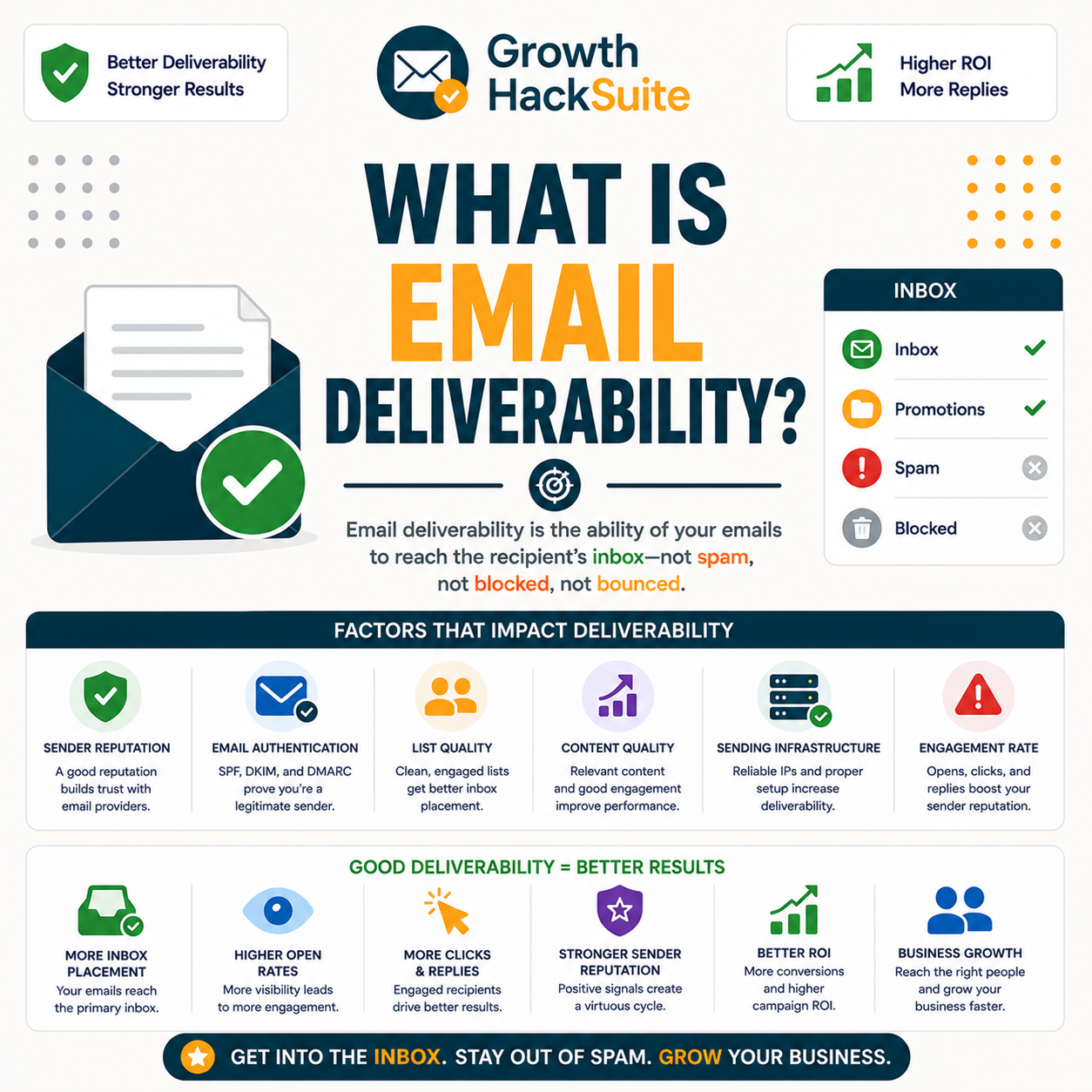
Email deliverability is the percentage of sent emails that land in the recipient’s inbox, as opposed to the spam folder or being blocked entirely. It reflects how mailbox providers judge your mail. High deliverability means your campaigns are seen; poor deliverability means they are filtered out before anyone reads them, regardless of how good the content is.
“Email deliverability is the ability to deliver emails to subscribers’ inboxes, and it is affected by sender reputation, authentication, and engagement.”
: Wikipedia: Email deliverability
Deliverability is whether your mail reaches the inbox, not just the server. Poor deliverability filters out campaigns before anyone reads them, no matter the content.
How Is Deliverability Different from Delivery Rate?
Delivery rate measures whether the receiving server accepted the email at all; deliverability measures whether it reached the inbox. An email can have a 99 percent delivery rate yet poor deliverability if most of it lands in spam. Delivery is the low bar; inbox placement is the metric that actually matters for cold email results.
- Delivery rate: The share of emails accepted by the receiving server, which counts spam-folder placement as delivered and so overstates real reach.
- Deliverability: The share that actually reaches the inbox, the figure that determines whether prospects ever see and open your cold email.
- The gap that matters: A high delivery rate with low deliverability is the silent killer of cold campaigns, since the mail is technically sent but never seen.
Delivery rate counts server acceptance; deliverability counts inbox placement. A campaign can be fully delivered and still mostly unseen in spam.
How Do You Measure Email Deliverability?
Measure deliverability with inbox placement tests, which send to seed accounts across providers and report where mail landed. Open rate is a rough proxy, and spam-complaint and bounce data add context. The core metric is inbox placement rate: the percentage reaching the inbox across Gmail, Outlook, and others.
Inbox placement tests are the direct measure; open, bounce, and complaint rates add context. Together they reveal where your mail actually lands.
What Factors Affect Deliverability?
Sender reputation, authentication, list quality, sending volume and rate, content, and recipient engagement all affect deliverability. No single factor controls it; providers weigh them together. A strong reputation with clean lists and proper authentication reaches the inbox, while any weak link can push mail to spam.
- Sender reputation: The accumulated standing of your domain and IP, the heaviest single factor providers use to decide inbox versus spam.
- Authentication: SPF, DKIM, and DMARC prove your mail is genuine, and missing them alone can route otherwise good email straight to spam.
- List quality and engagement: Clean lists with low bounces and real opens and replies signal wanted mail, lifting placement across providers.
Reputation, authentication, list quality, pacing, content, and engagement together set deliverability. Any weak link can push otherwise good mail into spam.
What Is a Good Inbox Placement Rate?
A healthy cold email inbox placement rate is above 90 percent; above 95 percent is excellent. Below 80 percent signals a reputation or list problem that needs fixing before scaling. The exact target varies by provider, but consistently landing more than nine in ten emails in the inbox is the mark of a well-run cold program.
“Maintaining a strong sender reputation and clean list is what keeps inbox placement high, since providers continuously evaluate how recipients engage with your mail.”
: HubSpot: Email Deliverability
Above 90 percent inbox placement is healthy; below 80 signals a problem. Consistently landing nine in ten emails in the inbox marks a well-run cold program.
How Does Sender Reputation Drive Deliverability?
Sender reputation is the trust score providers assign your domain and IP based on past sending. High reputation earns inbox placement; low reputation routes mail to spam regardless of content. Reputation is built slowly through consistent, clean sending and destroyed quickly by spikes, bounces, and complaints, making it the central deliverability lever.
Protect your sender reputation with paced, clean sending
Try GMass Free →Gmail-native sending with built-in verification. Free 50/day.
Sender reputation is the trust score that drives inbox placement. Built slowly and broken quickly, it is the central lever of deliverability.
How Does GMass Spam Solver Improve Deliverability?
GMass Spam Solver analyzes a campaign before sending and after, flagging deliverability risks and helping diagnose why mail lands in spam. Combined with Gmail-native sending and built-in verification, it gives senders concrete steps to lift inbox placement. It turns deliverability from a guessing game into a measurable, fixable process inside Gmail.
“GMass Spam Solver helps senders diagnose and fix deliverability issues, surfacing why a campaign may land in spam so it can be corrected before scaling.”
: Growth Hack Suite: GMass Cold Email Review
Diagnose and fix spam placement with GMass Spam Solver
See GMass Pricing →Built-in deliverability tooling. Free 50/day to start.
GMass Spam Solver diagnoses deliverability risks before and after sending, turning inbox placement into a measurable, fixable process inside Gmail.
How Does Authentication Affect Deliverability?
SPF, DKIM, and DMARC authentication proves your mail genuinely comes from your domain, so providers trust it and place it in the inbox. Without authentication, even reputable mail can be filtered as potential spoofing. It is a non-negotiable foundation: deliverability work on an unauthenticated domain is wasted effort.
- SPF and DKIM: Confirm the sending server is authorized and the message is unaltered, the baseline checks providers run on every incoming email.
- DMARC policy: Tells providers how to handle mail that fails the other checks, strengthening trust and protecting your domain from spoofing.
- Non-negotiable foundation: Without all three, deliverability efforts fail at the first gate, so authentication comes before any other optimization.
Authentication is the gate every email passes first. On an unauthenticated domain, all other deliverability work is wasted.
How Does List Quality Affect Deliverability?
A clean, validated list bounces little and engages well, both of which lift deliverability. A dirty list with dead addresses produces bounces and low engagement that providers read as spam signals. Because cold lists decay over time, ongoing validation is essential to keep list quality, and therefore deliverability, high.
Clean lists lift deliverability; dirty lists sink it through bounces and weak engagement. Ongoing validation keeps quality, and placement, high as lists decay.
How Do You Test Your Deliverability?
Run a seed test by sending your campaign to a set of seed inboxes across Gmail, Outlook, and Yahoo, then check where each landed. Pair it with an authentication check and a spam-content scan. Testing before a full send catches placement problems while they are still cheap to fix, rather than after burning the list.
- Send to seed inboxes: Mail your campaign to test accounts across major providers and record whether each lands in inbox, spam, or is blocked.
- Check authentication: Verify SPF, DKIM, and DMARC pass on the test send, since an authentication failure alone explains poor placement.
- Scan content for triggers: Review subject and body for spam-trigger words and excessive links that can route otherwise good mail to spam.
- Review per-provider results: Note which providers filter the mail, since a Gmail-only or Outlook-only problem points to a specific reputation or content issue.
- Fix before scaling: Correct the issues the test reveals and retest, only running the full campaign once placement clears the safe threshold.
Seed-test placement, check authentication, scan content, then fix before scaling. Testing first catches problems while they are cheap to correct.
How Do You Improve Poor Deliverability?
Fix authentication, validate and prune the list, slow the sending rate, warm the inbox, improve content, and remove spam-trigger words. Improving deliverability is rarely one change; it is tightening every factor until placement recovers. Start with authentication and list quality, the two highest-impact fixes for most senders.
Lift your inbox placement with Gmail-native deliverability tools
Try GMass Free →Spam Solver plus verification in one workflow. Free 50/day.
Improving deliverability means tightening every factor, starting with authentication and list quality. It is rarely one fix, but those two move the needle most.
How Does GMass Help You Reach the Inbox?
GMass combines Gmail-native sending on a trusted domain, paced delivery, built-in list verification, and Spam Solver diagnostics, addressing the main deliverability factors in one tool. For senders who want inbox placement without managing separate verification and warm-up services, this integrated approach keeps more mail in the inbox with less setup.
To set realistic deliverability targets, the cold email benchmarks guide defines healthy placement and reply rates, and the cold email list building guide keeps each send targeted to a clean list.
Reach the inbox with Gmail-native cold email
Try GMass Free →Sending, verification, and Spam Solver in one tool. Free 50/day.
GMass addresses the main deliverability factors in one tool: trusted sending, pacing, verification, and diagnostics. That keeps more mail in the inbox with less setup.
Frequently Asked Questions
The 12 most-asked questions about email deliverability for cold email.
What is email deliverability?
Email deliverability is the percentage of sent emails that land in the recipient’s inbox rather than the spam folder or being blocked. It reflects how mailbox providers judge your mail.
How is deliverability different from delivery rate?
Delivery rate measures whether the server accepted the email; deliverability measures whether it reached the inbox. Mail can be 99 percent delivered yet mostly in spam.
How do I measure email deliverability?
With inbox placement tests that send to seed accounts across providers and report where mail landed. Open, bounce, and complaint rates add context. The core metric is inbox placement rate.
What factors affect deliverability?
Sender reputation, authentication, list quality, sending volume and rate, content, and recipient engagement. Providers weigh them together, so any weak link can push mail to spam.
What is a good inbox placement rate?
Above 90 percent is healthy; above 95 percent is excellent. Below 80 percent signals a reputation or list problem to fix before scaling cold campaigns.
How does sender reputation drive deliverability?
Reputation is the trust score providers assign your domain and IP from past sending. High reputation earns inbox placement; low reputation routes mail to spam regardless of content.
How does GMass Spam Solver improve deliverability?
It analyzes a campaign before and after sending, flagging deliverability risks and helping diagnose why mail lands in spam, turning placement into a measurable, fixable process inside Gmail.
How does authentication affect deliverability?
SPF, DKIM, and DMARC prove your mail is genuine, so providers trust and inbox it. Without authentication, even reputable mail can be filtered as potential spoofing.
How does list quality affect deliverability?
Clean, validated lists bounce little and engage well, lifting placement. Dirty lists produce bounces and low engagement that providers read as spam signals. Validate regularly as lists decay.
How do I test my deliverability?
Send to seed inboxes across providers and check placement, verify authentication passes, and scan content for spam triggers. Test before a full send to catch problems cheaply.
How do I improve poor deliverability?
Fix authentication, validate and prune the list, slow the sending rate, warm the inbox, and remove spam-trigger words. Start with authentication and list quality, the highest-impact fixes.
How does GMass help me reach the inbox?
GMass combines Gmail-native sending, paced delivery, built-in verification, and Spam Solver diagnostics, addressing the main deliverability factors in one tool with less setup.