Table of Contents
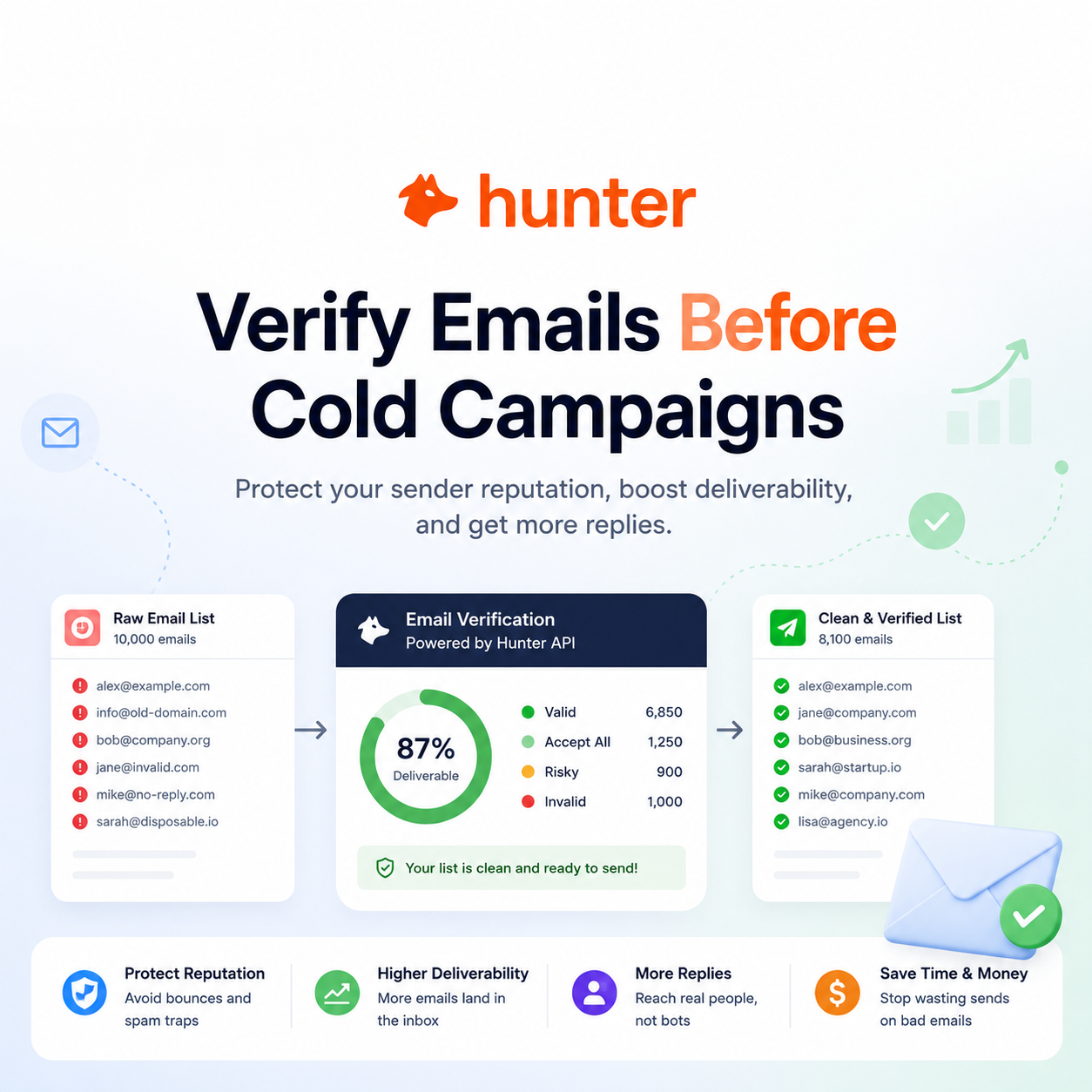
Verify emails before cold campaign sends and the deliverability of the very first batch is protected. Cold lists carry high invalid, role and spam-trap rates, so an unverified blast spikes bounces and damages the sending domain on day one. The pre-send fix: bulk-verify the prospect list, remove invalids, segment catch-alls by confidence, then warm up before the full send. This guide walks SDRs through each step.
Verify your cold list free before the first send protects the domain.
Verify Your List Free →Free plan included · No credit card · Full status and confidence scoring
Why Should You Verify Emails Before a Cold Campaign?
Cold lists are assembled from scraped or bought data that nobody has confirmed, so they carry high invalid, role and spam-trap rates. Sending unverified spikes bounces on the very first batch, damaging the sending domain before the campaign gets going. Verifying first removes the dead addresses and keeps the launch clean.
- Unconfirmed data: Scraped and purchased prospect records reach the inbox unchecked, so a meaningful share of them have already gone stale, changed roles, or never existed at all before any message is queued for the campaign.
- High invalid rate: Cold sources tend to carry far more dead and risky addresses than opt-in lists, because no recipient ever confirmed them, making raw cold data the single biggest bounce hazard a sender can launch on.
- First-send risk: A fresh cold domain has no engagement history to cushion mistakes, so the first unverified batch defines its reputation, turning one dirty send into a lasting deliverability problem for every later message.
Cold data is unverified by definition, and checking it first is the difference between a campaign and a blocklist. The discipline costs minutes and protects the domain that every later send depends on.
How Do Unverified Cold Lists Kill Deliverability?
On the first cold send, invalid addresses bounce and spam traps trigger complaints, signalling to mailbox providers that the sender is spamming. Reputation drops immediately, so even genuinely valid prospects stop reaching the inbox. One unverified blast can sink an entire cold program before it has a chance to start working.
High bounce rates and spam-trap hits signal abuse and quickly lower a sending domain’s reputation with mailbox providers.
— Hunter, Email Verifier API documentation
An unverified cold blast damages the domain on day one, exactly when a new campaign can least afford it. The harm compounds, because a reputation lost on the first send is slow and costly to rebuild.
How Do You Verify Emails Before Cold Campaign Sends?
Run the pre-send workflow as a fixed sequence: bulk-verify the prospect list, remove invalids, segment catch-alls by confidence, and send only to clean addresses starting with a warm-up batch. Done before the first send, this keeps bounce rate low and protects the cold domain from the start of the campaign.
- Bulk verify the list: Upload the entire prospect export to a bulk verifier and run every address through syntax, domain and mailbox checks at once, producing a status per row that surfaces dead and risky records.
- Remove invalids: Delete every address marked invalid before anything else, since these are confirmed dead and guarantee a hard bounce that directly harms the cold domain’s standing with mailbox providers.
- Segment catch-alls: Split accept-all addresses by confidence score, keeping only high-confidence ones for the launch and holding the rest aside, because cold sending allows no margin for unconfirmed mailboxes.
- Send clean, warm up: Begin with a small batch of the highest-confidence valid addresses, monitor results, and scale only once metrics stay clean, letting a fresh domain build reputation gradually.
Verify your prospect list free before you send the first batch.
Verify Your List Free →Free plan · No credit card · Status and confidence per address
Four steps before the first send turn a risky cold list into a safe, segmented one. The order matters: cleaning before segmenting before sending prevents any dead address from ever leaving the outbox.
How Do You Bulk-Verify a Cold Prospect List?
Export the prospect list to CSV, upload it to a bulk verifier, and download the returned file with a status on every row. For large prospecting lists, process in batches and keep the original intact. This is the heaviest step of the workflow and the one that removes most of the cold-list risk at once.
- Export CSV: Pull the prospect list out of the CRM or prospecting tool into a clean CSV, keeping a master copy untouched, so the original data survives if a verification pass needs to be rerun later.
- Bulk verify: Feed the CSV into a bulk verification engine that checks syntax, domain records and mailbox response for every row in parallel, returning results far faster than checking addresses one at a time.
- Download statuses: Retrieve the processed file carrying a deliverability status and confidence value per address, then use those labels to drive the removal and segmentation steps that follow in the workflow.
Bulk verification is the core of the pre-send workflow, because it surfaces every risky address in one pass. Everything downstream is sorting based on the statuses this single step produces.
How Do You Remove Invalids and Segment Catch-Alls for Cold?
Delete invalid addresses outright, then split catch-alls by confidence: include only high-confidence ones in the warm-up and hold the rest aside. For cold outreach, segmentation should be stricter than for warm lists, because the sending domain has no engagement history to absorb mistakes if a borderline address fails.
- Delete invalids: Remove every confirmed-invalid record before sending, since each one bounces hard and a cluster of hard bounces on a fresh domain reads as abuse to mailbox providers watching the first campaign.
- Include high-confidence catch-all: Keep only accept-all addresses that score high on confidence, treating them as the safest subset of an uncertain category, and route them into the early warm-up batches rather than the full blast.
- Hold the rest: Set aside low-confidence catch-alls and unknowns entirely for the cold launch, revisiting them later once the domain has built reputation and can tolerate the occasional borderline result.
Cold sending demands stricter segmentation, because a new domain cannot absorb the mistakes a warm one can. The held-back addresses are not wasted, only deferred until the domain earns the standing to handle them.
How Much Does Verification Lower Cold Bounce Rate?
Verifying a cold list typically moves bounce rate from a dangerous double-digit figure down under the safe single-digit threshold. The table below contrasts a raw cold send with a verified one, showing the bounce, inbox and reply differences that decide whether a campaign builds reputation or burns it on the first batch.
Source: Internal benchmark — directional comparison of raw versus verified cold sends from SDR campaign observations, 2026-06. Mailbox providers widely treat bounce rates above roughly 2–5% as a deliverability risk; confirm current thresholds with your sending platform.
The bounce gap between raw and verified cold sends is the whole case for the pre-send workflow. It converts an abstract best practice into the single metric that mailbox providers watch most closely on a new domain.
How Do You Warm Up Before the First Cold Send?
After verifying, ramp gradually: start with a small batch of the highest-confidence valid addresses, monitor bounces and replies closely, then scale up only if the metrics stay clean. Warming up lets a fresh domain build reputation steadily instead of spiking it with one large first send that providers may read as abuse.
- Start small: Send the opening batch to a limited set of the highest-confidence verified addresses, keeping daily volume low so a new domain introduces itself to mailbox providers at a pace that reads as legitimate rather than aggressive.
- Monitor metrics: Track bounces, complaints and replies after each batch, treating any rise in bounce or spam signals as a stop sign that the list or pacing needs adjustment before the next volume increase.
- Scale if clean: Increase volume step by step only while metrics stay healthy, growing the daily send gradually so reputation accumulates instead of breaking under a sudden jump in cold traffic.
Verified plus warmed is the safe cold combination, because ramping protects the reputation that verification preserved. One step cleans the list while the other paces its delivery, and a cold program needs both.
Verify vs Spray-and-Pray: What Is the Reply-Rate Difference?
A verified, targeted cold send reaches more inboxes and earns more replies than an unverified spray, which lands in spam and bounces. Beyond protecting reputation, verification lifts the metric SDRs actually care about, because a message that arrives in the inbox can be read, and one filtered as spam never gets the chance.
Hunter’s own verifier review found accuracy holds strong on standard domains, with valid-status addresses bouncing under 2% across a 2,000-email benchmark.
— Growth Hack Suite, Hunter Email Verifier Review
Verification is not just defensive, because it lifts reply rate, the number that defines a cold campaign’s success. Cleaner delivery means more messages seen, and more messages seen means more conversations started.
How Clean Does a Cold List Need to Be?
Cold lists should clear a high verified-valid threshold, with invalids removed and low-confidence catch-alls excluded before sending. Because cold domains lack engagement history, the bar sits stricter than for warm lists. The table below gives practical thresholds an SDR can apply when deciding whether a list is ready to launch.
Source: Internal benchmark — pre-send list-quality targets used for cold SDR campaigns, 2026-06. Thresholds are directional; tune them to the tolerance of the specific sending platform and domain age.
Hold cold lists to a stricter bar than warm ones, because no engagement history means no margin for error. The targets above are a starting discipline, tightened further whenever a domain is brand new.
How Often Should You Re-Verify a Cold List?
Re-verify right before each cold campaign, not once at acquisition. Prospect data decays continuously as people change jobs and addresses, so a list verified weeks ago is already partly stale. Re-checking immediately before the send accounts for that decay and keeps the bounce rate inside the safe zone for the launch.
- Re-verify per campaign: Run a fresh verification pass immediately before every cold send rather than relying on an earlier check, so the launch reflects the current state of the list and not its condition when the data was first acquired weeks or months earlier.
- Account for decay: Treat prospect data as perishable, since contacts leave roles and abandon mailboxes constantly, meaning a once-clean list steadily accumulates dead addresses that only a re-verification close to send time can catch and remove.
Re-verify to the send, not the acquisition date, because prospect data ages fast. A check that was accurate last month offers little protection for a campaign launching today.
What Are the Best Tools to Verify a Cold List?
Cold-list verification needs bulk processing, catch-all confidence scoring, and ideally email finding to enrich gaps in the list. Hunter covers all three with a free tier to start, while pure-play verifiers compete on bulk price. The table below compares the leading options for cold prospecting on the factors that matter most.
Source: hunter.io/pricing and provider feature pages, verified 2026-06-27. Feature availability changes; confirm catch-all handling and finder inclusion on each provider’s site before buying.
For cold prospecting, a verifier that also finds emails, like Hunter, covers both list gaps and list hygiene in one place. A pure bulk tool is cheaper per check but leaves the sourcing problem unsolved. For a deeper accuracy read, see the Hunter Email Verifier accuracy benchmark, and for a head-to-head, the Hunter vs ZeroBounce comparison.
Verdict: Always Verify Before a Cold Campaign
Never launch a cold campaign on an unverified list. Bulk-verify, remove invalids, segment catch-alls strictly, warm up, and re-verify before each send. Done this way, cold outreach protects the domain and lifts reply rate; skipped, it bounces and risks the blocklist on day one, taking the whole program down with it.
Verdict: Verify every cold list before send. Raw cold data carries high invalid and trap rates that push bounce into double digits; verified, segmented sends hold bounce under the safe single-digit threshold. Bulk-verify, cut invalids, keep only high-confidence catch-alls, warm up, and re-verify before each campaign.
Cold emailing is unsolicited bulk commercial email sent to recipients with no prior relationship.
— Wikipedia, Cold email
Verify your cold list free before launch and send with confidence.
Verify Your List Free →Free plan · No credit card · Protect the domain from the first send
Related Tools in the Hunter Stack
Verifying before a cold send pairs naturally with building the prospect list and reducing bounces over time. The Hunter verifier covers validation depth, and the finder covers building cold lists worth verifying, both on one connected stack and credit pool.
- Hunter Email Verifier: The validation layer behind the pre-send workflow, including how it scores addresses and flags risk — start with what the Hunter Email Verifier is.
- Hunter Email Finder: The sourcing half of the bundle that builds the cold lists this workflow then cleans — read the Hunter.io email finder review for list-building detail.
- Verification basics: The underlying concept every step here relies on, explained from the ground up in what email verification is.
Verify Before a Cold Campaign: Frequently Asked Questions
The 12 most-asked questions about verifying emails before a cold campaign.
Why verify emails before a cold campaign?
Cold lists come from scraped or purchased data that nobody confirmed, so they carry high invalid and spam-trap rates. Sending unverified spikes bounces on the first batch and damages the sending domain before the campaign even gets going, which is why verification has to happen first.
How do I verify a cold prospect list?
Export the list to CSV, upload it to a bulk verifier, and download the file with a status per address. Then delete the invalids, segment catch-alls by confidence, and send only to clean addresses starting with a small warm-up batch rather than the full list at once.
How much does verifying lower cold bounce rate?
Verifying a cold list typically moves bounce rate from a dangerous double-digit figure down under the safe single-digit threshold that mailbox providers tolerate. The exact drop depends on how dirty the raw list was, but the direction is always toward a cleaner, safer send.
How do I warm up before the first cold send?
Start with a small batch of the highest-confidence verified addresses, monitor bounces and replies, and scale volume only while metrics stay clean. Gradual ramping lets a fresh domain build reputation instead of spiking it with one large first send that providers may read as abuse.
How clean does a cold list need to be?
Cold lists should clear a high verified-valid threshold with invalids removed and low-confidence catch-alls excluded before sending. Because a cold domain has no engagement history to absorb mistakes, the bar sits stricter than for an established warm list with a track record.
How often should I re-verify a cold list?
Re-verify right before each cold campaign rather than once at acquisition. Prospect data decays continuously as people change jobs and abandon mailboxes, so a list checked weeks ago is already partly stale and needs a fresh pass close to send time to stay safe.
Does verifying improve cold reply rate?
Yes, indirectly but reliably. A verified, targeted send reaches more inboxes than an unverified spray that lands in spam, and a message in the inbox can be read and answered. By lifting inbox placement, verification raises the reply rate SDRs actually measure.
What do I do with catch-alls in a cold list?
Segment catch-alls by confidence score rather than treating them as a single bucket. Include only the high-confidence ones in the warm-up and hold the rest aside for the cold launch. A new domain has no margin to absorb unconfirmed accept-all mailboxes safely.
What are the best tools to verify a cold list?
Cold-list verification needs bulk processing, catch-all confidence scoring, and ideally email finding to enrich gaps. Hunter covers all three with a free tier to start, while pure-play verifiers such as NeverBounce compete mainly on bulk price per thousand for verify-only workflows.
Will an unverified cold blast hurt my domain?
Yes. Invalid addresses bounce and spam traps trigger complaints, signalling abuse to mailbox providers and dropping reputation immediately. On a fresh domain with no history, a single unverified blast can sink deliverability for every later message in the program, not just the first send.
Should I re-verify a list I just bought?
Always. Purchased lists are unverified by default and often stale, since the seller cannot guarantee when each address was last confirmed. Run a full verification pass before any send and never assume a bought list is clean, no matter what the vendor claims about its quality.
What is the pre-send cold workflow?
The pre-send cold workflow is a fixed sequence: bulk-verify the prospect list, remove invalids, segment catch-alls by confidence, send only to clean addresses starting with a warm-up batch, and re-verify before each future campaign. Running it in order keeps bounce low and protects the domain.