Table of Contents
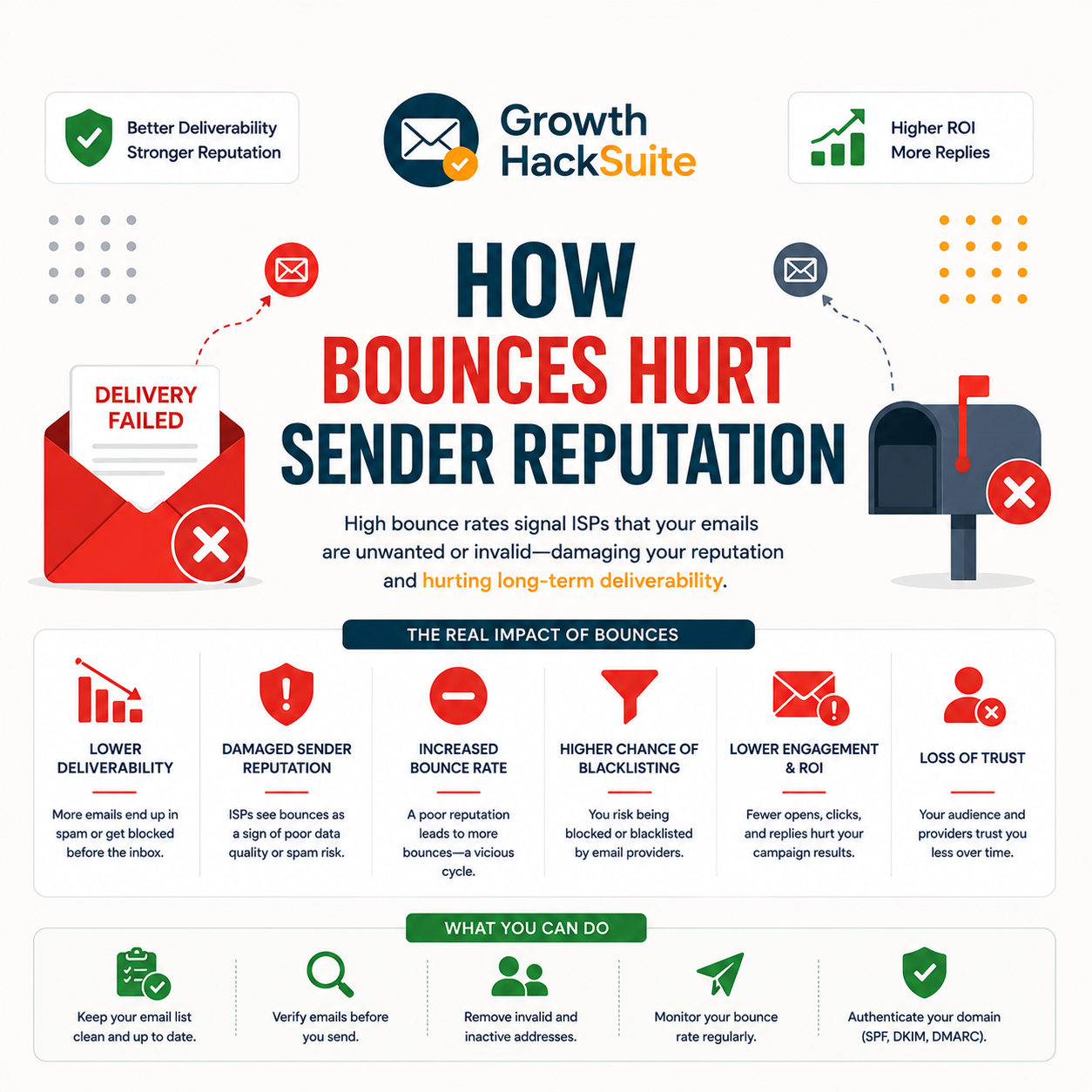
How bounces hurt sender reputation is a direct chain: a high bounce rate tells mailbox providers you are emailing unverified or stale addresses, so they trust the sending domain less, lower its reputation, and route more mail to spam. Even valid subscribers then stop seeing the message. This guide explains the bounce-to-reputation mechanism, the threshold that triggers damage, and how verification protects the reputation that decides inbox placement.
Protect your reputation from bounces — verify your list free.
Verify Your List Free →Free plan included · No credit card · Removes bounces before they send
How Do Bounces Hurt Your Sender Reputation?
Bounces hurt sender reputation through a direct chain: a high bounce rate signals to mailbox providers that the sender emails unverified or stale addresses, so they grant less trust, lower the reputation score, and route more mail to spam. The damage does not stay with the bounced addresses. It spreads from those failed sends across the whole list, suppressing delivery to valid subscribers too.
- Bounces signal bad hygiene: A failed delivery tells the provider an address was never validated or has gone stale, marking the sender as someone who mails without cleaning a list. Permission-based senders rarely bounce, so a rising rate stands out immediately.
- Providers lower trust: Mailbox systems translate repeated bounces into a falling reputation score attached to the sending domain and IP. That lower score becomes the gatekeeper deciding whether future mail reaches the inbox or the spam folder.
- Damage spreads list-wide: Reputation attaches to the sender, not to individual addresses, so a downgrade from bounces lowers inbox placement for every recipient. Valid, engaged subscribers lose visibility because a portion of the list was never verified.
- Spam folder placement follows: A lowered reputation score pushes a larger share of mail into the spam folder rather than the inbox. Recipients never see the message, so opens, clicks, and replies fall even for content they would have wanted.
- ESP penalties compound it: Email service providers monitor bounce rates too and may throttle sending, suspend accounts, or flag a domain after repeated high-bounce campaigns. That platform-level penalty stacks on top of the mailbox-provider reputation loss.
Bounces signal bad hygiene, providers lower trust, and the whole list pays for the unverified addresses. That is the chain in three steps.
Why Do Mailbox Providers Watch Bounce Rate?
Providers watch bounce rate because it is a reliable proxy for list quality. Senders who maintain permission-based, verified lists bounce rarely, while spammers and careless senders bounce often. A rising bounce rate is one of the clearest, hardest-to-fake signals of a sender worth distrusting, which is why mailbox systems weigh it so heavily in placement decisions.
- Proxy for list quality: Bounce rate maps almost directly onto how clean a list is, because invalid addresses are the main reason mail fails. Providers use it as a shortcut to judge whether a sender practices proper list hygiene or simply blasts everyone.
- Distrust signal at scale: A bounce is difficult to fake and expensive to hide, so a climbing rate flags a sender whose data is decaying or purchased. Mailbox systems treat that pattern as strong evidence of low-quality, often unwanted sending.
- Cheap to measure automatically: Bounce rate is a simple ratio that mailbox systems compute without human review, making it an efficient filter at the scale of billions of messages. That low cost is why it anchors automated reputation scoring.
- Correlates with spam behaviour: Senders who buy or scrape lists bounce heavily because the data was never permission-based. Providers learned that high bounce rates track closely with spam patterns, so the metric doubles as an early spam-detection signal.
- Protects recipient experience: Mailbox providers compete on keeping inboxes clean, so they police bounce-heavy senders to shield users from junk. Filtering distrusted senders preserves the inbox quality that keeps recipients loyal to the provider.
Sending to many invalid addresses signals poor list hygiene and harms domain reputation.
— Hunter.io, Email Verifier API documentation
Bounce rate is a trusted proxy for list quality, which is exactly why providers weigh it so heavily when deciding placement.
What Is the Bounce-to-Reputation Mechanism?
Each bounce is logged against the sending domain and IP. As bounces accumulate past a threshold, providers downgrade the reputation score, which lowers inbox placement for all mail from that sender. The mechanism is cumulative rather than per-message, so a few careless sends to bad data can leave a mark that suppresses delivery long afterward.
- Bounces get logged: Every failed delivery is recorded by the mailbox provider against the sending domain and IP address, building a running history that the reputation system reads as a measure of how often the sender targets invalid mailboxes.
- Reputation gets downgraded: Once logged bounces cross a tolerance threshold, the provider lowers the sender’s reputation score. The downgrade is automatic and data-driven, reflecting accumulated failures rather than any single send or campaign in isolation.
- Placement drops list-wide: A lower reputation score routes a larger share of all future mail to spam, regardless of recipient. The penalty applies to the sender as a whole, so engaged subscribers receive less mail because of unverified addresses.
- Penalty compounds over sends: Because the score reflects accumulated history, each additional high-bounce campaign deepens the downgrade rather than resetting it. The reputation hole grows with every careless send until hygiene improves and the trend reverses.
- Recovery lags behind damage: The mechanism downgrades fast but restores slowly, rewarding sustained clean sending over weeks. A sender pays for one bad batch across many later campaigns before placement returns to its prior level.
Bounces accumulate against the domain, the score drops, and placement falls for everything the sender mails. The effect compounds quietly.
Do Hard and Soft Bounces Hurt Reputation Equally?
No. Hard bounces from invalid or non-existent addresses damage reputation most, because they directly signal unverified data and permanent failure. Repeated soft bounces from temporary issues matter less individually but add up if ignored. Removing hard bounces immediately is the priority for protecting reputation, since they carry the strongest negative signal to providers.
- Hard bounces do the most damage: A permanent failure to a non-existent mailbox proves the address was never verified, the exact pattern providers punish hardest. Each hard bounce weighs heavily on the reputation score and should be removed from the list at once.
- Soft bounces add up cumulatively: Temporary failures from full inboxes or server issues carry a lighter penalty per event. Left unaddressed, repeated soft bounces to the same address signal neglect and gradually erode reputation, so persistent ones still warrant removal.
Hard bounces hurt reputation most because they directly signal the unverified data providers are designed to punish. Soft bounces matter only in bulk.
What Bounce Rate Triggers Reputation Damage?
Above roughly two percent, providers begin treating a sender as careless and reputation starts to slip. Well past that, into the five percent range and beyond, risks clear spam placement and ESP restrictions. The safe target is under two percent, and ideally under one percent, a level that keeps the reputation score intact across providers.
Source: Industry deliverability benchmarks, Mailmend and MailCleanup 2026 (under 1% excellent, 1–2% acceptable, over 5% red flag for ISPs). Cross-industry average bounce rate ~1.2%. Confirm provider-specific thresholds before sending.
A safe bounce rate stays under two percent, ideally under one, to keep reputation intact.
— Growth Hack Suite, reduce email bounce rate guide
Cross two percent and reputation starts slipping; staying under it, ideally under one, keeps provider trust intact.
How Long Does Bounce Damage Last?
Reputation damage from bounces lingers for weeks and recovers only through consistent, clean sending afterward. Industry guidance puts rebuilding at roughly thirty to sixty days of disciplined hygiene. There is no instant reset, so a single careless blast to an unverified list can suppress deliverability long after, which makes prevention far cheaper than recovery.
- Weeks to recover fully: Rebuilding a downgraded reputation typically takes thirty to sixty days of clean, engaged sending. Providers raise trust slowly and only after sustained good behaviour, so the lost inbox placement returns gradually rather than at once.
- No instant reset exists: No setting, payment, or support ticket clears a bounce-driven downgrade. Reputation is earned back through behaviour over time, meaning the cost of one bad send is paid across many subsequent campaigns before delivery normalizes.
Bounce damage lingers for weeks, often a full month or two, with no reset button. Prevention beats recovery every time.
How Does Verification Break the Chain?
Verification removes the invalid addresses behind hard bounces before they send, so the bounce rate stays low and the reputation-damaging signal never reaches providers. By keeping bounces under the threshold that triggers downgrades, verification protects the reputation score that decides inbox placement. It treats the cause, not the symptom, breaking the chain at its first link.
- Removes invalid addresses first: A verifier checks each address for syntax, domain records, and mailbox response before any campaign sends, flagging the dead addresses that would otherwise hard bounce. Pulling them out pre-send stops the failure before a provider ever logs it.
- Keeps the rate under threshold: With invalid addresses removed, bounce rate stays under the two percent line that signals careless sending. The reputation score holds steady because the data behind it stays clean, preserving inbox placement list-wide.
Verification removes the bounce sources before send, so the damaging signal never reaches providers and the chain never starts. See what email verification is for the underlying check.
The Bounce-to-Reputation Chain
Bounces vs Complaints: Which Hurts Reputation More?
Both damage reputation, but through different signals: bounces show poor list hygiene, while complaints show unwanted mail. Complaints often carry slightly more weight per incident because they reflect a recipient actively marking spam, yet bounces are usually far more numerous. Controlling both is necessary, and the table contrasts what each one tells providers.
Source: Mailbox provider sender guidelines, Gmail and Yahoo bulk-sender requirements 2024–2026 (spam complaint rate target under 0.1%, ideally 0.3% ceiling; bounce rate under 2%). Verify current provider rules before sending.
Bounces signal bad hygiene and complaints signal unwanted mail; both must stay low to protect reputation, since either alone can drag the score down.
How Do You Protect Reputation From Bounces?
Protect reputation by verifying lists before every send, removing hard bounces immediately, verifying at signup, re-verifying aging data, and warming up new domains. Verification is the foundational step, since it removes the bounce sources that start the damage chain. The rest reinforce it, but cleaning the list pre-send does the heaviest lifting for reputation.
- Verify before sending: Running a list through a verifier ahead of each campaign removes invalid addresses before they bounce, holding the rate under the threshold that triggers downgrades. This single habit prevents most bounce-driven reputation loss outright.
- Remove hard bounces fast: Pulling permanently failed addresses out of the list immediately after any send stops them from being mailed again. Repeated sends to the same dead address compound the negative signal and accelerate reputation decline.
- Re-verify aging data: Addresses decay over time as people change jobs and abandon accounts, so periodic re-verification of older segments catches the newly invalid ones. Fresh validation keeps a once-clean list from drifting back toward a high bounce rate.
- Verify at signup: Validating each address at the point of capture stops invalid and mistyped entries from ever entering the list. Front-loading verification at the form prevents bounces before a single send rather than cleaning them up afterward.
- Warm up new domains: A new sending domain has no reputation, so ramping volume gradually while keeping bounces near zero builds trust safely. Slow warm-up paired with a verified list establishes a clean record before any large campaign.
Verify your list free to protect your sender reputation.
Verify Your List Free →Free plan · No credit card · Status and confidence scoring
Verification is the foundation of bounce protection because it removes the sources that start the damage. The other steps reinforce a clean list.
What Tools Protect Reputation From Bounces?
A verifier prevents the bounces that damage reputation, while monitoring tools track the trend over time. Hunter handles verification with a recurring free tier; postmaster tools handle the monitoring side. The table compares verification options that protect reputation, focusing on bounce prevention, bulk and real-time support, and free access.
Source: hunter.io/pricing, verified 2026-06-27; category capabilities from public verifier and postmaster documentation. Free-tier and feature details change — confirm on each provider’s site before buying.
A verifier prevents the bounces and monitoring tracks the trend; together they protect reputation. For accuracy depth, see the Hunter Email Verifier accuracy benchmark.
Verdict: How Bounces Hurt Reputation and How to Stop It
Bounces hurt sender reputation by signaling poor list hygiene, prompting providers to lower trust and route mail to spam, list-wide and for weeks. Hard bounces do the most damage. Verification breaks the chain by removing invalid addresses before they bounce, keeping reputation and inbox placement intact at far lower cost than recovery.
Verdict: A bounce rate over 2% signals bad hygiene, drops reputation list-wide, and suppresses delivery for 30 to 60 days. Hard bounces hurt most. Verifying under 1% before each send breaks the chain before providers ever log it.
Sender reputation is a score that ISPs assign to the reliability of a sender.
— Wikipedia, Sender reputation
Verify your list free and protect your reputation before the next send.
Verify Your List Free →Free plan · No credit card · Breaks the bounce chain pre-send
Related Tools in the Hunter Stack
Bounces and reputation are linked, and so are the tools that protect them. The Hunter verifier review covers prevention in depth, and the finder review covers building the clean lists worth verifying in the first place, all on one connected platform and credit pool.
- Hunter Email Verifier: The validation layer that prevents the bounces behind reputation damage — start with what the Hunter Email Verifier is.
- Hunter Email Finder: The list-building half of the bundle on the same credit pool — read the Hunter.io email finder review for sourcing clean prospects.
How Bounces Hurt Sender Reputation: Frequently Asked Questions
The 12 most-asked questions about how bounces hurt sender reputation.
How do bounces hurt sender reputation?
Bounces hurt sender reputation by signaling to mailbox providers that a sender emails unverified or stale addresses. Providers log the bounces against the sending domain, lower the reputation score, and route more mail to spam. Because reputation attaches to the sender, the penalty suppresses delivery to the entire list, not just the addresses that failed.
Why do providers watch bounce rate?
Providers watch bounce rate because it is a reliable proxy for list quality that is hard to fake. Senders with verified, permission-based lists bounce rarely, while spammers and careless senders bounce often. A rising rate is one of the clearest signals of a sender worth distrusting, so mailbox systems weigh it heavily when deciding inbox placement.
What is the bounce-to-reputation mechanism?
Each bounce is logged against the sending domain and IP. As bounces accumulate past a tolerance threshold, the provider downgrades the reputation score automatically, and that lower score routes more of all future mail to spam. The mechanism is cumulative, so several bad sends build a lasting penalty rather than a one-off dip.
Do hard and soft bounces hurt equally?
No. Hard bounces from invalid, non-existent addresses damage reputation most, because they directly prove unverified data and permanent failure. Soft bounces from temporary issues carry a lighter penalty per event but add up if the same address keeps failing. Removing hard bounces immediately is the priority for protecting reputation.
What bounce rate triggers damage?
Above roughly two percent, providers start treating a sender as careless and reputation slips. Past five percent risks clear spam placement and ESP restrictions. The safe target is under two percent, and ideally under one, where reputation stays intact. The cross-industry average bounce rate sits near 1.2 percent, so under that band is healthy.
How long does bounce damage last?
Reputation damage lingers for weeks and rebuilds only through consistent, clean sending, typically thirty to sixty days of disciplined hygiene. There is no instant reset, no payment, and no support ticket that clears a downgrade. A single careless blast can suppress deliverability long after, which is why prevention costs far less than recovery.
How does verification break the chain?
Verification removes the invalid addresses behind hard bounces before they send, so the bounce rate stays low and the reputation-damaging signal never reaches providers. By treating the cause rather than the symptom, it keeps bounces under the threshold that triggers downgrades and preserves the reputation score that decides inbox placement.
Bounces vs complaints impact?
Both damage reputation through different signals: bounces show poor list hygiene, complaints show unwanted mail. Complaints often weigh slightly more per incident because a recipient actively marks spam, but bounces are usually far more numerous. Keeping bounces under two percent and complaints under 0.1 percent protects reputation on both fronts.
How do I protect reputation from bounces?
Verify lists before every send, remove hard bounces immediately, verify addresses at signup, re-verify aging data, and warm up new domains. Verification is the foundational step because it removes the bounce sources that start the damage chain. The other practices reinforce a clean list, but pre-send verification does the heaviest lifting.
What tools protect reputation?
A verifier prevents the bounces that damage reputation, while postmaster tools monitor the trend over time. Hunter handles verification with a recurring free tier and confidence scoring; monitoring dashboards track reputation but do not prevent bounces. Pairing a verifier for prevention with monitoring for visibility covers both sides of reputation protection.
Do bounces affect deliverability?
Yes, directly. Bounces lower the reputation score that providers use to decide inbox placement, so a high bounce rate pushes more mail to spam for the whole list. Deliverability and reputation move together: a clean, verified list keeps both high, while an unverified one drags both down at the same time.
Can one bad send hurt reputation?
Yes. A single blast to a large unverified list can spike the bounce rate past the danger threshold in one send, triggering an immediate downgrade. Because reputation rebuilds slowly over weeks, that one careless campaign can suppress deliverability for a month or more, making prevention the only reliable protection.