Table of Contents
A subsequence is a separate follow-up path that a prospect enters based on how they respond, so an interested reply, a question, or no reply each triggers a tailored next set of emails. This guide explains what it is, how it works, why it lifts conversion, what conditions trigger it, how to set one up, and how it differs from a sequence and from A/B testing.
This conditional follow-up path is triggered by a prospect’s behavior, branching outreach by intent.
Best for: agencies and scale senders routing many response types.
Caveat: over-branching adds complexity, so start with one or two paths.
Bottom line: branching makes sequences responsive instead of rigid.
Put this into practice. Try Smartlead free for 14 days.
Start Smartlead Free Trial →Unlimited mailboxes · no credit card · 14-day trial
What Is a Subsequence?
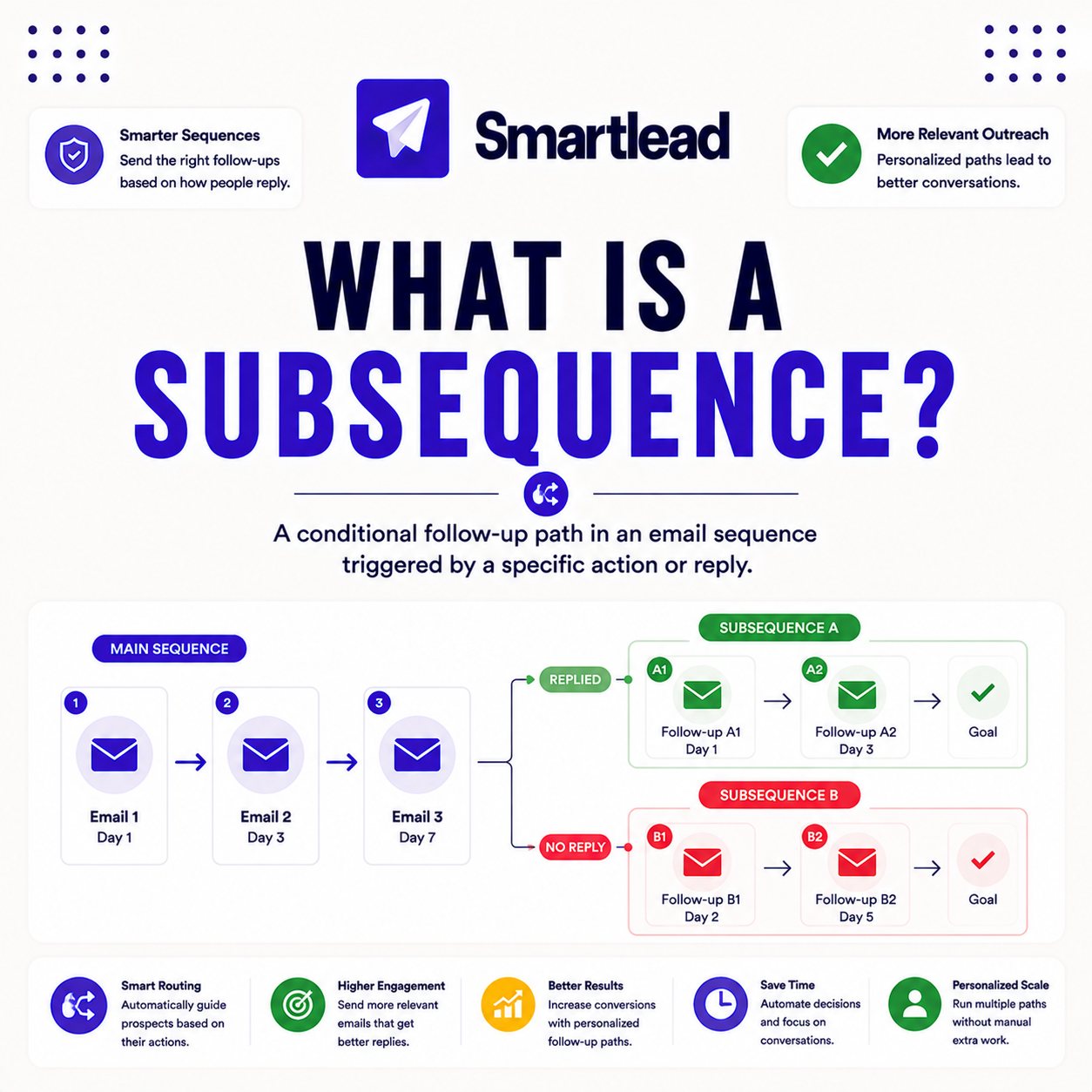
A subsequence is a separate follow-up path a prospect enters based on a condition, such as replying with interest, asking a question, or not responding. It branches outreach so each prospect gets follow-ups matched to their behavior. The deciding factor is that the path responds to intent rather than staying linear. The list below covers the parts.
- Conditional path: the branch is triggered by a prospect’s behavior or reply.
- Branches outreach: the sequence splits by intent into separate paths.
- Tailored follow-ups: each response type gets its own set of messages.
- Automatic routing: the platform moves prospects into the matching branch.
- Off the main line: it runs beside the linear sequence, not instead of it.
“Branching outreach by intent is what turns a rigid sequence into a responsive conversation.”
— Growth Hack Suite, on cold email tools
How Does a Subsequence Work?
It works by setting conditions on a sequence, so when a prospect’s reply or behavior matches, they move into the relevant branch automatically. The platform routes each prospect, so an interested reply and a non-response lead to different follow-ups. The deciding factor is that routing is condition-driven and automatic. The list below covers the flow.
- Set conditions: rules on the main sequence define what triggers a branch.
- Match behavior: a reply, click or silence is checked against those rules.
- Route the prospect: a match moves the prospect into the matching path.
- Deliver tailored follow-ups: the branch sends messages suited to that intent.
- Pairs with basics: branching runs on top of warmup and list verification.
“Relevant, behavior-based follow-ups convert far better than a single generic nudge.”
— HubSpot, on relevance
Why Do Subsequences Lift Conversion?
This branching approach lifts conversion because relevant follow-ups convert better than generic ones. A prospect who asked about pricing should get pricing-focused follow-ups, not the same generic nudge, and branching delivers that relevance. The deciding factor is that intent-matched messaging outperforms one-size-fits-all. The list below covers why.
- Relevance converts: follow-ups matched to intent beat a single generic nudge.
- Best for scale: the benefit compounds across many mailboxes and clients.
- Caveat: low-volume senders with uniform prospects gain less from branching.
- Right message, right moment: the branch fits where the prospect actually is.
- Pairs with warmup: relevance lifts replies only when emails reach the inbox.
What Conditions Trigger a Subsequence?
Common triggers are an interested reply, a specific question, a click, or no response after a set time. Each condition routes the prospect into a path designed for that situation, keeping messaging relevant. The deciding factor is that the trigger reflects a real behavior signal. The list below covers the common ones.
- Interested reply: a positive response moves the prospect to a closing path.
- Specific question: a query routes into an answer-focused branch.
- Click signal: engagement with a link can trigger a follow-up on that topic.
- No response: silence after a set time routes into a re-engagement path.
- Objection raised: a common objection can branch into a tailored response.
How Do You Set Up a Subsequence?
Set it up by defining the condition on your main sequence, then building the branch of follow-ups for prospects who meet it. Mapping likely response types first makes the branching logic clear. The ordered steps below make setup repeatable.
- Define the condition: pick the behavior or reply that should trigger the branch.
- Map response types: list the likely reactions before building any paths.
- Build the branch: write the follow-ups suited to that specific intent.
- Set the routing: connect the condition to the correct branch path.
- Test the flow: run a check so each response lands in the intended branch.
Want conditional branching? Test Smartlead free for 14 days.
Start Smartlead Free Trial →No credit card · unlimited mailboxes
How Is a Subsequence Different From a Sequence?
A sequence is the main linear set of emails, while a subsequence is a conditional branch off it. The sequence is what everyone starts in, and subsequences are the tailored paths prospects enter based on behavior. The deciding factor is linear versus conditional. The table below draws the distinction.
Source: standard sequencing terminology, mid-2026. Directional, not a measured benchmark.
Do Subsequences Make Campaigns Complex?
They add some complexity, so start simple with one or two branches, such as interested versus no reply. Over-branching can be hard to manage, so they are best added where they clearly improve relevance. The deciding factor is that complexity should buy real gains. The table below positions the feature against a typical rival.
Source: vendor sites plus internal review, mid-2026. Verify current features on smartlead.ai.
Does Smartlead Support Subsequences?
Yes, Smartlead supports this branching capability, letting outreach respond to prospect behavior. This is part of what makes its sequencing more powerful than simple linear follow-up tools. The deciding factor is that branching turns a static campaign into a responsive one. The honest read is that it matters most once a sender handles varied response types.
The practical point is to start with one or two branches and expand only where relevance clearly improves. Verify current features on smartlead.ai.
Who Gets the Most Value From a Subsequence?
Agencies and scale senders get the most value, since this branching compounds across many mailboxes and clients. Low-volume single-account senders with uniform prospects see a smaller benefit, so weigh it against how varied the responses are. The deciding factor is how much the audience splits by behavior. The honest read is that the more varied the replies, the more branching pays back.
The practical point is that a sender fielding many response types gains most, while one with uniform prospects can stay linear.
How Do You Get Started Today?
Start on the 14-day free trial, connect a mailbox, warm it, verify a small list and build one simple branch to test the routing. Confirming results on your own domains before committing is the lowest-risk way to begin. The trial needs no card, so the only cost is setup time. By launch, behavior routes prospects into tailored paths.
When Should You Use a Subsequence?
Use this approach when different response types need different follow-ups, such as routing interested replies to a closing path and non-responders to re-engagement. If everyone needs the same follow-ups, a linear sequence is simpler. The deciding factor is whether responses genuinely diverge. The honest read is that branching earns its complexity only when the audience splits by behavior.
The practical point is to add one where a real difference in intent calls for a different message, not by default.
Is a Subsequence the Same as A/B Testing?
No, A/B testing compares variants to find a winner,while this approach routes prospects by behavior. Testing optimizes copy, and branching tailors the path, so they serve different goals and can be used together. The deciding factor is optimization versus routing. The honest read is that A/B testing sharpens the message while branching sharpens the journey.
“Email marketing is sending a commercial message to a group using email.”
— Wikipedia, Email marketing
Subsequence: The Final Verdict
The final verdict is that this conditional follow-up path, triggered by behavior, makes cold email responsive instead of rigid. It lifts conversion by matching messaging to intent, and it works best once a sender fields varied response types. Start with one or two branches, keep the routing simple, and expand only where relevance clearly improves.
Growth Hack Suite Editorial — Outbound Tools Team
This guide explains the concept based on standard cold email sequencing practice plus hands-on testing of Smartlead. Behavior varies; verify current features on smartlead.ai. We review outbound tools for B2B senders.
Last updated: June 2026. Confirm current branching support on smartlead.ai.
Affiliate disclosure: this page contains affiliate links. If you start a plan through them, Growth Hack Suite may earn a commission at no extra cost to you. It does not change our guidance.
Make outreach respond to behavior. Start Smartlead free for 14 days.
Start Smartlead Free Trial →Unlimited mailboxes · no credit card · cancel anytime
Related Tools in the Outbound Stack
Two other tools in the Growth Hack Suite stack pair with this branching setup.
- Hunter Email Verifier: verifying the list keeps the deliverability branching depends on — see verifier accuracy.
- GMass: the Gmail-native option for a sender managing follow-ups from Gmail — read the GMass review.
- Gmail tools comparison: the Gmail-scoped breakdown for senders weighing platform versus extension — compare the Gmail tools.
Subsequence FAQ
The 12 most-asked questions about this feature.
What is a subsequence?
A subsequence is a separate follow-up path a prospect enters based on a condition, such as replying with interest, asking a question, or not responding. It branches outreach so each prospect gets follow-ups matched to their behavior.
How does a subsequence work?
It sets conditions on a sequence, so when a prospect’s reply or behavior matches, they move into the relevant branch automatically. The platform routes each prospect, so an interested reply and a non-response lead to different follow-ups.
Why do subsequences lift conversion?
Relevant follow-ups convert better than generic ones. A prospect who asked about pricing should get pricing-focused follow-ups, not the same generic nudge, and branching delivers that relevance.
What conditions trigger a subsequence?
An interested reply, a specific question, a click, or no response after a set time. Each condition routes the prospect into a path designed for that situation, keeping messaging relevant.
How do I set up a subsequence?
Define the condition on your main sequence, then build the branch of follow-ups for prospects who meet it. Mapping the likely response types first makes the branching logic clear before you build.
How is a subsequence different from a sequence?
A sequence is the main linear set of emails, while a subsequence is a conditional branch off it. The sequence is what everyone starts in, and subsequences are the tailored paths prospects enter based on behavior.
Do subsequences make campaigns too complex?
They add some complexity, so start simple with one or two branches, such as interested versus no reply. Over-branching is hard to manage, so add subsequences where they clearly improve relevance.
Does Smartlead support subsequences?
Yes, Smartlead supports subsequences and conditional branching so outreach responds to prospect behavior. This makes its sequencing more powerful than simple linear follow-up tools.
When should I use a subsequence?
When different response types need different follow-ups, such as routing interested replies to a closing path and non-responders to re-engagement. If everyone needs the same follow-ups, a linear sequence is simpler.
Can a subsequence handle objections?
Yes, you can branch a subsequence for common objections, sending tailored responses when a prospect raises one. This keeps objection handling consistent and relevant rather than improvised.
Do subsequences pause on reply?
Yes, like any sequence, a subsequence should auto-pause when a prospect replies, so they are not over-emailed. Branching changes which follow-ups they get, not the rule that replies stop the automation.
Is a subsequence the same as A/B testing?
No, A/B testing compares variants to find a winner, while a subsequence routes prospects by behavior. Testing optimizes copy, and subsequences tailor the path, so they serve different goals and can work together.