Table of Contents
AB testing, also written A/B testing, in cold email is sending two versions of an element, a subject line, opener or call to action, to comparable groups to see which earns more replies. This guide explains what AB testing is, how it works, what to test, how to read results, how to run a test, why to test one element at a time, and how big a sample you need.
AB testing compares two variants on real prospects to find which converts. Test one element, compare replies, scale the winner.
Best for: agencies and scale senders with enough volume to read results.
Caveat: very small campaigns cannot read results reliably.
Bottom line: testing replaces guessing with evidence from real prospects.
Put this into practice. Try Smartlead free for 14 days.
Start Smartlead Free Trial →Unlimited mailboxes · no credit card · 14-day trial
What Is A/B Testing in Cold Email?
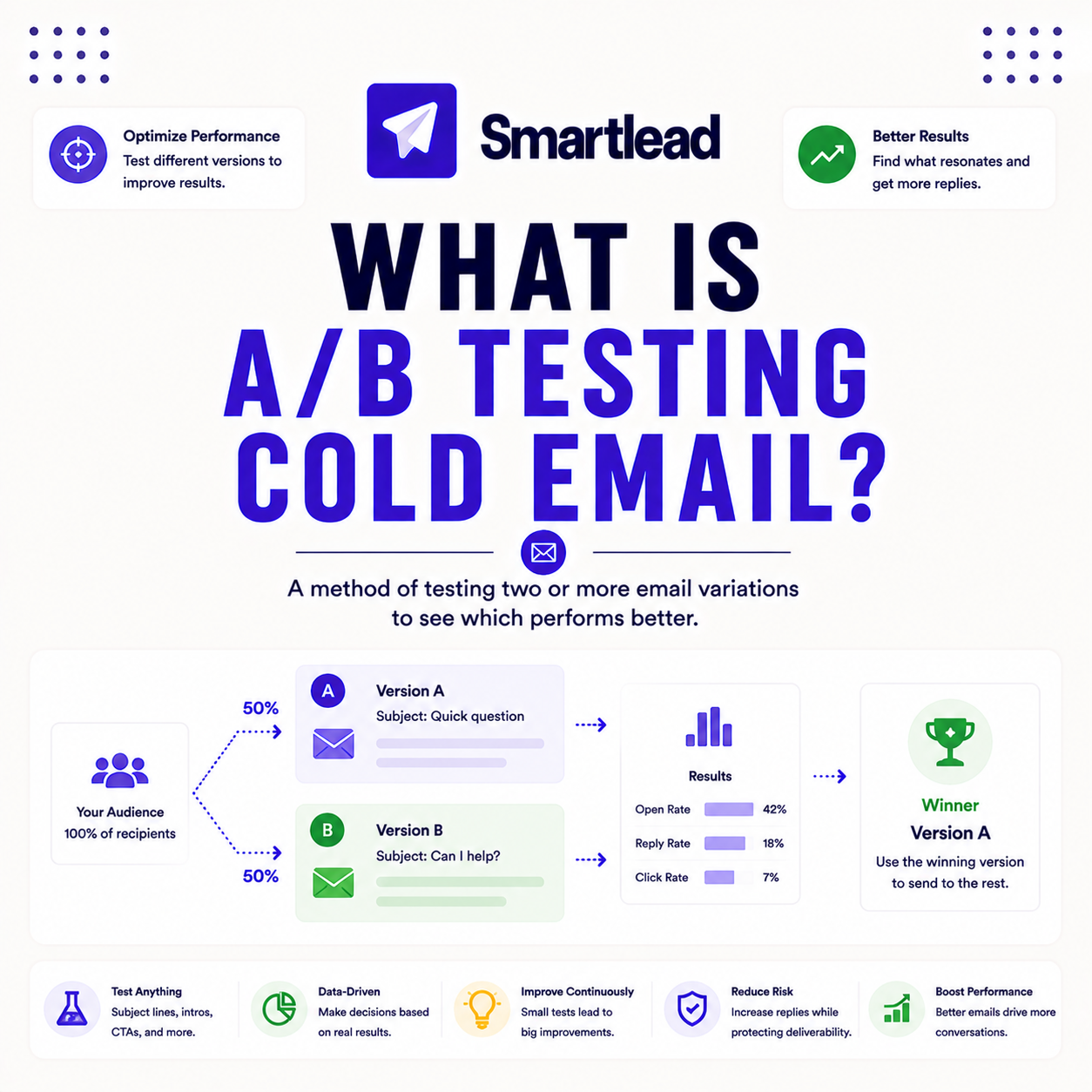
AB testing in cold email is sending two versions of one element, such as a subject line or opener, to comparable prospect groups and comparing which gets more replies. It replaces guessing with evidence from real sends. The deciding factor is that a controlled comparison shows what actually works. The list below covers the parts.
- Two versions: one element is written two ways to compare directly.
- Comparable groups: similar prospects on each side keep the test fair.
- Measure replies: the reply rate decides which variant wins.
- Evidence over guessing: real sends replace opinion about what performs.
- Scale the winner: the stronger variant becomes the new default.
“Testing copy on real prospects replaces opinion with evidence about what actually earns replies.”
— Growth Hack Suite, on cold email tools
How Does A/B Testing Work?
AB testing works by splitting a segment so each half receives a different variant, then comparing the reply rate. The platform assigns and tracks variants, so after enough sends the stronger performer is clear. The deciding factor is that the split and tracking are handled automatically. The list below covers the flow.
- Split the segment: the list is divided so each half gets one variant.
- Assign variants: the platform sends version A or B to each side.
- Track replies: reply rates are recorded per variant as sends go out.
- Compare results: after enough sends the stronger variant is identified.
- Pairs with basics: testing runs on top of warmup and list verification.
“A small change to a subject line can shift open and reply rates significantly.”
— HubSpot, on subject lines
What Should You A/B Test in Cold Email?
Test the elements that most affect replies: subject lines, the opening line, the call to action, and sometimes send timing. Starting with the highest-impact element gives the biggest gain per test. The deciding factor is that impact should guide the test order. The list below covers what to test.
- Subject line: it affects whether the email is opened at all.
- Opener: the first line earns the read and sets the tone.
- Call to action: the ask drives whether a prospect replies.
- Send timing: the day and hour can shift how often emails land well.
- Follow-up copy: later touches earn most replies and reward testing too.
How Do You Read A/B Test Results?
Read results by comparing reply rates between variants over a large enough sample to be meaningful, not just a handful of sends. A clear, consistent difference signals a winner, while a tiny gap on few sends is likely noise. The deciding factor is sample size and consistency. The list below covers how to read them.
- Compare reply rates: the reply rate per variant is the primary signal.
- Enough sample: a meaningful result needs enough sends, not a handful.
- Consistent gap: a clear, steady difference points to a real winner.
- Watch for noise: a tiny gap on few sends is likely random variation.
- Positive replies count: meeting or positive-reply rate matters more than raw opens.
How Do You Run an A/B Test?
Run a test by choosing one element, writing two variants, splitting a segment evenly, then comparing replies after enough volume. Once a winner is clear, scale it and test the next element. The ordered steps below make testing repeatable.
- Pick one element: choose a single variable such as the subject line.
- Write two variants: create A and B versions that differ only in that element.
- Split evenly: divide a comparable segment so each side is fair.
- Compare replies: wait for enough sends, then read the reply rates.
- Scale the winner: adopt the stronger variant and test the next element.
Ready to split-test copy? Test Smartlead free for 14 days.
Start Smartlead Free Trial →No credit card · unlimited mailboxes
Why Test One Element at a Time?
Testing one element at a time isolates cause, so you know exactly what drove the change. Changing the subject and opener together hides which mattered, so single-variable tests give clean, actionable results. The deciding factor is that isolation makes the result trustworthy. The table below shows common test elements and what they influence.
Source: standard cold email testing practice, mid-2026. Directional, not a measured benchmark.
How Big a Sample Do You Need?
You need enough sends per variant that the difference is unlikely to be chance, generally a few hundred at least, more for small differences. Calling a winner on a tiny sample leads to false conclusions. The deciding factor is that reliability rises with sample size. The table below positions the feature against a typical rival.
Source: vendor sites plus internal review, mid-2026. Verify current features on smartlead.ai.
Does Smartlead Support A/B Testing?
Yes, Smartlead supports A/B testing variants within campaigns so copy can be compared on real prospects and the winner scaled. Combined with reply tracking, it turns sending into a continuous improvement loop. The deciding factor is that testing plus tracking make optimization systematic. The honest read is that AB testing pays off most once volume is high enough to read results.
The practical point is to test one element per campaign, scale the winner, and move to the next. Verify current features on smartlead.ai.
Who Gets the Most Value From AB Testing?
Agencies and scale senders get the most value, since AB testing compounds across many mailboxes and clients and needs volume to read results. Low-volume single-account senders see a smaller benefit, so weigh it against sending volume. The deciding factor is whether volume is high enough for reliable reads. The honest read is that the more you send, the more testing pays back.
The practical point is that a high-volume sender gains most, while a low-volume sender should nail fundamentals before formal testing.
How Do You Get Started Today?
Start on the 14-day free trial, connect a mailbox, warm it, verify a small list and run a first test on one subject line. Confirming results on your own domains before committing is the lowest-risk way to begin. The trial needs no card, so the only cost is setup time. By launch, replies decide which copy wins.
What Metric Should You Use for Cold Email A/B Tests?
Use reply rate, and ideally positive-reply or meeting rate, since opens are unreliable due to privacy features. Replies tie directly to pipeline, making them the most meaningful signal. The deciding factor is that the metric should map to real outcomes, not vanity opens. The honest read is that a reply-based metric keeps tests focused on what actually drives revenue.
The practical point is to judge variants on positive replies where possible, since that ties the test straight to booked meetings.
Can You A/B Test Follow-Up Emails?
Yes, follow-up steps can be tested the same way, comparing variants of a later touch. Since most replies come from follow-ups, optimizing them through testing can lift overall campaign performance. The deciding factor is that follow-ups drive most replies, so they reward testing. The honest read is that skipping follow-up tests leaves the highest-reply part of the sequence unoptimized.
“A/B testing is a randomized experiment with two variants, A and B.”
— Wikipedia, A/B testing
AB Testing: The Final Verdict
The final verdict is that AB testing in cold email replaces guessing with evidence, comparing two variants on real prospects to find which converts. Test one element at a time, judge on reply rate over a large enough sample, and scale the winner before testing the next. It pays off most at volume, so nail fundamentals first, then let data drive the copy.
Growth Hack Suite Editorial — Outbound Tools Team
This guide explains AB testing based on standard cold email optimization practice plus hands-on testing of Smartlead. Behavior varies; verify current features on smartlead.ai. We review outbound tools for B2B senders.
Last updated: June 2026. Confirm current A/B testing support on smartlead.ai.
Affiliate disclosure: this page contains affiliate links. If you start a plan through them, Growth Hack Suite may earn a commission at no extra cost to you. It does not change our guidance.
Let data pick your best copy. Start Smartlead free for 14 days.
Start Smartlead Free Trial →Unlimited mailboxes · no credit card · cancel anytime
Related Tools in the Outbound Stack
Two other tools in the Growth Hack Suite stack pair with A/B testing.
- Hunter Email Verifier: verifying the list keeps the deliverability that clean tests depend on — see verifier accuracy.
- GMass: the Gmail-native option for a sender testing copy from Gmail — read the GMass review.
- Gmail tools comparison: the Gmail-scoped breakdown for senders weighing platform versus extension — compare the Gmail tools.
A/B Testing FAQ
The 12 most-asked questions about A/B testing in cold email.
What is A/B testing in cold email?
AB testing in cold email is sending two versions of one element, such as a subject line or opener, to comparable groups and comparing which gets more replies. It replaces guessing with evidence from real sends.
How does A/B testing work?
It splits a segment so each half receives a different variant, then compares the reply rate. The platform assigns and tracks variants, so after enough sends you can see which performed better.
What should I A/B test in cold email?
The elements that most affect replies: subject lines, the opening line, the call to action, and sometimes send timing. Test one element at a time so you know which change made the difference.
How do I read A/B test results?
Compare reply rates between variants over a large enough sample to be meaningful, not a handful of sends. A clear, consistent difference signals a winner, while a tiny gap on few sends is likely noise.
How do I run an A/B test?
Choose one element, write two variants, split a segment evenly, then compare replies after enough volume. Once a winner is clear, scale it and test the next element, improving the campaign step by step.
Why test one element at a time?
Testing one element isolates cause, so you know exactly what drove the change. Changing the subject and opener together hides which mattered, so single-variable tests give clean, actionable results.
How big a sample do I need for an A/B test?
Enough sends per variant that the difference is unlikely chance, generally a few hundred at least, more for small differences. Calling a winner on a tiny sample leads to false conclusions.
Does Smartlead support A/B testing?
Yes, Smartlead supports A/B testing variants within campaigns so you can compare copy on real prospects and scale the winner. Combined with reply tracking, it turns sending into a continuous improvement loop.
Should I A/B test subject lines first?
Subject lines are a high-impact starting point since they affect whether emails get opened at all. After finding a strong subject, test the opener and call to action to keep improving results.
What metric should I use for cold email A/B tests?
Reply rate, and ideally positive reply or meeting rate, since opens are unreliable due to privacy features. Replies tie directly to pipeline, making them the most meaningful signal.
Can I A/B test follow-up emails?
Yes, test follow-up steps the same way, comparing variants of a later touch. Since most replies come from follow-ups, optimizing them through testing can lift overall campaign performance.
Is A/B testing worth it for small campaigns?
For very small volume, results are hard to read reliably, so focus on fundamentals first. As volume grows, A/B testing becomes worthwhile, since larger samples give trustworthy results.