Table of Contents
GTM automation is using software and AI to automate go-to-market motions, prospecting, outreach, enrichment, reply handling and CRM updates, so revenue workflows run with less manual work. This guide explains what it is, how it works, why it matters, what can be automated, how to build it, what GTM engineering is, and where Smartlead fits.
This approach uses software and AI to run prospecting, outreach, enrichment and CRM updates with less manual work.
Best for: small teams and founders punching above their weight.
Caveat: it replaces repetitive tasks, not strategy or judgment.
Bottom line: automating busywork frees people for high-value work.
Put this into practice. Try Smartlead free for 14 days.
Start Smartlead Free Trial →Unlimited mailboxes · no credit card · 14-day trial
What Is GTM Automation?
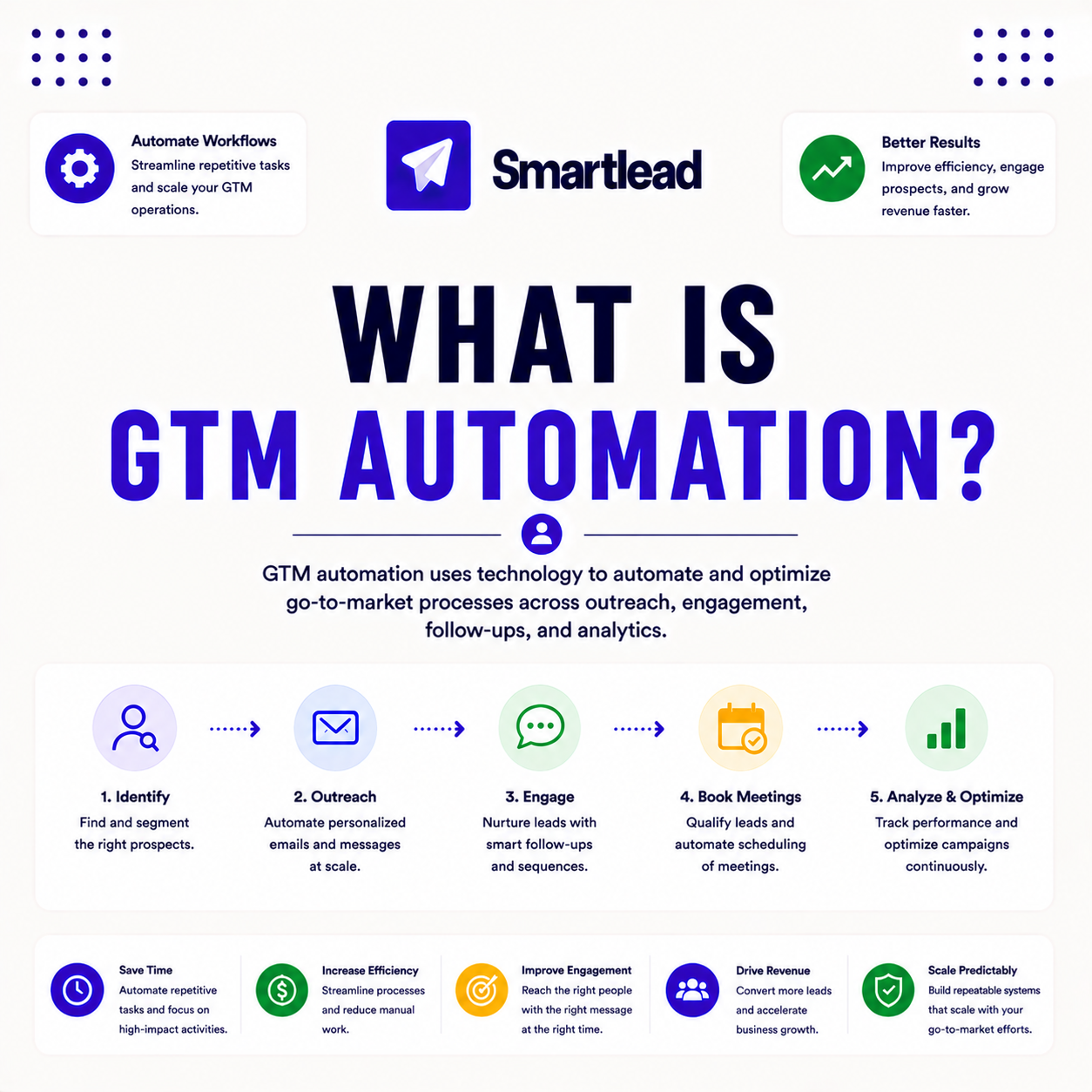
GTM automation is using software and AI to automate go-to-market activities such as prospecting, outreach, enrichment, reply handling and CRM updates. It connects the revenue stack so hand-offs happen without manual work. The deciding factor is that the repetitive glue between tools is automated. The list below covers the parts.
- Prospecting and enrichment: lists are built and enriched automatically.
- Outreach: sequences and follow-ups run without manual sending.
- Reply handling: responses are triaged and routed to the right place.
- CRM updates: outcomes sync to the pipeline without manual entry.
- Connected stack: tools pass data so one action triggers the next.
“Automating the glue between revenue tools is what lets a small team run like a large one.”
— Growth Hack Suite, on cold email tools
How Does GTM Automation Work?
It works by connecting tools, data sources, sending platforms and CRMs through integrations, APIs and AI agents, so an action in one triggers the next. A reply can update the CRM and route a lead without anyone lifting a finger. The deciding factor is that hand-offs are automated end to end. The list below covers the flow.
- Connect the tools: data sources, sending platforms and CRMs are linked.
- Trigger on events: an action in one tool starts the next automatically.
- Route data: a reply updates the CRM and routes the lead onward.
- Use AI agents: agents research, draft and classify inside the flow.
- Keep humans on strategy: people own offer and judgment, not the plumbing.
“The best revenue teams automate the busywork and reserve human time for judgment.”
— HubSpot, on revenue operations
Why Does GTM Automation Matter?
It matters because revenue teams spend huge time on repetitive tasks, and automating them frees people for strategy and high-value conversations. A small team with a strong setup like this can outrun a larger, manual one. The deciding factor is that leverage comes from removing busywork. The list below covers why.
- Repetitive tasks drain time: manual glue work eats revenue-team hours.
- Frees people for strategy: automation shifts effort to high-value work.
- Best for lean teams: small teams gain the most leverage from it.
- Caveat: automation amplifies a good motion, it does not fix a bad one.
- Compounds with scale: the saving grows as volume and steps increase.
What Can You Automate in Go-to-Market?
You can automate list building, enrichment, personalized outreach, follow-ups, reply triage, CRM logging and routing. The judgment-heavy parts, offer, strategy and complex conversations, stay human. The deciding factor is that repeatable steps automate while judgment does not. The list below covers what fits.
- List and enrichment: prospect lists are built and enriched automatically.
- Outreach and follow-up: sequenced sends run without manual chasing.
- Reply triage: responses are classified and surfaced by intent.
- CRM logging and routing: outcomes sync and leads route automatically.
- Judgment stays human: offer, strategy and nuance remain with people.
How Do You Build GTM Automation?
Build it by mapping the go-to-market steps, then connecting tools so each hand-off is automatic, starting with the highest-volume task. Automating one workflow end to end first proves the value before expanding. The ordered steps below make building it repeatable.
- Map the steps: lay out the go-to-market motion from list to closed deal.
- Connect the tools: link data, sending and CRM so hand-offs are automatic.
- Automate one workflow: start with the highest-volume task end to end.
- Measure the result: confirm the automation saves time and holds quality.
- Expand step by step: add the next workflow once the first proves out.
Building a GTM stack? Test Smartlead free for 14 days.
Start Smartlead Free Trial →No credit card · unlimited mailboxes
What Is GTM Engineering?
GTM engineering is the practice of building these automated revenue workflows, often combining data tools, sending platforms and AI. A GTM engineer designs the systems that make go-to-market run on autopilot. The deciding factor is that it treats revenue operations as a system to be built. The honest read is that GTM engineering turns a manual motion into a repeatable, automated machine.
The practical point is that a GTM engineer connects the stack and maintains the flows, so the revenue motion keeps running without constant manual effort.
Does GTM Automation Replace People?
It replaces repetitive tasks, not people. By removing manual busywork, it shifts teams toward strategy, creative offers and relationship-building. The deciding factor is that automation handles the routine while people handle the judgment. The table below positions the feature against a typical rival.
Source: vendor sites plus internal review, mid-2026. Verify current features on smartlead.ai.
How Does Smartlead Fit GTM Automation?
Smartlead fits GTM automation as the sending and reply layer, with AI agents, a deep API and CRM integrations that connect outreach to the rest of the stack. It is a core building block, not the whole system. The deciding factor is that the sending layer is where outreach automation lives. The honest read is that Smartlead handles outreach and replies while other tools cover data and pipeline.
The practical point is to slot Smartlead in as the outreach engine and connect it to enrichment and CRM tools. Verify current features on smartlead.ai.
Who Gets the Most Value From GTM Automation?
Small teams and founders get the most value, since automation lets them punch above their weight. Larger teams use it too, but the leverage is greatest where headcount is scarce. The deciding factor is how much manual work a lean team is trying to cover. The honest read is that the smaller the team relative to its ambition, the more GTM automation pays back.
The practical point is that a founder or lean revenue team gains most, using automation to run a motion that would otherwise need more people.
How Do You Get Started Today?
Start on the 14-day free trial, connect a mailbox, warm it, verify a small list and automate one outreach workflow end to end. Proving one flow on your own stack before committing is the lowest-risk way to begin. The trial needs no card, so the only cost is setup time. By launch, one revenue workflow runs without manual glue.
Is GTM Automation the Same as Marketing Automation?
No, marketing automation is one part, focused on nurturing opted-in audiences, while GTM automation is broader, covering outbound prospecting, sending, reply handling and CRM across the whole revenue motion. The deciding factor is scope: nurture flows versus the full go-to-market. The honest read is that marketing automation is a component inside a wider GTM automation system.
The practical point is to treat marketing automation as one workflow within a broader GTM stack, not as the whole thing.
What Tools Are Used for GTM Automation?
A typical GTM stack combines a data or enrichment tool, a sending platform like Smartlead, a CRM, and connectors like Zapier, Make, n8n or APIs, with AI agents increasingly tying them together. The deciding factor is that each layer handles one job and connectors link them. The table below maps the layers.
Source: common GTM stack layers, mid-2026. Directional, not an endorsement of specific tools.
“Artificial intelligence is intelligence demonstrated by machines, as opposed to natural intelligence.”
— Wikipedia, Artificial intelligence
GTM Automation: The Final Verdict
The final verdict is that GTM automation uses software and AI to run go-to-market motions, prospecting, outreach, enrichment and CRM updates, with less manual work. It replaces repetitive tasks, not judgment, and gives lean teams the leverage to run like larger ones. Start by automating one high-volume workflow end to end, keep people on strategy, and expand once each flow proves out.
Growth Hack Suite Editorial — Outbound Tools Team
This guide explains GTM automation based on standard revenue-operations practice plus hands-on testing of Smartlead. Behavior varies; verify current features on smartlead.ai. We review outbound tools for B2B senders.
Last updated: June 2026. Tool mentions are examples, not endorsements.
Affiliate disclosure: this page contains affiliate links. If you start a plan through them, Growth Hack Suite may earn a commission at no extra cost to you. It does not change our guidance.
Automate your outreach layer. Start Smartlead free for 14 days.
Start Smartlead Free Trial →Unlimited mailboxes · no credit card · cancel anytime
Related Tools in the Outbound Stack
Two other tools in the Growth Hack Suite stack pair with GTM automation.
- Hunter Email Verifier: verifying enriched lists keeps the data layer clean for automation — see verifier accuracy.
- GMass: the Gmail-native option for a solo sender automating lighter outreach — read the GMass review.
- Gmail tools comparison: the Gmail-scoped breakdown for senders weighing platform versus extension — compare the Gmail tools.
GTM Automation FAQ
The 12 most-asked questions about GTM automation.
What is GTM automation?
GTM automation is using software and AI to automate go-to-market activities such as prospecting, outreach, enrichment, reply handling and CRM updates. It connects the revenue stack so hand-offs happen without manual work.
How does GTM automation work?
It connects tools, data sources, sending platforms and CRMs through integrations, APIs and AI agents, so an action in one triggers the next. A reply can update the CRM and route a lead automatically.
Why does GTM automation matter?
Revenue teams spend huge time on repetitive tasks, and automating them frees people for strategy and high-value conversations. A small team with strong GTM automation can outrun a larger, manual one.
What can I automate in go-to-market?
List building, enrichment, personalized outreach, follow-ups, reply triage, CRM logging and routing. The judgment-heavy parts, offer, strategy and complex conversations, stay human.
How do I build GTM automation?
Map your go-to-market steps, then connect tools so each hand-off is automatic, starting with the highest-volume task. Automating one workflow end to end first proves the value before expanding.
What is GTM engineering?
GTM engineering is the practice of building automated revenue workflows, often combining data tools, sending platforms and AI. A GTM engineer designs the systems that make go-to-market run on autopilot.
Does GTM automation replace people?
It replaces repetitive tasks, not people. By removing manual busywork, it shifts teams toward strategy, creative offers and relationship-building. Automation amplifies a good motion rather than fixing a bad one.
How does Smartlead fit GTM automation?
Smartlead is the sending and reply layer, with AI agents, a deep API and CRM integrations that connect outreach to the rest of the stack. It is a core building block rather than the whole system.
Is GTM automation the same as marketing automation?
Marketing automation is one part, focused on nurturing opted-in audiences. GTM automation is broader, covering outbound prospecting, sending, reply handling and CRM across the whole revenue motion.
What tools are used for GTM automation?
A data or enrichment tool, a sending platform like Smartlead, a CRM, and connectors like Zapier, Make, n8n or APIs. AI agents increasingly tie the layers together into one flow.
Is GTM automation only for large teams?
No, small teams and founders benefit most, since automation lets them punch above their weight. Larger teams use it too, but the leverage is greatest where headcount is scarce.
Do I need a developer for GTM automation?
No-code tools cover many workflows without engineering, while deeper custom automation benefits from a developer or GTM engineer. Most teams start no-code and add custom work as needs grow.