
Table of Contents
Smartlead AI agents, branded SmartAgents, are built-in AI workers that research leads, draft personalized copy, classify replies and trigger follow-ups inside the platform. They speed up the repetitive parts of outbound, but they assist an SDR rather than replace the team. This guide explains what SmartAgents do, how they work, where they help, their limits, and who gets the most value.
SmartAgents are AI workers that research, write, classify and follow up inside Smartlead, assisting an SDR rather than replacing one.
Best for: teams that want AI to handle volume, not judgment.
Caveat: a human still owns offer, targeting and edge cases.
Bottom line: AI multiplies a good SDR, it does not replace one.
Want AI to handle the busywork? Try Smartlead free for 14 days.
Start Smartlead Free Trial →Unlimited mailboxes · no credit card · 14-day trial
What Are Smartlead’s AI Agents?
Smartlead’s AI agents, called SmartAgents, are built-in AI workers that automate research, copywriting, reply handling and follow-ups inside the outbound workflow. They act on campaign data without leaving the platform. The deciding factor is that the AI lives where the sending happens. The list below covers the core roles.
- Research agent: gathers context on a lead to inform personalization.
- Copy agent: drafts opening lines and sequence variants at scale.
- Reply agent: classifies responses by intent so hot leads surface.
- Follow-up agent: triggers the next step based on how a lead responds.
- In-platform design: the agents run on live campaign data, not a separate tool.
“AI is most useful in outbound when it handles volume and a human keeps the judgment.”
— Growth Hack Suite, on cold email tools
What Do SmartAgents Do?
SmartAgents take on the repetitive work of outbound: researching prospects, drafting copy, sorting replies and scheduling follow-ups. They compress hours of manual effort into automated steps a rep reviews. The deciding factor is that they remove busywork, not decisions. The list below covers the main jobs.
- Lead research: pulls context so messages reference real details.
- Copy drafting: produces first-draft openers a rep edits, not ships blindly.
- Reply sorting: tags responses as interested, objection or not now.
- Follow-up timing: schedules the next touch based on reply intent.
- Reviewable output: every step leaves a draft a human can approve or change.
How Do SmartAgents Work?
SmartAgents work by acting on campaign and lead data, running a defined task and returning output a rep can review. Each agent maps to one stage of the outbound flow. The deciding factor is that they are task-specific, not a single black box. The table below maps agents to tasks.
Source: Smartlead SmartAgents overview, mid-2026. Verify current agents on smartlead.ai.
What Types of SmartAgents Are There?
SmartAgents split by the outbound stage they handle: research, writing, reply management and follow-up, with calling handled by SmartDialer alongside them. Grouping by stage makes the roles easy to reason about. The deciding factor is that each agent owns one job. The list below covers the types.
- Research agents: assemble lead context to fuel personalization.
- Writing agents: draft openers and sequence variants for review.
- Reply agents: categorize inbound responses by intent.
- Follow-up agents: automate timing of the next outreach step.
- Dialer companion: SmartDialer adds a calling channel beside the agents.
Can AI Agents Replace an SDR Team?
No, Smartlead AI agents do not replace an SDR team; they remove the manual load so a smaller team covers more ground. Strategy, offer, targeting and nuanced conversations still need a human. The deciding factor is that AI scales execution, not judgment. The honest read is that agents let a lean team punch above its size, but a team is still needed.
The practical point is to treat SmartAgents as force multipliers for reps, not headcount replacements. Verify current agent capabilities on smartlead.ai.
How Do SmartAgents Compare to Standalone AI Tools?
Smartlead AI agents run inside the sending platform, so output flows straight into campaigns, while standalone AI writers need copy-paste between tools. The trade is integration versus model choice. The deciding factor is whether workflow speed or model flexibility matters more. The table below compares the two.
Source: vendor sites plus internal review, mid-2026. Verify current features on smartlead.ai.
“AI works best in sales as an assistant that speeds up reps, not a replacement for human relationships.”
— HubSpot, on AI in sales
Do SmartAgents Improve Reply Rates?
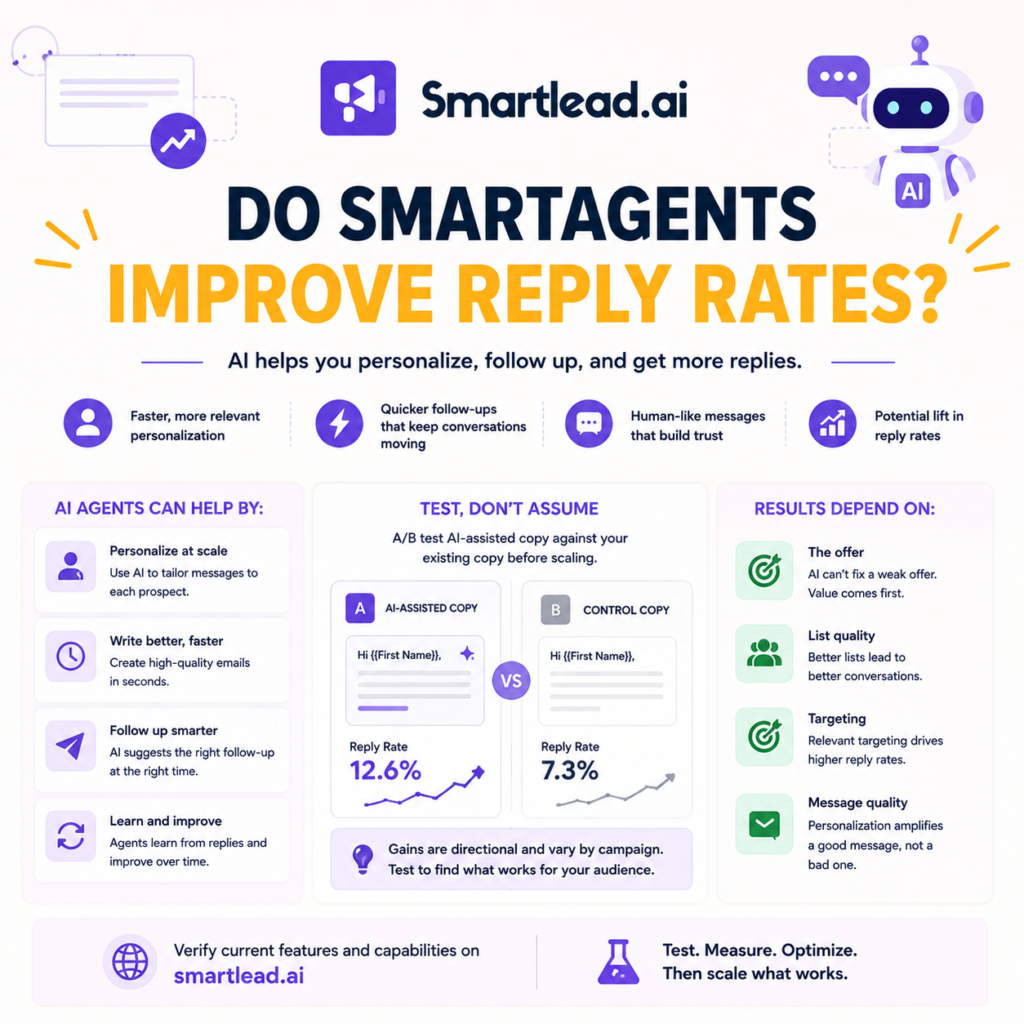
Smartlead AI agents can support reply rates by enabling faster, more relevant personalization and quicker follow-up, but results depend on the offer, list quality and targeting. AI does not fix a weak offer. The deciding factor is that personalization amplifies a good message, not a bad one. The honest read is that the gains are directional and vary by campaign, so test rather than assume a fixed lift.
The practical point is to A/B test AI-assisted copy against a control before scaling it. Verify current features on smartlead.ai.
What Are the Limits of AI Agents?
Smartlead AI agents have clear limits: they can produce generic copy, miss nuance, and need human review on strategy and edge cases. Left unchecked, they scale mistakes as fast as good work. The deciding factor is that oversight is not optional. The honest read is that SmartAgents reward teams that review output and punish teams that fully automate.
The practical point is to keep a human in the loop on offer, targeting and any non-standard reply. Verify current features on smartlead.ai.
See how the agents fit your workflow. Test Smartlead free.
Start Smartlead Free Trial →No credit card · unlimited mailboxes
How Do You Set Up SmartAgents?
Setting up SmartAgents means enabling them in a campaign, defining the task, reviewing the first outputs, then letting them run with oversight. Proving one campaign first catches issues early. The ordered steps below make it repeatable.
- Enable the agents: turn on SmartAgents inside a live campaign.
- Define the task: set what each agent should research, draft or classify.
- Review first output: check early drafts and tags before trusting them.
- Refine the prompts: adjust instructions until output matches the brand voice.
- Scale with oversight: expand once quality holds, keeping spot checks.
Are SmartAgents Safe for Deliverability?
Smartlead AI agents are safe for deliverability when the underlying sending stack, warmup, authentication and volume control, is set up correctly, because agents shape content and timing, not sending reputation. The deciding factor is that deliverability comes from infrastructure, not the AI. The honest read is that AI copy still has to avoid spammy patterns, so review remains part of staying in the inbox.
The practical point is to keep warmup and authentication solid and review AI copy for spam triggers. Verify current features on smartlead.ai.
Who Gets the Most Value from SmartAgents?
Lean teams and agencies running high volume get the most value, because SmartAgents let a few operators cover work that once needed many. Solo senders benefit too, on a smaller scale. The deciding factor is how much repetitive work there is to automate. The honest read is that the more outbound a team runs, the more the agents pay back.
The practical point is that high-volume teams should lean on SmartAgents hardest, while occasional senders gain less. Verify current features on smartlead.ai.
How Do You Get Started with SmartAgents?
Get started by running the core sending stack first, then enabling SmartAgents on one campaign to learn their output before scaling. Starting small keeps quality in check. The deciding factor is that the sending foundation comes before the AI layer. The honest read is that teams who add agents onto a working stack see cleaner results than those who start with AI.
The practical point is to get warmup and a first campaign live, then layer SmartAgents on top. Verify current features on smartlead.ai.
Do SmartAgents Work Without Coding?
Yes, SmartAgents are built for non-technical users and run without code, configured through the platform interface rather than a developer. The API exists for teams that want deeper custom automation. The deciding factor is that the default experience is no-code. The honest read is that most teams never touch the API, while technical teams can extend the agents further.
“Artificial intelligence is intelligence demonstrated by machines, particularly computer systems.”
— Wikipedia, Artificial intelligence
Growth Hack Suite Editorial — Outbound Tools Team
This guide explains Smartlead AI agents based on standard cold email practice plus hands-on testing. Smartlead AI agents and their behavior vary; verify current capabilities on smartlead.ai. We review outbound tools for B2B senders.
Affiliate disclosure: this page contains affiliate links. If you start a plan through them, Growth Hack Suite may earn a commission at no extra cost to you. It does not change our guidance.
Let AI handle the busywork. Start Smartlead free for 14 days.
Start Smartlead Free Trial →Unlimited mailboxes · no credit card · cancel anytime
Related Tools in the Outbound Stack
Two other tools in the Growth Hack Suite stack pair with Smartlead’s AI agents.
- Hunter Email Verifier: verify lists so AI-personalized sends reach real inboxes — see verifier accuracy.
- GMass: the Gmail-native option for a low-volume solo sender — read the GMass review.
- Gmail tools comparison: the Gmail-scoped breakdown for senders weighing platform versus extension — compare the Gmail tools.
Smartlead AI Agents FAQ
The 12 most-asked questions about Smartlead AI agents.
What are Smartlead’s AI agents?
Smartlead AI agents, called SmartAgents, are built-in AI workers that research leads, draft copy, classify replies and trigger follow-ups inside Smartlead. They run on live campaign data instead of a separate tool.
What do SmartAgents do?
They handle the repetitive parts of outbound: researching prospects, drafting message variants, sorting replies by intent and scheduling follow-ups, leaving a draft a rep reviews at each step.
Can Smartlead AI agents replace an SDR team?
No. They remove manual load so a smaller team covers more ground, but strategy, offer, targeting and nuanced conversations still need a human. AI scales execution, not judgment.
Do SmartAgents improve reply rates?
They can support reply rates through faster, more relevant personalization and quicker follow-up, but results depend on offer, list quality and targeting. Test AI-assisted copy against a control rather than assuming a fixed lift.
What are the limits of Smartlead’s AI agents?
They can produce generic copy, miss nuance and need human review on strategy and edge cases. Unchecked, they scale mistakes as fast as good work, so oversight is not optional.
How do SmartAgents compare to standalone AI writers?
SmartAgents run inside the platform, so output flows into campaigns and they see live data. Standalone tools need copy-paste but often offer wider model choice. The trade is integration versus flexibility.
Are SmartAgents safe for deliverability?
Yes, when warmup, authentication and volume control are set up correctly, because agents shape content and timing, not sending reputation. Review AI copy for spam triggers as part of staying in the inbox.
Do SmartAgents work without coding?
Yes, they are built for non-technical users and run without code, configured through the interface. The API exists for teams wanting deeper custom automation, but most teams never touch it.
Who gets the most value from SmartAgents?
Lean teams and agencies running high volume, because agents let a few operators cover work that once needed many. Solo senders benefit on a smaller scale; the more outbound you run, the more they pay back.
How do you set up SmartAgents?
Enable them in a campaign, define each agent’s task, review the first outputs, refine the prompts to match your voice, then scale with spot checks once quality holds.
Do you need the sending stack before adding AI agents?
Yes. Run warmup and a first campaign first, then layer SmartAgents on a working stack. Teams that add agents onto a solid foundation see cleaner results than those starting with AI.
What is SmartDialer’s role alongside the agents?
SmartDialer adds a calling channel beside the email agents, so outreach can combine automated email with human calls in one platform. It extends the stack into multichannel.