Table of Contents
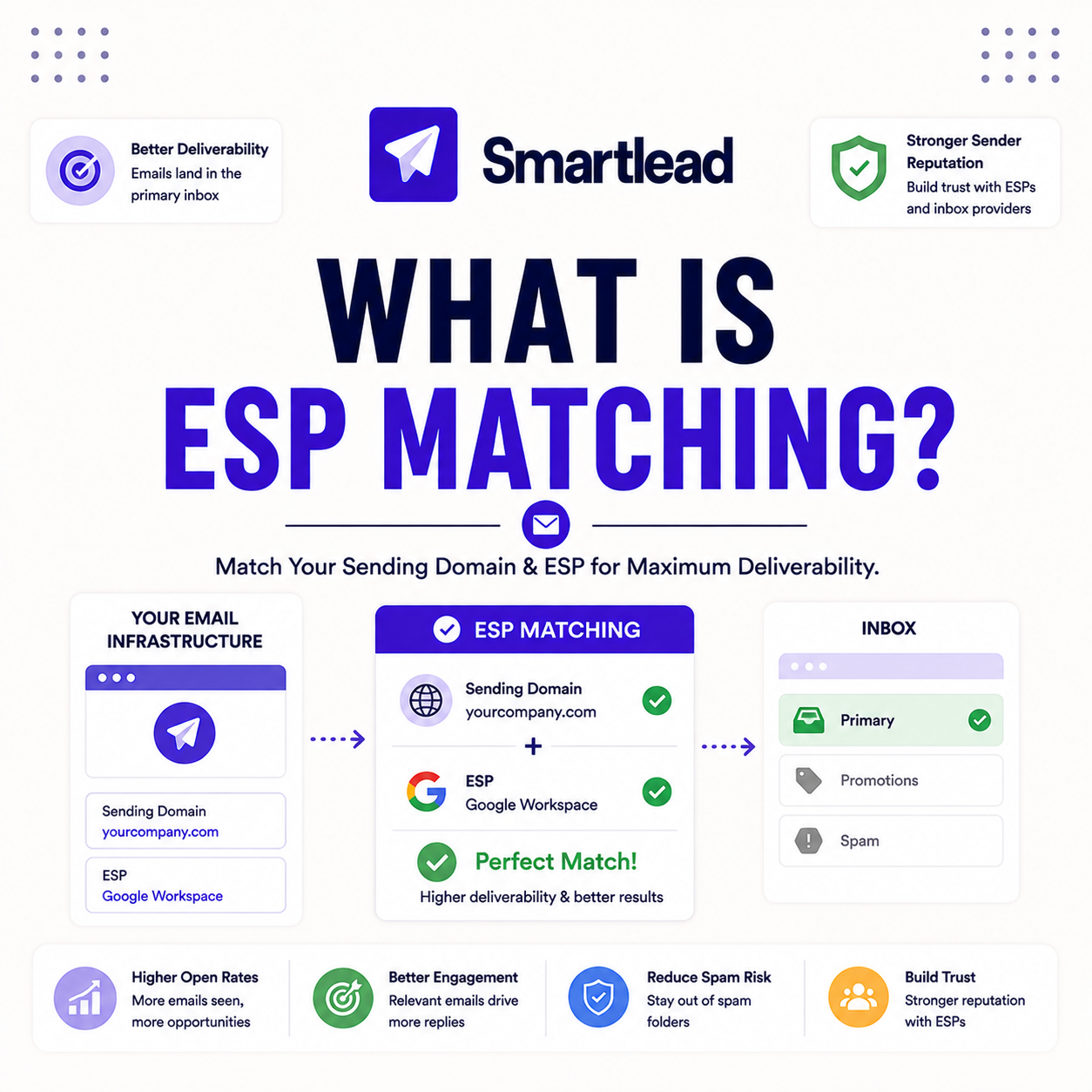
ESP matching is the practice of sending email from the same provider the recipient uses, so a Gmail recipient receives mail from a Gmail-hosted mailbox, on the theory that same-provider mail is trusted slightly more. This guide explains what it is, how it works, why it may help, how big a factor it really is, and where it fits alongside the deliverability fundamentals.
It sends from the same provider the recipient uses, since same-provider mail is often trusted a little more.
Best for: a marginal deliverability edge on top of the fundamentals.
Caveat: it is a minor factor, not a substitute for warmup or auth.
Bottom line: get the fundamentals right first, treat it as a bonus.
Put this into practice. Try Smartlead free for 14 days.
Start Smartlead Free Trial →Unlimited mailboxes · no credit card · 14-day trial
What Is ESP Matching?
ESP matching is sending email from the same email service provider the recipient uses, so a Gmail recipient gets mail from a Google-hosted mailbox and an Outlook recipient from a Microsoft one. The idea is that same-provider mail may earn a little more trust. The deciding factor is that it is a marginal edge, not a core feature. The list below covers the concept.
- Same provider: the sender’s provider is matched to the recipient’s where possible.
- Possible trust signal: providers may treat same-ecosystem mail slightly more favorably.
- A marginal edge: the effect is small and works only on top of solid fundamentals.
- Needs multiple mailboxes: it requires mailboxes on more than one provider.
- Runs automatically: the routing happens behind the scenes without manual segmenting.
“ESP matching is a marginal edge, so it helps only once the deliverability fundamentals are already right.”
— Growth Hack Suite
How Does ESP Matching Work?
It works by detecting a recipient’s provider and routing the send through a matching sender mailbox where one is available. The platform picks the mailbox whose provider aligns with the recipient’s. The deciding factor is that matching only happens when a suitable mailbox exists in the pool. The list below covers the mechanism.
- Detect the provider: the platform identifies which ESP the recipient’s address belongs to.
- Route to a match: the send is routed through a sender mailbox on the same provider.
- Needs mailbox variety: matching requires mailboxes across the major providers in the pool.
- Falls back gracefully: where no match exists, the send uses a normal mailbox instead.
- Runs automatically: the routing happens behind the scenes without manual segmenting.
“Mailbox providers may extend slightly more trust to mail sent within their own ecosystem.”
— HubSpot, on deliverability signals
Why Might ESP Matching Lift Deliverability?
It might lift deliverability because mailbox providers can apply slightly different trust to mail that originates within their own ecosystem versus mail crossing from another provider. The effect is subtle and not guaranteed. The deciding factor is that any lift is marginal and situational. The list below covers why it may help.
- Same-ecosystem trust: some providers may score internal-origin mail a touch more favorably.
- Fewer cross-provider hops: same-provider routing can look more familiar to the filter.
- Marginal by nature: the lift is small and only shows on top of good fundamentals.
- Not guaranteed: provider behavior changes, so the effect is not something to rely on.
- A bonus, not a base: it complements warmup and authentication rather than replacing them.
Is ESP Matching a Major Deliverability Factor?
It is a minor-to-moderate factor compared with warmup, authentication and list quality, which do the heavy lifting for deliverability. Treating it as a primary lever is a mistake. The deciding factor is that the fundamentals decide placement, and it only nudges the margin. The table below weighs it against the core factors.
Source: relative-impact assessment from standard cold email practice, mid-2026. Directional, not a measured ranking.
Does Smartlead Use ESP Matching?
Smartlead references dynamic ESP matching as part of its deliverability approach, alongside its warmup, sender rotation and authentication support. Exact behavior can change, so confirm the current feature on the platform. The deciding factor is that it is one piece of a broader deliverability toolkit, not the headline feature. The table below positions it against a typical rival.
Source: Smartlead deliverability positioning, mid-2026. Features change; verify current behavior on smartlead.ai.
What Providers Are Involved in ESP Matching?
The main providers are Google Workspace and Microsoft Outlook, which dominate B2B email, so most of it happens between these two ecosystems. Coverage beyond them is limited. The deciding factor is that matching is only possible where the platform has a mailbox on the recipient’s provider. The honest read is that it is really a Google-and-Outlook feature in practice.
The practical point is that running mailboxes across both Google and Outlook is what lets a platform match the widest share of B2B recipients.
How Do You Benefit From ESP Matching?
You benefit by sending from mailboxes across both major providers, so a platform can match more recipients, while keeping the fundamentals strong. Provider variety is the enabler. The ordered steps below put it to work.
- Use both providers: run Google and Outlook mailboxes so more recipients can be matched.
- Warm each mailbox: warmup every mailbox regardless of provider before real sends.
- Authenticate all domains: set SPF, DKIM and DMARC on every sending domain.
- Let the platform route: enable matching and let it pick the aligned mailbox automatically.
- Keep fundamentals first: treat matching as a bonus on top of warmup, auth and clean lists.
Want a stronger deliverability stack? Test Smartlead free for 14 days.
Start Smartlead Free Trial →No credit card · unlimited mailboxes
Should You Choose a Tool for ESP Matching Alone?
No, choose a tool on deliverability fundamentals first, with it as a nice-to-have rather than a deciding factor. Warmup quality, authentication support, unlimited mailboxes and reply management matter far more. The deciding factor is that the fundamentals drive results and it only nudges the margin. The honest read is that picking a tool for it alone would be optimizing the wrong variable.
The practical guidance is to evaluate tools on warmup, deliverability features and workflow, and treat it as a minor tiebreaker at most.
Who Gets the Most Value From ESP Matching?
Agencies and scale senders get the most value, since a marginal edge compounds across very high volume. At small volume the effect is negligible. The deciding factor is total send volume, where a tiny percentage lift adds up. The honest read is that it matters most to senders already doing everything else right at scale.
The practical point is that a solo sender should focus on fundamentals, while a high-volume agency may see a small aggregate benefit from it.
How Do You Get Started Today?
Start on the 14-day free trial, connect mailboxes across Google and Outlook, warm them and verify a small list, so the deliverability stack is solid before it adds its edge. Building the fundamentals first is what makes any marginal feature worthwhile. The trial needs no card, so the only cost is setup time. By launch, the stack is doing the real work and matching is a bonus.
Is ESP Matching the Same as Warmup?
No, warmup builds a mailbox’s reputation over time, while ESP matching routes sends through a provider-aligned mailbox. They solve different problems and are not interchangeable. The deciding factor is that warmup is a core reputation tool and it is a routing tweak. The honest read is that warmup is essential and it is optional polish.
The practical point is to never treat it as a replacement for warmup, since a matched send from an unwarmed mailbox still lands in spam.
Does ESP Matching Work for All Recipients?
ESP matching only works where the platform has a mailbox on the recipient’s provider, so it mainly applies to Google and Outlook recipients. For recipients on other providers, sending falls back to a normal mailbox. The deciding factor is provider coverage in the mailbox pool. The honest read is that it covers most B2B recipients but is not universal.
“Email deliverability is the ability to deliver emails to subscribers’ inboxes.”
— Wikipedia, Email deliverability
ESP Matching: The Final Verdict
The final verdict is that ESP matching is a marginal deliverability edge: sending from the same provider the recipient uses may earn a little more trust, mainly across Google and Outlook. It is a bonus, not a base, so get warmup, authentication and list quality right first. Treated as polish on a solid stack, it is worth having, but it never carries deliverability on its own.wn.
Growth Hack Suite Editorial — Outbound Tools Team
This guide explains ESP matching based on standard cold email deliverability practice plus hands-on testing of Smartlead. It is a minor factor and provider behavior changes; verify current features on smartlead.ai. We review outbound tools for B2B senders.
Last updated: June 2026. Confirm current behavior on smartlead.ai.
Affiliate disclosure: this page contains affiliate links. If you start a plan through them, Growth Hack Suite may earn a commission at no extra cost to you. It does not change our guidance.
Build the full deliverability stack. Start Smartlead free for 14 days.
Start Smartlead Free Trial →Unlimited mailboxes · no credit card · cancel anytime
Related Tools in the Outbound Stack
Two other tools in the Growth Hack Suite stack strengthen the deliverability fundamentals it sits on.
- Hunter Email Verifier: verifying lists keeps bounce low, which matters far more than ESP matching — see verifier accuracy.
- GMass: the Gmail-native option for a sender working within a single provider — read the GMass review.
- Gmail tools comparison: the Gmail-scoped breakdown for senders weighing platform versus extension — compare the Gmail tools.
ESP Matching FAQ
The 12 most-asked questions about ESP matching.
What is ESP matching?
It means sending email from the same provider the recipient uses, so a Gmail recipient gets mail from a Google-hosted mailbox. The idea is that same-provider mail may earn slightly more trust.
How does ESP matching work?
It detects a recipient’s provider and routes the send through a matching sender mailbox where one is available. Matching only happens when a suitable mailbox exists in the sending pool.
Why does ESP matching lift deliverability?
Providers can apply slightly different trust to internal versus external-origin mail, so same-ecosystem sending may help at the margin. The effect is subtle and not guaranteed.
Is ESP matching a major deliverability factor?
It is minor-to-moderate compared with warmup, authentication and list quality, which do the heavy lifting. Treat ESP matching as a marginal edge, not a primary lever.
Does Smartlead use ESP matching?
Smartlead references it as part of its deliverability approach, alongside warmup, rotation and authentication support. Behavior can change, so verify the current feature on smartlead.ai.
What providers are involved in ESP matching?
Mainly Google Workspace and Microsoft Outlook, which dominate B2B email, so most of it happens between these two ecosystems. Coverage beyond them is limited.
How do I benefit from ESP matching?
Send from mailboxes across both major providers, so a platform can match more recipients, while keeping the fundamentals strong. Provider variety is what enables it.
Should I pick a tool just for ESP matching?
No, choose on deliverability fundamentals first, treating it as a nice-to-have rather than a deciding factor. Warmup, authentication and unlimited mailboxes matter far more.
Does ESP matching guarantee inbox placement?
No, it is one minor signal. Warmup, authentication, list quality and sensible volume decide placement; it only nudges the margin once those are already right.
Is ESP matching the same as warmup?
No, warmup builds a mailbox’s reputation, while it routes sends through a provider-aligned mailbox. They solve different problems, and a matched send from an unwarmed mailbox still lands in spam.
Can I do ESP matching manually?
Manually you could segment recipients by provider and send from matching mailboxes, but it is tedious at scale. A platform that automates the routing is what makes this practical.
Does ESP matching work for all recipients?
Only where the platform has a mailbox on the recipient’s provider. For recipients on other providers, sending falls back to a normal mailbox, so it covers most B2B but is not universal.