Table of Contents
Cheaper than Kinsta means two very different things, and knowing which one you are buying is the whole point of this comparison. Some hosts match Kinsta’s managed, isolated model for less money, while others are cheaper only because they drop to a lower tier of hosting. The saving is real in both cases, but so is the trade.
Last updated: August 2026. Prices and models were read from each vendor’s own plan pages in the same week, with Kinsta figures taken from Kinsta’s official documentation. This page carries affiliate links to Kinsta, so it also states plainly what the premium buys and when a cheaper host is the smarter choice.
What Is the Best Cheaper Alternative to Kinsta?
Cloudways, because at 14 dollars it is genuinely cheaper than Kinsta while staying managed, isolated by server and unmetered on visits. It is the rare option that costs less without dropping to a lower tier of hosting, which is what most people searching for a cheaper Kinsta actually want.
Verdict: Two kinds of host are cheaper than Kinsta. Cloudways, Rocket.net and DreamHost match its managed model for less, so the saving costs little. Hostinger, SiteGround and DigitalOcean are cheaper by moving to shared or unmanaged hosting, so the saving costs a real drop in resources or convenience. Decide which trade you are making before the price.
The ranking below is split on exactly that line, so a reader can pick a saving that matches their site rather than the lowest number on the page.
“WordPress is a web content management system.”
: Wikipedia, WordPress
Every host here runs that software, so the difference a lower price buys is not the platform but the resources behind it and the amount of management the customer takes on.
What Are the Two Kinds of Cheaper?
Cheaper-but-comparable and cheaper-by-downgrade, and they are not interchangeable. The first keeps the managed, isolated experience Kinsta provides at a lower price, while the second lowers the bill by giving up isolation, management, or both.
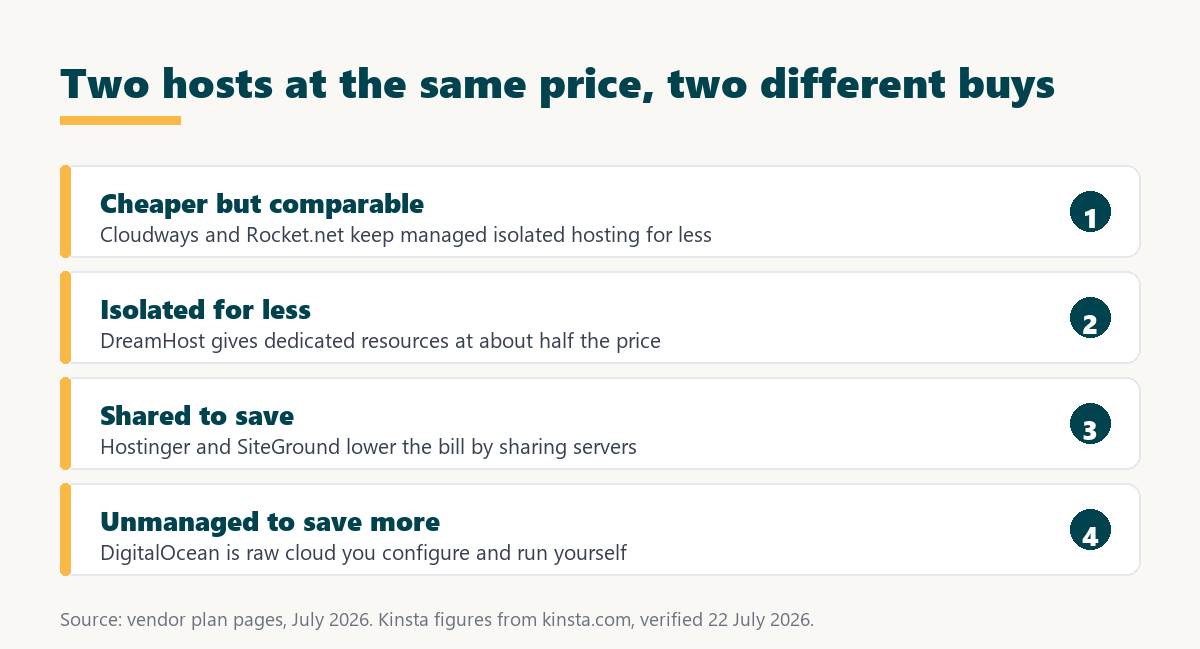
- Comparable and cheaper: Cloudways and Rocket.net keep managed hosting with dedicated resources, so the lower price costs little in capability.
- Isolated for less: DreamHost provides a dedicated managed WordPress environment at roughly half Kinsta’s price, a genuine middle option.
- Shared to save: Hostinger and SiteGround lower the bill by placing sites on shared servers, which is cheaper but caps concurrent traffic.
- Unmanaged to save more: DigitalOcean gives raw cloud at a low price, but the customer manages the server, which is the largest trade of convenience here.
- Watch the metering: Some cheaper hosts are unmetered where Kinsta charges overage, so a busy site can be both cheaper and less capped at once.
The mistake to avoid is comparing only the entry price, because a shared plan and a managed one at similar numbers are not the same purchase in any way that matters under load.
How Much Cheaper Is Each One?
From a few dollars to more than 30 below Kinsta’s 35, but the saving reads differently once the model is attached. The table pairs each price with what changes relative to Kinsta.
Source: each vendor’s published plan pages, read July 2026, with Kinsta figures from kinsta.com/plans verified in August 2026. Savings are against Kinsta’s 35-dollar entry plan; shared-host renewal rates and DigitalOcean droplet pricing vary by configuration.
The last column matters more than the middle one. A 24-dollar saving on shared hosting and a 21-dollar saving on comparable managed hosting are not the same value, even though the numbers look close.
How Was This Ranking Built?
On how much capability the lower price preserves, then on the size of the saving, then on what the host gives up against Kinsta. Speed carries no weight as a benchmark, because a cheaper managed host and Kinsta both cache a WordPress page at speeds a visitor cannot distinguish.
The useful question for someone searching cheaper than Kinsta is not which host is fastest but which saving costs the least in capability. A host that is cheaper and comparable ranks above one that is cheaper by downgrading, even when the downgrade saves more.
1. Cloudways: Cheaper and Comparable
Cloudways is the largest saving that keeps a managed, isolated model, at 14 dollars against Kinsta’s 35. It runs each site on a dedicated server with unlimited visits and no metering, so a busy site can cost less and avoid overage at the same time.
- Dedicated server resources: Each Cloudways site runs on its own cloud server rather than a shared pool, which preserves the isolation that Kinsta charges more for.
- No visit metering: Unlimited visits per server remove the overage Kinsta applies above its allowance, a saving that grows with traffic.
- Hourly billing: Servers bill by the hour and resize on demand, so scaling for a busy month and back down is a normal operation.
- Independent ownership: Owned by DigitalOcean, it is a separate company from Kinsta with its own low-cost cloud infrastructure.
- The trade is the dashboard: Its interface exposes server concepts Kinsta hides, so a non-technical owner gives up some polish for the lower price.
It does not include email and its control panel is more technical than Kinsta’s, but for a saving of 21 dollars a month with the managed model intact, those are modest concessions.
See what Kinsta includes before you trade it away
Compare Kinsta Plans →Isolated containers, Cloudflare Enterprise and engineer-level support, so you know what a cheaper host drops.
2. Rocket.net: Barely Cheaper, but Unmetered
Rocket.net is only 5 dollars below Kinsta at 30 dollars, so the headline saving is small, but it removes the visit meter entirely with unmetered visitors and unlimited PHP workers. For a growing site, avoiding overage is worth more than the 5-dollar difference.
It uses Cloudflare Enterprise edge caching for speed and publishes a 99.99 percent uptime guarantee with no renewal price increase. As a cheaper-but-comparable option it is closer to Kinsta on price than on model, since the unmetered structure is arguably the better fit for a busy site.
“a B2B site that loads in 1 second has a conversion rate 3x higher than a site that loads in 5 seconds”
: HubSpot, page load time and conversion rates
That conversion point is why the comparable hosts rank above the downgrades: they hold the speed that a cheaper shared plan can lose under load, which is exactly when it costs money.
3. DreamHost: Isolated for Half the Price
DreamHost’s DreamPress provides isolated managed WordPress at a renewal near 20 dollars, roughly half Kinsta’s price, with bundled email and a small sign-up-to-renewal gap. It is the middle of the two categories: cheaper and still isolated, with fewer premium features.
It lacks Kinsta’s engineer-level support depth and its broad plan range, so a fast-scaling site may outgrow it. For a site that wants dedicated resources at a moderate saving rather than the deepest feature set, it is a sensible independent choice.
4. SiteGround: Cheaper by Sharing
SiteGround renews near 30 dollars with bundled email and a friendly managed experience, but its plans are shared rather than isolated. The saving over Kinsta is modest, and it comes specifically from sharing server resources with other sites.
For a small site that will not strain a shared plan, that trade is invisible most of the time and the bundled email is a genuine plus. Under real traffic the shared model is the difference, which is why it sits in the downgrade category despite a comfortable managed interface.
5. Hostinger: The Big Saving, Shared
Hostinger renews at 10.99 dollars, a 24-dollar saving over Kinsta, with staging, object caching, a content delivery network and a free first-year domain. It is the largest saving here that still offers a managed WordPress experience, on shared resources.
The trade is explicit: shared servers, weekly backups on the entry tier and a 99.9 percent uptime commitment rather than isolation and denser backups. For a small or new site it is an excellent value, and it is a genuine downgrade in resources from Kinsta rather than a like-for-like at a lower price.
6. DigitalOcean: Cheapest, but You Run It
DigitalOcean offers raw cloud servers from around 6 dollars, the lowest price here, but it is unmanaged: the customer configures, secures and maintains the server. It is the biggest saving and the biggest trade of convenience on the list.
For a developer comfortable running a server it is superb value, and it is the infrastructure Cloudways manages on a customer’s behalf for a few dollars more. For anyone who wanted Kinsta’s hands-off experience, it is not a comparable alternative but a different job, and that distinction belongs in any honest cheaper-than-Kinsta list.
When Is Kinsta’s Premium Worth Paying?
When the extra 20 or so dollars buys something the site genuinely needs, which is a real situation rather than a sales line. Five cases make the premium worth keeping rather than trading away.
- Support to lean on: Engineer-level support that solves WordPress problems directly is worth the difference for a business site where downtime costs money.
- Isolation without configuration: Kinsta gives dedicated resources with no server to manage, which the cheaper isolated options either expose or charge to match.
- Certifications on paper: SOC 2 Type II and ISO 27001 published by name matter when a client or employer asks, and most cheaper hosts do not list them.
- A hands-off experience: For a non-technical owner, Kinsta’s polished dashboard is part of the product, and the cheaper technical options undo that.
- Room to grow in place: A range from one install to sixty within one account means growth needs no migration, which a downgrade host cannot always offer.
If none of those apply, a cheaper host is the rational choice, and this article exists to name the right one. If several do, the premium is buying something real rather than a logo.
Decide whether the premium is buying something you need
View Kinsta Pricing →Engineer support, published certifications and a range from one site to sixty, with a 30-day guarantee.
Comparable or Downgrade: Which Is Which?
Three of these hosts keep Kinsta’s managed, isolated model and three lower the bill by giving something up. Sorted into those two groups, the choice is clearer than a single price-ordered list.
Source: each vendor’s published hosting model, read July 2026, with Kinsta as the managed isolated baseline from kinsta.com/plans. The group decides the trade; the price decides how much is saved within it.
Read this way, a reader picks a group first and a price second, which is the order that produces a host they will still be happy with under real traffic.
The managed isolated baseline every saving is measured against
See Kinsta Tiers →Isolated containers and included security, so a cheaper host’s trade is visible before you commit.
Which Should You Choose?
Pick the saving that matches your site rather than the lowest number, and four paths cover it.
- Cheaper and comparable: Cloudways for the largest managed saving, or Rocket.net when unmetered traffic matters more than the small price gap.
- Isolated at a moderate saving: DreamHost keeps dedicated resources at roughly half Kinsta’s price with fewer premium features.
- Cheapest with a managed experience: Hostinger for a small site happy on shared resources, or SiteGround for bundled email.
- Cheapest overall, self-run: DigitalOcean for a developer who wants raw cloud and will manage the server themselves.
Match the trade to the site and the right host is obvious, which is a better outcome than chasing the biggest number in the saving column.
“Tool spend is only defensible when the outcome it protects is measured, not assumed.”
: Growth Hack Suite, ROI on sales tools
For hosting the outcome is uptime and speed under real traffic, both measurable. A cheaper host that holds them is a saving, and a cheaper host that loses them under load is a false economy dressed as one.
Cheaper Than Kinsta: Frequently Asked Questions
The 12 most-asked questions about finding a cheaper host than Kinsta.
What is the best cheaper alternative to Kinsta?
Cloudways at 14 dollars, because it is genuinely cheaper while staying managed, isolated by server and unmetered on visits. It saves 21 dollars a month without dropping to a lower tier of hosting.
What are the two kinds of cheaper?
Cheaper-but-comparable, which keeps managed isolated hosting for less, and cheaper-by-downgrade, which lowers the bill by moving to shared or unmanaged hosting. Cloudways and Rocket.net are the first; Hostinger and DigitalOcean are the second.
Is a cheaper host slower than Kinsta?
Not on a quiet site, where every host caches WordPress well. Under load a shared plan can slow down where an isolated one holds steady, so the difference appears exactly when traffic and revenue are highest.
Which cheaper host is closest to Kinsta?
Cloudways on model and Rocket.net on experience. Cloudways matches the isolated managed structure for much less, while Rocket.net is only 5 dollars cheaper but removes the visit meter Kinsta applies.
Is Rocket.net really cheaper if it is only 5 dollars less?
Marginally on the plan, but it removes overage with unmetered visitors, so a busy site saves more than 5 dollars once traffic exceeds Kinsta’s allowance. The real saving grows with the site.
What is the cheapest way to leave Kinsta?
DigitalOcean from around 6 dollars if you will manage the server yourself, or Hostinger at 10.99 dollars for a managed shared experience. Both are large savings, and both are downgrades in resources or convenience.
Does a cheaper host mean shared hosting?
Not always. Cloudways and DreamHost are cheaper than Kinsta while keeping isolated resources, so cheaper does not have to mean shared. Hostinger and SiteGround are the cheaper-by-sharing options on this list.
When is Kinsta worth the higher price?
When engineer-level support, isolation without configuration, published certifications, a hands-off dashboard or a wide growth range genuinely matter. If none apply, a cheaper host is the rational choice.
Is DigitalOcean a real Kinsta alternative?
Only for a developer. It is unmanaged raw cloud, so the customer runs the server, which is the infrastructure Cloudways manages for a few dollars more. For a hands-off Kinsta user it is a different job, not a like-for-like.
Do cheaper hosts charge overage like Kinsta?
Some do not. Cloudways and Rocket.net are unmetered on visits, so they avoid the 50-cents-per-thousand overage Kinsta applies above its allowance. That can make them both cheaper and less capped on a busy site.
Will I lose features moving to a cheaper host?
Usually some. The comparable hosts keep the managed model but may drop email, application monitoring or the polished dashboard, and the downgrade hosts drop isolation or management. List the features you use before comparing prices.
Is the migration from Kinsta difficult?
Usually not, since most cheaper hosts offer migration help and the process copies the site to the new host before switching. Cloudways and Hostinger both provide migration tools, so the move is rarely the obstacle it seems.
About this ranking
Written by the Growth Hack Suite editorial team. Prices and hosting models were read from each vendor’s own plan pages in August 2026, with Kinsta figures taken from Kinsta’s official documentation. No speed benchmark is used, because a cheaper managed host and Kinsta both cache a WordPress page indistinguishably, and the real difference appears under load. This page carries affiliate links to Kinsta, and unusually it recommends cheaper hosts above it, because that is what the reader is asking for; Kinsta is the premium baseline being compared against, not the pick.
The honest split is stated throughout: Cloudways, Rocket.net and DreamHost are cheaper while keeping a managed isolated model, whereas Hostinger, SiteGround and DigitalOcean are cheaper by moving to shared or unmanaged hosting. Kinsta’s premium is worth paying only when engineer-level support, published certifications, a hands-off experience or a wide growth range genuinely matter to the site.