Table of Contents
Green hosting is web hosting that runs on renewable energy or offsets its carbon footprint through verified credits. It cuts the emissions of running a website while delivering the same performance as standard hosting, letting site owners lower their environmental impact without sacrificing speed or reliability. This guide explains how green hosting works and how to choose a genuinely eco-friendly host.
Last updated: August 2026. Written by the Growth Hack Suite editorial team, with sustainability details cross-checked against provider documentation. This page carries affiliate links to Kinsta.
What Is Green Hosting?
Green hosting is web hosting where the provider powers its servers and data centers with renewable energy, or neutralizes the resulting emissions through verified carbon offsets and renewable energy credits. As a result, hosting a website causes less environmental harm than conventional hosting drawing on fossil-fuel electricity.
“Green computing aims to reduce the environmental impact of computing.”
— Wikipedia, Green computing
Green hosting applies that principle to the web, so a site’s servers either run on clean power or have their emissions cancelled out, reducing the footprint of simply keeping a website online.
How Does Green Web Hosting Work?
Green hosting works by matching a data center’s electricity use with renewable sources like wind or solar, or by purchasing renewable energy certificates and carbon offsets equal to the power consumed. The net effect is that the carbon impact of running the servers is reduced or cancelled out entirely.
Verdict: Green hosting delivers the same speed, uptime and features as standard hosting, with one difference: the electricity is either sourced from renewables or offset with verified credits. The honest caveat is that greenwashing is common, so a truly green host publishes proof, such as renewable energy certificates or carbon-offset records. Managed hosts built on carbon-neutral clouds like Google Cloud inherit those sustainability commitments.
In short, the mechanism is about energy sourcing and offsetting, not the hardware itself, which is why performance is unaffected while the footprint drops.
Why It Matters for Website Owners
Green hosting matters because data centers consume significant electricity, and choosing an eco host lowers a site’s carbon footprint. It also supports a brand’s sustainability claims and appeals to the growing share of customers who prefer to buy from environmentally responsible companies.
The honest point is that one small site’s footprint is modest, but the choice compounds across the web and gives owners a credible, verifiable sustainability story.
Green vs Standard Hosting
Green hosting and standard hosting deliver the same website performance, but green hosting additionally sources or offsets its energy. The difference is environmental impact and brand positioning rather than speed, uptime or the features a visitor experiences on the site.
Source: provider documentation and kinsta.com/plans, verified August 2026. The difference is environmental, not technical.
Comparing energy source, carbon impact, performance and brand value shows the difference between green and standard hosting is environmental and reputational, not something a visitor feels in speed.
See how Kinsta handles green hosting on Google Cloud
Try Kinsta →Built on Google Cloud, with a 30-day money-back guarantee.
Types of Green Hosting Explained
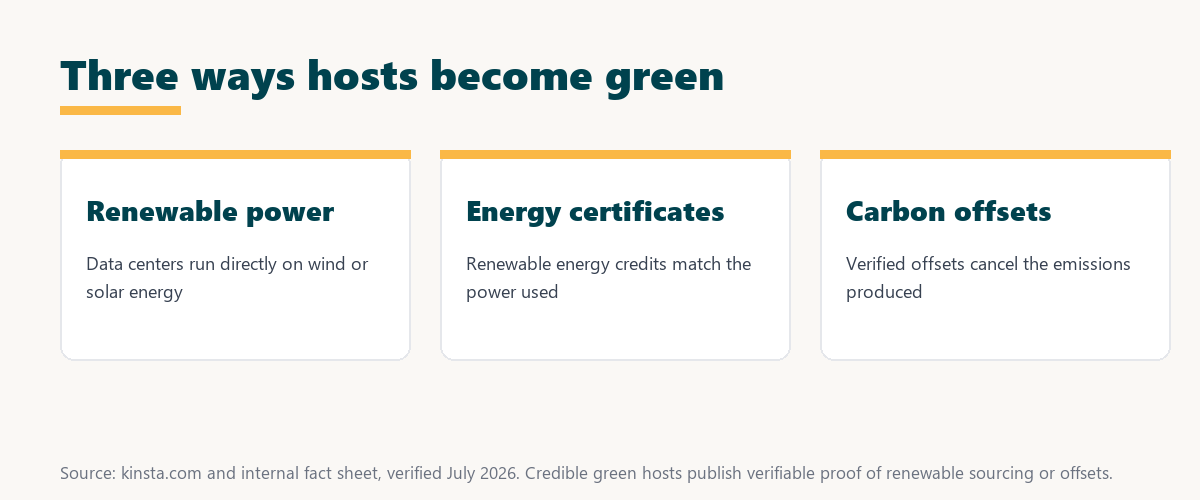
Types of green hosting include providers that buy renewable energy certificates, those that purchase carbon offsets, and those running data centers directly on renewable power. The most credible hosts publish verifiable proof of their renewable sourcing rather than relying on marketing alone.
- Renewable-powered data centers: The provider runs its facilities directly on wind, solar or hydro power, the most direct form of green hosting.
- Renewable energy certificates: The host buys certificates equal to its electricity use, funding renewable generation on the grid.
- Carbon offsets: The provider purchases verified offsets that cancel the emissions its infrastructure produces.
- Carbon-neutral cloud: A managed host built on a carbon-neutral cloud inherits that platform’s renewable matching automatically.
- Efficiency measures: Cooling and hardware efficiency reduce the energy a data center needs in the first place.
The honest takeaway is that the strongest green claims combine direct renewable power or a carbon-neutral cloud with published proof, not a single certificate alone.
Benefits of Choosing a Green Host
Choosing a green host reduces a website’s environmental footprint, strengthens the sustainability messaging a brand can share with customers, and increasingly aligns with corporate ESG goals. It does all of this without requiring any compromise on hosting performance or reliability.
“The first five seconds of page-load time have the highest impact on conversion rates.”
— HubSpot, page load time and conversion rates
Because a fast site protects conversions, the ideal green host pairs verified sustainability with the speed that keeps those first seconds quick, so eco choices never cost performance.
How to Verify a Host Is Really Green
To verify a host is genuinely green, look for published renewable energy certificates, carbon offset documentation or membership in recognized environmental programs, rather than vague eco claims. Greenwashing is common among providers marketing sustainability without any verifiable proof behind the branding.
- Published certificates: Verifiable renewable energy certificates show the host funds clean power equal to its usage.
- Offset documentation: Records from recognized offset registries confirm emissions are actually cancelled, not just claimed.
- Program membership: Membership in recognized environmental initiatives signals independent scrutiny of the host’s claims.
- Cloud transparency: A host on a carbon-neutral cloud can point to that provider’s public sustainability reporting.
- Specific figures: Concrete percentages and dates beat vague words like eco or green with no numbers attached.
The honest takeaway is that proof, not adjectives, separates a real green host from one that simply markets the label.
How to Choose a Green Web Host
Choose a green hosting provider by weighing verifiable renewable sourcing against the performance, uptime and support a site needs. The goal is a host that is both genuinely eco-friendly and fast enough for a professional website, so sustainability does not come at the cost of quality.
Source: provider documentation, verified August 2026. Ask for the specific proof that matches each method before trusting a green claim.
Weighing renewable energy certificates, carbon offsets and directly renewable-powered data centers, with the proof each requires, helps a buyer separate credible green hosts from vague marketing.
How Kinsta Approaches Sustainable Hosting
Kinsta runs on the Google Cloud Platform, which operates as carbon-neutral infrastructure matched with renewable energy. Sites hosted on Kinsta therefore benefit from Google’s sustainability commitments while still getting premium managed WordPress performance on isolated resources.
Get green hosting handled on Google Cloud
Start With Kinsta →Free migration and a 30-day money-back guarantee.
How Going Green Affects Brand Reputation
Green hosting supports brand reputation because customers increasingly favor environmentally responsible companies. Hosting on verifiably renewable infrastructure gives a business a credible sustainability claim it can share on its site and in marketing, without overstating its actual impact.
“A tool is only worth its premium when the hours or revenue it protects exceed the invoice.”
— Growth Hack Suite, on tool ROI
Applied to hosting, a green choice earns its place when the brand trust and performance it supports outweigh any difference in price, which is why verifiable sustainability beats a hollow label. Teams weighing platform commitment can also read our note on SaaS vendor lock-in.
Does Going Green Help SEO?
Green hosting does not directly boost rankings, but the fast, reliable infrastructure eco hosts often use improves Core Web Vitals, which do influence search performance. Sustainability can also strengthen the brand trust that indirectly supports engagement and repeat visits.
The honest qualifier is that Google does not rank a site higher simply for being green, so the SEO benefit comes from the speed and trust, not the label itself.
Is Going Green Worth It for Your Site?
Green hosting is worth it when sustainability matters to a brand or its customers, because the site gets the same performance with a lower carbon footprint. Running on infrastructure like Kinsta’s Google Cloud stack means the eco benefits come without a speed tradeoff.
The honest summary is that green hosting is a low-cost, high-credibility choice when it is verifiable, so the main test is proof, not the price of going green.
Try green hosting on Kinsta risk-free
Try Kinsta Risk-Free →Google Cloud infrastructure, free migration, and a 30-day money-back guarantee.
Green Hosting: Frequently Asked Questions
The 12 most-asked questions about green hosting.
What is green hosting in simple terms?
Green hosting is web hosting where the provider powers its servers with renewable energy or offsets the carbon they produce, so running a website has a smaller environmental impact than with a conventional host.
Does green hosting slow down my website?
No, green hosting delivers the same speed and uptime as standard hosting, because the eco difference lies in how the electricity is sourced or offset, not in the server performance visitors experience.
How do hosts make their servers green?
Hosts make servers green by powering data centers with renewable energy, buying renewable energy certificates, or purchasing verified carbon offsets equal to the electricity their infrastructure consumes.
Is green hosting more expensive?
Green hosting is not necessarily more expensive, since many providers, including those on carbon-neutral clouds like Google Cloud, offer eco-friendly infrastructure at prices comparable to standard managed hosting.
What is carbon-neutral hosting?
Carbon-neutral hosting means the provider balances the emissions from powering a site by purchasing offsets or renewable energy credits equal to its carbon output, resulting in a net-zero footprint for the hosting.
How can I tell if a host is truly green?
You can tell a host is truly green by checking for published renewable energy certificates, carbon offset records or recognized environmental program membership, rather than relying on vague sustainability marketing.
Does green hosting help SEO?
Green hosting does not directly boost rankings, but the fast, reliable infrastructure eco hosts often use improves Core Web Vitals, and sustainability can strengthen brand trust that indirectly supports engagement.
Is Google Cloud hosting environmentally friendly?
Yes, Google Cloud operates as carbon-neutral and matches its energy use with renewable sources, so managed hosts built on Google Cloud, such as Kinsta, inherit those sustainability benefits.
What is greenwashing in web hosting?
Greenwashing in web hosting is when a provider markets itself as eco-friendly without real proof, so you should look for documented renewable sourcing or offsets rather than trusting unsupported green branding.
Can a small website benefit from green hosting?
Yes, even a small website benefits from green hosting, because it lowers that site’s carbon footprint and lets the owner make a credible sustainability claim to their audience.
Does green hosting mean the host uses solar power?
Not always, since green hosting can mean direct renewable power like solar or wind, or it can mean the host offsets its conventional energy use with certificates and carbon credits.
Is green hosting worth switching to?
Green hosting is worth switching to when environmental impact matters to you or your customers, especially since eco infrastructure like Google Cloud delivers strong performance alongside its sustainability benefits.
About this guide
Written by the Growth Hack Suite editorial team, drawing on hands-on experience evaluating managed WordPress hosting. Sustainability details were cross-checked against provider documentation. This page carries affiliate links to Kinsta, so the position is stated plainly: green hosting delivers the same performance as standard hosting while sourcing or offsetting its energy, greenwashing is common so proof matters, and managed hosts on carbon-neutral clouds such as Google Cloud, including Kinsta, inherit that platform’s renewable-energy matching.