Table of Contents
Core Web Vitals are a set of Google metrics measuring real-world user experience: LCP for loading, INP for interactivity and CLS for visual stability. Passing them signals a fast, stable, responsive page, which supports rankings and keeps visitors from bouncing off slow or janky sites. This guide explains each metric and how to pass all three.
Last updated: August 2026. Written by the Growth Hack Suite editorial team, with thresholds cross-checked against Google web.dev guidance. This page carries affiliate links to Kinsta.
What Are Core Web Vitals?
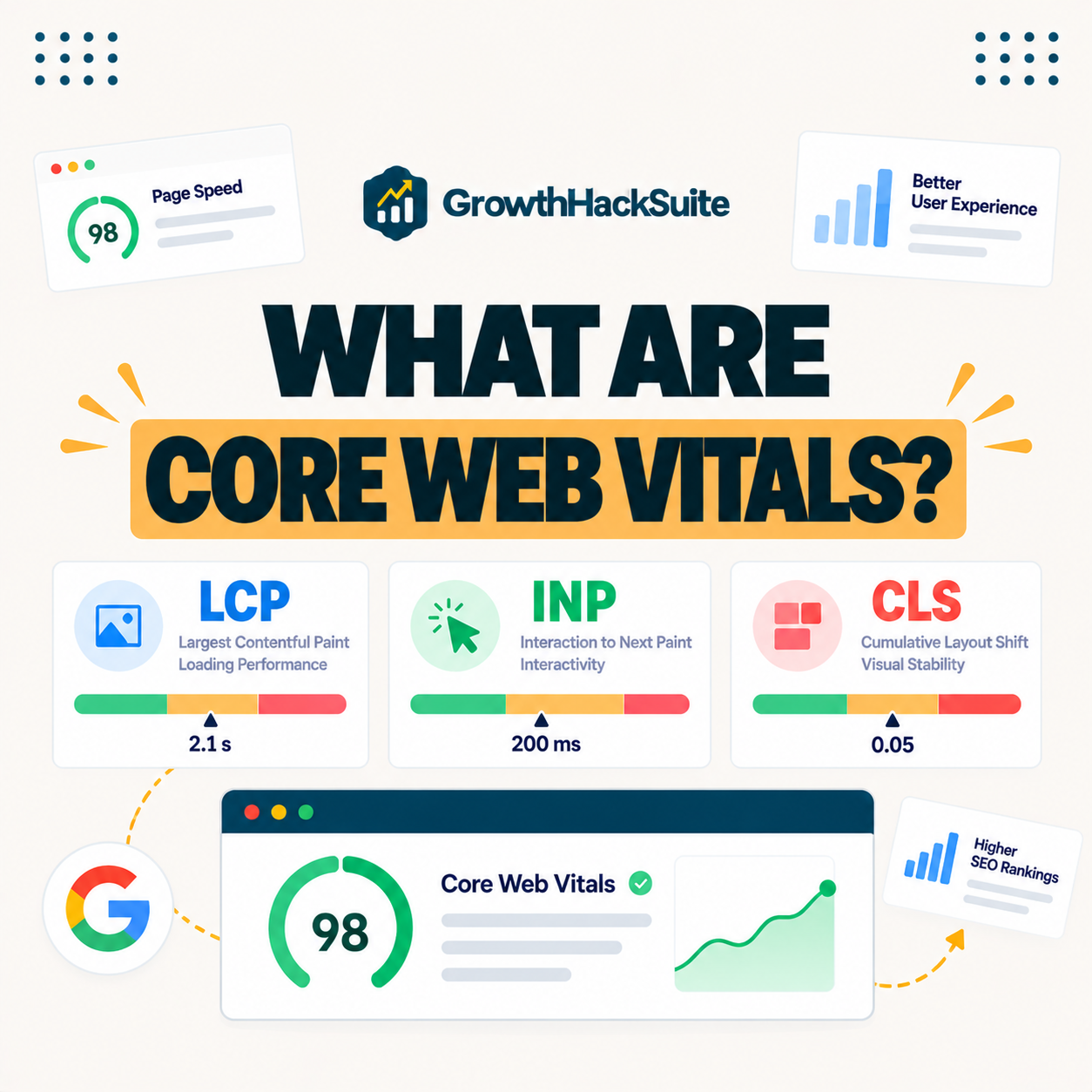
Core Web Vitals are a set of Google metrics that measure real-world user experience on a page, focusing on loading performance, interactivity and visual stability. They form part of Google’s page experience signals, which are used to help rank pages alongside content relevance.
“Web performance refers to the speed in which web pages are downloaded and displayed.”
— Wikipedia, Web performance
They put numbers on that experience, turning how fast, responsive and stable a page feels into three measurable metrics a site owner can improve.
LCP, INP and CLS Explained
The three metrics are Largest Contentful Paint, which measures loading, Interaction to Next Paint, which measures responsiveness to input, and Cumulative Layout Shift, which measures how much the page unexpectedly moves while loading. Together they cover speed, responsiveness and stability.
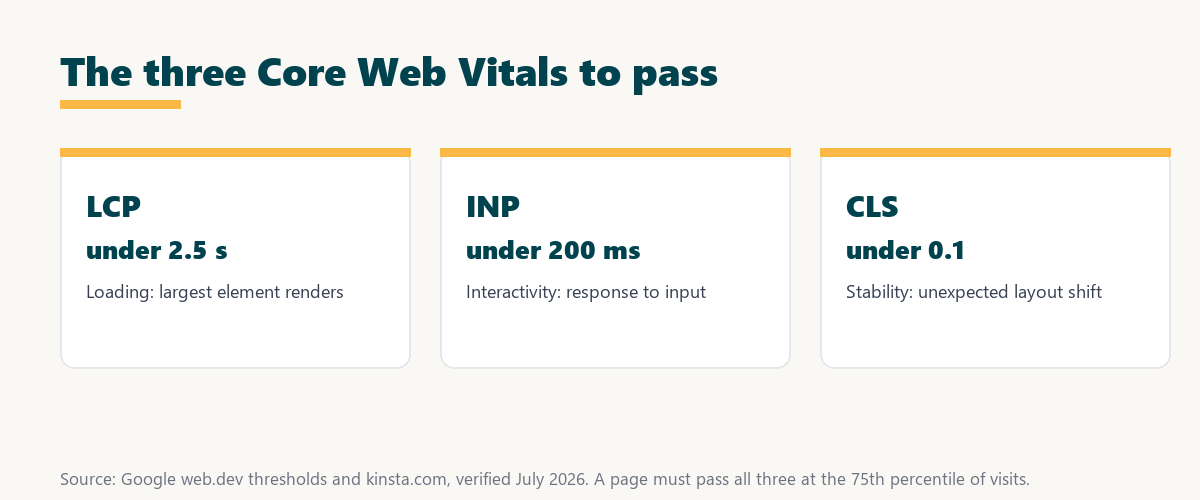
- Largest Contentful Paint: LCP measures how long the largest visible element takes to render, with a good score under 2.5 seconds.
- Interaction to Next Paint: INP measures how quickly the page responds to user input, with a good score under 200 milliseconds.
- Cumulative Layout Shift: CLS measures how much content unexpectedly moves while loading, with a good score under 0.1.
The honest point is that the three metrics cover different failure modes, so a page can be fast to load yet still fail on interactivity or stability.
How They Are Measured
Core Web Vitals are measured from real user data in the Chrome User Experience Report and estimated in lab tools like PageSpeed Insights and Lighthouse. Both field data and lab tests help you understand and improve your scores, though field data is what Google uses for ranking.
Verdict: Core Web Vitals are three field-measured metrics: LCP under 2.5 seconds, INP under 200 milliseconds, and CLS under 0.1, judged at the 75th percentile of real visits. The honest rule is that hosting and caching drive LCP most, JavaScript drives INP, and layout discipline drives CLS, so passing all three means addressing loading, interactivity and stability together rather than chasing one number.
In short, real-user field data at the 75th percentile is the scoreboard, so lab tools guide the work but the field report decides whether a page passes.
Field Metrics vs Page Speed Score
Core Web Vitals differ from a single page speed score by measuring specific experience dimensions from real users, whereas an overall speed score is a lab estimate. Passing Core Web Vitals therefore reflects actual visitor experience more directly than a headline performance number does.
Source: Google web.dev thresholds, verified August 2026. A page must pass all three at the 75th percentile of visits.
Showing LCP, INP and CLS with their good, needs-improvement and poor thresholds gives clear targets, so a site owner knows exactly what each metric must reach to pass.
See how Kinsta helps pass Core Web Vitals
Try Kinsta →Fast servers and caching that lift LCP, with a 30-day money-back guarantee.
What Are Good Core Web Vitals Thresholds?
Good Core Web Vitals thresholds are an LCP under 2.5 seconds, an INP under 200 milliseconds and a CLS under 0.1. A page must meet all three at the 75th percentile of visits to be considered passing, so most real visitors need a good experience, not just an average one.
The honest point is that the 75th percentile bar means a few slow visits are tolerated, but a page failing for a quarter of users does not pass.
Why They Matter for SEO
Core Web Vitals matter for SEO because they are part of Google’s page experience signals. While content relevance still leads, strong vitals can act as a tiebreaker and, more importantly, keep visitors from bouncing off slow pages, which protects both rankings and conversions.
“The first five seconds of page-load time have the highest impact on conversion rates.”
— HubSpot, page load time and conversion rates
Because those early seconds decide whether a visitor stays, good Core Web Vitals protect the conversions that a fast, stable page is built to earn.
How to Improve LCP, INP, and CLS
You improve LCP with faster hosting, caching and optimized images, improve INP by reducing heavy JavaScript, and improve CLS by setting size attributes on images and reserving space for dynamic elements. Addressing all three keeps loading, interactivity and stability strong together.
- Improve LCP: Fast hosting, server-level caching and compressed, correctly sized images speed up the largest element’s render.
- Improve INP: Reducing and deferring heavy JavaScript lets the page respond quickly to clicks and taps.
- Improve CLS: Setting width and height on images and reserving space for ads and embeds stops content from jumping.
- Use a CDN: Serving assets from near each visitor lowers load time and supports a better LCP.
- Trim third-party scripts: Removing unnecessary external scripts cuts both the JavaScript and layout-shift they cause.
The honest takeaway is that each vital has its own fixes, so passing all three means working on hosting, JavaScript and layout rather than one alone.
How Hosting Affects LCP and Your Scores
Hosting affects Core Web Vitals, especially LCP, because a slow server delays the largest element from rendering. Fast hosting with caching and a CDN gives every other optimization a better foundation to build on, so infrastructure sets the ceiling the front-end work can reach.
Source: Google web.dev guidance, verified August 2026. Hosting most directly affects LCP.
Listing LCP, INP and CLS with the main fixes for each, from hosting to JavaScript to layout stability, shows the whole job at a glance. Owners weighing platform commitment can also read our note on SaaS vendor lock-in.
How to Test and Monitor Your Scores
Test Core Web Vitals with PageSpeed Insights and the Core Web Vitals report in Search Console for field data, and monitor them over time. Real-user scores can differ from lab tests and change as content and traffic evolve, so ongoing monitoring matters as much as a one-off test.
Get a fast platform for Core Web Vitals
Start With Kinsta →Free migration and a 30-day money-back guarantee.
How Kinsta Helps You Pass
Kinsta helps you pass Core Web Vitals with fast Google Cloud servers, edge caching, a Cloudflare CDN and image optimization. Together these improve LCP and give your interactivity and stability work a fast underlying platform, so the front-end fixes land on a solid foundation.
“A tool is only worth its premium when the hours or revenue it protects exceed the invoice.”
— Growth Hack Suite, on tool ROI
Applied here, a fast platform earns its premium when the better Core Web Vitals it enables protect rankings and conversions worth more than the plan.
How Long Until Improvements Show?
Because Core Web Vitals use 28 days of field data, improvements can take several weeks to fully reflect in Search Console, even though lab tools show changes immediately. Fixing a page today therefore updates the field report gradually rather than all at once.
The honest qualifier is that patience is part of the process, so verify fixes in lab tools first and expect the field report to catch up over weeks.
Passing Core Web Vitals on WordPress
You pass Core Web Vitals on WordPress by combining fast managed hosting with image optimization, reduced JavaScript and stable layouts. Addressing loading, interactivity and visual stability together, rather than chasing a single metric, is what moves a page from failing to passing.
The honest summary is that Core Web Vitals reward a balanced approach, so a fast host plus disciplined front-end work beats fixing one metric while neglecting the others.
Pass Core Web Vitals risk-free on Kinsta
Try Kinsta Risk-Free →Fast hosting, image optimization and free migration, with a 30-day money-back guarantee.
Core Web Vitals: Frequently Asked Questions
The 12 most-asked questions about Core Web Vitals.
What are Core Web Vitals in simple terms?
Core Web Vitals are Google metrics measuring real-world page experience, covering loading speed, interactivity and visual stability, and they help indicate whether a page feels fast and smooth to visitors.
What are the three Core Web Vitals?
The three Core Web Vitals are Largest Contentful Paint for loading, Interaction to Next Paint for responsiveness, and Cumulative Layout Shift for how much the page unexpectedly shifts while loading.
What are good Core Web Vitals scores?
Good scores are an LCP under 2.5 seconds, an INP under 200 milliseconds, and a CLS under 0.1, and a page must meet all three at the 75th percentile of real visits.
Do Core Web Vitals affect SEO?
Yes, Core Web Vitals are part of Google’s page experience signals, so while content still leads, strong vitals can help rankings and, importantly, reduce how often visitors bounce.
How do I check my Core Web Vitals?
You check Core Web Vitals using PageSpeed Insights and the Core Web Vitals report in Google Search Console, which combine lab estimates with real-user field data from Chrome.
How can I improve my Core Web Vitals?
You improve them with faster hosting and caching for LCP, reduced JavaScript for INP, and reserved space and sized images for CLS, addressing all three dimensions together.
What is LCP in Core Web Vitals?
LCP, or Largest Contentful Paint, measures how long the largest visible element on a page takes to render, and a good LCP is under 2.5 seconds.
What is INP in Core Web Vitals?
INP, or Interaction to Next Paint, measures how quickly a page responds to user input, and a good INP is under 200 milliseconds.
What is CLS in Core Web Vitals?
CLS, or Cumulative Layout Shift, measures how much page content unexpectedly moves while loading, and a good CLS is under 0.1.
Does hosting affect Core Web Vitals?
Yes, hosting affects Core Web Vitals, especially LCP, because a slow server delays rendering, so fast hosting with caching and a CDN improves your scores at the foundation.
How long until Core Web Vitals updates show?
Because Core Web Vitals use 28 days of field data, improvements can take several weeks to fully reflect in Search Console, even though lab tools show changes immediately.
How does Kinsta help with Core Web Vitals?
Kinsta helps with fast Google Cloud servers, edge caching, a CDN and image optimization, which improve LCP and give your interactivity and stability fixes a fast platform to build on.
About this guide
Written by the Growth Hack Suite editorial team, drawing on hands-on experience optimizing site performance. Thresholds were cross-checked against Google web.dev guidance. This page carries affiliate links to Kinsta, so the position is stated plainly: Core Web Vitals are three field-measured metrics, LCP under 2.5 seconds, INP under 200 milliseconds and CLS under 0.1 at the 75th percentile, and passing them means addressing loading, interactivity and stability together. Hosting most directly affects LCP, which is why a fast platform like Kinsta, on Google Cloud with caching and a CDN, gives the rest of the work a solid foundation.