Table of Contents
VPS hosting, or virtual private server hosting, partitions a physical server into isolated virtual servers, each with dedicated resources and root access. It offers more power and control than shared hosting at a lower cost than a dedicated server, making it a middle option for sites that have outgrown shared hosting but do not need a full server. This guide explains how it works and who needs it.
Last updated: August 2026. Written by the Growth Hack Suite editorial team, with details cross-checked against provider documentation. This page carries affiliate links to Kinsta.
What Is VPS Hosting?
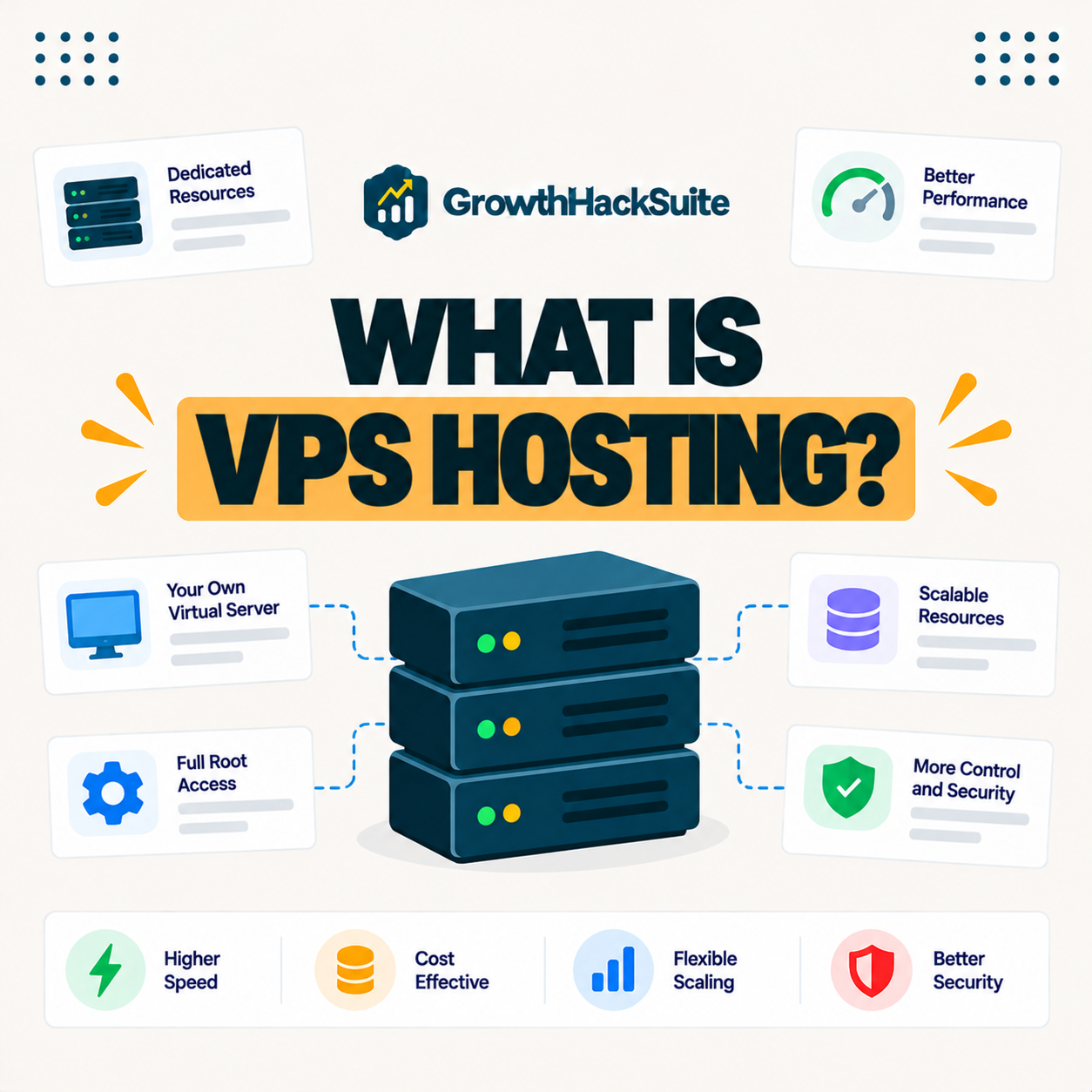
VPS hosting, or virtual private server hosting, divides a physical server into multiple isolated virtual servers, each with its own dedicated CPU, memory and storage. Your site gets guaranteed resources and more control than it would on shared hosting, without the cost of a full server.
“A virtual private server is a virtual machine sold as a hosting service.”
— Wikipedia, Virtual private server
Because a VPS behaves like an independent server, it gives a site the isolation of dedicated resources while sharing the underlying hardware with other virtual servers.
How Does VPS Hosting Work?
VPS hosting works by using virtualization to split one physical machine into separate virtual servers that each behave like an independent server. Your allocation is isolated from other users, and you often get root access to configure the environment to a site’s specific needs.
Verdict: A VPS is an isolated slice of a physical server with dedicated CPU, memory and storage, sitting between cheap shared hosting and a costly dedicated server. It comes in managed and unmanaged forms: unmanaged gives full root control but demands server skills, managed hands the maintenance to the provider. The honest alternative for a WordPress site is a managed platform that delivers VPS-level isolation without any server administration at all.
In short, a VPS trades the shared pool for a defined, isolated allocation, and the managed-versus-unmanaged choice decides how much you administer.
What Is the Difference Between Managed and Unmanaged VPS?
A managed plan has the provider handle server maintenance, security and updates, while an unmanaged one gives you root access and full responsibility. Managed suits those wanting power without administration, and unmanaged suits technical users who want complete control over the server.
The honest point is that a VPS is only as easy as its management model, so an unmanaged plan is powerful but demanding, while managed removes most of that work.
VPS Hosting vs Shared Hosting
VPS hosting differs from shared hosting by giving your site dedicated, isolated resources rather than sharing one pool with many sites. It delivers more consistent performance and control, at a higher price than shared plans, so it suits sites that have outgrown a shared server.
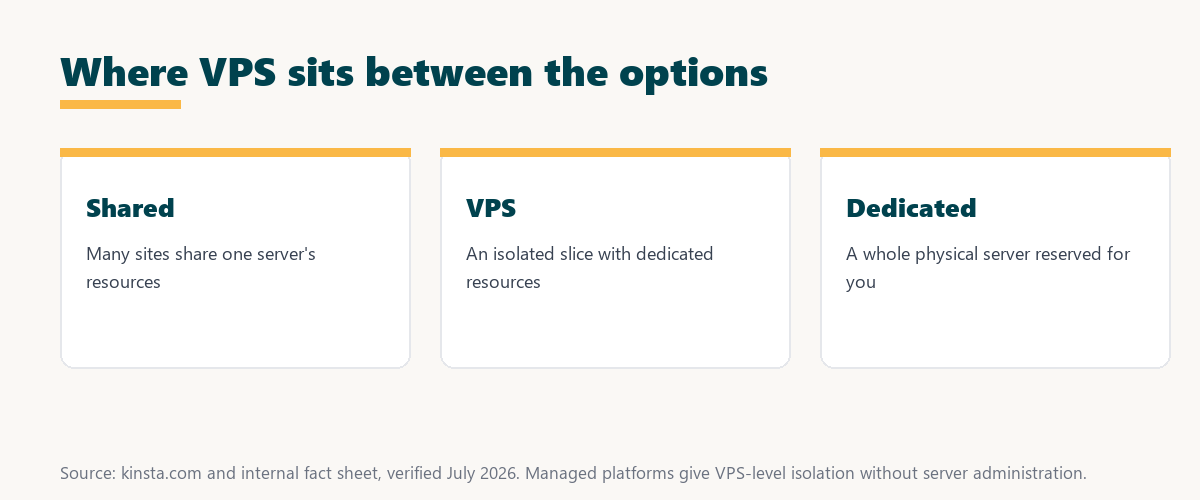
Source: provider documentation, verified August 2026. A VPS gives fixed isolated resources; cloud adds elastic scaling.
Comparing resources, isolation, scalability, control and price across VPS, shared and cloud hosting shows a VPS as the isolated middle option between cheap shared plans and elastic cloud.
Get VPS-level isolation without the admin work
Try Kinsta →Isolated Google Cloud containers, with a 30-day money-back guarantee.
VPS Hosting vs Cloud Hosting
VPS hosting runs your site on one virtual server with fixed resources, while cloud hosting spreads it across a network. Cloud therefore scales and absorbs failures more flexibly, whereas a VPS offers a defined, isolated allocation that is simpler but less elastic under sudden load.
The honest point is that a VPS is predictable and isolated, while cloud is flexible and resilient, so the better fit depends on whether a site’s traffic is steady or spiky.
Main Benefits of a VPS
A VPS benefits sites with dedicated resources, better performance than shared hosting, root-level control and the ability to scale the allocation. Together these make it a solid step up for sites that have outgrown shared hosting but do not yet need a dedicated server.
- Dedicated resources: Guaranteed CPU and memory mean a busy neighbour cannot slow the site down.
- Better performance: Isolated resources deliver more consistent speed than a crowded shared server.
- Root control: Root access allows custom server configuration that shared hosting does not permit.
- Scalable allocation: A VPS can be resized to more resources as the site grows.
- Cost middle ground: A VPS costs less than a dedicated server while offering isolation shared hosting lacks.
“The first five seconds of page-load time have the highest impact on conversion rates.”
— HubSpot, page load time and conversion rates
Because a VPS’s dedicated resources keep those early seconds consistent under load, its main benefit is the steady performance a shared server cannot guarantee.
Who Needs VPS Hosting?
Sites that have outgrown shared hosting, need custom server configurations, run resource-heavy applications or want isolated performance benefit from a VPS. It fits especially well when a full dedicated server would be more capacity than the site actually requires.
- Outgrown shared hosting: A site straining shared resources gains headroom from a VPS’s dedicated allocation.
- Custom configuration needs: Projects needing specific server software use the root access a VPS provides.
- Resource-heavy apps: Applications with steady high load benefit from guaranteed, isolated resources.
- Developers and teams: Technical users who want control over the environment suit an unmanaged setup.
- Growing stores: A store outgrowing shared hosting may use a VPS or a managed platform for isolation.
The honest takeaway is that a VPS suits sites needing control and isolation, while non-technical owners often prefer a managed platform that delivers the same isolation.
How to Choose VPS Hosting
Choose VPS hosting by deciding between managed and unmanaged based on your technical skills, then comparing resources, the underlying infrastructure, support and scalability. The plan should match both a site’s needs and the owner’s ability to administer the server.
Source: provider documentation, verified August 2026. Match the model to your technical skills.
Contrasting who handles maintenance, the skill required and the best fit for each shows a managed plan suits non-experts while unmanaged suits technical users. Owners weighing platform commitment can also read our note on SaaS vendor lock-in.
How Kinsta Compares to Traditional VPS
Kinsta offers managed WordPress hosting on isolated Google Cloud containers, giving you the dedicated resources and performance of a VPS without server administration. You gain VPS-level isolation with a fully managed, WordPress-tuned experience, so the power comes without the maintenance burden.
Get VPS-level performance handled on Kinsta
Start With Kinsta →Free migration and a 30-day money-back guarantee.
Running WordPress on a VPS
Running WordPress on a VPS gives dedicated resources for better performance, but on an unmanaged VPS you must install and secure the stack yourself. This is why many WordPress owners choose managed hosting that provides VPS-level isolation without the ongoing maintenance and security work.
“A tool is only worth its premium when the hours or revenue it protects exceed the invoice.”
— Growth Hack Suite, on tool ROI
Applied here, managed hosting earns its premium when the server-admin hours it saves are worth more than the difference over a cheaper unmanaged VPS.
What Is Root Access on a VPS?
Root access is full administrative control over your virtual server, letting you install software and configure the environment. Unmanaged VPS provides it, while managed plans may restrict it to keep the platform stable, so root access is a hallmark of the unmanaged, do-it-yourself model.
The honest qualifier is that root access is powerful but risky, since a misconfiguration can break or expose the server, which is one reason managed hosting limits it.
Is a VPS the Right Choice?
VPS hosting is the right choice when you need dedicated resources and control beyond shared hosting. That said, a managed platform like Kinsta can provide similar isolation and performance for WordPress without the burden of managing the server yourself, which suits most non-technical owners.
The honest summary is that a VPS is right when control matters and skills are available, while managed hosting is right when isolation is wanted without the administration.
Try VPS-level managed hosting risk-free
Try Kinsta Risk-Free →Isolated containers and free migration, with a 30-day money-back guarantee.
Frequently Asked Questions Before You Choose
The 12 most-asked questions about VPS hosting.
What is VPS hosting in simple terms?
VPS hosting divides one physical server into isolated virtual servers, each with dedicated CPU, memory and storage, so your site gets guaranteed resources and more control than on shared hosting.
How is VPS hosting different from shared hosting?
VPS hosting gives your site dedicated, isolated resources instead of sharing one pool with many sites, so it delivers more consistent performance and control at a higher price than shared plans.
What is the difference between managed and unmanaged VPS?
Managed VPS has the provider handle maintenance, security and updates, while unmanaged VPS gives you root access and full responsibility, so managed suits non-experts and unmanaged suits technical users.
Is VPS hosting better than cloud hosting?
Neither is simply better; a VPS offers fixed isolated resources on one virtual server, while cloud hosting spreads your site across a network for more flexible scaling and failure tolerance.
Who needs VPS hosting?
VPS hosting suits sites that have outgrown shared hosting, need custom server configurations, or run resource-heavy applications, especially when a full dedicated server would be more than required.
Do I need technical skills for VPS hosting?
Unmanaged VPS hosting requires technical skills to configure and secure the server, while managed VPS or a managed platform handles that for you, so your needed skill depends on the type.
Is VPS hosting expensive?
VPS hosting costs more than shared hosting because of dedicated resources, but less than a dedicated server, making it a mid-range option for sites that need more power than shared plans.
Can I run WordPress on a VPS?
Yes, you can run WordPress on a VPS, though on an unmanaged VPS you must configure and secure the stack yourself, which is why many prefer managed WordPress hosting instead.
Does VPS hosting improve performance?
Yes, VPS hosting improves performance over shared hosting by giving your site dedicated, isolated resources, so a busy neighbor cannot consume the CPU and memory your site relies on.
What is root access in VPS hosting?
Root access is full administrative control over your virtual server, letting you install software and configure the environment, which unmanaged VPS provides and managed plans may restrict.
Is a VPS the same as a dedicated server?
No, a VPS is an isolated slice of a shared physical machine, while a dedicated server is an entire physical machine reserved for you, offering more resources at a higher cost.
How does Kinsta compare to a VPS?
Kinsta offers managed WordPress hosting on isolated Google Cloud containers, giving VPS-level dedicated resources and isolation without server administration, in a fully managed, WordPress-tuned setup.
About this guide
Written by the Growth Hack Suite editorial team, drawing on hands-on experience running sites on VPS and managed hosting. Details were cross-checked against provider documentation. This page carries affiliate links to Kinsta, so the position is stated plainly: a VPS is an isolated slice of a physical server with dedicated resources, sitting between shared and dedicated hosting, and it comes in managed and unmanaged forms. For a WordPress site, a managed platform like Kinsta delivers VPS-level isolation on Google Cloud without any server administration.