
Table of Contents
GDPR, the General Data Protection Regulation, is the European Union law that governs how organizations collect, store and use personal data. It applies to any site handling data of people in the EU, requiring consent, transparency and data rights, so websites must manage cookies, forms and data securely to comply and avoid significant fines. This guide explains what it requires and how to comply.
Last updated: August 2026. Written by the Growth Hack Suite editorial team, with details cross-checked against provider documentation. This is a general educational overview, not legal advice; consult a qualified professional for your situation. This page carries affiliate links to Kinsta.
What Is GDPR?
GDPR, the General Data Protection Regulation, is a European Union law that governs how organizations collect, store and use the personal data of individuals. It gives people rights over their data and requires businesses to handle it lawfully, transparently and securely, so it shapes how any data-collecting site operates.
“The General Data Protection Regulation is a regulation in EU law on data protection.”
— Wikipedia, General Data Protection Regulation
For a website, the regulation translates that data-protection principle into practical duties around consent, transparency and security whenever it handles personal data.
Who Does GDPR Apply To?
GDPR applies to any organization that processes the personal data of people in the EU, regardless of where the business is located. A website anywhere that has EU visitors and collects their data generally needs to comply, so the law’s reach extends well beyond Europe itself.
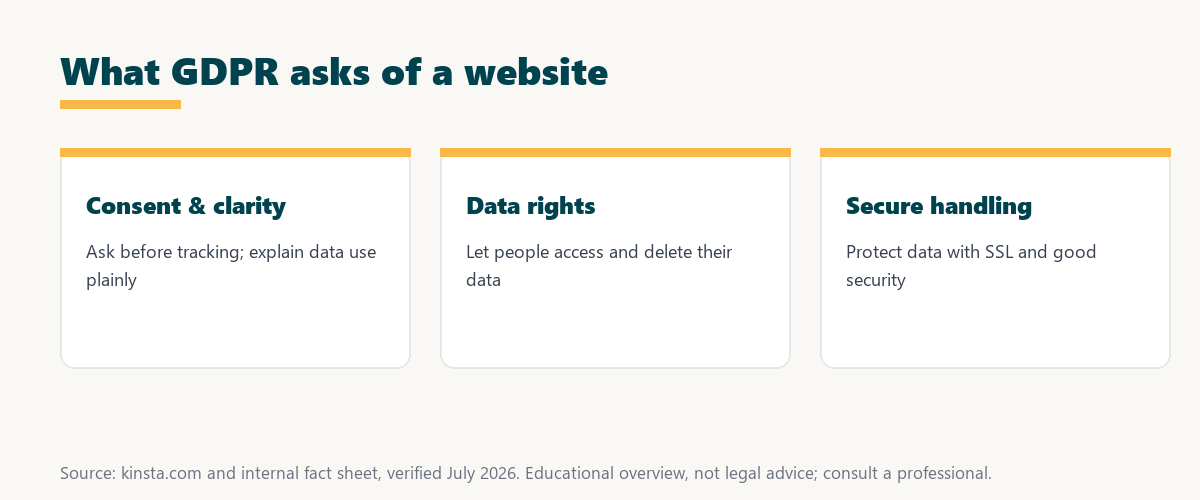
The practical point is that location does not exempt a site: if it collects data from EU visitors, the regulation generally applies regardless of where it is hosted.
What Personal Data Does GDPR Cover?
GDPR covers any information relating to an identifiable person, including names, emails, IP addresses and cookie identifiers. Much of what a typical website collects through forms, analytics and cookies falls under the regulation, so the scope is broader than many site owners expect.
The takeaway is that personal data is not only names and emails; identifiers like IP addresses and cookies count too, which is why so much site data is in scope.
What Are the Key GDPR Requirements?
Key GDPR requirements include obtaining clear consent, being transparent about data use, allowing people to access and delete their data, securing the data and reporting breaches. Compliance touches consent, privacy policies and data handling, so it is a set of practices rather than a single checkbox.
Source: general overview from public regulation summaries, verified August 2026. Not legal advice.
Listing consent, transparency, data rights and security with what each means on your site shows compliance is a set of practices spanning your cookie banner, privacy policy and data handling.
See how Kinsta helps secure the data your site handles
Try Kinsta →Free SSL and a firewall, with a 30-day money-back guarantee.
The Regulation and Website Cookies
GDPR affects cookies because non-essential cookies require prior consent. Websites need a compliant cookie banner that lets visitors accept or decline tracking, rather than setting analytics or marketing cookies automatically, so consent must come before the tracking, not after.
The practical rule is consent first: non-essential cookies should not load until the visitor has agreed through the banner.
Why GDPR Compliance Matters
GDPR compliance matters because violations can bring substantial fines and damage trust. Beyond avoiding penalties, handling data responsibly reassures visitors and customers that their information is respected and protected, so compliance supports both risk reduction and reputation.
“The first five seconds of page-load time have the highest impact on conversion rates.”
— HubSpot, page load time and conversion rates
Just as a fast, trustworthy site earns those early seconds, visible respect for privacy reinforces the trust that keeps visitors engaged and willing to share their data.
How Hosting Relates to the Regulation
Hosting relates to compliance because where and how data is stored and secured matters. Using a host with strong security, and being able to choose a data center region, supports the security and data-handling aspects of compliance, so the host is part of your data-protection posture.
The practical point is that the regulation is not only about your site’s code: the security and location of the hosting behind it also matter.
How to Make Your Website GDPR Compliant
You make a website more GDPR compliant by adding a clear privacy policy, a compliant cookie consent banner, secure data handling with SSL, ways for users to access or delete data and by minimizing the data you collect. These steps cover the common practical requirements, though a professional should confirm your specifics.
Source: general overview from public regulation summaries, verified August 2026. Not legal advice.
Listing a privacy policy, cookie banner, SSL and data access controls shows the practical building blocks of a compliant site. Anyone weighing a long hosting commitment can read our note on SaaS vendor lock-in.
How Kinsta Supports Data Protection
Kinsta supports data protection with free SSL, a firewall, isolated containers, secure Google Cloud infrastructure and a choice of data center regions. You can host in a chosen location and secure the data your site handles, so the hosting layer helps with the security and data-handling side of compliance.
Secure your data with free SSL and region choice
Start With Kinsta →Free migration and a 30-day money-back guarantee.
Handling Personal Data Responsibly on Your Site
You handle personal data responsibly by collecting only what you need, securing it with SSL and a firewall, being transparent through a privacy policy and honoring data rights. This helps your site meet the regulation’s expectations and earns trust, so responsible data handling serves both compliance and your relationship with visitors.
“A tool is only worth its premium when the hours or revenue it protects exceed the invoice.”
— Growth Hack Suite, on tool ROI
Applied to compliance, secure hosting and good data practices earn their cost when the fines and lost trust they help avoid exceed the effort of getting them right.
Common Compliance Mistakes to Avoid
Common compliance mistakes include setting cookies before consent, vague privacy policies, ignoring data-deletion requests and collecting unnecessary data. Addressing consent, transparency and data minimization avoids the most frequent compliance failures, so most problems come from a few recurring oversights.
The honest point is that most compliance failures are avoidable habits, from loading cookies too early to holding data you never needed.
Building Readiness Into Your Site
You build GDPR readiness into your site by pairing a clear privacy policy and consent banner with secure hosting, minimal data collection and a process for data requests. Making these part of how the site runs keeps compliance ongoing rather than a one-time task, though a professional should review your specifics.
The honest summary is that GDPR readiness is an ongoing practice, combining clear policies, consent and secure hosting, and it deserves professional review for your particular case.
Try Kinsta risk-free with secure, region-based hosting
Try Kinsta Risk-Free →Free SSL, region choice and migration, with a 30-day money-back guarantee.
GDPR for Websites: Frequently Asked Questions
The 12 most-asked questions about GDPR for websites.
What is GDPR in simple terms?
GDPR, the General Data Protection Regulation, is the EU law governing how organizations collect, store and use personal data, giving people rights over their data and requiring lawful, transparent handling.
Who does GDPR apply to?
GDPR applies to any organization processing the personal data of people in the EU, regardless of location, so a website anywhere with EU visitors that collects their data generally must comply.
What data does GDPR cover?
GDPR covers any information relating to an identifiable person, including names, emails, IP addresses and cookie identifiers, so much of what a website collects falls under it.
What are the main GDPR requirements?
Key requirements include obtaining consent, being transparent, allowing data access and deletion, securing data and reporting breaches, so compliance covers consent, policies and handling.
Does GDPR require a cookie banner?
GDPR requires prior consent for non-essential cookies, so websites need a compliant cookie banner that lets visitors accept or decline tracking rather than setting cookies automatically.
What happens if I ignore GDPR?
Ignoring GDPR can bring substantial fines and damage trust, so beyond penalties, non-compliance risks your reputation with visitors and customers who expect their data to be protected.
Does GDPR apply to small websites?
Yes, GDPR applies regardless of business size if you process EU residents’ personal data, so even a small website with EU visitors collecting data generally needs to comply.
How does hosting affect GDPR compliance?
Hosting affects compliance because data security and storage location matter, so a secure host with SSL, a firewall and a choice of data center region supports the data-handling requirements.
How do I make my website GDPR compliant?
You add a clear privacy policy, a compliant cookie banner, secure data handling with SSL, ways to access or delete data, and minimize what you collect to meet GDPR.
Does GDPR require SSL?
GDPR requires appropriate security for personal data, and SSL encryption is a basic expectation, so securing data in transit with HTTPS supports compliance for any site handling personal data.
Can I choose where my data is stored?
With some hosts you can choose a data center region, which helps with data residency preferences, so hosting in a specific location supports the data-handling side of compliance.
How does Kinsta support GDPR compliance?
Kinsta supports it with free SSL, a firewall, isolation, secure Google Cloud infrastructure and a choice of data center regions, helping you secure and locate the data your site handles.
About this guide
Written by the Growth Hack Suite editorial team, drawing on hands-on experience running WordPress sites. Details were cross-checked against public regulation summaries. This is a general educational overview, not legal advice; consult a qualified professional for your situation. This page carries affiliate links to Kinsta. The position is stated plainly: GDPR governs how sites handle EU residents’ personal data, requiring consent, transparency, data rights and security. Kinsta supports the security and data-handling side with free SSL, a firewall, isolation and a choice of data center regions.