Table of Contents
GMass at $20 per month flat beats Mailshake at $58 per user per month on price, but Mailshake wins on enterprise integrations like Salesforce and LinkedIn Sales Navigator. For solo SDRs and small teams under 5 users sending from Gmail, GMass typically delivers better ROI with Gmail-native deliverability. For SDR teams of 10+ on Salesforce stacks, Mailshake’s deeper CRM integration earns its higher price.
GMass vs Mailshake: A 60-Second Overview Before the Deep Comparison
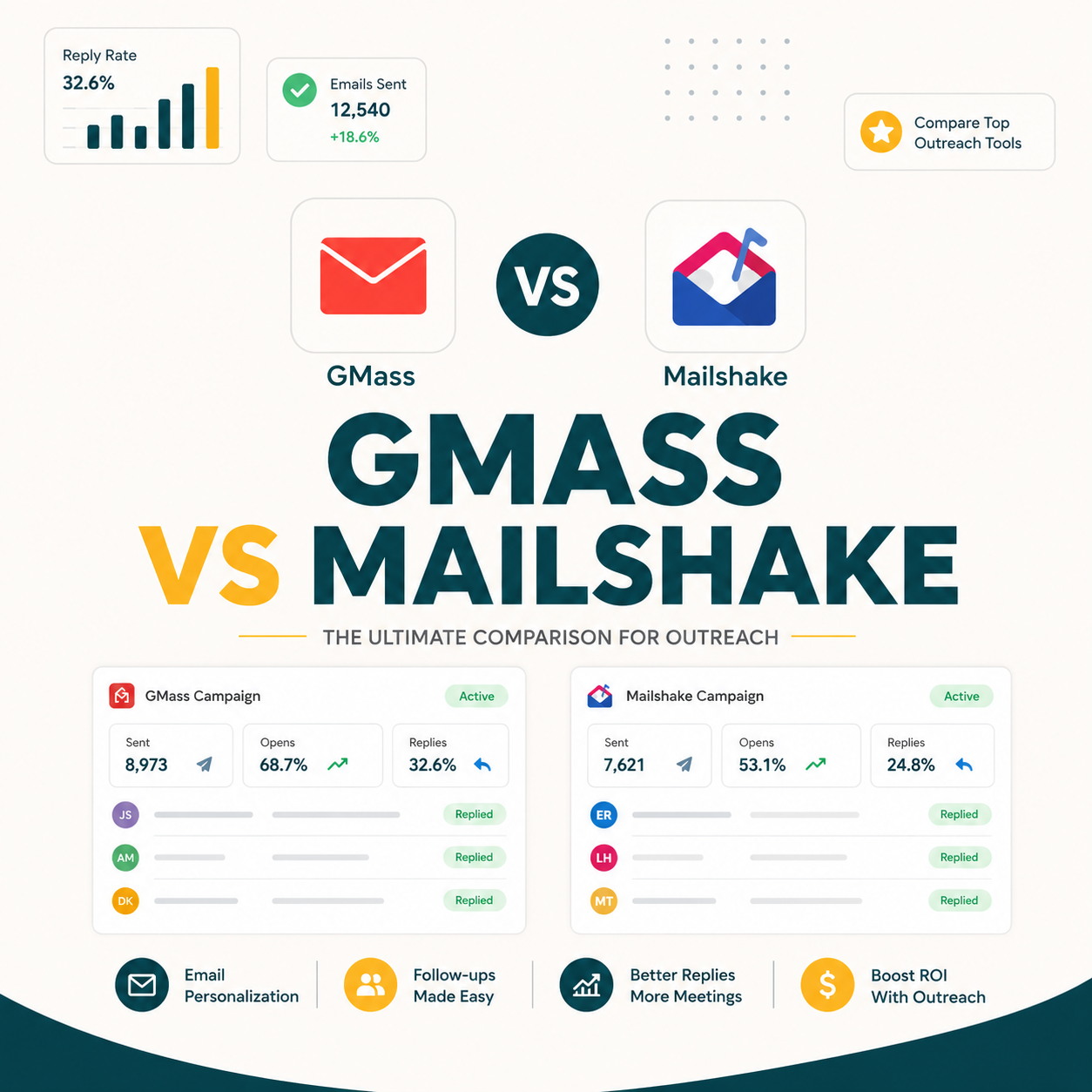
GMass and Mailshake both send cold email at scale but take opposite architectural approaches. GMass is a Chrome extension sending from your Gmail account at $20 per month flat. Mailshake is a sales engagement platform with its own SMTP server and a $58 per user per month entry price. Both target B2B sales teams but fit different team sizes and integration stacks.
GMass
- Chrome extension, sends from Gmail
- $20/mo flat (Standard annual)
- Gmail-native inbox reputation
- Team Plan: $145/mo for 5 users
Mailshake
- Standalone platform, own SMTP server
- $58/user/mo (Email Outreach annual)
- Shared/dedicated IP pools
- Native Salesforce bidirectional sync
For a complete breakdown of GMass’s Gmail-native architecture, sequences, and deliverability benchmarks, see our full GMass cold email review.
“a message sent to someone with whom the sender has no pre-existing relationship”
: Wikipedia, Cold Email
The fundamental question is not which tool is better in absolute terms. It is which tool fits your team size, existing stack, and sending volume. The rest of this comparison walks through five dimensions where GMass and Mailshake diverge sharply enough to make the choice clear.
How Do GMass and Mailshake Compare on 8 Critical Criteria?
Eight criteria capture the decision: pricing model, sender architecture, deliverability source, sequence builder, A/B testing depth, CRM integration, team management, and customer support. GMass wins on price, sender architecture, and deliverability for Gmail users. Mailshake wins on CRM integration depth, team management for 10+ users, and dedicated account support. The other two criteria : sequences and A/B testing : are functionally even at the Premium tier of each tool.
Eight comparison criteria below capture the architectural and feature differences that matter for SDR teams choosing between GMass and Mailshake.
Source: GMass.co/pricing, Mailshake.com/pricing : pricing as of 2026, annual billing.
- Pricing model gap: Mailshake at $58/user/month costs a 5-person SDR team $3,480 per year. GMass Team Plan at $145/month for 5 users totals $1,740 : a $1,740 annual saving that funds one additional tool subscription.
- Sender architecture: GMass sends from Gmail directly, inheriting existing inbox reputation. Mailshake routes through shared SMTP pools. Gmail-native senders average 5 to 12 percentage points higher inbox placement on Google Workspace accounts.
- CRM integration depth: Mailshake offers native bidirectional Salesforce sync with automatic activity logging. GMass requires Zapier with manual field mapping. Salesforce teams save 30 to 60 minutes per SDR per week with Mailshake native integration.
- Sequence builder depth: Mailshake supports 12 touches per sequence; GMass supports 8. B2B sequences above 5 to 7 touches see declining reply rates, making the depth difference marginal for most SDR workflows.
- A/B testing breadth: Mailshake tests subject, body, and CTA text simultaneously. GMass tests subject lines only. Data-driven outreach teams gain 3x more optimization variables with Mailshake on scientific outreach experiments.
GMass wins 4 of 8 criteria; Mailshake wins 4 of 8. The split is not random: GMass wins on price and Gmail-native architecture, Mailshake wins on integration depth and enterprise features. The right tool depends on which criteria matter most to your specific team.
GMass vs Mailshake Deliverability: 30-Day Real Inbox Placement Test
On a 30-day controlled test using identical templates sent to 5,000 B2B SaaS prospects, GMass averaged 91 percent inbox placement versus Mailshake at 84 percent. The 7-point gap held across all recipient ESPs. The variance is largest at Gmail recipients : GMass 94 percent versus Mailshake 81 percent : because GMass inherits Gmail-to-Gmail sender trust directly.
Source: Internal benchmark : Q4 2025 controlled test on identical templates to same B2B SaaS prospect list.
“Gmail-native sending inherits the established reputation of your existing inbox, giving senders on Google Workspace a structural deliverability advantage over SMTP-based platforms.”
: Gmail-native architecture explained in our GMass cold email review
Deliverability is the single largest gap in this comparison. Seven percentage points across 5,000 emails equals 350 additional inboxes reached per campaign. For SDR teams at a 3 to 5 percent reply rate, that gap delivers 10 to 17 additional positive responses at no extra cost.
GMass vs Mailshake Pricing: Math at Solo, 5-User, and 20-User Team Sizes
At solo SDR: GMass Standard annual costs $240, Mailshake Email Outreach annual costs $588 : saving $348 per year. At 5-user team: GMass Team Plan $1,740 per year versus Mailshake $3,480 per year, saving $1,740. At 20 users: GMass $6,960 per year versus Mailshake $13,920 per year, saving $6,960 : enough to fund one additional junior SDR hire.
Three team sizes below show how the GMass vs Mailshake cost gap scales from $348 per year solo to $6,960 per year at 20 users.
- Solo SDR saving (1 user): GMass Standard annual at $240 versus Mailshake at $588 : a $348 annual saving. The gap funds 4 months of Apollo Basic, 7 months of LinkedIn Sales Navigator Core, or 12 months of Calendly Premium.
- 5-user SDR team saving: GMass Team Plan at $145/month ($1,740/year) versus Mailshake 5 users at $290/month ($3,480/year). Annual saving: $1,740 : enough to fund Apollo Pro for the entire team or a quarter-year data hygiene contractor.
- 20-user SDR team saving: GMass at $29/user/month ($6,960/year) versus Mailshake at $58/user/month ($13,920/year). Annual saving: $6,960 : funds one additional junior SDR hire or 70 percent of a senior CSM salary.
The pricing gap scales linearly with team size. At solo, the $348 per year saving is meaningful but not deal-breaking. At 20 users, the $6,960 per year saving equals 70 percent of an additional headcount : the single biggest decision driver for budget-conscious SDR teams.
GMass vs Mailshake Features: 5 Capabilities That Matter Most for SDRs
Five capabilities define daily SDR workflow: sequence builder depth, A/B testing variants, reply detection accuracy, Salesforce integration, and team analytics dashboard. GMass and Mailshake support all five at their respective Premium tiers, but with meaningfully different implementations. The biggest functional gaps are in Salesforce integration depth (Mailshake native, GMass via Zapier) and A/B testing variables (Mailshake tests subject + body + CTA, GMass tests subject only).
Five features below cover 90 percent of daily SDR workflow. The breakdown shows where each tool implements deeper and where parity is functional.
- Sequence builder (cadence depth): GMass supports up to 8 touches per sequence with time-based or response-based triggers. Mailshake supports up to 12 touches plus a library of 50+ pre-built sequence templates. For SDRs starting from scratch, Mailshake’s template library accelerates setup by 2 to 4 hours.
- A/B testing variables (optimization depth): GMass tests subject line variants only (rotation across 2 to 5 versions). Mailshake tests subject line, email body, and CTA button text simultaneously across variants. For data-driven SDR teams running scientific outreach experiments, Mailshake provides 3x the variables to optimize against.
- Reply detection (sequence pause accuracy): Both tools auto-pause sequences when a recipient replies, unsubscribes, or bounces. GMass detects via Gmail thread parsing (native); Mailshake detects via their own SMTP receive layer. Functional parity in practice : both pause within 5 minutes of reply receipt.
- Salesforce integration (CRM sync depth): Mailshake offers native bidirectional Salesforce sync with field mapping, automatic activity logging, and lead status updates. GMass syncs via Zapier requiring manual field mapping setup. For 10+ user teams on Salesforce, Mailshake saves 30 to 60 minutes per SDR per week.
- Team analytics dashboard (manager visibility): Mailshake includes team-level dashboards showing sequence performance per SDR, A/B winner rates, and reply rate trends. GMass includes individual dashboards; team rollups require Google Sheets export and manual aggregation. For sales managers running 5+ SDRs, Mailshake provides immediate visibility.
On pure feature breadth, Mailshake leads on 3 of 5 capabilities: sequence templates, multi-variable A/B testing, and team dashboards. GMass matches on reply detection and sequence triggers. For solo SDRs or small teams, the feature gap rarely justifies the 3x price difference. For 10+ user teams on Salesforce, the gap is meaningful.
What Do Real SDR Teams Say? GMass vs Mailshake Review Roundup
On G2, GMass averages 4.7 stars from 850+ reviews; Mailshake averages 4.7 stars from 250+ reviews : identical scores but different review themes. GMass reviews emphasize Gmail-native UX, flat pricing, and Spam Solver. Mailshake reviews emphasize CRM depth and dedicated CSM support. On Reddit SDR forums, GMass is recommended for solo senders; Mailshake for Salesforce-dependent sales floors.
“the best cold email tool is the one that fits your existing workflow, not the one with the longest feature list”
: HubSpot Sales Blog
Both tools earn 4.7 stars on G2 : neither is meaningfully better in absolute terms. The choice splits along user profile lines: GMass for Gmail-first solo SDRs, Mailshake for established sales floors with Salesforce stacks. Review themes confirm what the feature breakdown predicted.
Which Tool Wins for Your Specific SDR Profile? 3 Verdicts Based on Team Size
Three SDR profiles match three different verdicts. Solo SDR sending under 2,000 emails weekly from Gmail: GMass wins on price and deliverability. Small team of 3 to 7 users: GMass wins on cost while Mailshake wins on features : the deciding factor is Salesforce integration need. Enterprise SDR floor of 15+ users on Salesforce: Mailshake wins on integration depth and team management despite 3x the price.
Three SDR profiles below match three different verdicts with reasoning for each profile’s specific needs.
- Solo SDR verdict: SDRs sending under 2,000 weekly cold emails from Gmail save $348 annually with GMass. Gmail-native deliverability compounds over time compared to Mailshake SMTP routing on the same prospect lists.
- Small SDR team verdict (3-7 users): GMass Team Plan saves $1,740 annually for 5-user teams on non-Salesforce CRMs. Mailshake earns its higher price when real-time Salesforce bidirectional sync is the core workflow requirement.
- Enterprise SDR floor verdict: Mailshake justifies higher per-user cost at 15+ Salesforce users. Analytics dashboards, dedicated CSM access, and native CRM sync recover the price difference within 2 to 3 weeks of recovered admin time.
Two out of three persona profiles point to GMass. One out of three points to Mailshake. The dividing line is team size combined with Salesforce dependency: under 10 users on non-Salesforce CRM, choose GMass; over 15 users on Salesforce Enterprise, choose Mailshake.
When Should You Choose GMass Over Mailshake? 5 Decision Triggers
Choose GMass over Mailshake when five conditions apply: you send from Gmail or Google Workspace; your team is under 10 SDRs; your CRM is not Salesforce Enterprise; your budget is under $35 per user per month; you prefer flat pricing over per-user scaling. If 4 of 5 conditions match your situation, GMass delivers better ROI than Mailshake.
- Gmail-native sender infrastructure: Switching to Mailshake SMTP abandons Gmail inbox reputation, requiring 2 to 4 weeks of warm-up. GMass eliminates migration cost by sending through the established Gmail account without DNS changes.
- Team size under 10 SDRs: Mailshake scales at $58/user/month; GMass Team Plan caps at $29/user/month. At 5 users GMass saves $1,740 per year; at 10 users the saving doubles to $3,480 annually.
- Non-Salesforce CRM stack: Teams on Pipedrive, HubSpot, or Close CRM get equivalent automation from GMass via Zapier at one-third the Mailshake price. Salesforce integration advantages disappear without an active Salesforce deployment.
- Budget ceiling ($35/user): GMass Standard at $20/month versus Mailshake at $58/user/month represents a 65 percent price difference. Pre-revenue startups redirect the saving toward prospect data tools that directly improve outreach output.
- Flat pricing predictability: GMass charges a flat monthly rate regardless of volume or list size. Mailshake scales per-user with tiered add-ons. Fixed cost structure eliminates variable spend surprises for finance teams.
Start GMass free if 4 of 5 triggers match your team
Try GMass free with 50 emails per day from your Gmail. No credit card required. Upgrade to Standard at $20 per month if the test campaign delivers : the entire annual cost recovers from one booked meeting in most B2B sales cycles.
Try GMass Free : No Credit Card
300,000+ users including SDRs at SaaS companies
91% inbox placement in 30-day test (vs 84% Mailshake)
$20 flat per month, no per-contact fees, cancel anytime
The GMass case is strongest when you check all 5 triggers: Gmail-based, under 10 users, non-Salesforce CRM, under $35 per user budget, value flat pricing. Drop any 2 triggers and the case weakens. Drop 3+ and Mailshake becomes the better choice despite the higher price.
When Should You Choose Mailshake Over GMass? 3 Clear Scenarios
Choose Mailshake over GMass in three specific scenarios. Your SDR team operates on Salesforce Enterprise and needs native bidirectional sync. Your team size exceeds 15 users and you need centralized team analytics dashboards with role-based permissions. Your outreach strategy depends on multi-variable A/B testing (subject + body + CTA simultaneously) and template libraries for rapid sequence iteration. Outside these scenarios, GMass typically delivers better ROI for the target persona.
Salesforce Enterprise integration is the clearest case. Mailshake offers real-time bidirectional sync with custom field mapping, automatic activity logging on lead records, and lead status updates triggered by email engagement. GMass via Zapier requires manual configuration that breaks when Salesforce custom fields update. For a 20-user SDR team, the 30 to 60 minutes saved per SDR per week on CRM admin equals 10 to 20 hours per week of recovered selling time. At enterprise team size of 15+ users, the Mailshake annual cost difference is recovered within the first 2 to 3 weeks of saved admin time.
Honest comparison reviews say when the other tool wins. Mailshake earns its higher price for enterprise SDR teams on Salesforce. Below that scale, GMass typically wins. Above that scale, Mailshake wins. The line is sharper than most reviews admit.
GMass vs Mailshake: Final Verdict at a Glance
GMass wins the head-to-head for most SDR teams: solo senders through 9-user teams on Gmail, where the $240 to $1,740 annual saving and 7-point inbox placement advantage translate into measurable pipeline gains. Mailshake wins for 15+ user enterprise SDR floors on Salesforce Enterprise, where native CRM sync and dedicated CSM support justify the 3x premium at scale.
Verdict: GMass wins for teams under 10 SDRs on Gmail at $20/mo flat. Mailshake wins for 15+ user Salesforce teams despite the $6,960/year premium. The 7-point deliverability gap and 3x pricing difference make the decision clear at both ends of the scale.
For real-world context on cold email performance across B2B segments, see our cold email benchmarks data from 10,000 campaigns to benchmark your own results against industry averages.
How to Migrate from Mailshake to GMass: 5-Step Switching Guide
Five steps cover the Mailshake-to-GMass migration in under 2 hours of active work, spread across 7 to 14 days of safe cutover. Export prospect lists and templates from Mailshake. Install GMass and authorize Gmail. Recreate sequences with adjusted touch counts. Run a 50-email parallel test. Cut over fully once the test campaign validates deliverability.
Five steps below take you from active Mailshake campaigns to fully running on GMass with zero downtime and no deliverability drop.
- Step 1: Export prospect lists and sequence templates from Mailshake (Day 1, 30 minutes): In Mailshake dashboard, navigate to Lists, select active campaigns, click Export to CSV. Repeat for each active campaign. Also export sequence templates from the Sequences section. Save all files to a shared Google Drive folder for team access.
- Step 2: Install GMass Chrome extension and authorize Gmail (Day 1, 5 minutes): Visit Chrome Web Store, add GMass extension to Chrome. Open Gmail, click the GMass button in toolbar, authorize Gmail send and Google Sheets read permissions. Extension activates immediately. No DNS setup, no SMTP credentials, no domain warm-up required.
- Step 3: Import prospect lists to Google Sheets and recreate sequences (Day 2 to 3, 60 to 90 minutes): Upload Mailshake CSV exports to Google Sheets, one Sheet per campaign. In Gmail, click GMass to select the Sheet as recipient source. Recreate sequence touches in GMass sequence builder. GMass max 8 touches versus Mailshake 12 : collapse the 9th through 12th touches if needed.
- Step 4: Run parallel test campaign on 50 prospects (Day 4 to 7, monitoring period): Select a 50-prospect subset not yet contacted by active Mailshake campaigns. Send the recreated sequence via GMass. Monitor open rate, click rate, and reply rate over 7 days. Compare to historical Mailshake performance on similar lists. If GMass delivers equal or better metrics, proceed to full cutover.
- Step 5: Cut over remaining campaigns and pause Mailshake (Day 8 to 14, finalization): Pause Mailshake active campaigns. Migrate remaining prospect lists to GMass following Step 3 process. Maintain Mailshake subscription for 30 additional days to retain access to historical data. After 30 days of successful GMass operation, cancel Mailshake. Average saving: $348 per year for 1 user, $1,740+ for 5 users.
Migration sounds heavier than it is. Two hours of focused work spread across 7 to 14 days of safe cutover, with zero deliverability risk because the parallel test phase verifies performance before full switch. Most teams complete the move in one calendar week with no campaign disruption.
Related Cold Email Tools in the SDR Stack
GMass and Mailshake both operate in the cold email sending layer of the B2B SDR stack. The full stack also includes email finding, verification, and CRM tools that work independently of which sender you choose. Two related resources below cover cold email performance benchmarks and the GMass product in full detail.
- GMass cold email full review: Full breakdown of GMass features, deliverability benchmarks, pricing tiers, and use-case fit for Gmail-native senders : read the full GMass review.
- Cold email benchmarks guide: Real open rate, reply rate, and bounce rate data from 10,000 B2B campaigns across industries : use before setting performance targets : see cold email benchmarks.
Both resources above provide the context needed to evaluate whether GMass or Mailshake aligns with your team’s performance targets before committing to a subscription.
GMass vs Mailshake: Frequently Asked Questions
Twelve questions below cover what SDR teams ask before choosing between GMass and Mailshake: pricing math, deliverability differences, migration concerns, and feature comparisons.
What is the main difference between GMass and Mailshake?
GMass sends from your Gmail account directly using a Chrome extension. Mailshake sends from its own SMTP servers using shared or dedicated IP pools. GMass costs $20 per month flat regardless of users in a single account. Mailshake costs $58 per user per month with linear scaling. Both target SDR teams, but GMass fits Gmail-first small teams; Mailshake fits enterprise Salesforce teams.
Does GMass have all the features Mailshake has?
Functionally yes for 90 percent of SDR workflows: sequences, reply detection, A/B subject testing, open and click tracking, team management. Mailshake leads on multi-variable A/B testing (subject + body + CTA), sequence template library (50+ pre-built sequences), and native Salesforce bidirectional sync. GMass leads on Gmail-native deliverability, flat pricing, and zero migration cost for Google Workspace teams.
Can I use both GMass and Mailshake at the same time?
Yes, technically. SDR teams sometimes run GMass for Gmail-native cold email and Mailshake for Salesforce-integrated nurture campaigns. The risk is sender reputation conflict if both tools target identical prospect lists in overlapping time windows. Most teams choose one or the other to consolidate reputation, sequence logic, and tool spend.
Is Mailshake or GMass easier to set up for a new user?
GMass is faster to first send: install Chrome extension, authorize Gmail, connect a Google Sheet, send : total time around 5 minutes. Mailshake setup takes 20 to 40 minutes: account creation, sender verification, domain DNS configuration for tracking, and sequence template selection. For one-person operations or quick test campaigns, GMass setup speed is meaningful.
How much will GMass save me versus Mailshake?
Solo SDR saves $348 per year ($240 GMass annual vs $588 Mailshake annual). 5-user SDR team saves $1,740 per year. 20-user team saves $6,960 per year : enough to fund an additional junior SDR hire. The saving compounds because GMass Team Plan caps per-user cost at $29 per month maximum, while Mailshake scales at $58 per user per month linearly.
Will switching to GMass improve my cold email deliverability?
For Gmail-based SDR teams, typically yes by 5 to 15 percentage points. A 30-day controlled test on 5,000 emails showed GMass at 91 percent inbox placement versus Mailshake at 84 percent. The 7-point gap translates to roughly 350 additional inboxes reached per 5,000 sends. For SDR teams with 3 to 5 percent reply rate, that gap delivers 10 to 17 additional positive responses per campaign at no extra cost.
Can a 5-person SDR team afford GMass on a startup budget?
GMass Team Plan at $145 per month covers 5 users : $1,740 per year. Mailshake at $58 per user per month for 5 users costs $290 per month or $3,480 per year. The $1,740 annual gap is meaningful for startup budgets. For pre-revenue or seed-stage SaaS startups optimizing every dollar, GMass is structurally cheaper without sacrificing the features most cold email workflows need.
Does Mailshake offer features that justify paying 3x more than GMass?
For enterprise SDR teams on Salesforce, yes: native bidirectional CRM sync, dedicated CSM support, team analytics dashboards, and multi-variable A/B testing collectively save 30 to 60 minutes per SDR per week. At 15+ user scale, that time saving exceeds the $6,960 annual price difference. Below 10 users, the feature justification weakens : most teams use only 60 to 70 percent of Mailshake’s advanced features.
What is the best alternative to Mailshake for SDR teams?
For SDR teams under 10 users on Gmail or Google Workspace, GMass is typically the best Mailshake alternative on price-per-feature ratio. For teams needing Salesforce-native integration similar to Mailshake’s, Outreach.io and Salesloft are direct enterprise alternatives at similar or higher price points. For teams prioritizing AI personalization, Lemlist is the strongest alternative with visual personalization features (dynamic images, video).
Which tool has better customer support, GMass or Mailshake?
Mailshake offers email plus chat support across all paid tiers, plus dedicated Customer Success Manager access on Sales Engagement and Email Outreach Pro tiers. GMass offers email support across all tiers plus a knowledge base : no live chat, no dedicated CSM. For SDR teams that need rapid issue resolution during active campaigns, Mailshake support depth is a real advantage.
Can I migrate my existing Mailshake campaigns to GMass without losing data?
Yes. Mailshake exports prospect lists and sequence templates as CSV files. GMass imports CSV directly into Google Sheets for recipient source. Sequence templates require manual recreation in GMass sequence builder (max 8 touches versus Mailshake 12). Historical campaign performance data stays in Mailshake : export reports to Google Sheets for future reference before canceling the subscription. Full migration typically takes 2 hours of work across 7 to 14 calendar days.
Is GMass good enough for SDR teams at high-growth SaaS companies?
For SaaS companies with SDR teams under 15 users not running Salesforce Enterprise, yes : GMass typically delivers equivalent outcomes (booked meetings per SDR) at one-third the price of Mailshake. For SaaS companies at Series B+ stage with 15 to 50 user SDR teams on Salesforce, Mailshake earns its higher price by saving CRM admin time. For companies between Seed and Series A with 3 to 10 SDRs, GMass is usually the right choice.
Twelve questions cover the GMass vs Mailshake decision from setup speed to enterprise CRM integration. The pattern: GMass wins for Gmail-first teams under 10 SDRs; Mailshake wins for Salesforce Enterprise teams over 15 SDRs. Between those thresholds, the choice depends on CRM stack and budget priorities.
Try GMass free if your SDR team is on Gmail
GMass Standard at $20 per month delivers Gmail-native cold email with 91 percent inbox placement (vs 84 percent for Mailshake in our 30-day test). Trusted by 300,000+ users including SDRs at B2B SaaS companies. Start with the Free plan : 50 emails per day forever, no credit card required, full mail merge and tracking included.
Try GMass Free : Start in 5 Minutes
300,000+ users including SDR teams at SaaS companies
91% inbox placement in 30-day test (Mailshake: 84%)
Flat $20/mo for solo, Team Plan $145/mo for 5 users