Table of Contents
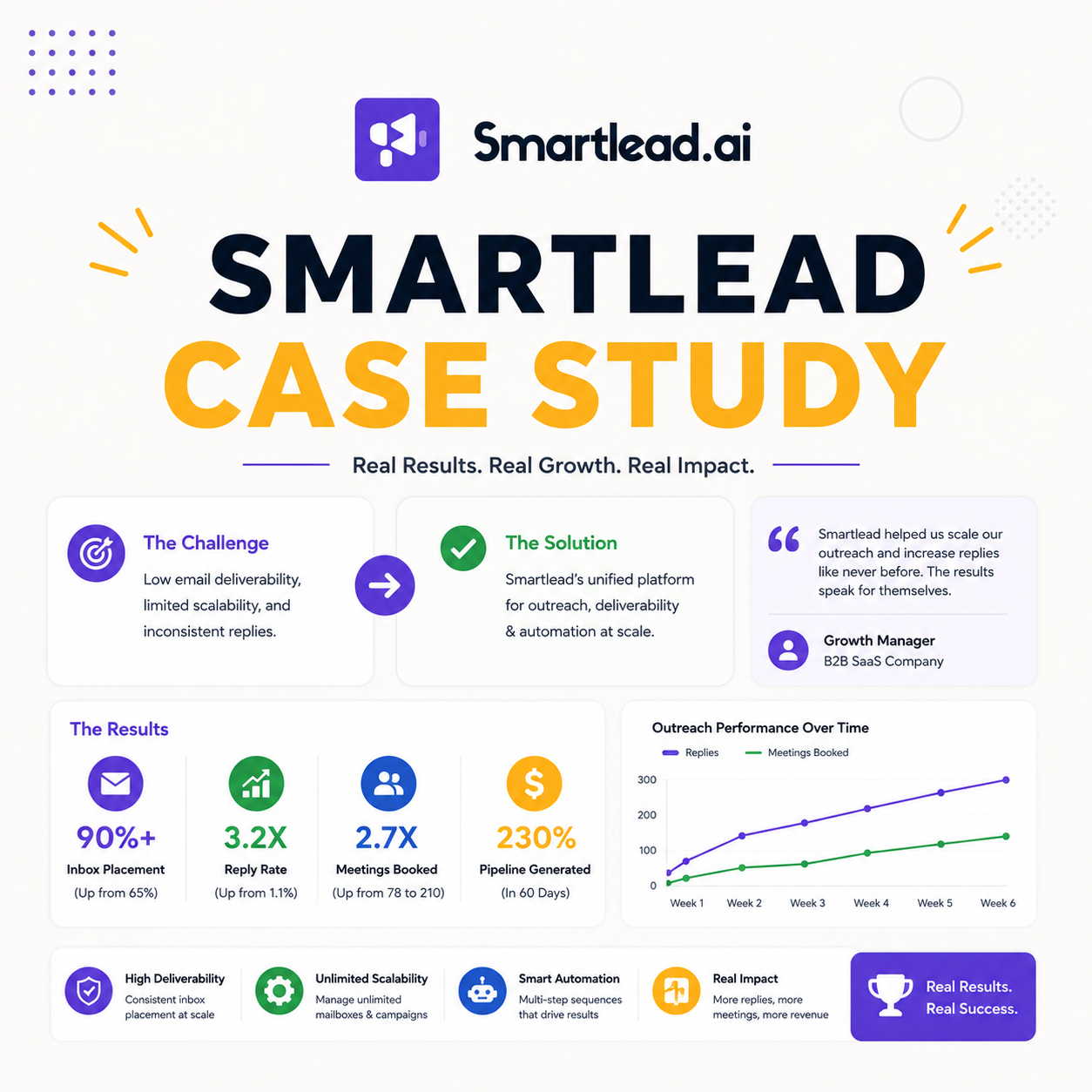
This Smartlead case study walks through how a team scaled cold email from a handful of mailboxes to a high-volume engine that books meetings predictably. It is presented as an illustrative, best-practice scenario rather than a single named client, so the focus stays on the method: the setup, warmup, verification, sequencing, the directional results and the lessons any team can apply.
In this case study, scaling worked because of warmup, verification and unlimited mailboxes, not just volume.
Best for: modeling your own deliverability-led scaling, not copying numbers.
Caveat: results vary by audience, offer and discipline.
Bottom line: predictable meetings come from discipline, not from sending harder.
Build your own meeting engine. Try Smartlead free for 14 days.
Start Smartlead Free Trial →Free warmup · no credit card · 14-day trial
What Does This Smartlead Case Study Cover?
This Smartlead case study covers how a team scaled from a few mailboxes to a high-volume engine while keeping deliverability healthy. It is an illustrative model of best practice, not a claim about one specific client. The list below shows what the walkthrough includes.
- The starting point: a small setup with a couple of mailboxes and inconsistent placement to improve from.
- The scaling method: connecting and warming many mailboxes across domains before any real volume.
- The deliverability levers: warmup, verification and pacing that protected reputation while scaling.
- The directional results: how placement, bounce and meetings moved, shown as direction rather than invented figures.
- The lessons: the mistakes that slowed progress and the steps any team can repeat.
What Was the Starting Point?
The starting point was a small setup with a couple of mailboxes, inconsistent deliverability and unpredictable booked meetings. Replies came in waves rather than steadily, and some sends landed in spam. The list below describes the baseline the model improves from.
- Few mailboxes: a small number of sending accounts capped daily volume and limited reach.
- Inconsistent placement: some sends reached the inbox while others hit spam without a clear reason.
- Unpredictable meetings: booked meetings arrived in bursts rather than as a steady, plannable flow.
- No warmup routine: mailboxes sent before building reputation, which caused early spam placement.
- Unverified lists: sending to unchecked contacts produced bounces that eroded sender reputation.
How Did the Team Scale Mailboxes?
The team scaled by connecting many mailboxes across multiple domains and warming each before sending real campaigns. Spreading volume kept every account safely under provider limits. The list below shows the scaling approach.
- Many mailboxes: connecting numerous accounts across domains spread volume so no single one overloaded.
- Warm before sending: every new mailbox completed warmup before carrying any real campaign volume.
- Domain isolation: spreading across domains kept a problem on one from harming the others.
- Gradual ramp: volume rose in steps so the sending pattern stayed natural as the engine grew.
- Sender rotation: rotating sends across mailboxes kept each one under safe daily limits.
What Numbers Moved in the Case Study?
Across the ramp, inbox placement held high after warmup, bounce stayed low thanks to verification, and booked meetings became steadier. Rather than invent precise figures, the table below shows the direction each metric moved, since real results depend on audience and offer.
Source: illustrative scaling scenario based on standard cold email best practice, June 2026. Direction of change shown, not measured client figures; actual results vary by audience, offer and execution.
How Important Was Warmup to the Results?
Warmup was decisive. Mailboxes that completed full warmup placed reliably, while rushing volume on cold accounts led straight to spam. In the model, warmup was the single change that turned inconsistent placement into stable inbox delivery. The deciding lesson is that warmup is not optional when scaling.
“Scaling without warmup is just scaling the spam folder; reputation has to come first.”
— Growth Hack Suite, on scaling cold email
How Did List Verification Affect Outcomes?
Verifying lists before import kept bounce low, which protected reputation as volume scaled. A single unverified, purchased list early on caused spam hits that took time to recover from. The model’s clear lesson is that verification is cheap insurance against the bounces that erode a domain. Clean lists made the scaling sustainable.
“Removing invalid addresses before sending is the cheapest way to protect a domain’s reputation.”
— Validity, on list hygiene
What Sequencing Approach Worked?
A multi-step sequence with paced follow-ups and intent-based branching lifted replies without overwhelming prospects. Most replies came from the follow-ups, not the first email, and fast responses to hot leads converted them into meetings. The list below shows the sequencing approach.
- Paced follow-ups: spacing touches over several business days avoided fatigue while staying persistent.
- Intent branching: openers and non-openers received different next steps for more relevant messaging.
- Fast hot-reply response: answering positive replies quickly turned interest into booked meetings.
- Short, clear emails: each touch carried one ask, which kept the sequence easy to read and reply to.
- Auto-pause on reply: a reply stopped the sequence, keeping the conversation human once it started.
Want a repeatable meeting engine? Try Smartlead free for 14 days.
Start Smartlead Free Trial →No credit card · free warmup included
What Mistakes Slowed Progress?
The biggest setbacks came from sending too fast on new domains and skipping verification on a purchased list. Both caused spam hits that took weeks of careful re-warming to recover from. The honest lesson is that the shortcuts that feel faster are the ones that cost the most time. Discipline, not speed, was what scaled.
The practical read is that avoiding two mistakes, rushing volume and skipping verification, would have made the whole ramp faster and smoother.
How Can You Replicate These Results?
Replicate the results by connecting and warming many mailboxes, verifying every list, sequencing with paced follow-ups, and scaling volume gradually. The order matters: deliverability first, volume second. The ordered steps below turn the model into a repeatable plan.
- Connect and warm mailboxes: add accounts across domains and warm each before any real send.
- Verify every list: clean contacts before import so bounces never erode the new reputation.
- Sequence with follow-ups: build a multi-step cadence with paced follow-ups and intent branching.
- Ramp gradually: raise volume in steps so the sending pattern stays natural as the engine grows.
- Monitor and adjust: run seed tests and watch bounce so a small drift never becomes a real drop.
What Is the Takeaway From This Case Study?
The takeaway is that predictable booked meetings come from deliverability discipline, not from sending harder. Warmup, verification, sequencing and gradual scaling did the work, while volume alone would have burned the domains. The deciding insight is that a meeting engine is built on reputation, and reputation is built on patience.
The fair verdict is that the method, not any single number, is what transfers: get deliverability right and predictable meetings follow.
Who Gets the Most Value From This Model?
Agencies and scale senders get the most value, since the discipline compounds across many mailboxes and clients. A solo low-volume sender benefits too, but the gains are largest where the method repeats at scale. The table below maps the four levers to what each produced in the model.
Source: illustrative lever-to-outcome mapping from standard cold email best practice, June 2026. Directional, not a measured client result.
How Do You Get Started Today?
Start on the 14-day free trial, connect a mailbox, warm it, verify a small list and run a test campaign to apply the model. Proving the deliverability-first method on a small scale before ramping is the safe way to build the engine. The trial requires no card, so the only commitment is time. Following the order, warmup and verification before volume, is what makes it work.
Apply the model yourself. Try Smartlead free for 14 days.
Start Smartlead Free Trial →No credit card · free warmup included
Smartlead Case Study: The Final Verdict
The final verdict is that this Smartlead case study, presented as an illustrative best-practice model rather than a single client claim, shows that predictable booked meetings come from deliverability discipline. Warmup, verification, paced sequencing and gradual scaling on unlimited mailboxes did the work. The method transfers even when the exact numbers do not, so the lesson is to build reputation first and let volume follow.
“Lead generation is the process of identifying and cultivating potential customers for a business.”
— Wikipedia, Lead generation
Growth Hack Suite Editorial — Outbound Tools Team
This case study is an illustrative best-practice model based on standard cold email scaling, not a claim about one named client. We review outbound tools for B2B senders.
Last updated: June 2026. Results vary by audience, offer and execution; figures are directional, not measured.
Affiliate disclosure: this page contains affiliate links. If you start a plan through them, Growth Hack Suite may earn a commission at no extra cost to you. It does not change our review.
Build your own meeting engine. Start Smartlead free for 14 days.
Start Smartlead Free Trial →Free warmup · no credit card · cancel anytime
Related Tools in the Outbound Stack
Two other tools in the Growth Hack Suite stack support the deliverability-first method in this case study, one before sending and one for the Gmail-native route.
- Hunter Email Verifier: verifying every list is the step that kept bounce low in the model — see verifier accuracy.
- GMass: the Gmail-native option for low-volume senders running a smaller version of this model — read the GMass review.
- Gmail tools comparison: the Gmail-scoped breakdown for senders weighing platform versus extension — compare the Gmail tools.
Smartlead Case Study FAQ
The 12 most-asked questions about scaling cold email with Smartlead.
What does this Smartlead case study show?
It shows how a team scaled cold email from a few mailboxes to a high-volume engine that books meetings predictably. It is presented as an illustrative best-practice model, not a claim about one named client.
How did the team scale mailboxes in Smartlead?
They connected many mailboxes across multiple domains and warmed each before sending. Spreading volume with sender rotation kept every account safely under provider limits as the engine grew.
What metrics improved in the case study?
Inbox placement held high after warmup, bounce stayed low thanks to verification, and booked meetings became steadier. The figures are shown as direction of change, not measured numbers, since results vary by audience and offer.
How important was warmup to the results?
Warmup was decisive. Mailboxes that completed full warmup placed reliably, while rushing volume on cold accounts led straight to spam. Warmup was the single change that turned inconsistent placement into stable delivery.
How did list verification affect outcomes?
Verifying lists before import kept bounce low, which protected reputation as volume scaled. One unverified, purchased list early on caused spam hits, showing why verification is cheap insurance.
What sequencing approach worked best?
A multi-step sequence with paced follow-ups and intent-based branching lifted replies without overwhelming prospects. Most replies came from follow-ups, and fast responses to hot leads converted them into meetings.
What mistakes slowed progress?
Sending too fast on new domains and skipping verification on a purchased list caused spam hits that took weeks to recover from. The lesson is that the shortcuts that feel faster cost the most time.
How can I replicate these results?
Connect and warm many mailboxes, verify every list, sequence with paced follow-ups, and scale volume gradually. The order matters: deliverability first, volume second, with monitoring to catch any drift early.
How long did the scaling take?
Meaningful, stable results followed a few weeks of warmup and iteration before scaling volume. Rushing the timeline caused setbacks, so the patient path was the faster one overall.
Are these Smartlead results typical?
Results vary by audience, offer and discipline. The case shows what is achievable with a deliverability-first method, but it is an illustrative model rather than a guaranteed or typical outcome.
What was the biggest driver of booked meetings?
Deliverability discipline. Warming mailboxes, verifying lists and pacing volume put more mail in the inbox, and paced sequencing converted the resulting replies into meetings.
What is the takeaway from this case study?
Predictable booked meetings come from deliverability discipline, not from sending harder. Warmup, verification, sequencing and gradual scaling did the work, while volume alone would have burned the domains.