Table of Contents
A dedicated IP is a sending IP address used only by you, so the reputation built on it reflects only your sending, unaffected by other senders. This guide explains what it is, how it differs from a shared IP, why it helps deliverability, when high-volume cold email needs one, its downsides, and when a verifier and warmup make it unnecessary.
A dedicated IP is a sending IP used only by you, isolating your reputation, and it helps consistent high-volume senders.
Best for: consistent high-volume senders and agencies isolating clients.
Caveat: it needs steady volume and warmup, or it hurts more than helps.
Bottom line: most senders do fine on shared IPs with warmup and clean lists.
Put this into practice. Try Smartlead free for 14 days.
Start Smartlead Free Trial →Unlimited mailboxes · no credit card · 14-day trial
What Is a Dedicated IP?
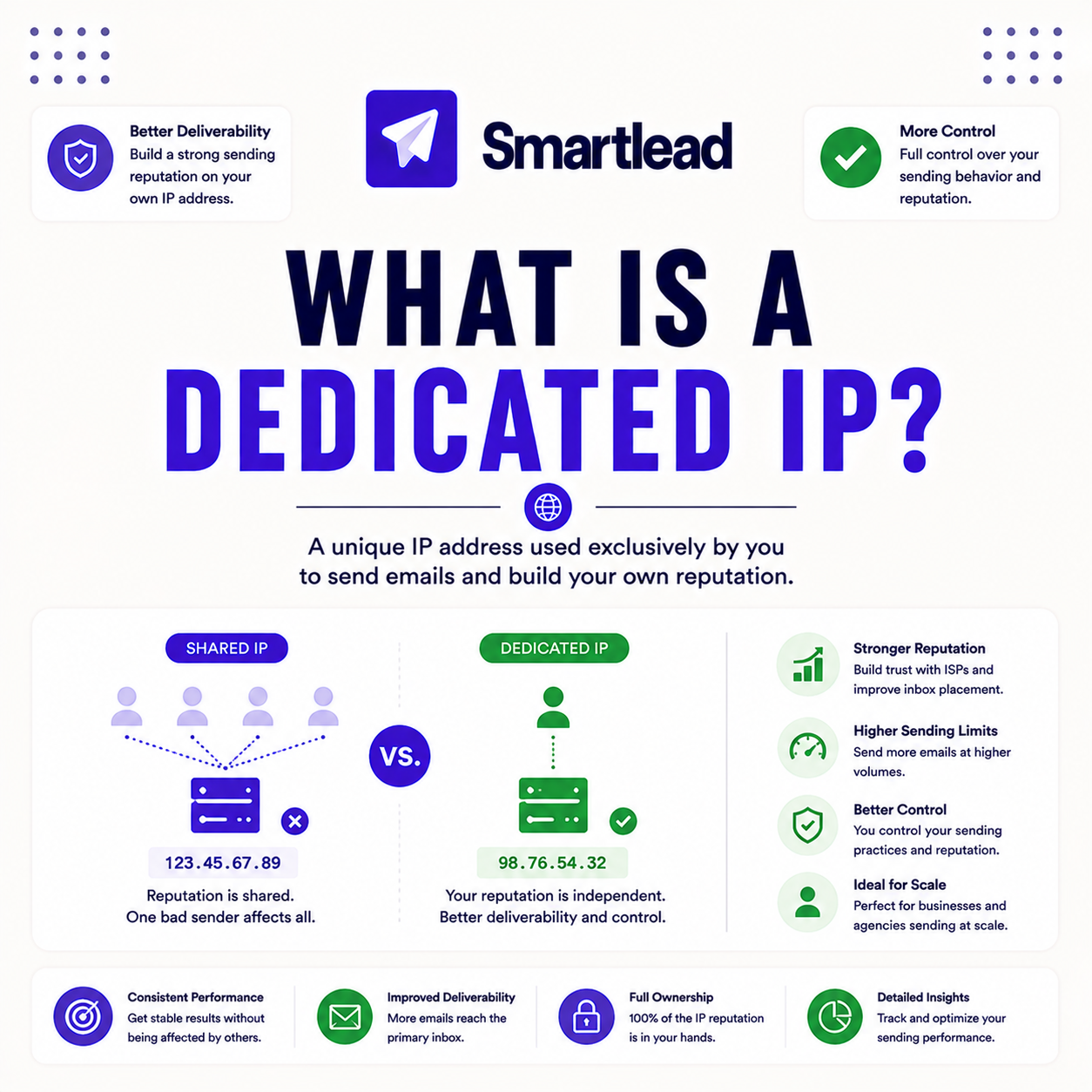
A dedicated IP is a sending IP address assigned to you alone, so its reputation reflects only your sending behavior and no one else’s. Nothing another sender does can affect it. The deciding factor is that isolation gives full control over the IP’s reputation. The list below covers the concept.
- Yours alone: the IP is not shared with any other sender.
- Isolated reputation: the IP’s standing reflects only one sender’s own sending.
- Full control: good sending builds the reputation; no third party can damage it.
- Needs warmup: a new dedicated IP starts with no reputation and must be warmed.
- Volume-dependent: it holds reputation only with steady, consistent sending.
“A dedicated IP gives full control of reputation, but only a steady, high-volume sender can keep it warm.”
— Growth Hack Suite
How Is a Dedicated IP Different From a Shared IP?
On a shared IP, your mail mixes with other senders, so their behavior can lift or hurt your deliverability, while a dedicated IP isolates you completely. Shared IPs spread both benefit and risk. The deciding factor is whether you want your reputation tied to others or entirely your own. The table below compares the two.
Source: dedicated-versus-shared comparison from standard email practice, mid-2026. Directional, not a measured benchmark.
“IP reputation is a major deliverability signal, so isolating it matters at high, steady volume.”
— Validity, on IP reputation
Why Does a Dedicated IP Help Deliverability?
It helps because IP reputation is a major placement signal, and isolation means only your sending shapes it, with no risk from noisy neighbors on a shared IP. Control is the benefit. The deciding factor is that it only helps a sender disciplined enough to keep the IP warm and clean. The table below positions it against a typical rival.
Source: dedicated-IP feature positioning, mid-2026. Features and terms change; verify current offering on smartlead.ai.
When Do You Need a Dedicated IP?
You need one when sending high, consistent volume or running many client domains where isolation matters, not for typical small-scale cold email. Below that threshold, a shared IP with warmup is fine. The deciding factor is consistent volume high enough to keep the IP warm. The list below covers when it fits.
- High consistent volume: it helps only when sending is high and steady.
- Agencies isolating clients: separate IPs can keep one client’s sending off another’s reputation.
- Full control needed: senders who want their reputation entirely their own choose dedicated.
- Not for low volume: one left idle loses reputation, so low senders should skip it.
- Threshold matters: only reach for one once volume clearly justifies it.
Do Dedicated IPs Need Warmup?
Yes, a new one starts with no reputation, so it must be warmed gradually just like a new mailbox, ramping volume slowly over time. Skipping IP warmup lands mail in spam. The deciding factor is that a fresh IP has zero history and must earn trust. The honest read is that it is more work, not less, than a shared one at the start.
The practical point is to warm a new one over weeks with a slow, steady volume ramp before relying on it for real campaigns.
Sending at real scale? Test Smartlead free for 14 days.
Start Smartlead Free Trial →No credit card · unlimited mailboxes
What Are the Downsides of a Dedicated IP?
The downsides are that it needs consistent volume to stay warm, requires its own warmup, and gives no benefit at low volume, where it can actually hurt. It is a commitment, not a quick win. The deciding factor is that the reputation upside only appears with steady, high sending. The list below covers the trade-offs.
- Needs steady volume: an idle one loses reputation over time.
- Requires warmup: a new IP must be warmed like a mailbox before real use.
- No low-volume benefit: at small scale a shared IP outperforms an under-fed dedicated one.
- Extra cost and setup: it adds provisioning, warmup and maintenance work.
- Can be blocklisted: one sending to bad lists gets flagged with no shared cover.
How Do You Set Up a Dedicated IP?
Set it up by provisioning through your platform, warming it gradually, authenticating the sending domains and keeping volume steady. The setup is a slow ramp, not a switch. The ordered steps below make it repeatable.
- Provision the IP: obtain one through the sending platform or infrastructure.
- Warm it gradually: ramp volume slowly over weeks so the IP builds reputation safely.
- Authenticate domains: align SPF, DKIM and DMARC with it.
- Keep volume steady: maintain consistent daily sending so the IP stays warm.
- Monitor reputation: track IP reputation and blocklists to catch problems early.
Does Smartlead Offer Dedicated IPs?
Yes, Smartlead offers them through its infrastructure for senders who want reputation isolation, alongside its warmup and rotation features. Exact terms can change, so confirm the current offering on the platform. The deciding factor is that this is an option for high-volume senders, not a default every account needs. The honest read is that most senders should start on shared IPs and only move to dedicated at real scale. The practical point is to treat it as an advanced option to add once volume is consistently high, not a first step.
Who Gets the Most Value From a Dedicated IP?
Agencies and scale senders get the most value, since only consistent high volume keeps it warm and justifies the setup. A low-volume sender gets little or negative value. The deciding factor is steady send volume high enough to maintain the IP. The honest read is that it rewards scale and punishes inconsistency. The practical point is that a small sender should stay on shared IPs, while a high-volume agency may benefit from one to isolate reputation.
How Do You Get Started Today?
Start on the 14-day free trial, connect a mailbox, warm it and verify a small list to get the fundamentals right first, then consider a dedicated IP only once volume is consistently high. Getting warmup and list quality right matters more than the IP type. The trial needs no card, so the only cost is setup time. By the time this makes sense, the fundamentals are already in place.
Can a Dedicated IP Get Blocklisted?
Yes, if you send to bad lists or spam traps, it can be blocklisted, and with no shared cover the damage is entirely yours. Isolation cuts both ways. The deciding factor is that it amplifies both good and bad sending. The honest read is that it demands even cleaner lists than a shared one, since there is nowhere to hide a mistake.
The practical point is to verify every list and pace volume carefully on it, because a blocklisting falls entirely on that single IP.
Do You Need a Dedicated IP If You Use a Verifier and Warmup?
Not necessarily. Verification, warmup and rotation cover the deliverability fundamentals for most senders, so a shared IP with those in place is usually enough. A dedicated IP adds isolation, not fundamentals. The deciding factor is that the basics matter far more than the IP type. The honest read is that most senders should invest in verification and warmup before ever considering one.
“An IP address is a numerical label assigned to a device on a network.”
— Wikipedia, IP address
What Is a Dedicated IP Address in LinkedIn Automation?
A dedicated IP address in LinkedIn automation is one IP assigned to a single LinkedIn account, so the account keeps signing in from the same place instead of shifting locations. It protects account consistency rather than email deliverability. Cloud LinkedIn tools assign it when the account is connected, usually matched to the country where the profile is normally used.
- Different job: on LinkedIn the IP keeps one account on one stable location, while on email it isolates sending reputation with mailbox providers.
- Assigned at connection: Expandi’s help center states that every user gets a personal dedicated IP address from a data center in the country chosen when the LinkedIn account is connected.
- Country match: the selected country should be where the profile is normally used, and Expandi allows a wrong choice to be changed later in its LinkedIn settings.
- Warmup still applies: what ramps up is the account’s daily LinkedIn activity, which Expandi’s gradual warm-up raises from five actions a day to twenty-one over fourteen days.
- Not a policy shield: LinkedIn does not permit third-party software that automates activity on its site, so a stable IP lowers location inconsistency but does not make automation allowed.
The same term covers two different jobs: on email a dedicated IP isolates sending reputation, while on LinkedIn it keeps one account on one stable, country-matched address.
Dedicated IP: The Final Verdict
The final verdict is that a dedicated IP is a sending IP used only by you that isolates reputation, valuable for consistent high-volume senders and agencies but wasteful or harmful at low volume. It needs its own warmup, steady sending and clean lists. For most senders, verification, warmup and rotation on a shared IP deliver the results a dedicated IP would, without the commitment.
Growth Hack Suite Editorial — Outbound Tools Team
This guide explains the concept based on standard email deliverability practice plus hands-on testing of Smartlead. Dedicated-IP availability and terms change; verify current features on smartlead.ai. We review outbound tools for B2B senders.
Last updated: June 2026. Confirm current dedicated-IP offering on smartlead.ai.
Affiliate disclosure: this page contains affiliate links. If you start a plan through them, Growth Hack Suite may earn a commission at no extra cost to you. It does not change our guidance.
Get the fundamentals right first. Start Smartlead free for 14 days.
Start Smartlead Free Trial →Unlimited mailboxes · no credit card · cancel anytime
Related Tools in the Outbound Stack
Two other tools in the Growth Hack Suite stack matter more than IP type for most senders.
- Hunter Email Verifier: verifying lists protects any IP, shared or dedicated, from blocklisting — see verifier accuracy.
- GMass: the Gmail-native option for a sender on shared provider infrastructure — read the GMass review.
- Gmail tools comparison: the Gmail-scoped breakdown for senders weighing platform versus extension — compare the Gmail tools.
Dedicated IP FAQ
The 12 most-asked questions about dedicated IPs.
What is a dedicated IP?
A dedicated IP is a sending IP address assigned to you alone, so its reputation reflects only your sending behavior. No other sender can affect it, which gives full control over the IP’s standing.
How is a dedicated IP different from a shared IP?
On a shared IP, your mail mixes with others, so their behavior can lift or hurt your deliverability, while one isolates you completely. Shared spreads both benefit and risk.
Why does a dedicated IP help deliverability?
IP reputation is a major placement signal, and isolation means only your sending shapes it, with no risk from noisy neighbors. It helps only a sender disciplined enough to keep the IP warm and clean.
When do I need a dedicated IP?
When sending high, consistent volume or running many client domains where isolation matters. For typical small-scale cold email, a shared IP with warmup is fine, so only reach for one at real scale.
Do dedicated IPs need warmup?
Yes, a new one starts with no reputation, so it must be warmed gradually just like a new mailbox, ramping volume slowly over weeks before relying on it for real campaigns.
What are the downsides of a dedicated IP?
It needs consistent volume to stay warm, requires warmup, and gives no benefit at low volume, where it can hurt. It is a commitment whose upside only appears with steady, high sending.
How do I set up a dedicated IP?
Provision it through your platform, warm it gradually, authenticate domains and keep volume steady. Monitor IP reputation and blocklists throughout, since the setup is a slow ramp rather than a switch.
Does Smartlead offer dedicated IPs?
Yes, Smartlead offers them through its infrastructure for reputation isolation, alongside warmup and rotation. Terms can change, so confirm the current offering on smartlead.ai.
Is a dedicated IP better than shared for cold email?
Only for consistent high-volume senders. A dedicated IP left under-fed loses reputation, so most senders do better on a shared IP with warmup, verification and rotation in place.
How much volume justifies a dedicated IP?
Enough consistent daily volume to keep the IP warm, generally the realm of high-volume senders and agencies. Below that, a dedicated IP goes idle and its reputation fades.
Can a dedicated IP get blocklisted?
Yes, if you send to bad lists or spam traps, a dedicated IP can be blocklisted, and with no shared cover the damage is entirely yours. It demands even cleaner lists than a shared IP.
Do I need a dedicated IP if I use a verifier and warmup?
Not necessarily. Verification, warmup and rotation cover the deliverability fundamentals for most senders, so a shared IP with those in place is usually enough. A dedicated IP adds isolation, not fundamentals.