Table of Contents
What is an AI SDR? It is software that automates sales development tasks like prospecting and initial outreach. It scales top-of-funnel work without adding headcount, so a team can research and reach more leads than reps could by hand. This guide explains what it is, how it works, why it matters in sales, its key elements, common mistakes, and how Claap helps.
Give it real call context with Claap. Start free.
Start for Free →Free plan available · no credit card · no bot joins your call
What Is an AI SDR?
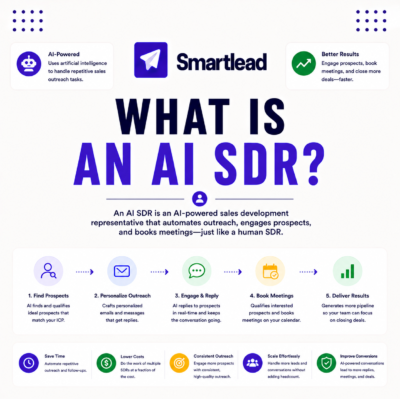
This kind of software is a version of a sales development representative that automates the top-of-funnel job. It researches prospects, drafts and sends first-touch outreach, handles simple replies, and books meetings, so human reps can focus on qualified conversations instead of manual prospecting.
“In marketing, lead generation refers to the process of attracting and capturing consumer interest in a product or service.”
— Wikipedia
In sales, it turns a routine idea into a lever for scaling outbound without adding headcount.
How Does an AI SDR Work?
It works by taking a list of prospects and running the outreach cycle on its own. It researches each lead, drafts a personalized message, sends it across channels, reads and classifies replies, and books a meeting or hands off to a human when a prospect is interested.
Understanding how it works makes it easier to apply on real outbound.
Why Does an AI SDR Matter in Sales?
It matters in sales because top-of-funnel work is slow and expensive to staff. Automating research and first-touch outreach lets a team reach far more prospects than reps could by hand, while human SDRs focus their time on the replies that turn into pipeline.
Teams that get this right scale outbound while keeping the human touch where it counts.
What Are the Key Elements of an AI SDR?
The key elements are the parts that let it run outbound well: a lead source, an AI model, outreach channels, and clear handoff rules. Getting each right is what makes it generate pipeline rather than spam.
- A lead source: The list of prospects it works, from a database or the CRM.
- An AI model: The engine that researches each lead and writes the outreach.
- Outreach channels: The email and other channels it sends and replies on.
- Handoff rules: The rules for booking a meeting and passing an interested lead to a human.
These elements together define whether it is set up well.
An AI SDR in Practice: A Simple Example
In practice, it pulls a list of target accounts, researches each one, and sends a tailored first email. When a prospect replies with interest, it books a meeting on a rep’s calendar and passes the context along, so the human joins the call already briefed.
A concrete example makes it easy to picture on your own outbound.
Common AI SDR Mistakes to Avoid
The most common mistakes come from spraying generic email or ignoring deliverability. Avoiding them keeps it a pipeline source rather than a way to burn a domain’s reputation.
- Generic email at scale: Untargeted mass outreach gets ignored and hurts the brand.
- No personalization: Sending the same message to everyone wastes the research the model can do.
- Ignoring deliverability: High volume without warm-up lands messages in spam and burns the domain.
- No human handoff: Letting the agent run the whole conversation loses deals a rep would win.
Sidestepping these mistakes is often the fastest way to get value from one.
AI SDR Best Practices
The best practices keep it personalized, deliverable, and human-backed. Personalizing from real data, protecting deliverability, keeping a human handoff, and starting narrow turn it into a reliable pipeline source rather than a spam risk.
- Personalize from real data: Use CRM and call context so each message is relevant, not generic.
- Protect deliverability: Warm up domains and keep volume sane so messages reach inboxes.
- Keep a human handoff: Pass interested replies to a rep for the real conversation.
- Start narrow: Prove it on one segment before scaling across the whole list.
Applying these practices makes it repeatable and safe across the team.
How Is an AI SDR Measured or Improved?
It is measured with a few practical signals and improved by sharpening targeting and messaging. Tracking meetings booked, reply rate, deliverability, and handoff quality turns a vague “we automated outbound” into something you can manage.
Source: framework based on common outbound criteria; impact varies by team and market, so benchmark against your own baseline.
The table shows how to track and improve it over time.
An AI SDR vs an AI Agent: What’s the Difference?
An AI SDR and an AI agent are related but differ in scope: one is a specific role focused on prospecting and booking meetings, while an AI agent is the broad category of software that automates any sales task. The AI SDR is one job; the AI agent is the category it belongs to.
Source: general definitions; an AI SDR is one kind of AI agent. Confirm how your team uses each term before comparing.
The table clarifies where an AI SDR ends and a broader AI agent begins.
“An AI BDR is a software agent that uses artificial intelligence to automate and optimize core and repetitive business development tasks, such as prospecting, lead qualification, and outreach, with the goal of generating new business opportunities at scale.”
— HubSpot
See how Claap briefs its handoffs. Start free, no bot.
Start for Free →Free plan available · real call context for handoffs
How Does Claap Help With an AI SDR?
Claap helps it by capturing every call with no bot and turning it into clean context for the handoff. When it books a meeting, the human rep and the follow-up both work from real call detail, so nothing is lost between the automated first touch and the human conversation.
- Capture the calls: Claap records calls with no bot joining the meeting.
- Brief the handoff: Clean call notes give the human rep context after it books.
- Feed the follow-up: Real call detail lets follow-up outreach reference the actual conversation.
- Keep it current: Fresh call data means the next touch reflects the latest conversation.
Claap makes it more effective by capturing and structuring the call data the handoff depends on.
Which Tools Support an AI SDR?
Tools that support one range from dedicated platforms to the tools around them. Claap provides clean call context for the human handoff, while platforms run the outreach and a CRM stores the records.
- Claap: No-bot capture that gives the human handoff real call context.
- Dedicated platforms: Tools that run the research, outreach, and reply handling.
- CRM: HubSpot and Salesforce store the leads and the meetings it books.
- Deliverability tools: Warm-up and monitoring tools keep the outreach reaching inboxes.
The right combination makes it practical across a sales stack.
Key Takeaways on an AI SDR
In short, it is software that automates sales development tasks like prospecting and initial outreach. Used well, it scales top-of-funnel work without adding headcount, so human reps focus on the qualified conversations that build pipeline.
“It fills the top of the funnel; the deal is still won in the conversation.”
— Growth Hack Suite, GMass review
Master the AI SDR and the top of your funnel gets easier to scale.
AI SDR: Quick Answers
Quick answers on an AI SDR: what it is, why it matters, and how it fits a sales stack. The FAQ below covers the most common questions teams ask when they adopt one.
These quick answers make an AI SDR easy to explain to your team.
Brief every AI SDR handoff with real call data. Start Claap free, no bot.
Start for Free →Free plan available · no credit card · no bot joins your call
Related Tools in the Sales Stack
An AI SDR sits alongside the tools that feed and follow the call. These adjacent guides help you build the wider workflow.
- Hunter.io review: An email finder and verifier for building outbound lists before the call — read the review.
- GMass review: A cold-email tool that sends and tracks outreach from Gmail — read the review.
- Apollo guide: A sales-intelligence platform with a large B2B contact database for prospecting — read the guide.
About this guide
Last updated: July 2026. This definition draws on how these tools are used in real sales teams. AI outbound tools evolve fast, so treat any detail as directional and verify against your own setup.
Affiliate disclosure: links to Claap are affiliate links. If you start a plan through them we may earn a commission at no extra cost to you. This does not affect our honest assessment of the product.
AI SDR: Frequently Asked Questions
The 12 most-asked questions about this topic.
What is an AI SDR?
It is a software version of a sales development representative that automates top-of-funnel work: researching prospects, sending first-touch outreach, and booking meetings.
How does an AI SDR work?
It takes a list of prospects, researches each lead, drafts and sends personalized outreach, classifies replies, and books a meeting or hands off to a human.
Why does it matter in sales?
Top-of-funnel work is slow and expensive to staff. Automating it lets a team reach far more prospects while human SDRs focus on the replies that build pipeline.
What are its key elements?
A lead source, an AI model, outreach channels, and clear handoff rules. Getting each right is what makes the AI SDR generate pipeline rather than spam.
Can you give a simple example?
An AI SDR pulls target accounts, sends a tailored first email, and when a prospect replies with interest, books a meeting and passes the context to a rep.
What mistakes should you avoid?
Generic email at scale, no personalization, ignoring deliverability, and no human handoff. Each one turns the AI SDR into spam that burns the domain.
What are the best practices?
Personalize from real data, protect deliverability, keep a human handoff, and start narrow. Together these make an AI SDR a reliable pipeline source.
How is it measured?
By meetings booked, reply rate, deliverability, and handoff quality. Tracking a few signals turns a vague outbound setup into something you can manage.
How is it different from an AI agent?
An AI SDR is a specific role for prospecting and booking meetings; an AI agent is the broad category of software that automates any sales task. The AI SDR is one job within it.
Which tools support it?
Claap for real call context on the handoff, AI SDR platforms to run the outreach, a CRM for leads and meetings, and deliverability tools to protect the domain.
How does Claap help?
Claap captures every call with no bot and turns it into clean context, so when an AI SDR books a meeting, the human rep and follow-up work from real call detail.
What is the key takeaway?
An AI SDR is software that automates sales development tasks. Used well, it scales top-of-funnel work so human reps focus on qualified conversations.