Table of Contents
Cold calling is phoning prospects who have not expressed interest, to introduce an offer and start a conversation, and it reinforces cold email in a multichannel motion. This guide explains what it is, how it works in outbound, why it pairs with cold email, when to call versus email, how to make it effective, and whether it is still effective and legal.
This channel phones prospects who have not expressed interest to start a conversation, and it pairs powerfully with cold email.
Best for: high-value B2B sales where a conversation moves the deal.
Caveat: it is harder to scale than email and is regulated.
Bottom line: a call plus email beats either channel alone.
Put this into practice. Try Smartlead free for 14 days.
Start Smartlead Free Trial →Unlimited mailboxes · no credit card · 14-day trial
What Is Cold Calling?
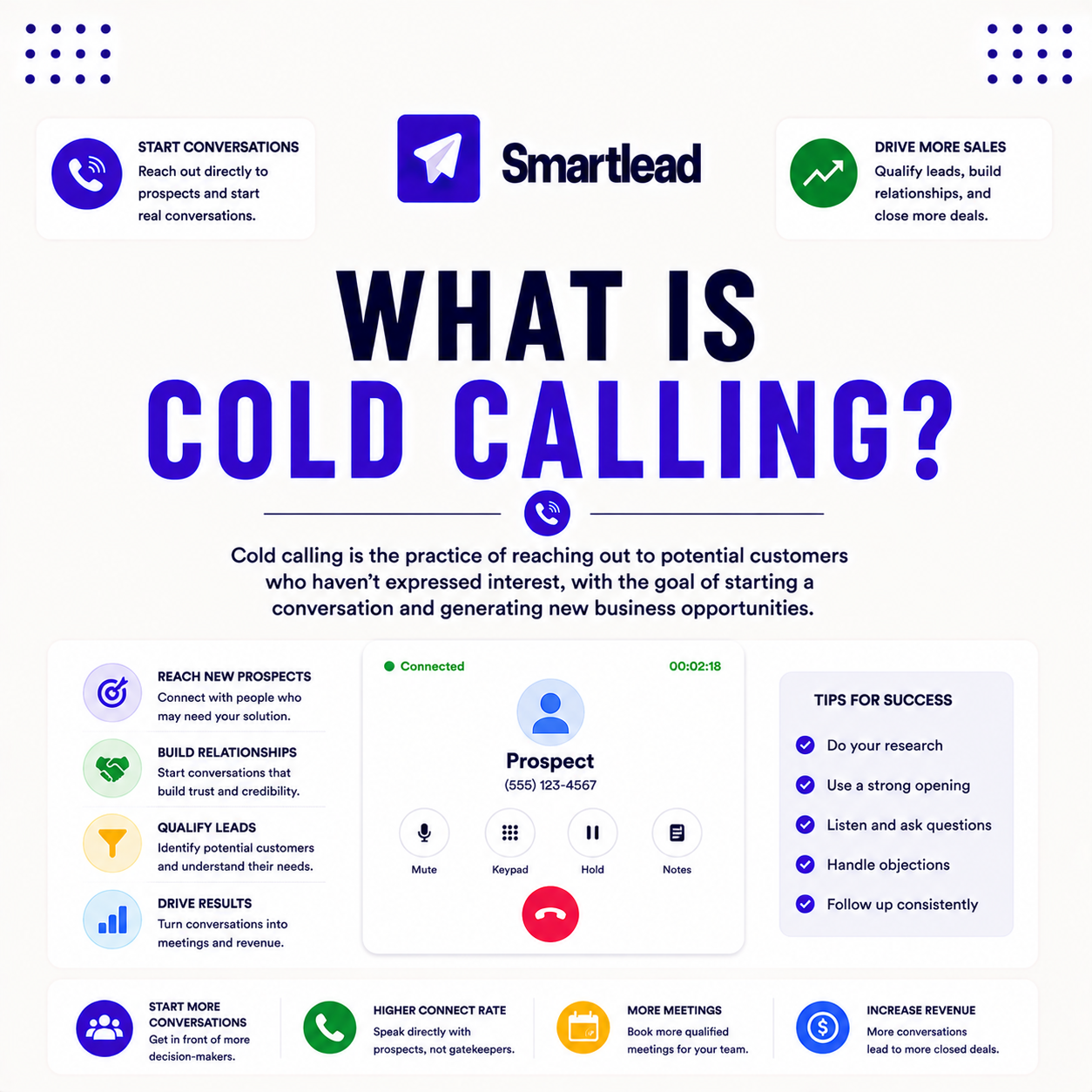
Cold calling is phoning prospects who have not previously expressed interest, to introduce an offer and open a conversation. It remains a direct way to reach decision-makers. The deciding factor is that it starts a live conversation, not a passive touch. The list below covers the parts.
- Unsolicited call: the prospect has not asked to be contacted.
- Direct conversation: it reaches decision-makers in real time.
- Introduces an offer: the call opens with a clear reason to talk.
- High-intent touch: a live call carries more weight than a passive email.
- Pairs with email: it reinforces the email side of the motion.
“A live call catches a prospect directly, where an email waits passively in a crowded inbox.”
— Growth Hack Suite, on cold outreach tools
How Does Cold Calling Work in Outbound?
In outbound, it targets a researched list of prospects, often after or alongside email touches. A power dialer and local presence raise connection rates. The deciding factor is that calls work best on a warmed, researched list. The list below covers the flow.
- Research the list: targets are qualified before any dialing begins.
- Warm with email: an email touch makes the name familiar first.
- Dial efficiently: a power dialer removes the dead time between calls.
- Use local presence: a familiar caller ID lifts answer rates.
- Log the outcome: call results feed follow-up and the CRM.
“Live conversations still close high-value deals when they move the sale forward.”
— HubSpot, on outbound calling
Why Does Cold Calling Pair With Cold Email?
It pairs with cold email because the two reinforce each other: an email warms the name, and a call catches the prospect directly. A coordinated email-plus-call motion lifts connection and reply rates. The deciding factor is that the channels cover each other’s blind spots. The list below covers why.
- Email warms the name: a prior email makes the call less cold.
- Call catches directly: a live call reaches prospects who skip email.
- Best for scale: the combined motion compounds across a large list.
- Caveat: calling is harder to scale, so it targets higher-value prospects.
- Covers blind spots: each channel reaches prospects the other misses.
When Should You Call Versus Email?
Call high-value prospects, warm-but-quiet contacts, and situations that benefit from a conversation, while email scales the top of the funnel. The two play different roles. The deciding factor is value and warmth of the prospect. The table below maps the choice.
Source: standard channel-choice practice, mid-2026. Directional, not a measured benchmark.
How Do You Make Cold Calling Effective?
Make it effective with a researched list, a strong opener, a clear reason to call, and quick objection handling. Pairing calls with email and tracking outcomes tightens the motion. The ordered steps below make it repeatable.
- Research the list: qualify prospects so calls land on the right people.
- Open strong: a clear, specific opener earns the first thirty seconds.
- Give a reason to call: state a relevant reason tied to the prospect.
- Handle objections fast: answer common pushbacks briefly and move on.
- Pair with email: reinforce the call with an email before or after.
Adding calls to email? Test Smartlead free for 14 days.
Start Smartlead Free Trial →No credit card · unlimited mailboxes
Is Cold Calling Still Effective?
Yes, it still works, especially for high-value B2B sales where a conversation accelerates deals. It is harder to scale than email, but as part of a multichannel motion it lifts results. The deciding factor is that a live conversation moves high-value deals faster. The honest read is that this channel is not dead, it is a targeted play best used alongside email.
The practical point is to use it selectively on high-value prospects rather than as a scaled top-of-funnel channel.
Is Cold Calling Legal?
It is legal but regulated, with rules on do-not-call registries, consent, calling hours and disclosures that vary by region. Compliance depends on where recipients are. The deciding factor is following the regulations for each market. The table below outlines the compliance areas. This is general guidance, not legal advice, so check the specific laws for your region.
Source: general cold-calling compliance areas, mid-2026. General guidance, not legal advice — verify your region’s rules.
Does Smartlead Support Cold Calling?
Yes, through SmartDialer, Smartlead adds calling to the platform with parallel dialing, local presence and AI insights, integrated with email campaigns. This lets a team run calls and email in one motion. The deciding factor is that the dialer and email live together. The honest read is that a built-in dialer makes the email-plus-call motion practical without stitching tools.
The practical point is to add a call step to email sequences with SmartDialer rather than running a separate calling tool. Verify current features on smartlead.ai.
Who Gets the Most Value From Cold Calling?
Sales teams with high-value B2B deals get the most value, since a conversation moves those sales faster. Low-ticket, high-volume sellers may lean on email instead. The deciding factor is deal value and how much a conversation helps. The honest read is that the higher the deal value, the more it pays back.
The practical point is that a high-ticket B2B team gains most from calling, while a low-ticket, high-volume seller can lead with email.
How Do You Get Started Today?
Start on the 14-day free trial, connect a mailbox, warm it, verify a small list and add a call step to an email sequence. Testing the call-plus-email motion on your own list before committing is the lowest-risk way to begin. The trial needs no card, so the only cost is setup time. By launch, calls reinforce email in one coordinated motion.
Is Cold Calling or Cold Email Better?
Neither is universally better: email scales and is low-friction, while calling is direct and high-intent. Combining them in a multichannel motion beats using either alone. The deciding factor is that the two solve different problems. The honest read is that the best answer is not one or the other, but both used where each is strongest.
The practical point is to scale with email and reserve calls for high-value prospects, running the two together.
Should You Email Before or After a Cold Call?
Both work, but emailing first warms the name so the call is less cold, while a follow-up email after a call reinforces the conversation. The best pattern often uses both. The deciding factor is that email brackets the call, before and after. The honest read is that a call sandwiched between emails performs better than a lone cold call.
“It is the solicitation of a prospect who has not expressed interest before.”
— Wikipedia, Cold calling
Cold Calling: The Final Verdict
The final verdict is that cold calling phones prospects who have not expressed interest to start a conversation, and it pairs powerfully with cold email. It is harder to scale than email, so it targets high-value prospects where a conversation moves the deal. Warm the name with email, use a researched list, dial within the rules, and reserve calls for prospects worth a live touch.
Growth Hack Suite Editorial — Outbound Tools Team
This guide explains cold calling based on standard outbound practice plus hands-on testing of Smartlead. Behavior varies; verify current features on smartlead.ai. We review outbound tools for B2B senders.
Last updated: June 2026. Calling compliance notes are general guidance, not legal advice.
Affiliate disclosure: this page contains affiliate links. If you start a plan through them, Growth Hack Suite may earn a commission at no extra cost to you. It does not change our guidance.
Pair calls with email in one motion. Start Smartlead free for 14 days.
Start Smartlead Free Trial →Unlimited mailboxes · no credit card · cancel anytime
Related Tools in the Outbound Stack
Two other tools in the Growth Hack Suite stack pair with cold calling.
- Hunter Email Verifier: verifying the email list keeps the paired email channel clean — see verifier accuracy.
- GMass: the Gmail-native option for the email side of a lighter motion — read the GMass review.
- Gmail tools comparison: the Gmail-scoped breakdown for senders weighing platform versus extension — compare the Gmail tools.
Cold Calling FAQ
The 12 most-asked questions about cold calling.
What is cold calling?
Cold calling is phoning prospects who have not previously expressed interest, to introduce an offer and open a conversation. It remains a direct way to reach decision-makers.
How does cold calling work in outbound?
It targets a researched list, often after or alongside email touches. A power dialer and local presence raise connection rates, so reps reach more prospects on a warmed list.
Why does cold calling pair with cold email?
The two reinforce each other: an email warms the name, and a call catches the prospect directly. A coordinated email-plus-call motion lifts connection and reply rates.
When should I call versus email?
Call high-value prospects, warm-but-quiet contacts, and situations that benefit from a conversation, while email scales the top of the funnel. The two play different roles.
How do I make cold calling effective?
Use a researched list, a strong opener, a clear reason for the call, and quick objection handling. Pairing calls with email and tracking outcomes tightens the motion.
Is cold calling still effective?
Yes, especially for high-value B2B sales where a conversation accelerates deals. It is harder to scale than email, but as part of a multichannel motion it lifts results.
Is cold calling legal?
Cold calling is legal but regulated, with rules on do-not-call registries, consent, calling hours and disclosures that vary by region. This is general guidance, not legal advice, so check the rules for your region.
Does Smartlead support cold calling?
Yes, through SmartDialer Smartlead adds calling with parallel dialing, local presence and AI insights, integrated with email campaigns. This lets a team run calls and email in one motion.
Is cold calling or cold email better?
Neither is universally better: email scales and is low-friction, while calling is direct and high-intent. Combining them in a multichannel motion beats using either alone.
How many cold calls does it take to book a meeting?
It varies widely by list quality, offer and skill, but cold calling is a numbers game requiring many dials per meeting. Measure it on your own list rather than assuming a fixed rate.
Should I email before or after a cold call?
Both work, but emailing first warms the name so the call is less cold, while a follow-up email after a call reinforces the conversation. The best pattern often uses both.
Does cold calling hurt my brand?
Done respectfully and within regulations, cold calling does not hurt a brand and can build relationships. Poorly targeted, aggressive calling is what damages reputation, so keep it relevant and compliant.