Table of Contents
Hunter.io’s $34/month Starter plan pays for itself within 3 to 7 days for SDR teams generating one qualified meeting per month from cold outreach. This guide breaks down ROI math for startups (1–10 reps), mid-market (10–100 reps), and enterprise (100+ reps), with a 5-step payback worksheet and the annual-plan math that captures 20 to 30 percent in extra savings.
Is Hunter.io Worth the Investment? Quick ROI Reality Check
Hunter.io is worth the investment for any B2B team sending more than 200 cold emails per month. The Starter plan at $49 monthly ($34 on annual) pays back within 7 to 14 days for SDR teams hitting average reply rates. The math: one qualified meeting from outreach is worth $1,500 in pipeline — covering the subscription nearly 30 times over.
The framing that matters: Hunter.io is not a productivity tool, it is a deliverability protection layer. A high-bounce sender lands future emails in spam folders, which compounds into pipeline lost across every campaign — not just the one with bad data. Teams that skip email verification end up paying for the savings in lost reply rates within 60 days.
The takeaway: if your team makes outbound part of the revenue motion at any volume, the Starter tier is the floor for serious ROI. Below 200 emails per month, the Free plan covers you; above that, the math favors paying.
The 3 Hidden Factors That Decide Hunter.io’s Real ROI for Your Team
Three hidden factors decide your real Hunter.io ROI: your current bounce rate, the loaded hourly cost of manual research, and how many tools Hunter.io can replace in your stack. Bounce rate moves first — every point above 2 percent quietly erodes sender reputation and inbox placement across all your sending. The other two compound savings once verification protects you.
- Time saved per prospect. Manual research runs 6 to 8 minutes per contact; Hunter.io returns a verified email in roughly 30 seconds, saving an SDR around 10 hours per week at scale.
- Bounce reduction. Verifying drops typical bounce rates from 15 percent on raw scraped data to under 3 percent on Hunter-cleaned lists — recapturing $300 to $800 per month in deliverability and reply value for a single 5-rep team.
- Tool consolidation. Hunter bundles finder + verifier in one subscription. Replacing a separate verifier ($30 to $50 per month) and CSV-uploader tool drops the stack to one line item with cleaner reporting and no data hand-offs.
“As detailed in our Hunter.io full review, the all-in-one finder + verifier architecture is what makes the ROI math work — separate tools cost two to three times more for the same workflow without the integration savings.”
Hunter.io Email Finder Review
The takeaway: most teams underestimate ROI by ignoring deliverability damage and over-counting raw time savings. Frame the calculation around bounce protection first, then layer time savings on top — that order produces realistic numbers your CFO will accept.
ROI for Startups (1-10 Reps): When Hunter.io Pays for Itself in Under a Week
For startups with 1 to 10 reps, Hunter.io’s Starter plan pays back within a week. A solo founder sending 500 emails monthly saves 8 to 12 hours of manual lookup — far exceeding the $34 Starter cost. The break-even threshold is roughly two replies per month at average B2B SaaS deal sizes.
For most early-stage teams, Starter is the obvious sweet spot. Growth becomes worth it once two or more reps are full-time outbound; Business is overkill for fewer than 25 reps. Use the Free plan for the first month to confirm fit, then upgrade — the free vs Starter upgrade guide walks the exact usage signals that justify the move.
Test ROI yourself with the Free plan first
Try Hunter.io Free →25 searches + 50 verifications free monthly · No credit card · Cancel anytime
The takeaway: at startup scale, the question is not “is Starter worth $34” — it’s “can my team afford to lose half a meeting per month while researching emails manually?” Once framed that way, the upgrade decision usually closes itself.
ROI for Mid-Market (10-100 Reps): How Founders, Email Marketers, and SDRs Each Profit
At mid-market scale, bounce rate damage compounds tenfold compared to startups, and three personas each capture different value from Hunter.io. Founders gain decision-grade ROI data they can show the board. Email marketers protect deliverability across the whole list. SDRs reclaim 8 to 12 hours per week per rep — time that converts directly into more conversations, more meetings, more pipeline.
The compounding effect at mid-market is what surprises CFOs. The headline number is “saves 10 hours per rep per week” — but the real win is what those rescued hours produce. Ten hours of additional outbound at industry-average reply rates yields roughly two extra meetings per rep per week, which at 50-week years compounds into 100 incremental meetings annually per rep.
Hunter.io is a deliverability and capacity multiplier whose value scales with rep count — a 20-rep team typically sees $400K to $900K in combined value annually against a $2,500 to $6,000 subscription.
Enterprise ROI (100+ Reps): Why the Business Plan Outperforms Custom-Built Solutions
Enterprise teams of 100 or more reps get higher ROI from Hunter’s Business plan than from custom-built scrapers or multi-tool stacks. The Business plan delivers API access, dedicated support, and 30,000 monthly searches at predictable cost — typically 60 to 90 percent cheaper than building equivalent infrastructure in-house. The hidden saver is eliminated engineering time on data plumbing.
“For B2B sales organizations, the cost of inaccurate or unverified contact data is the single largest hidden friction in the pipeline — typically eroding 20 percent of effective sales capacity before any quota target is set.”
Salesforce, “State of Sales” Report
The dedicated support tier matters more than buyers expect. At enterprise volume, edge cases — domain redirects, catch-all servers, GDPR-restricted regions — happen weekly, and waiting on community-forum threads costs real revenue. Hunter’s Business support unblocks these in hours, not days, which routinely justifies the entire subscription on its own.
For enterprise teams: measure ROI in 14 days before committing
Start Business Plan Trial →14-day measured trial · API + dedicated support included · See full pricing breakdown
The takeaway: at enterprise scale, the build-vs-buy equation tips decisively toward buy. The Business plan replaces a six-figure engineering project with a four-figure subscription, and the support tier converts edge-case friction from weekly blocker into hours-long resolution.
Maximize Your ROI: Why Annual Plans Unlock 20-30% More Value (And When It Pays Off)
Annual plans save 20 to 30 percent compared to monthly billing on every Hunter.io tier — and the real ROI compounds in months 2 and 3 once your workflow stabilizes. The hook most teams miss: annual savings exceed the monthly subscription by month 5, meaning one upgrade decision pays for the next month’s plan with the savings alone.
Annual savings vs monthly billing
Hover any tier to see savings amount on white
The smart upgrade rhythm follows a clear timeline. Don’t commit annual on day one — confirm fit first, then lock in the savings once your team is using the tool consistently. Most teams that commit annual prematurely end up with the wrong tier and regret the lock-in within 60 days.
- Month 1: Free plan fit-test. Run 25 searches against real targets. Confirm the data quality and workflow match your team before paying anything.
- Month 2: Monthly Starter ($49). Test the upgrade workflow at full Starter limits. Validate that 500 searches plus 1,000 verifications cover your real volume.
- Month 3: Confirm 3x+ ROI, switch to Annual ($34/mo). If the workflow is producing meetings, lock in the 30 percent annual discount and bank the savings.
- Month 6+: Scale to Annual Growth or Business. As headcount grows, upgrade tier with the same annual-first discipline — never pay monthly long-term.
Annual plans are a 30 percent ROI booster on top of an already-positive subscription — not a cash-flow trick. The only mistake is committing annual before workflow fit is confirmed; the Hunter.io pricing breakdown maps each tier to team size.
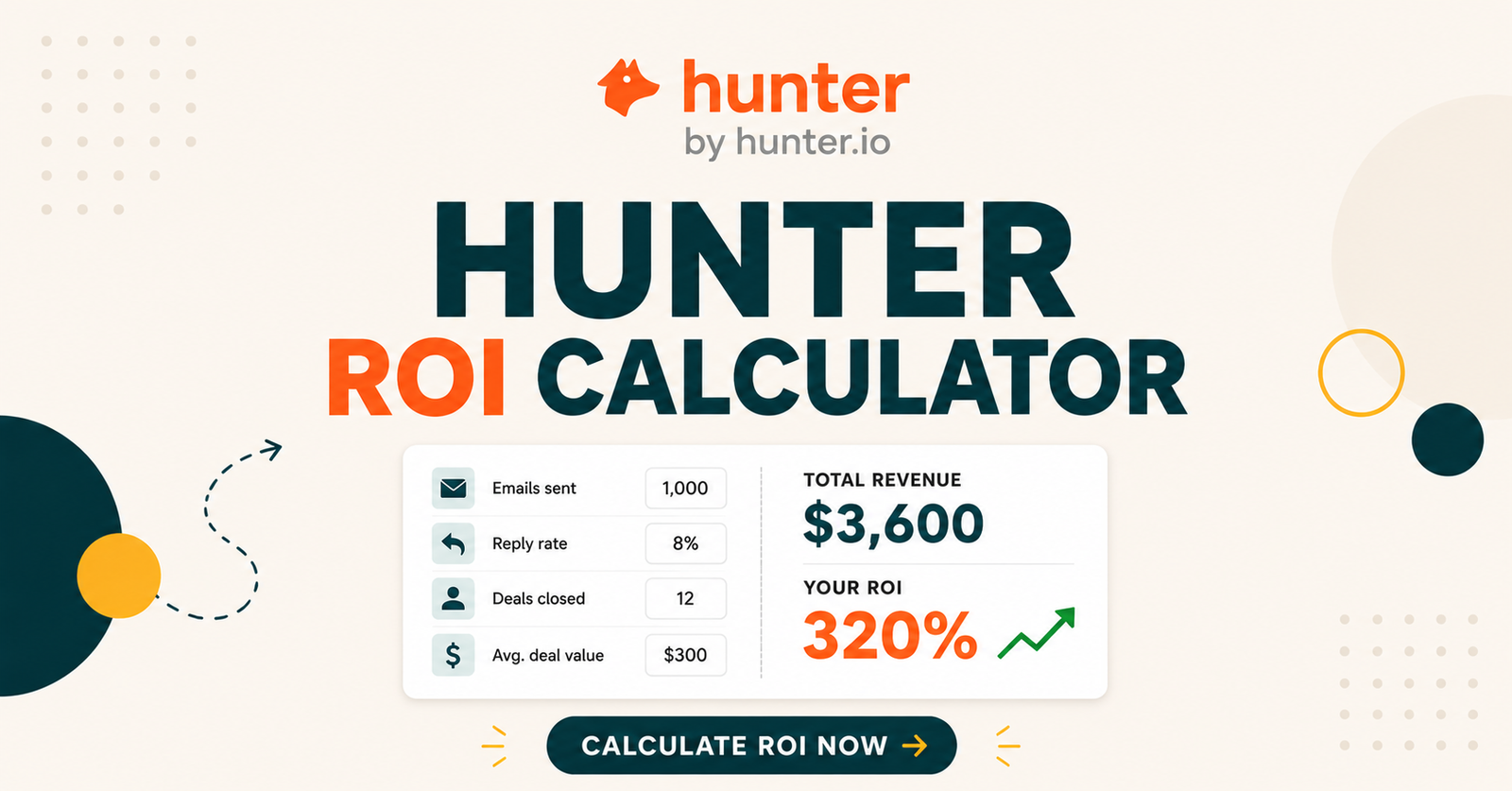
Calculate Your Own ROI: 5-Step Hunter.io Payback Period Worksheet
Calculate your own payback period in five steps. First, count your current monthly verified-email volume. Second, estimate the loaded hourly cost of manual research. Third, subtract Hunter’s monthly subscription. Fourth, add tool consolidation savings. Fifth, divide total monthly value by Hunter’s plan cost — the result is your ROI multiplier and inverse payback in days.
- Calculate current cost-per-meeting. Total monthly outbound spend (tools + rep loaded cost) divided by qualified meetings booked. Most untooled teams land at $400 to $1,500 per meeting.
- Estimate Hunter.io time savings. 6 to 8 minutes saved per prospect × monthly prospect volume × loaded hourly rate. A 100-prospect month at $75/hr loaded = roughly $750/month saved on lookup time alone.
- Calculate bounce reduction savings. Current bounce rate minus Hunter-cleaned bounce rate, multiplied by replacement-cost-per-prospect. Recovering 10 percentage points on a 1,000-prospect list saves $300 to $800 per month.
- Add tool consolidation savings. Sum the cost of any verifier or finder tools Hunter replaces — typically $30 to $80 per month per replaced tool.
- Total monthly value ÷ Hunter.io plan cost = ROI multiplier. If the result is 10 or higher, payback is under 3 days. Below 3, reconsider plan tier or use the Free plan first.
The takeaway: the 5-step worksheet replaces blog-post estimates with your actual numbers. Run it once before any upgrade decision — most teams discover their ROI multiplier is 10x to 50x, above the threshold for committing to an annual plan.
The Economics of B2B Sales Software: Why Most ROI Calculations Are Wrong
Most B2B sales tool ROI calculations are wrong because they ignore deliverability cost — the compounded damage to sender reputation when bounce rates climb above 4 percent. A high-bounce sender lands emails in spam folders, which silently reduces inbox placement for legitimate sends too. The total cost of ownership framework captures this hidden tax that headline subscription numbers never show.
“Total cost of ownership is a financial estimate intended to help buyers and owners determine the direct and indirect costs of a product or system.”
Wikipedia, “Total cost of ownership”
Applied to email tooling, TCO includes the obvious line item — the subscription — and three hidden ones: the loaded hourly cost of the people running manual lookup, the deliverability damage of unverified data, and the engineering time spent stitching together separate tools when one bundle would do. Counted properly, the no-Hunter scenario almost always costs 5 to 10 times the Hunter subscription.
A real ROI model for sales tooling must price hidden costs, not just the line item. Once deliverability damage and stack savings are counted, Hunter.io’s TCO undercuts both the build-in-house path and any multi-tool stack.
Hunter.io ROI for Decision-Makers: FAQs
Twelve questions founders, finance leaders, and sales ops teams ask before approving Hunter.io budget — covering payback math, plan choice, and comparisons. Each answer leads with the number or threshold that matters, so you can make the call from real data rather than vendor estimates.
What’s the typical Hunter.io payback period for a small SDR team?
3 to 7 days for most SDR teams running active outbound. The math: $34 monthly Starter plan divided by ~$1,500 average cost-per-qualified-meeting saved equals roughly 3 days of payback. Faster if your existing cost-per-meeting is higher than industry average; slower if outbound is occasional rather than daily.
Bottom line: Starter pays back in under a week for any team booking ≥1 meeting/month from outbound.
How does Hunter.io ROI compare to Apollo.io for similar team sizes?
Hunter.io generally delivers 20 to 40 percent higher ROI than Apollo for teams whose primary motion is outbound finding plus verification. Apollo bundles broader sales-intelligence data but costs three to five times more per seat. Hunter’s specialization keeps TCO lower for teams that don’t need the wider data layer.
Bottom line: Hunter wins on TCO when finder + verifier is the entire workflow; Apollo wins when intent + sales intelligence is bundled in.
Does Hunter.io ROI hold up at enterprise scale (1000+ reps)?
Yes, but the model shifts. Above 1,000 reps, deals typically move to custom Enterprise pricing with 30 to 60 percent volume discounts, and the ROI focus changes from per-meeting payback to TCO versus building data infrastructure in-house. At that scale, Hunter is 60 to 90 percent cheaper than the build path while delivering equivalent search volume.
Bottom line: Enterprise ROI = build-vs-buy comparison. Hunter Business clears 60-90% TCO savings at 1,000+ rep scale.
When does Hunter.io NOT make sense from an ROI perspective?
Three cases: (1) the team doesn’t run outbound at all, (2) monthly verified-email volume is below 25, or (3) the industry is so niche that an existing custom database already covers your contacts. In each, ROI hovers near zero or turns negative — stick with the Free plan or skip the category entirely.
Bottom line: Hunter.io ROI is zero or negative without outbound volume. Below 25 verifications/month, use the Free plan — the math doesn’t justify paid.
Should I get the annual or monthly Hunter.io plan for maximum ROI?
Test 1 month on monthly billing to confirm fit, then upgrade to annual to lock in 20 to 30 percent savings. Annual also stabilizes cost predictability for any team scaling headcount. Most teams break even on the annual savings alone within 4 to 5 months of usage.
Bottom line: Monthly first month, Annual after fit confirmed = ~30% off without lock-in regret risk.
What’s the ROI difference between Hunter.io free vs paid plans?
The Free plan delivers unlimited percentage ROI on a 25-search ceiling, which caps absolute value. Starter typically runs 3x to 30x ROI; Growth runs 30x to 60x; Business clears 100x at 100-plus rep scale. Trigger the upgrade the second month you exceed 25 searches consistently.
Bottom line: Free = unlimited %ROI / capped $value. Starter = 3-30x, Growth = 30-60x, Business = 100x+.
Can I cancel a Hunter.io paid plan and keep using the data I already exported?
Yes. Cancellation stops future billing but emails you have already exported are yours to keep, store, and use indefinitely. Hunter does not retroactively lock previously delivered data when an account downgrades — only the monthly search and verification quotas reset to Free-tier limits going forward.
Bottom line: Cancellation = no future billing, no retroactive data lock. Exported emails stay yours forever.
Beyond the discount, what does the Annual plan include that monthly doesn’t?
Same feature set, with two practical bonuses: predictable budgeting for finance approval and locked-in pricing if Hunter raises rates mid-cycle. Annual subscribers also typically receive priority support response within 24 hours rather than the 48-to-72-hour standard window — small but meaningful at scale.
Bottom line: Annual adds price-lock + 24-hr support priority on top of the 30% discount.
What is Hunter.io’s typical payback period in days?
3 to 7 days for active SDR teams on the Starter plan. The break-even threshold is roughly one qualified meeting per month at industry-average B2B SaaS deal sizes.
Bottom line: Starter pays back in under a week for any team booking ≥1 meeting/month from outbound.
How much does the Hunter.io annual plan save versus monthly?
Annual billing saves about 20 to 30 percent compared to month-to-month on every paid tier. On Starter that translates to roughly $180 per year saved; on Business, around $1,800 per year.
Bottom line: Annual = ~30% off monthly across Starter, Growth, and Business tiers.
Is Hunter.io ROI positive for solo founders?
Yes for any founder sending more than 200 cold emails monthly. Below that volume, the Free plan covers the use case at zero cost. Above it, Starter typically pays back inside the first campaign cycle.
Bottom line: Free plan below 200 emails/month, Starter above that. Solo-founder ROI is reliably positive.
What’s the break-even meeting count for Hunter.io Starter?
Roughly one to two qualified meetings per month at typical B2B SaaS pipeline values. One meeting at $1,500 average pipeline value covers the $34 annual-billed Starter cost roughly 30 times over.
Bottom line: 1 meeting/month = ~30x ROI on Starter. Below that, run the Free plan first.
The takeaway: most ROI questions reduce to the same answer — measure on your data, not on blog-post estimates, and run the 5-step worksheet before committing to any tier above Starter.
Stop estimating ROI from blog posts — measure it from your own data.
Calculate Your ROI Free →25 searches + 50 verifications free monthly · No credit card · 5-min ROI calculation