
Table of Contents
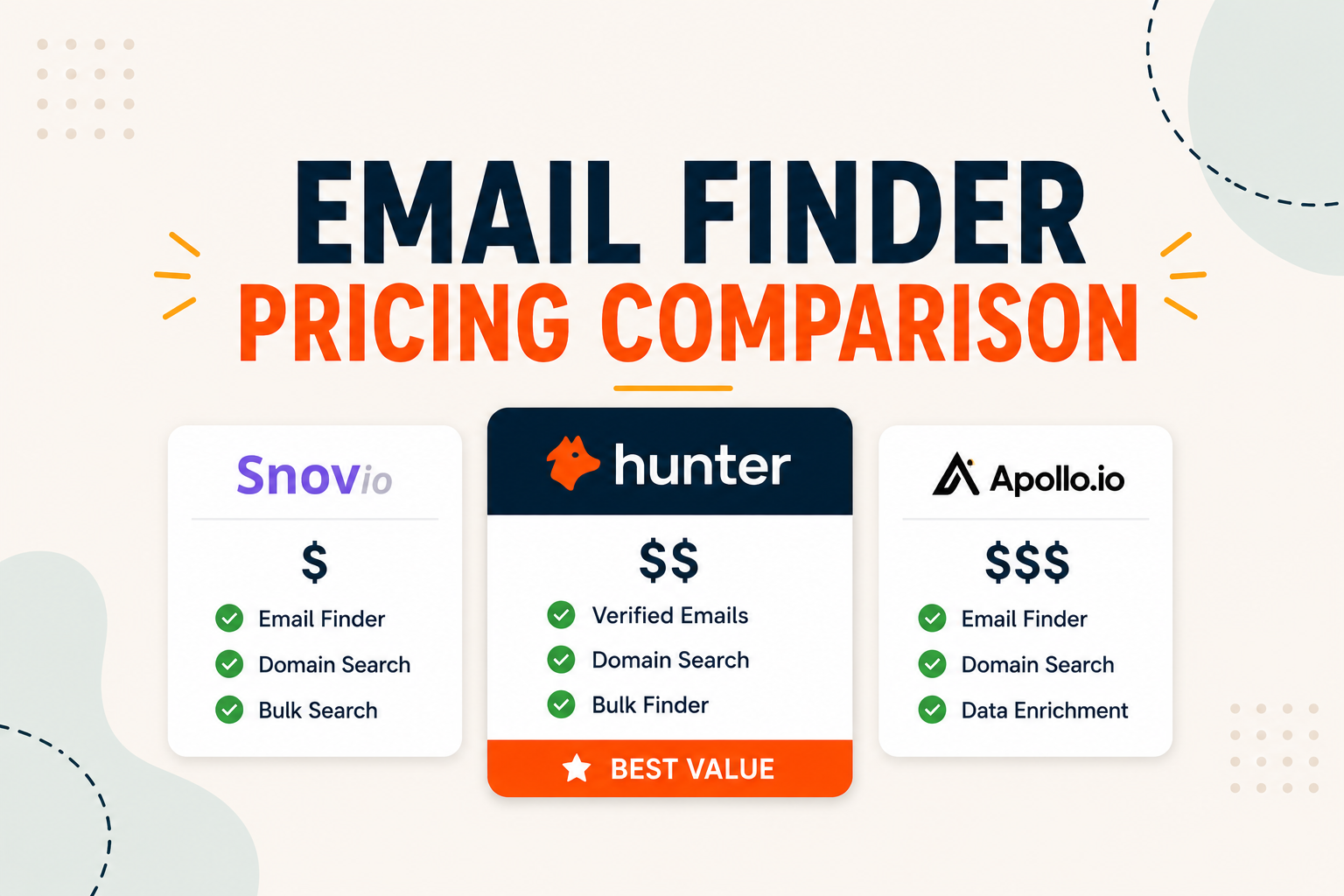
Hunter.io, Apollo.io, and Snov.io use three fundamentally different pricing models: Hunter.io charges per email search ($34–$349/mo per account), Apollo charges per user seat ($59–$149/user/mo), and Snov.io sells tiered credit packs ($39–$169/mo). For most email-focused teams running fewer than 500 searches per month, Hunter.io delivers the lowest effective cost-per-email : typically 30–45% less than Apollo once you factor in seat fees.
If you are not yet familiar with how email finders work before comparing their pricing, the email finder guide covers how these tools find and verify professional email addresses, who they are built for, and what to look for before committing to a paid plan.
Why Email Finder Pricing Is So Confusing (And What to Compare Instead of Sticker Price)
Comparing Hunter.io’s $34/month Starter against Apollo’s $59/month or Snov.io’s $39/month on sticker price alone will give you the wrong answer. Each tool meters usage differently: Hunter.io limits monthly searches per account, Apollo charges per seat regardless of how many emails each user finds, and Snov.io sells credit bundles that you buy upfront and draw down over time. The only metric that normalizes all three models is your effective cost per verified email at your real monthly volume.
To compare these tools correctly, answer three questions before looking at any pricing page: How many emails does your team search per month? How many users need concurrent access? And does your workflow require sales intelligence data beyond email addresses? Your answers : not the plan sticker prices : determine which tool saves you money at your actual scale.
At 100 searches per month, Hunter.io’s Starter plan costs $0.34 per verified email. Apollo’s Basic plan at the same volume costs $0.59 per email. At 500 searches per month, Hunter.io drops to $0.068 versus Snov.io at $0.078 and Apollo at $0.12. The gap only closes at very high volumes where Apollo’s unlimited Professional tier becomes competitive. For a full breakdown of Hunter.io’s tier economics, see our Hunter.io pricing guide.
The most common mistake in email finder comparisons is choosing based on headline plan price rather than volume-adjusted cost. Once you run the math at your actual usage level, the pricing picture changes significantly for most teams.
How Each Tool Charges You: 3 Different Pricing Models Explained
Hunter.io, Apollo.io, and Snov.io each use a distinct charging mechanism. Hunter.io’s per-search model gives you a monthly search allowance that resets with no rollover : straightforward and predictable. Apollo’s per-seat subscription charges by the number of users regardless of how many emails each person actually searches, making it expensive as teams scale headcount. Snov.io’s credit pack model lets you buy in bulk, which is flexible for variable-volume months but creates expiry risk : unused credits disappear after 12 months.
- Cost-per-verified-email. Hunter.io runs $0.07–$0.17 per email depending on plan tier. Apollo’s per-credit cost looks similar ($0.05–$0.12), but you’re also paying a per-seat fee on top : so your real effective cost is higher than the credit math alone suggests. Snov.io sits at $0.06–$0.12 per credit, competitive at mid-volume.
- Free tier value. Hunter.io’s free plan includes 25 searches plus 50 verifications per month with no card required : the most generous recurring free tier of the three. Apollo’s free plan offers 50 email credits per month with limited feature access. Snov.io’s free plan provides 50 credits as a one-time trial, not a recurring monthly reset.
- Hidden scaling costs. Apollo’s per-seat model scales fast as you add users : adding a second rep on Basic doubles your cost from $59 to $118/month. Hunter.io’s Starter, Growth, and Business plans cover your entire team at one flat fee. Snov.io’s annual credit expiry creates implicit pressure to use credits or lose them at renewal.
“As detailed in our Hunter.io full review, the per-search model gives small teams predictable monthly costs without paying per-seat fees that scale faster than usage : this is the key reason Hunter.io often wins on effective cost-per-email despite its sticker price being mid-range.”
: Hunter.io Email Finder Review 2026, Growth Hack Suite
Choosing between these models comes down to whether your costs scale with search volume or with team headcount. For teams where a few people do most of the searching, Hunter.io’s flat per-account model delivers meaningfully better economics at every tier below enterprise scale.
Side-by-Side Tier Comparison: What You Get at Each Price Point
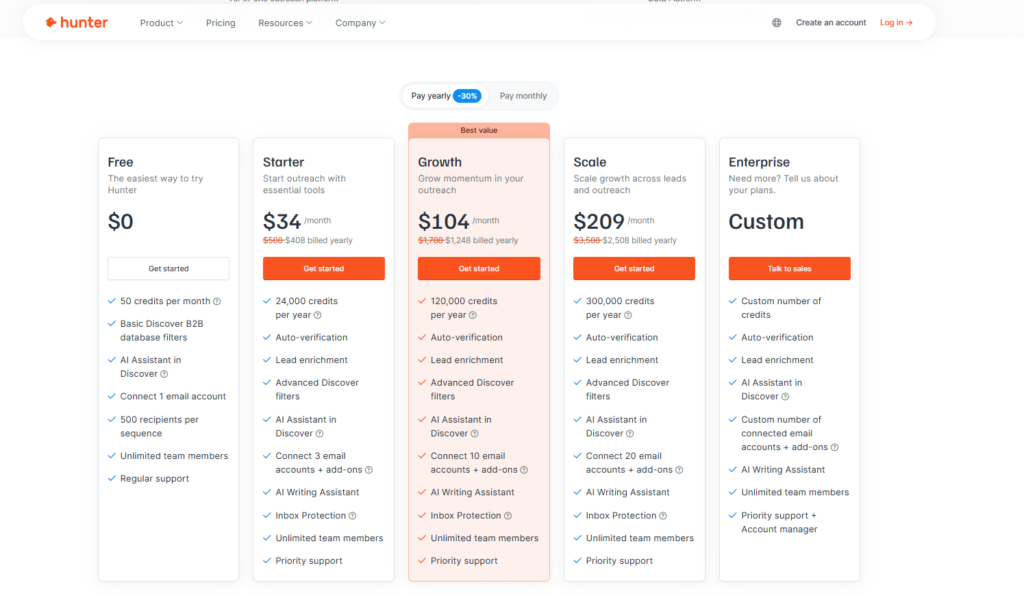
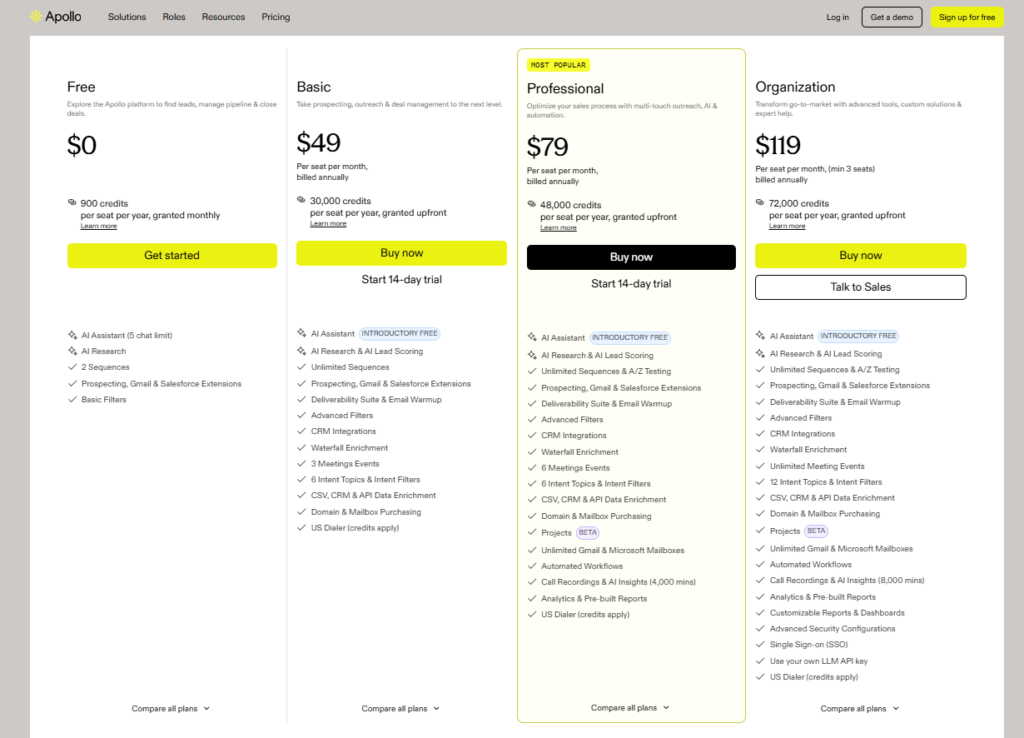
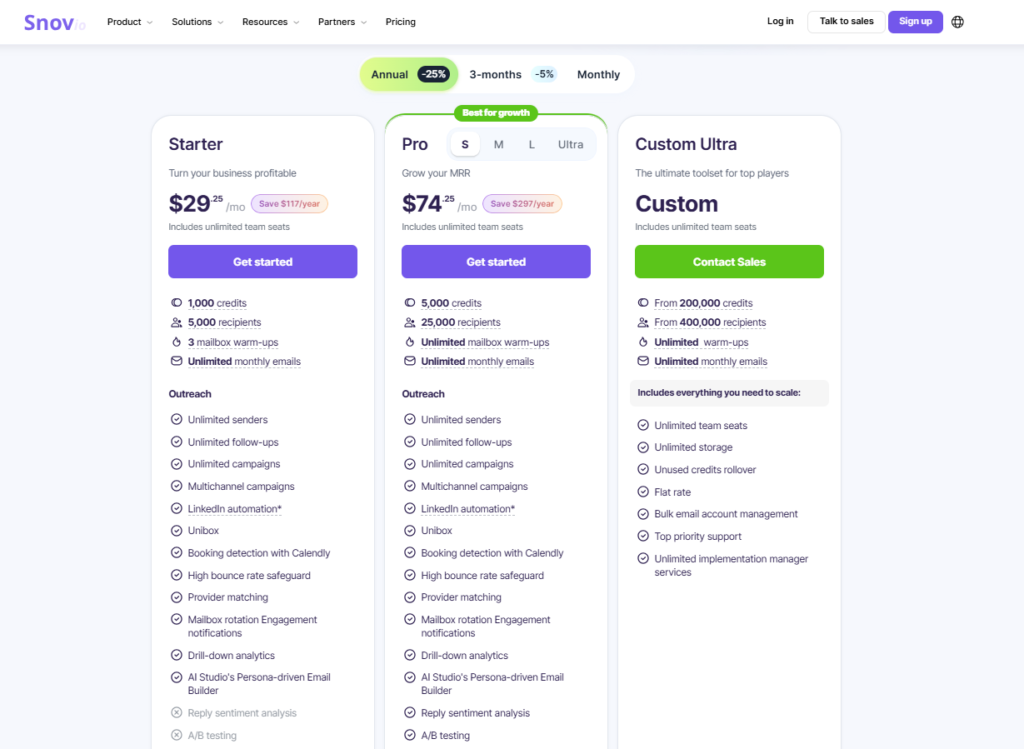
Matching plan tiers across three different pricing models requires normalizing by search volume. Hunter.io’s Starter ($34/mo, 500 searches) compares against Apollo’s Basic ($59/user/mo, 500 credits) and Snov.io’s Starter ($39/mo, 1,000 credits). On free tiers, Hunter.io’s recurring 25 searches plus 50 verifications monthly beats both Apollo and Snov.io whose free access is either limited or one-time. At every paid tier through mid-market, Hunter.io delivers more verified emails per dollar spent.
Hunter.io’s Starter at $34/month is the clearest value at entry level : 500 searches per account versus Apollo’s 500 credits per single user, at $25 less per month. At the mid tier, Hunter.io’s Growth plan offers 2,500 searches for slightly more than Apollo’s Professional at $99, but covers unlimited users while Apollo’s $99 covers just one seat. Also see: Hunter.io alternatives for a broader comparison beyond Apollo and Snov.io.
Real Cost-Per-Verified-Email: The Math That Actually Matters
Effective cost-per-email is the only metric that normalizes across all three pricing models. At 100 emails per month, Hunter.io Starter costs $0.34 per email : still lower than Apollo’s $0.59 per email on Basic. At 500 emails per month, Hunter.io drops to $0.068, Snov.io sits at $0.078, and Apollo at $0.12. Only at 2,000+ emails per month, where Apollo’s Professional tier offers unlimited searches, do the three tools reach near-parity on cost-per-email.
Cost-per-Email at 500 Searches/Month : Starter Plans Compared
“Value for money is consistently rated the most critical factor in email finder tool selection : above feature set, brand recognition, or integrations.”
: G2 Sales Intelligence Category, G2.com
Want to verify Hunter.io’s cost math with your own real usage numbers?
Try Hunter.io Free →Free plan: 25 searches + 50 verifications/month. No credit card required.
At moderate volumes under 500 searches/month : the majority of small and mid-sized teams : Hunter.io wins the cost-per-email comparison by a meaningful margin before you even account for the free tier advantage. For a feature-level comparison beyond cost, see our Apollo vs Hunter.io comparison.
Which Tool Fits Your Team Size: Startup, Mid-Market, or Enterprise?
For startups with 1–10 reps, Hunter.io’s Starter plan wins on cost and simplicity: one flat fee covers the entire team with no seat counting. Mid-market teams running 1,000+ monthly searches often find Hunter.io’s Growth plan or Apollo’s Professional tier comparable in effective cost : the choice comes down to whether the team needs Apollo’s CRM intelligence layer. For enterprise teams at 100+ users doing 5,000+ searches monthly, Apollo’s Organization tier or Hunter.io’s Business plan with API access serve the scale better, and the per-seat math becomes more favorable for Apollo at very high headcount.
The honest verdict: Apollo wins for enterprise teams that need CRM intelligence at scale. Hunter.io is the right default for most teams in the startup-to-mid-market range where search volume, not headcount, drives email finding costs. For upgrade timing guidance within Hunter.io’s own tiers, see our detailed Hunter.io pricing breakdown.
Hidden Costs to Watch: Per-Seat Fees, Credit Expirations, and Lock-In Risks
The sticker price for all three tools understates the true cost of ownership once you account for per-seat scaling, credit expiration, and annual lock-in. Apollo’s per-seat model is the most aggressive: adding one user to a Basic plan costs $59/month more : $708/year per additional seat. Snov.io credits expire after 12 months, creating use-it-or-lose-it pressure on any unused allocation. Hunter.io’s main hidden cost is its monthly plan commitment : there is no pay-per-use override for burst months where you need extra searches.
Of the three tools, Hunter.io has the most predictable total cost : the plan price is essentially what you pay, with no per-seat surprises and no credit expiry pressure. Apollo’s seat model is fine for stable teams but can become materially expensive when headcount scales faster than initially planned.
How to Choose in 5 Steps: A Decision Framework for Email Finder Pricing
Rather than comparing sticker prices, use this five-step framework to match your real usage pattern to the right tool. Each step filters the options by volume, user count, budget, feature requirements, and pricing model fit. Most teams arrive at a clear answer by step three : before they need to evaluate features at all.
- Estimate your monthly email search volume. Count how many individual email searches your team runs per month. Light: under 200. Regular: 200–1,000. Heavy: over 1,000. This determines which tier you actually need : and whether a free plan covers your real workflow.
- Count how many users need concurrent access. If more than one person needs login access, multiply any per-seat plan cost by your headcount. Hunter.io and Snov.io charge per account regardless of users. Apollo charges per seat, so your user count directly multiplies your monthly cost.
- Set a firm monthly budget ceiling. For early-stage teams: $30–$100/month. For mid-market: $100–$400/month. This alone eliminates at least one option at most volume levels. Choose the cheapest plan you won’t outgrow in six months : not the cheapest plan available.
- Identify your must-have features beyond email finding. Need sales intelligence : intent data, technographics, company signals? Apollo covers this; Hunter.io and Snov.io do not. Need bulk email verification included in the plan? Hunter.io includes it; Apollo charges separately. Need API access or CRM native integration?
- Match volume + users + budget + features to a pricing model. Hunter.io: ideal for volume under 2,500/month, teams under 20 users, budgets of $34–$349/month, verification-included workflows. Apollo: best when CRM intelligence matters, teams have 5+ dedicated SDRs, budget scales with headcount. Snov.io: best for credit flexibility without monthly volume pressure, without needing built-in verification.
This framework resolves the comparison for most teams without requiring a full feature audit. Volume and seat count together determine your cost structure; feature requirements are the tiebreaker when costs come out similar.
The Economics of SaaS Pricing Models: Why Per-Search Often Beats Per-Seat
Usage-based pricing models like Hunter.io’s per-search approach align vendor revenue directly with customer value : you pay for what you use, not for access you may not fully utilize. Per-seat models like Apollo’s charge for headcount regardless of actual usage: a team with five seats but two active searchers still pays for all five seats every month. For most email outreach workflows where search volume, not team size, determines value delivered, per-search pricing is structurally more cost-efficient for the buyer.
“SaaS products are typically offered via a subscription or usage-based pricing model : with usage-based pricing increasingly favored for its alignment between vendor revenue and customer-realized value.”
: Software as a Service, Wikipedia
For email finder tools specifically, usage-based pricing wins over seat-based pricing at volumes under 1,000 searches per month : which represents the majority of small and mid-market use cases. The per-search model makes cost predictable: your invoice next month equals your actual usage this month, with no seat expansion surprises mid-year.
Frequently Asked Questions: Email Finder Pricing Comparison
These twelve questions cover the most common pricing decision points when comparing Hunter.io, Apollo.io, and Snov.io : from cost-per-email math and free tier value to annual discount calculations, switching costs, and tool-stacking strategies.
Which is cheapest: Hunter.io, Apollo.io, or Snov.io?
It depends on your usage volume and team size. For light users sending under 200 searches per month, Hunter.io’s Starter at $34/month delivers the lowest cost-per-email at $0.34 versus Apollo’s $0.59 on Basic. For heavy users at 1,000+ per month with 5+ seats, Apollo’s Professional unlimited tier can compete on effective cost. Snov.io sits in the middle and fits best when you want credit flexibility without strict monthly search limits.
Bottom line: For most teams under 500 searches/month, Hunter.io wins on cost. At enterprise scale with many seats, run the per-seat math before deciding.
Does Apollo include features Hunter.io doesn’t?
Yes. Apollo’s core differentiator is its sales intelligence database : 60M+ verified companies, intent data, technographic signals, and contact scoring. Hunter.io is purpose-built for email finding and verification; it does not offer intent data, company insights, or CRM-style enrichment. If your workflow requires prospect intelligence beyond contact email addresses, Apollo delivers meaningful additional value. For email-only workflows, that additional value comes at a cost you may not need to pay.
Bottom line: Apollo is broader; Hunter.io is sharper. Choose based on whether your workflow needs CRM intelligence or just verified emails. See our full Apollo vs Hunter.io comparison.
What’s the difference between credit-based and search-based pricing?
Search-based pricing (Hunter.io) gives you a monthly search allowance that resets every billing cycle : unused searches don’t roll over and don’t expire. Credit-based pricing (Snov.io) lets you purchase credit bundles upfront that can span multiple months, but credits expire after 12 months. Search-based pricing is more predictable for monthly budgeting. Credit-based is more flexible for variable-volume months but creates expiry risk if your usage drops before renewal.
Bottom line: Monthly search-based pricing is more predictable; credit packs are more flexible but carry expiry risk at lower utilization.
Can I switch between these tools without losing data?
You can export your found emails as CSV from all three tools before cancelling. Confidence scores, source attribution, and domain search history do not transfer : they stay with the tool that generated them. If you have built contact lists inside Apollo’s CRM layer, that enrichment data also does not export cleanly to Hunter.io or Snov.io. The practical advice: export your full lead lists before cancelling, and allow 30 days of parallel use to verify data parity between tools.
Bottom line: Basic email lists export fine as CSV, but enrichment data and confidence scores do not transfer between tools.
Are there any free email finder alternatives worth considering?
Yes, but all free alternatives have meaningful limitations. Hunter.io’s free plan (25 searches + 50 verifications/month) is the most generous recurring free tier available : it resets monthly and requires no credit card. Apollo’s free plan gives 50 email credits per month with restricted feature access. Snov.io’s free allocation is a one-time 50-credit trial rather than a recurring reset. For consistent production outreach, all three require at least a paid Starter tier. See also: Hunter.io alternatives for a broader free tier landscape comparison.
Bottom line: Hunter.io has the best recurring free tier; others offer limited one-time or feature-restricted trials.
Do Hunter.io, Apollo, and Snov.io offer annual discounts?
Yes, all three offer annual billing discounts. Hunter.io discounts annual plans by approximately 30% : Starter drops from $34 to roughly $24/month billed annually. Apollo offers approximately 17% off on annual commitments. Snov.io discounts annual plans by around 25%. All three plans lock you in for 12 months. The recommended approach across the board: test on monthly billing for 60–90 days to confirm the tool fits your actual workflow before committing to an annual plan.
Bottom line: Hunter.io offers the deepest annual discount (~30%). Test monthly first, upgrade to annual once usage patterns confirm fit.
How accurate are the emails found by each tool?
Hunter.io is generally considered the most accurate for email finding and verification : it publishes a confidence score for every result and includes built-in SMTP verification. Apollo’s email database is broader but occasionally includes outdated contacts given its very large data set. Snov.io’s accuracy is competitive with Hunter.io for most domains but less consistent on smaller companies and international domains. For deliverability-sensitive campaigns where bounce rate matters, Hunter.io’s tightly integrated verification gives the most reliable quality signal before sending.
Bottom line: Hunter.io leads on verified accuracy with per-result confidence scores; Apollo’s breadth trades some precision for larger coverage.
Does Hunter.io’s free plan include email verification?
Yes. Hunter.io’s free plan includes 50 email verifications per month in addition to 25 email searches. This is a notable distinction because Apollo’s free plan does not include bulk email verification, and Snov.io treats verification as a separate credit-consuming action on its free tier. The combined search plus verification allowance in Hunter.io’s free plan makes it the most complete free offering for email outreach workflows that need to validate addresses before sending campaigns.
Bottom line: Hunter.io free includes both search and verification in a single plan; competitors either separate or restrict verification on free tiers.
Is Hunter.io worth using if I already have Apollo?
Possibly yes, especially if your Apollo plan is hitting verification accuracy limits or if you primarily use Apollo for its CRM and intelligence features rather than email finding. Some teams run Hunter.io for high-confidence email verification and Apollo for prospect enrichment : using the tools in complementary roles. Running both at their entry tiers ($34 Hunter.io + $59 Apollo) costs $93/month total, which is competitive with Apollo’s Professional solo-user tier at $99/month while delivering better verification accuracy on Hunter.io’s side.
Bottom line: Running both is viable when Apollo handles CRM intelligence and Hunter.io handles verification accuracy as a quality layer.
How do I calculate my actual monthly email finder cost?
Divide the plan’s monthly price by your expected email volume, then add any per-seat fees multiplied by your user count. Hunter.io Starter: $34 ÷ 500 searches = $0.068/email, one account covers all users. Apollo Basic with 3 users: $59 × 3 = $177/month ÷ 1,500 credits = $0.118/email effective. Snov.io Starter: $39 ÷ 1,000 credits = $0.039/credit where each search consumes at least one credit. The credit efficiency factor is most important for Snov.io, where some actions consume multiple credits per operation.
Bottom line: Real cost = (plan price + seat fees) ÷ monthly searches. Hunter.io’s formula has no seat variable, making it simpler to project.
What happens to my searches or credits if I cancel my subscription?
For Hunter.io, your monthly search allowance ends immediately at cancellation with no pro-rated refund on monthly plans. Annual plan holders do not receive mid-term refunds, so remaining months are forfeited. For Apollo, credits also expire at plan cancellation with no refund on unused monthly credit balance. For Snov.io, credits expire 12 months after purchase regardless of cancellation : purchasing a large credit pack shortly before cancelling results in lost value. Across all three tools: export all found email lists before cancelling, and time your cancellation to the very start of a new billing cycle.
Bottom line: Export all data before cancelling any plan. Snov.io credit expiry risk is highest; Hunter.io losses are limited to unused monthly searches only.
Can multiple team members share one Hunter.io account?
Yes. Hunter.io plans are priced per account, not per individual seat. Your Starter, Growth, or Business plan supports your entire team : Hunter.io allows adding team members on paid plans via email invite, with each member getting their own login while sharing the plan’s monthly search and verification allowance. This is a meaningful advantage over Apollo’s per-seat model: a Hunter.io Growth plan at $104/month serving five users costs $20.80 per user, while five Apollo Basic seats would cost $295/month. For teams of three or more users, this per-account pricing difference often decides the comparison on cost alone.
Bottom line: Hunter.io’s account-based pricing beats Apollo’s per-seat model for any team with three or more active users.
Pricing questions in this comparison almost always resolve to two variables: your monthly search volume and your team size. Once you calculate cost-per-email at your actual usage and factor in any per-seat fees, the right tool for your budget becomes clear in most scenarios.
Pricing math depends on your real usage. Test before you commit to a plan.
Try Hunter.io Free →Free plan: 25 searches + 50 verifications/month. No credit card required.
Or read our full Hunter.io Email Finder review before deciding.


