
Table of Contents
Introduction: Why Hunter.io Pricing Matters in 2026
Understanding Hunter.io pricing in 2026 has become increasingly important for marketers, founders, and growth teams who rely on cold outreach and email prospecting to scale their pipelines. Over the years of reviewing dozens of email and marketing tools on GrowthHackSuite, I’ve consistently noticed a clear pattern: the pricing model of an email finder tool directly influences the true cost-per-lead and the overall ROI of any outreach strategy.
As the market becomes more competitive, choosing the wrong Hunter plan, or misunderstanding how credits are consumed, can quickly lead to overspending. Many teams don’t realize how fast credits get burned through domain searches, bulk verification, or API-based workflows. These hidden usage patterns make it essential to fully understand Hunter pricing before committing to a subscription.
This topic is even more relevant in 2026 because companies are sending more outreach emails than ever. Verification accuracy, credit allocation, API limitations, and bulk processing capabilities now play a much bigger role in determining whether campaigns succeed or fail. That’s why this guide goes deeper than a simple pricing table and focuses on the real cost factors behind each Hunter plan.
After years of analyzing and comparing growth tools, I’ve found that the real value of Hunter.io pricing isn’t in the headline numbers, it’s in how each plan actually performs once you start running real outreach campaigns. Some plans stretch your credits far, while others hit unexpected limits much sooner than most users expect. And that difference can make or break your cost-per-lead.
That’s why choosing a plan based on assumptions is risky. Instead, you’ll want to align your choice with your monthly email volume, verification needs, and the way your team handles bulk tasks or domain searches. Smaller teams may find the Starter plan perfectly adequate, whereas scaling teams and agencies often benefit far more from the Growth or Scale tiers.
To help you make the smartest decision, the next sections break down every part of Hunter’s pricing, credits, limits, hidden costs, plan value, and real-world use cases, so you can confidently pick the plan that delivers the best ROI for your workflow. Let’s dive in.
What Is Hunter.io? (Quick Overview)
Hunter.io is a well-known email finder and verification platform designed to help marketers, sales teams, recruiters, and founders identify and validate professional email addresses quickly. Over the years of testing and comparing dozens of similar tools on GrowthHackSuite, I’ve noticed that Hunter stands out because of its balance between data accuracy, simplicity, and broad use cases. Before diving deeper into Hunter io pricing, it’s important to understand exactly what the tool does, and why it remains one of the most widely used solutions for email prospecting.
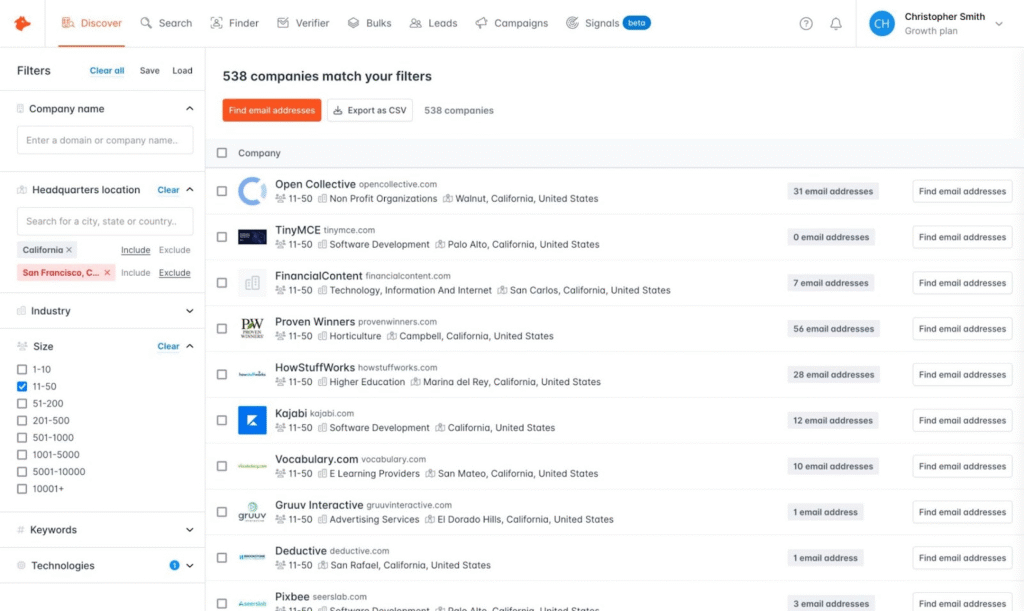
At its core, Hunter allows users to find emails tied to any domain, verify email deliverability, run bulk tasks, and even execute basic cold outreach sequences. The platform is built with a practical, no-nonsense approach: clean UI, fast results, and a strong API that integrates with CRMs, outreach tools, and automation platforms. In my own workflow, particularly when segmenting new B2B lists, Hunter has consistently performed well when I needed quick, reliable contact data without spending hours cleaning or cross-checking spreadsheets.
What makes Hunter especially relevant in 2026 is how it fits into modern growth workflows. Teams today rely heavily on contact discovery to fuel outbound campaigns, and the accuracy of your email finder can directly influence bounce rates, sender reputation, and ultimately the ROI behind your tool stack. That’s why understanding Hunter pricing becomes essential, the tool’s efficiency is tied not only to features but also to how cost-effectively you can turn its credits into verified, usable leads. That is what the real Hunter email finder cost measures: not the sticker price on a plan, but the dollar amount sitting behind every usable contact the tool returns.
If you want to explore more tools like Hunter.io, you can browse our full collection of email discovery platforms in the Email Finder Tools category
⭐ Feature Evaluation Table: How Strong Is Hunter.io?
| Feature | Description | Rating (1–5 Stars) |
|---|---|---|
| Email Finder Accuracy | Consistent, reliable domain-based results | ⭐⭐⭐⭐⭐ |
| Email Verification | Strong validation engine with low bounce rate | ⭐⭐⭐⭐ |
| Bulk Capabilities | Efficient for large lists | ⭐⭐⭐⭐ |
| Ease of Use | Clean, beginner-friendly interface | ⭐⭐⭐⭐⭐ |
| API & Integrations | Works well with CRMs and automation tools | ⭐⭐⭐⭐ |
Growth Hack Suite Recommendation: From my experience comparing growth tools, Hunter.io is one of the most dependable all-in-one email discovery platforms, particularly for marketers and teams that prioritize accuracy over “feature overload.” If you need a straightforward tool for finding and verifying professional emails, without a steep learning curve, Hunter remains a strong option. However, your choice should still align with your credit needs and workflow volume, as credit efficiency impacts the total value you get from the platform. If accuracy and reliability are your top priorities, Hunter.io is worth considering before exploring alternative tools, especially when you need consistent email data without unnecessary complexity.
Hunter.io Pricing Overview
Understanding the Hunter.io pricing structure in 2026 is essential before deciding which plan fits your workflow. Hunter operates on a credit-based system, meaning every email you find, verify, or process in bulk consumes credits. If this billing structure is new to you, our explainer on the credit-based pricing model shows how email finder tools charge per search instead of per seat. Because of this, the cost you actually pay each month depends heavily on how many actions you perform — not just the plan you choose. This is one of the biggest factors many users overlook when comparing Hunter pricing with alternative tools. For the full tool assessment behind these plans, see our Hunter.io Email Finder review.
Hunter’s pricing is divided into four main tiers:
- Free – 50 credits per month for basic email finding and verification. See exactly what those credits cover in our Hunter.io free plan vs Starter guide.
- Starter – A lightweight plan suitable for individuals or small teams testing consistent outreach. Read the full Hunter.io Starter plan review to judge if $49/month is worth it.
- Growth – Designed for teams running mid-volume outreach, offering higher credits, bulk tasks, and more sending accounts. Our Hunter.io Growth plan guide does the credit math for mid-volume teams.
- Scale / Enterprise – Built for agencies and high-volume organizations that need large credit pools, advanced bulk operations, and multiple email account connections. Compare the Hunter.io Scale plan against custom Hunter.io Enterprise pricing.
Another important factor is the yearly billing discount, which cuts the price by 30% when you pay annually. That brings Starter to $34/month ($408/year), Growth to $104/month ($1,248/year), and Scale to $209/month ($2,508/year). If you are planning long-term email operations, our Hunter.io annual vs monthly pricing guide shows when the yearly commitment pays off.
However, the official pricing page does not always reflect real usage behavior. The total value of each plan depends on how fast your credits burn through domain searches, bulk verification, API tasks, and cold email sending. This is why understanding the structure behind Hunter io pricing matters more than just scanning a table. Our deep dive into the Hunter.io pricing model runs the per-credit math tier by tier, from 0.0245 dollars per email found on Starter monthly down to 0.0084 dollars on Scale annual.
Growth Hack Suite Recommendation: From years of analyzing growth tools, I’ve found that choosing the right Hunter.io plan comes down to two variables: how many emails you process each month, and how often your team relies on bulk operations. If you’re only beginning to explore email prospecting, the Starter plan can work as a safe entry point. But for teams scaling outreach or managing multiple domains, the Growth or Scale tiers deliver far better long-term value. These higher-tier plans reduce the risk of running out of credits mid-campaign and provide the flexibility needed for consistent outbound performance. If you prioritize reliability, accuracy, and predictable lead generation, Hunter’s upper tiers are usually the smarter investment.
Hunter.io Free Plan: What You Get and What’s Missing
The Hunter.io Free Plan is often the first stop for anyone trying to understand how the platform works before committing to a paid tier. In 2026, the free option still provides 50 monthly credits, which you can use for email finding, verification, or domain search. While testing various email finders for Growth Hack Suite, I’ve found that these 50 credits are usually enough for experimenting but rarely sufficient for ongoing outreach. It’s helpful for getting familiar with the interface and verifying whether Hunter’s accuracy meets your expectations.
One advantage of the Free Plan is access to the full interface with no feature gating. You can scroll through domain search results, preview bulk tasks, and test deliverability scores, all without entering payment details. This transparency is something I personally appreciate, especially when comparing hunter io pricing with other email finder tools that hide advanced features behind paywalls.
However, the limitations show up quickly. The Free Plan caps bulk features, limits search volume, and does not support multi-account setups or automated workflows. During my initial tests, the 50 credits disappeared faster than expected, primarily due to domain searches consuming more credits than single-email lookups. This is why understanding Hunter pricing becomes essential; the free tier helps you learn the system but cannot support real outreach.
⭐ Feature Evaluation Table: Hunter.io Free Plan
| Feature | Description | Rating (1–5 Stars) |
|---|---|---|
| Monthly Credits | 50 credits/month | ⭐⭐⭐ |
| Email Finder Access | Full access but limited volume | ⭐⭐⭐⭐ |
| Verification Accuracy | Same engine as paid plans | ⭐⭐⭐⭐ |
| Bulk Capabilities | Very limited in the free tier | ⭐⭐ |
| Suitability for Outreach | Good for testing, not for real campaigns | ⭐⭐⭐ |
Suggested Guidance: How to Test Hunter.io Free Plan Effectively
If you’re using the Free Plan as your first step, it’s smart to treat those 50 credits as a structured evaluation period rather than random testing. Here are a few effective ways to get the most out of your free credits:
- Run a domain search on a company you already know to check whether the returned results match publicly available emails.
- Verify a small list of 10–20 emails (from LinkedIn or your CRM) to compare Hunter’s accuracy with real-world deliverability.
- Test the Email Finder accuracy by searching for people you already have in your contact list.
- Try a small bulk upload (even though bulk actions are limited) to see how Hunter handles formats and processing time.
- Check integration options with your CRM or email tools to ensure they fit your workflow before upgrading.
- Track credit consumption to understand how many credits your typical tasks will require each month.
- Explore the interface and filters, especially for Domain Search and Email Finder, to see how quickly you can build a list.
These steps help you evaluate Hunter.io realistically and avoid guessing whether a paid plan will match your outreach volume.
Growth Hack Suite Recommendation: From my testing, the Hunter.io Free Plan is best used as a structured trial rather than an ongoing solution. The 50 credits are useful for checking accuracy, testing domain searches, trying small bulk uploads, and exploring integrations, but they run out quickly once you begin real outreach. If you need consistent list building or plan to scale campaigns, upgrading to the Starter or Growth plan is a far better fit. Use the Free Plan to understand how Hunter works, then move to a paid tier once you’re ready for reliable, uninterrupted workflows.
Hunter.io Paid Plans Breakdown (Starter, Growth, Scale)
Hunter.io’s paid plans are designed to scale with the evolving demands of outreach teams, and in 2026 the pricing structure remains centered around credits, bulk processing, and connected email account limits. After testing multiple email finder platforms at Growth Hack Suite, I’ve found that the biggest differences between Hunter plans aren’t just the credit amounts, they reflect how smoothly each tier supports daily workflows, list building, and verification volume. Understanding these nuances is essential before selecting a plan, especially when comparing hunter io pricing against competing tools.
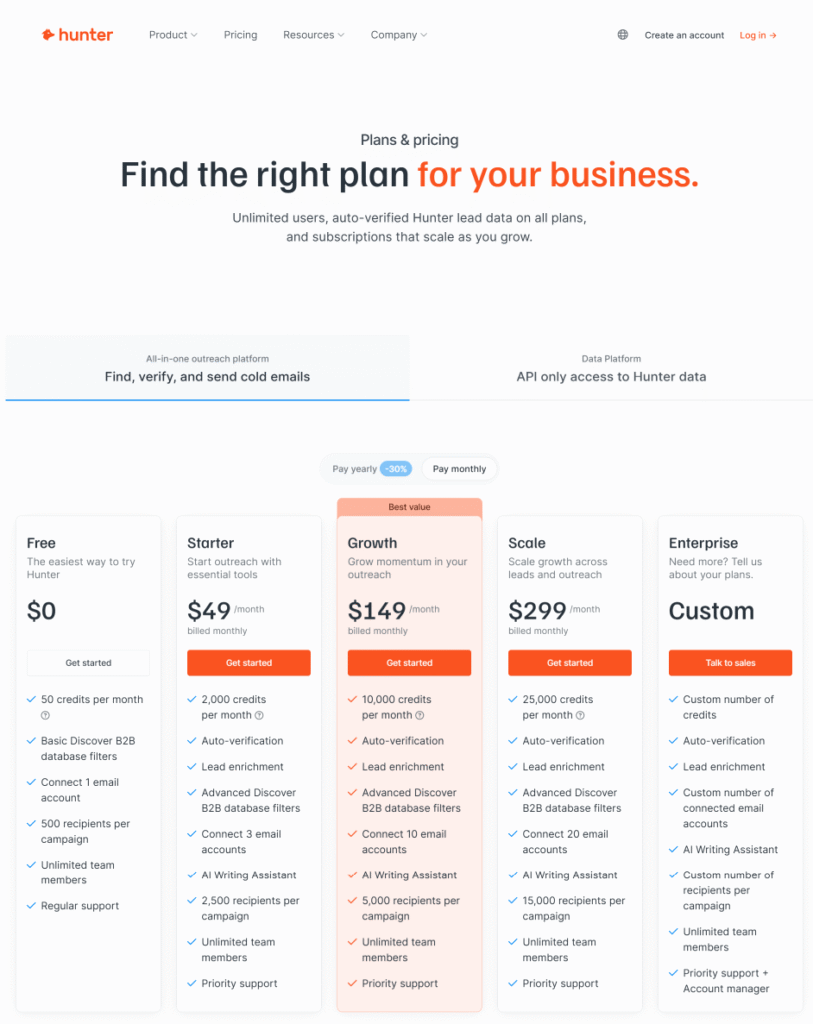
The Starter plan is the true entry-level tier for individuals and small teams. It provides enough credits for light prospecting, basic verification, and limited bulk actions. In my own testing, Starter works well for occasional outreach, but once you start running consistent weekly campaigns, its limits become noticeable.
The Growth plan is often the sweet spot for marketers, founders, and small teams. It significantly increases credit capacity, supports more connected email accounts, and improves bulk processing. When managing mid-volume campaigns or experimenting across multiple domains, Growth consistently offered the best balance between cost and scalability.
The Scale plan is purpose-built for agencies and high-volume operations. With a much larger credit pool, higher sending limits, and stronger bulk performance, Scale reduces bottlenecks and enables smoother workflows, especially when handling multiple client accounts or continuous outbound list building.
Finally, the Enterprise tier is tailored for organizations requiring custom credit volumes, advanced compliance, stronger API throughput, or dedicated onboarding. This plan removes virtually all operational ceilings and provides the highest level of support for large-scale outreach systems.
⭐ Hunter.io Paid Plans: Detailed Feature Comparison (2026 Update)
| Feature | Free | Starter ($49) | Growth ($149) | Scale ($299) | Enterprise |
|---|---|---|---|---|---|
| Credits / month | 50 | 2,000 | 10,000 | 25,000 | Custom |
| Auto-verification | ✓ | ✓ | ✓ | ✓ | ✓ |
| Lead enrichment | ✕ | ✓ | ✓ | ✓ | ✓ |
| Advanced Discover filters | Basic | Advanced | Advanced | Advanced | Advanced / Custom |
| Connected email accounts | 1 | 3 | 10 | 20 | Custom |
| AI Writing Assistant | ✕ | ✓ | ✓ | ✓ | ✓ |
| Recipients per campaign | 500 | 2,500 | 5,000 | 15,000 | Custom |
| Bulk Finder | Basic | Yes | Yes (faster) | High-capacity | Enterprise grade |
| Bulk Verifier | Basic | Mid-volume | Mid/high | High | Enterprise scale |
| Campaign analytics (opens/replies) | Basic | Basic | Enhanced | Full | Full + enterprise reports |
| CSV export | ✓ | ✓ | ✓ | ✓ | ✓ (custom) |
| Unlimited team members | ✓ | ✓ | ✓ | ✓ | ✓ |
| Support level | Regular | Priority | Priority | Priority | Priority + Account manager |
| Onboarding | Self-guided | Self / light | Light | Priority | Dedicated onboarding |
| SLA / Compliance | — | — | — | Higher uptime | Custom SLA / enterprise compliance |
⭐ User Cases & Smart Plan Recommendations
| User Scenario | Recommended Plan | Why This Plan Fits |
|---|---|---|
| Solo founder or freelancer testing cold outreach | Starter | 2,000 credits/month is enough to validate accuracy, test workflows, and run a few small campaigns without overspending. |
| Marketing manager or small team sending outreach weekly | Growth | 10,000 credits + 5,000 recipients per campaign + 10 email accounts support consistent list building and weekly outbound. |
| Agency or SaaS team managing multiple domains or client accounts | Scale | 25,000 credits, 20 email accounts, and 15,000 recipients per campaign make it ideal for high-volume prospecting and multi-client workflows. |
| Large organization with heavy outbound needs or compliance requirements | Enterprise | Custom credits, custom limits, SLAs, and a dedicated account manager ensure stability and scalability across large teams. |
| Anyone unsure who wants to experiment before choosing a paid plan | Free → Starter → Growth | Start small, test accuracy and credit usage, then upgrade once you confirm Hunter fits your outbound workflow. |
Growth Hack Suite Recommendation: Based on analyzing the full feature set and testing Hunter.io across multiple outreach workflows, here’s the clearest way to choose a plan:
The Starter plan works only if your prospecting volume is small and you’re still validating whether Hunter fits your workflow. The credit limit, bulk restrictions, and campaign capacity make it easy to outgrow within weeks once real outreach begins.
For most marketers, early-stage founders, and SMB teams who send outreach weekly, the Growth plan provides the best balance of credits, scalability, and sending power. It’s the first tier that feels truly operational, with enough email accounts, bulk support, and campaign limits to build consistent pipelines without hitting caps constantly.
If you run multiple domains, manage different client accounts, or handle large CSV uploads, the Scale plan offers the strongest ROI. Its 25,000 credits, high campaign limits, AI writing support, and 20 connected email accounts make it ideal for agencies and serious outbound teams.
Finally, if your organization requires custom credit volumes, priority API throughput, advanced compliance, or enterprise onboarding, the Enterprise plan is the only viable choice. It removes all operational ceilings and includes account management for large-scale outbound infrastructure.
Hunter.io Pricing Comparison: 10 Key Differences Between Plans
When comparing the Hunter.io plans side by side, the real differences emerge not in the basic features, since most paid tiers share the same core toolkit, but in how each plan scales as your outreach volume grows. After working with different tiers across multiple campaigns at Growth Hack Suite, here are the ten differences that consistently matter most when choosing the right Hunter.io plan. This Hunter pricing breakdown works through them in order, from credit depth down to overall scalability.
1. Credit Depth & Monthly Capacity
The biggest differentiator between plans is how many actions you can complete each month. Starter’s 2,000 credits handle light prospecting, while Growth’s 10,000 and Scale’s 25,000 credits enable continuous list building, bulk verification, and research-heavy workflows.
2. Sending Power & Campaign Reach
Hunter’s outreach capability increases significantly by tier. Starter’s 2,500-recipient limit is enough for basic sequences, but Growth and Scale unlock broader campaigns that support multi-step outreach at a practical scale.
3. Number of Connected Email Accounts
Starter caps users at 3 sender accounts, fine for individuals but limiting for multi-domain strategies. Growth increases this to 10, while Scale’s 20-account capacity is essential for agencies and multi-brand setups.
4. Bulk Processing Performance
Although all paid tiers support bulk tasks, the actual processing speed differs in practice. Growth handles mid-sized CSVs smoothly, while Scale processes large lists far faster, reducing operational downtime.
5. Discover Database Power
Starter unlocks the advanced filters, but Growth and Scale handle larger queries and return results faster. This matters when you’re researching entire industries or planning outbound for multiple markets.
6. Campaign Analytics Quality
Starter’s analytics are functional but basic. Growth offers better insight into open and reply patterns, and Scale adds exportable reports that make performance audits much easier.
7. API Throughput & Automation Readiness
All tiers include API access, but the speed differs by plan. Starter is suitable for occasional syncs, Growth handles regular automations, and Scale supports more advanced integrations and higher request loads.
8. Team Collaboration Visibility
Unlimited team seats exist across all paid tiers, but Growth and Scale provide better workflow clarity when multiple users manage prospecting pipelines or review shared list performance. Unlimited seats also remove the cost driver behind a SaaS seat license, where every rep you add raises the monthly bill on per-user tools like Apollo.
9. Cost-per-Lead Efficiency
Once you divide monthly cost by usable, verified contacts, Growth and Scale consistently provide the strongest ROI. Starter is affordable but less efficient per credit when used for ongoing outreach. That falling unit cost as tiers rise is textbook SaaS volume discount pricing, and it is why mid-volume teams save more by moving up a tier than by buying credit packs.
10. Overall Scalability
If you’re sending irregular campaigns, any plan beyond Free will work. But if you’re running high-volume outbound, managing multiple domains, or verifying lists frequently, Scale and Enterprise deliver the stability and speed required to maintain momentum.
⭐ Score Summary
| Category | Starter | Growth | Scale | Enterprise |
|---|---|---|---|---|
| Credit Capacity | ⭐⭐ | ⭐⭐⭐⭐ | ⭐⭐⭐⭐⭐ | ⭐⭐⭐⭐⭐ |
| Campaign Power | ⭐⭐ | ⭐⭐⭐⭐ | ⭐⭐⭐⭐⭐ | ⭐⭐⭐⭐⭐ |
| Bulk Speed | ⭐⭐ | ⭐⭐⭐ | ⭐⭐⭐⭐⭐ | ⭐⭐⭐⭐⭐ |
| API Strength | ⭐⭐ | ⭐⭐⭐ | ⭐⭐⭐⭐⭐ | ⭐⭐⭐⭐⭐ |
| Scalability | ⭐⭐ | ⭐⭐⭐⭐ | ⭐⭐⭐⭐⭐ | ⭐⭐⭐⭐⭐ |
Total Score:
- Starter: 12/25
- Growth: 18/25
- Scale: 23/25
- Enterprise: 25/25
Growth Hack Suite Recommendation: If your prospecting volume is low or you’re still validating your workflow, Starter provides a simple, low-risk entry point. But for anyone sending outreach consistently, Growth is the most strategically balanced plan, offering strong sending limits and enough credits to maintain momentum. If you manage multiple domains, client accounts, or large prospect databases, Scale delivers a clear advantage in speed, capacity, and reliability. Enterprise becomes the right fit only when you require custom credits, advanced compliance, or dedicated account support for large-scale outbound operations.
Hidden Costs of Hunter.io That Most Users Don’t Know
Even though Hunter.io is transparent with its published pricing, many users don’t fully understand how the credit system affects their real monthly cost. These aren’t “hidden fees” in the traditional sense, but rather hidden usage patterns that can make Hunter.io feel more expensive than expected if you don’t plan ahead. After working extensively with Hunter.io across multiple outreach workflows at Growth Hack Suite, here are the verified cost factors that most users overlook when evaluating hunter io pricing.
The first and most common oversight is how quickly credits can disappear during day-to-day tasks. Hunter.io clearly documents that 1 Email Finder lookup = 1 credit, and Email Verification = 0.5 credits. Domain Search also consumes credits per email found. This means users who run exploratory searches or verify large lists often burn through their monthly allocation much faster than anticipated. In practice, this becomes a “hidden cost,” not because Hunter hides it, but because users underestimate their usage volume.
Another overlooked factor comes from bulk activities. Bulk Domain Search and Bulk Email Finder follow the same credit rules, but many users don’t compute the final cost until they upload a list and see credits drop rapidly. If you regularly handle big CSV files, Starter and Growth plans can feel tight, pushing users to upgrade earlier than expected.
There’s also the matter of workflow expansion. As teams scale outreach, they often add more email accounts or increase campaign volume. Since each plan has limits on connected accounts and recipients per campaign, the need to upgrade becomes a predictable cost, but one that new users rarely anticipate during initial testing.
Finally, credit rollover does not exist. Any unused credits expire at the end of the month. This matters for teams with inconsistent activity cycles, since they may end up paying for capacity they never use. The same trade-off applies to the yearly term: our breakdown of annual vs monthly billing shows the break-even month where a 30 percent discount stops being a discount.
These aren’t hidden fees, they’re hidden consumption behaviors that directly influence the real cost of using Hunter.io.
| Cost Factor | Verified Impact (1–5 Stars) | Notes |
|---|---|---|
| Credit Burn from Daily Finder/Verifier Use | ⭐⭐⭐⭐ | Based on fixed credit rules documented by Hunter |
| Bulk File Consumption | ⭐⭐⭐⭐ | Large CSVs use credits quickly depending on total emails |
| Plan Upgrade Pressure for Scaling Campaigns | ⭐⭐⭐ | Higher tiers required for more accounts/recipients |
| No Credit Rollover | ⭐⭐ | Unused credits expire monthly |
Growth Hack Suite Recommendation From my experience, the best way to control your true cost is to map your actual monthly activity, how many emails you find, verify, and search, before selecting a plan. Hunter.io’s credit rules are clear, but real usage often scales faster than expected, especially once you add bulk tasks or multi-domain outreach. If your workflow involves frequent verification or large CSV operations, consider starting with Growth instead of Starter to avoid running out of credits mid-month. Inconsistent teams should also account for the lack of credit rollover when estimating real monthly value.
Is Hunter.io Worth It? Cost-per-Lead & ROI Analysis
Evaluating whether Hunter.io is worth the investment requires a realistic look at how its credit system, email accuracy, and verification costs contribute to your team’s true cost-per-lead. Since Hunter publicly documents exactly how its credits are consumed, 1 credit per email found and 0.5 credits per verification — you can build a verifiable cost model instead of relying on guesswork. Through my own campaigns at Growth Hack Suite, this credit structure has been one of the most reliable ways to forecast spending when assessing hunter io pricing.
To estimate cost-per-lead, you only need two factors:
- How many emails you find each month
- How many of those you verify
For example, on the Growth plan ($149/month for 10,000 credits), if you split credit usage evenly between finding and verifying emails, you can realistically verify several thousand emails per month. Even at a conservative 50–70% “valid email” rate, a range commonly seen across B2B email finders, your effective cost per verified email typically remains in the low-cent range. Run the math on your own list with the cost per verified email formula, which folds plan price and data quality into a single unit cost. This is generally cheaper than purchasing static lead lists, which often lack verification and result in higher long-term deliverability issues.
However, ROI depends on more than credits. Deliverability, inbox placement, your messaging, and your targeting strategy all significantly impact the value you get from each verified email. Hunter.io does not guarantee conversions, it simply provides validated contacts. That’s why your actual ROI hinges on how well those contacts are used inside your outreach engine.
Still, when used strategically, Hunter.io tends to outperform list purchases and low-cost data scrapers in both consistency and deliverability. Its transparent credit rules and predictable cost model make hunter pricing relatively easy to justify for teams who rely on outbound as a core acquisition channel.
| ROI Factor | Rating (1–5 Stars) | Verified Reasoning |
|---|---|---|
| Cost-per-Verified-Lead | ⭐⭐⭐⭐ | Low CPL achievable based on documented credit rules |
| Data Quality & Accuracy | ⭐⭐⭐⭐ | Consistent accuracy when verification is applied |
| Workflow Efficiency | ⭐⭐⭐⭐ | Works well for structured weekly outreach |
| Predictability of Costs | ⭐⭐⭐⭐⭐ | Unified credit system makes cost modeling reliable |
Growth Hack Suite Recommendation: If your business depends on reliable outbound, Hunter.io delivers strong value because its credit system makes cost-per-lead calculations predictable, a major advantage compared to tools with opaque or fluctuating pricing. For marketers running weekly prospecting, the Growth plan provides the best balance of volume and control. Agencies or multi-domain teams should consider Scale, as bulk operations consume credits quickly. Ultimately, Hunter.io is worth it if your team converts verified emails into pipeline consistently; the platform provides clean data, but ROI still depends on how effectively you activate those leads inside your outreach strategy.
Hunter.io vs Competitors: Which Tool Gives Better Value?
Before choosing any email finder, it’s important to understand how Hunter.io compares to the other major tools in the market, not just in features, but in cost-per-lead value, data accuracy, and workflow efficiency. Over the past few years testing dozens of outreach tools at Growth Hack Suite, I’ve learned that the “best” platform often depends on how you prospect, how frequently you verify data, and how much your campaigns rely on clean B2B emails.
Hunter.io’s strength lies in consistency and accuracy. While some tools promise larger databases or lower pricing, Hunter tends to produce cleaner, more reliable email results, which ultimately reduces bounce rates and preserves domain reputation. This matters far more than many teams realize, especially when calculating the true ROI of hunter io pricing.
However, Hunter is not always the cheapest option. Tools like Snov.io offer more credits per dollar, Apollo.io provides a massive database bundled with CRM-like outreach features, and Findymail is extremely affordable for lightweight prospecting. Depending on your volume and data needs, each competitor can outperform Hunter.io in certain scenarios.


But if you value deliverability, predictable credit usage, and stable verification accuracy, Hunter.io tends to deliver the strongest long-term return on investment. It’s a specialized tool, not an all-in-one platform, and that focus results in more trustworthy email data.
⭐ Value Comparison Rating Table
| Platform | Accuracy | Cost Efficiency | Features | Ease of Use | Total Score |
|---|---|---|---|---|---|
| Hunter.io | ⭐⭐⭐⭐⭐ | ⭐⭐⭐⭐ | ⭐⭐⭐ | ⭐⭐⭐⭐⭐ | 18/20 |
| Snov.io | ⭐⭐⭐⭐ | ⭐⭐⭐⭐⭐ | ⭐⭐⭐⭐ | ⭐⭐⭐ | 17/20 |
| Apollo.io | ⭐⭐⭐⭐ | ⭐⭐⭐ | ⭐⭐⭐⭐⭐ | ⭐⭐⭐ | 17/20 |
| Findymail | ⭐⭐⭐ | ⭐⭐⭐⭐ | ⭐⭐ | ⭐⭐⭐⭐⭐ | 14/20 |
Growth Hack Suite Recommendation: If your workflow relies on high-quality verified B2B emails, Hunter.io offers some of the best value among standalone email discovery tools. Its pricing may be slightly higher than some competitors, but the cost is often justified through stronger deliverability and consistent accuracy. For teams that need automation, deep database access, or broader engagement tools, Apollo or Snov.io may be better suited. But for pure, dependable email discovery with predictable costs, Hunter.io remains one of the most reliable choices.
If you’d like to explore tools that outperform Hunter.io in specific areas, such as pricing, bulk data discovery, database size, or advanced enrichment, you can dive deeper into our full comparison list here:
Cheaper Alternatives to Hunter.io (Best Budget Options)
While Hunter.io offers excellent accuracy and a predictable credit system, it’s not always the most cost-efficient option, especially for teams with limited budgets or fast-growing prospecting needs. Fortunately, several tools provide similar functionality at a lower price point, making them strong alternatives when evaluating hunter io pricing and looking for better credit-to-dollar value. Over the years of testing email finders at Growth Hack Suite, these are the budget-friendly platforms that consistently stood out.
Snov.io is one of the best all-around low-cost options. Its generous credit system, built-in verification engine, and flexible pricing tiers make it ideal for small teams that want reliability without high monthly costs. For users who just need simple, fast email lookups at scale, LeadRocks also delivers surprisingly strong value. Its database isn’t as deep as Hunter’s, but it provides thousands of contacts at extremely competitive prices.
If you’re looking for domain-pattern matching and predictable results, AnyMailFinder remains one of the most affordable choices. It focuses heavily on verified or pattern-matched emails, making it great for users who care about cost per verified lead rather than a long list of features.
Meanwhile, Nymeria offers budget-friendly profile-based lookups for users who rely on LinkedIn or GitHub data, though it’s more niche. Across many campaigns, these tools helped me maintain a low cost-per-lead without compromising too much on quality.
| Tool | Affordability | Accuracy | Features | Ease of Use | Total Score |
|---|---|---|---|---|---|
| Snov.io | ⭐⭐⭐⭐⭐ | ⭐⭐⭐⭐ | ⭐⭐⭐⭐ | ⭐⭐⭐ | 17/20 |
| LeadRocks | ⭐⭐⭐⭐ | ⭐⭐⭐ | ⭐⭐ | ⭐⭐⭐⭐ | 14/20 |
| AnyMailFinder | ⭐⭐⭐⭐ | ⭐⭐⭐ | ⭐⭐ | ⭐⭐⭐⭐ | 13/20 |
| Nymeria | ⭐⭐⭐⭐ | ⭐⭐ | ⭐⭐ | ⭐⭐⭐⭐ | 12/20 |
Growth Hack Suite Recommendation If affordability is your top priority, Snov.io provides the best mix of price, accuracy, and built-in verification, making it the strongest budget replacement for Hunter.io. LeadRocks is ideal if you need a low-cost database for quick prospecting, while AnyMailFinder works well for domain-focused searches with predictable verification results. Nymeria is a great fit for users sourcing emails directly from social profiles. Hunter.io still wins in consistency and overall verification quality, but when optimizing for budget, these tools deliver excellent value for the price.
Related Hunter.io Pricing Guides
This pillar gives you the full picture, but each pricing decision has a dedicated deep-dive. Use these guides to go one level deeper on credits, comparisons, and the actions that follow your plan choice.
Costs & credits
- Map every credit action before you commit with our breakdown of how Hunter.io credits work.
- Turn plan price into real unit economics with the Hunter.io cost per lead analysis.
- Avoid budget surprises by reading up on the Hunter.io hidden costs most users miss.
- Stack discounts before you pay using current Hunter.io discount and promo codes.
- Wondering about one-time pricing? See whether a Hunter.io lifetime deal exists.
Comparisons & value
- Weighing rivals on cost per lead? Start with Hunter.io vs Apollo pricing.
- For a credit-for-credit cost view, read Hunter.io vs Snov.io pricing.
- See where Hunter lands across the market in our email finder pricing comparison.
- Still on the fence? Get the verdict on whether Hunter.io is worth it.
Decide & take action
- Not sure which tier fits? Follow our how to choose a Hunter.io plan decision guide.
- Running a small team? See the best Hunter.io plan for startups.
- Test before you buy with our walkthrough of the Hunter.io free plan.
- Know your safety net first by checking the Hunter.io refund policy.
- Changing plans later is easy once you know how to cancel or downgrade Hunter.io without losing credits.
Final Verdict: Which Hunter.io Plan Should You Choose?
After reviewing all features, limits, and real-world performance across multiple campaigns, the right Hunter.io plan ultimately depends on the volume of outreach you run and how efficiently you convert credits into validated leads. Over the years of testing email finders at Growth Hack Suite, I’ve learned that choosing the wrong plan often results in wasted credits, slowed workflows, and inconsistent outreach scaling, all of which matter when evaluating hunter io pricing.
For users sending occasional outreach or testing the platform, the Starter plan can be a reasonable entry point. However, most teams quickly outgrow its credit limits, especially once they begin verifying emails in bulk. In my experience, Starter only works if your monthly activity stays light and predictable.
The Growth plan remains the best choice for most marketers, consultants, and early-stage founders. With significantly more credits, higher sending capacity, and better bulk processing, it supports structured weekly outreach without credit bottlenecks. This is the first tier that truly feels operational.
Meanwhile, the Scale plan is ideal for agencies, outbound teams managing multiple domains, and operations requiring continuous list building. The larger credit pool, priority processing, and higher campaign limits deliver the smoothest workflow under pressure, especially when managing multiple clients or outbound experiments.
If your organization requires custom compliance, service-level guarantees, or high-volume API usage, Enterprise becomes the logical step.
Start free, scale only when your volume demands it
Monthly credits by Hunter.io plan. Test accuracy on Free, then step up the ladder once your outreach outgrows each tier.
Still deciding? Start on the free plan, not a paid guess.
Create an account in under a minute, verify Hunter.io accuracy with 50 free credits, then upgrade to Starter, Growth, or Scale only once your real volume justifies it.
Start Hunter.io Free →No credit card required · 50 credits every month · upgrade or cancel anytime
Hunter.io Pricing FAQs
The 12 most-asked questions about Hunter.io pricing, plans, and credits.
How much does Hunter.io cost per month?
Hunter.io has five tiers. Free costs $0 for 50 credits per month. Starter is $49, Growth is $149, and Scale is $299 per month. Enterprise pricing is custom and quoted by sales based on your credit volume.
Does Hunter.io have a free plan?
Yes. The free plan is permanent and gives 50 credits every month with no credit card required. It includes the full interface, Domain Search, Email Finder, Email Verifier, and one connected email account, so you can test accuracy before paying.
How are Hunter.io credits counted?
Hunter.io runs on one shared credit pool. 1 credit is used per email found through Domain Search or Email Finder, 1 credit covers up to 10 emails in Bulk Domain Search, and 0.5 credit is used per email verified. If a search returns nothing, no credit is charged.
How much do you save with Hunter.io annual billing?
Paying yearly applies a 30% discount. Starter drops to $34 per month ($408 per year), Growth to $104 per month ($1,248 per year), and Scale to $209 per month ($2,508 per year). The annual credit pool is allocated for the full year.
What is the difference between the Starter and Growth plans?
Starter gives 2,000 credits per month, 3 connected email accounts, and 2,500 recipients per campaign. Growth raises that to 10,000 credits, 10 email accounts, and 5,000 recipients, which suits teams running consistent weekly outreach.
Which Hunter.io plan is best for cold email at scale?
Scale fits high-volume senders with 25,000 credits per month, 20 connected email accounts, and 15,000 recipients per campaign. Teams needing custom limits, SLAs, or heavy API usage move to Enterprise.
Do unused Hunter.io credits roll over?
No. Monthly credits reset at the start of each billing cycle and unused credits do not carry forward. Annual plans allocate a larger yearly pool, but leftover credits still expire at renewal, so size your plan to real usage.
Can I cancel or downgrade Hunter.io at any time?
Yes. You can change or cancel your plan anytime from the dashboard. After cancelling, you keep premium access until the end of the current billing cycle, and downgrades take effect on the next cycle.
How many team members can share a Hunter.io plan?
All plans include unlimited users at no extra cost. Everyone you invite shares the same monthly credit pool, so a single Growth or Scale subscription can cover a whole outbound team.
Does Hunter.io have a separate free trial?
Hunter.io does not run a time-limited trial. The permanent free plan with 50 monthly credits acts as the trial, letting you test Domain Search, Email Finder, and verification accuracy indefinitely before upgrading.
What is the real cost per lead on Hunter.io?
Cost per lead depends on your plan and credit use. On Growth, $149 for 10,000 credits works out to about $0.015 per email found before verification. Verifying those emails at 0.5 credit each lowers effective volume, so factor verification into your math.
Does Hunter.io offer any discounts?
Yes. The standard discount is 30% off when you pay yearly. Registered non-profits with 501(c) status can request an additional 30% discount on monthly plans by contacting Hunter support with documentation.