
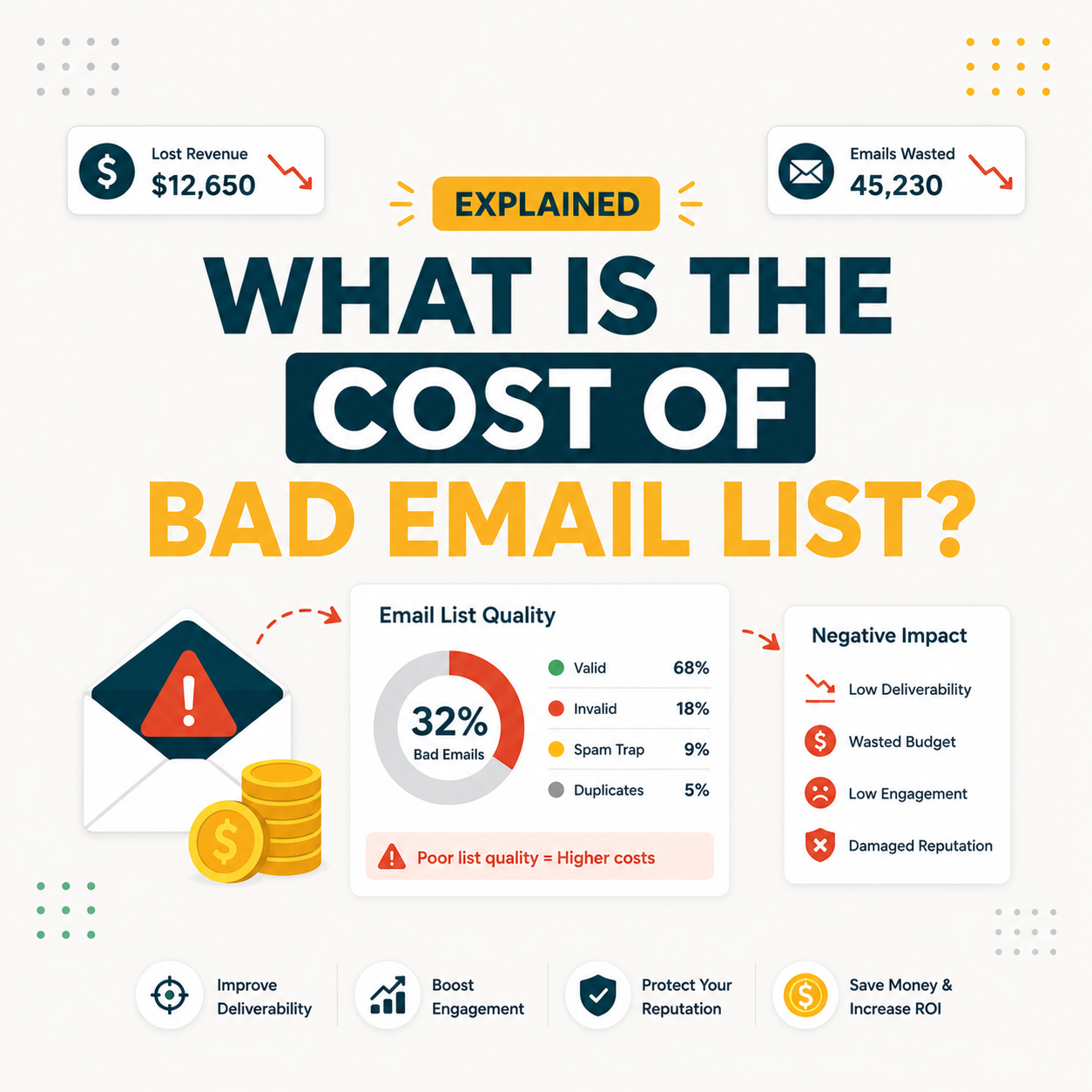
The true cost of a bad email list goes beyond bounced messages. For B2B sales teams, invalid addresses trigger sender reputation penalties, route future campaigns to spam, and burn outreach credits. Industry data puts the annual toll of bad data at $3.1 trillion globally. Hunter.io’s real-time verification catches bad addresses before they reach your sending queue.
What Is Cost of a Bad Email List? Core Definition for B2B Sales and Marketing Teams
Cost of a bad email list refers to the combined financial and operational damage B2B teams absorb when sending to unverified or stale contact data. The damage spans hard bounces exceeding the 2% ISP threshold, spam complaints degrading sender score, and wasted sequence slots on addresses that will never convert.
Source: HubSpot Marketing Statistics (22.5% decay rate); Hunter.io verification data (catch-all domain rate estimate); ESP industry standard (2% bounce threshold).
“A bounce occurs when an email message cannot be delivered to the intended recipient.”
: Wikipedia, “Bounce Message”
A bad email list is not just a quality problem: it is a revenue problem. Every invalid address on a send list extracts a compounding cost through deliverability penalties, wasted credits, and reduced reply rates across every subsequent campaign.
How Does Cost of a Bad Email List Actually Work? The Technical Mechanism Explained
Cost of a bad email list activates through a chain reaction starting at the ESP level. When hard bounce rates exceed 2%, major email service providers automatically flag the sending domain, reducing inbox placement rates for all future sends, including those going to clean, verified contacts on the same domain. For the full cost-benefit math on one popular tool, read our is Hunter.io worth it verdict.
Five components in the bad-list cost chain compound on each other with every send cycle:
- Hard bounce accumulation: ESPs flag sending domains when hard bounce rates exceed 2%, triggering automatic throttling and inbox placement penalties that affect all contacts in subsequent batches, not just the bounced ones.
- Spam complaint spike: Recipients who do not recognize the sender mark the message as spam. Gmail and Microsoft track complaints per 1,000 sends and penalize senders who exceed the 0.1% threshold with increased spam folder routing.
- Sender score erosion: Third-party reputation databases track bounce and complaint history across all sending domains. Low scores trigger preemptive blocking by enterprise mail servers before any delivery is attempted.
- Sequence slot waste: Each sequence slot occupied by an invalid address displaces a convertible prospect, directly compressing pipeline capacity by the same count as the number of invalid contacts in each batch.
- Domain blacklisting risk: Repeated hard bounces combined with spam complaints can place the sending domain on DNSBL blocklists, requiring 4-6 weeks of active warming cycles to recover inbox placement rates.
The mechanism is sequential: a single bad-list campaign creates a bounce spike that triggers ESP flagging, which suppresses inbox placement for all subsequent sends regardless of list quality. Recovery takes 4-6 weeks minimum, during which verified contacts also experience lower open rates.
What Are the Top 5 Use Cases for Cost of a Bad Email List in B2B Sales?
Bad email list costs manifest differently depending on team function. SDRs absorb costs through sequence slot waste and reply rate suppression, while marketing teams pay through campaign deliverability and attribution errors. Founders see it in pipeline conversion rates and customer acquisition cost inflation that compounds with every send cycle.
Five use cases below show where bad email list costs compound fastest for B2B revenue teams:
- SDR cold outreach campaigns: Invalid addresses inflate bounce metrics, triggering ESP throttling that suppresses deliverability for verified contacts in the same sequence batch, reducing reply rates across the entire send.
- Marketing email nurture programs: Stale subscriber lists cause open rate dilution, leading marketing ops to incorrectly attribute low performance to content quality rather than contact quality and list hygiene failures.
- Recruiting and talent acquisition: Candidate email lists built from LinkedIn scraping carry 15-30% invalid rates, wasting recruiter time and ATS sequence credits on dead addresses that will never receive outreach.
- Agency client list management: Agencies managing multiple client sending domains risk cross-domain reputation contamination when clients supply unverified contact lists for campaign execution without prior validation.
- Account-based marketing target lists: ABM campaigns targeting specific accounts lose precision when key stakeholder emails are invalid, leaving high-value accounts unreached during time-sensitive campaign windows with no fallback contact.
“Email marketing lists naturally decay by about 22.5% every year.”
: HubSpot Marketing Statistics
Whether the team runs cold outreach, nurture campaigns, or ABM, bad email list costs appear in the same three places: lower deliverability, higher per-contact acquisition cost, and compressed pipeline conversion rates that erode revenue contribution over time.
What Are the 5 Limitations of Cost of a Bad Email List Every Buyer Should Know?
Understanding the limitations of bad-list cost frameworks prevents over-investing in verification for use cases where the cost math does not justify it. Batch verification for low-volume senders, catch-all handling, and the accuracy ceiling of real-time verification all create scenarios where additional context is needed before committing to a verification workflow.
Five limitations define the boundary conditions where bad-list cost reduction tools deliver less than their full value:
- Verification accuracy ceiling: No tool achieves 100% accuracy on catch-all domains, meaning a percentage of verified-valid addresses will still bounce on send, particularly for domains that accept all SMTP checks but only deliver to real inboxes.
- Low-volume sender exception: Teams sending fewer than 200 emails per month rarely trigger ESP bounce thresholds, making aggressive verification an over-investment for the actual risk level that low-volume operations carry.
- Data decay offset gap: Verification confirms address status at the moment of check; B2B contact data decays at 22.5% annually, meaning a verified list degrades steadily after initial cleaning and requires re-verification every 90 days.
- Role-based address risk: Addresses such as info@, sales@, or support@ may verify as valid but deliver to shared inboxes with low individual engagement, inflating soft bounce rates without triggering hard bounce flags that ESPs track.
- Sole reliance trap: Using verification as the only deliverability lever ignores other reputation factors including domain authentication (SPF, DKIM, DMARC), sending volume ramp-up, and engagement-based filtering that ISPs apply independently of list quality.
“Hunter.io combines email pattern detection with real-time SMTP verification, giving B2B sales teams both discovery and confidence scoring in a single workflow.”
: Hunter.io Email Finder review, Growth Hack Suite
Bad email list cost frameworks have real boundaries. Teams with low send volumes, catch-all-heavy prospect lists, or heavily role-based contact databases need to adjust verification ROI expectations before committing to a paid plan, since the cost savings may not materialize at their specific send volume.
Top 5 Tools Compared by Cost of a Bad Email List Approach: Hunter, Apollo, Snov, ZeroBounce, NeverBounce
Five tools address bad email list costs differently: Hunter.io combines finding and verification in one platform, ZeroBounce specializes in bulk list cleaning, Apollo.io layers data enrichment on top of verification, Snov.io targets mid-market teams with bundled prospecting, and NeverBounce focuses on real-time API verification at scale.
Source: Hunter.io, ZeroBounce, Apollo.io, Snov.io, NeverBounce official pricing pages, 2026.
Hunter.io stands apart by combining email discovery and real-time verification in one platform, eliminating the workflow gap where bad addresses slip through between the finding and sending stages of a typical SDR workflow.
How Do You Apply Cost of a Bad Email List Reduction in 5 Steps with Hunter.io (Free Workflow)?
Applying bad-list cost reduction with Hunter.io follows a five-step process starting with domain-level pattern detection and ending with a verified, scored send list. The free plan handles up to 50 credits per month, making the full workflow accessible before committing to a paid tier.
Five steps to eliminate bad email list costs from the next outreach batch:
- Step 1, Domain Search: Enter the target company domain in Hunter.io’s Domain Search to retrieve all verified email patterns and addresses associated with that organization, each graded by confidence score and verification status.
- Step 2, Confidence Score Filter: Filter Domain Search results to addresses with a confidence score above 70%. Scores below this threshold indicate insufficient SMTP verification data and a statistically higher bounce probability on send.
- Step 3, Email Verifier Run: For individual addresses sourced outside Hunter.io, paste directly into the Email Verifier to receive a verdict of Valid, Risky, Unknown, or Invalid before adding the contact to any outreach sequence.
- Step 4, Bulk Task Upload: For lists exceeding 100 contacts, use Hunter.io’s Bulk Task to upload a CSV and receive verified statuses in bulk. Available on Starter and above plans, processing up to 10,000 addresses in 15-30 minutes.
- Step 5, CRM Sync and Suppression: Export verified contacts directly to HubSpot, Salesforce, or Pipedrive via native integration, and configure suppression rules to block Invalid and Unknown addresses from entering active sequences.
Run the 5-step verification workflow on your next prospect batch.
Try Hunter.io Free →Free plan: 50 credits per month. No credit card required.
The five-step Hunter.io workflow takes a raw prospect domain and delivers a scored, verified send list in under 10 minutes, completing the full verification cycle before a single message enters the outreach queue.
How Has the Concept of Cost of a Bad Email List Evolved Across the B2B Email Tool Category?
Cost of a bad email list was largely invisible before 2015, when ISP-level inbox filtering was less sophisticated. The shift to engagement-based filtering by Gmail and Microsoft in 2018-2019 transformed unverified sending from a minor inefficiency into a sender reputation risk that could block entire sending domains from reaching inboxes.
Early email marketing tools in the 2000s operated without SMTP verification. List hygiene meant manual removal of addresses that bounced or unsubscribed. The 2010s introduced bulk verification services as standalone tools, but the workflow required exporting lists, cleaning them externally, and reimporting: a process most SDR teams skipped due to friction.
The industry inflection point came with Google’s 2019 Postmaster Tools release, which gave senders granular visibility into domain reputation, user spam rates, and IP reputation scores. When Gmail’s spam filtering began applying sender reputation scores to sort messages before they reached inboxes, the cost of a bad list became immediately measurable in open rate drops and reply rate collapses that revenue teams could not ignore.
Hunter.io entered the combination workflow category in 2021, enabling teams to find and verify in a single platform. See the confidence scoring breakdown in the Hunter.io review for detail on how accuracy rates translate to bounce prevention at scale.
The evolution from manual bounce removal to real-time SMTP verification took 15 years. The 2019 Gmail reputation scoring shift made list quality a sender survival issue, not just a deliverability optimization, permanently changing the ROI math for verification investment.
What Are the Real Cost Implications of Implementing Cost of a Bad Email List at SDR Team Scale?
At SDR team scale, bad email list costs compound across labor, tool credits, and domain reputation recovery. A 5-person SDR team sending 200 emails per week on a list with 10% invalid addresses absorbs $4,800-$9,600 in annual avoidable costs from wasted sequence slots and domain recovery cycles.
Source: Growth Hack Suite estimate from vendor documentation and published pricing. Calculated at $10-$20 cost per wasted sequence slot (SDR hourly rate multiplied by avg time per contact plus tool credit cost).
The cost math favors investment in verification once team size exceeds two SDRs. At a 10% invalid rate, a 5-person team wastes the equivalent of one full SDR’s weekly output annually on undeliverable contacts that consume time, credits, and domain reputation without contributing any pipeline.
What Are the 5 Common Mistakes B2B Teams Make With Cost of a Bad Email List?
Most B2B teams underestimate bad email list costs because the damage accrues gradually rather than appearing as a single line item. Five mistakes consistently drive avoidable cost accumulation, and each one has a direct fix that most verification tools already support without additional workflow complexity.
Five mistakes that compound bad email list costs for B2B revenue teams:
- Skipping initial verification: Teams import prospect lists directly into CRM without running them through an SMTP verifier first, accepting a 5-15% invalid rate as normal operating overhead rather than addressing the root cause before it affects sender reputation.
- Ignoring list age thresholds: Lists older than six months carry significantly higher invalid rates, but teams reuse static spreadsheets without re-verification, particularly in ABM target lists built from previously qualified accounts that have since experienced staff turnover.
- Conflating bounce rate with list quality: A 3% bounce rate can mask a 15% invalid rate when ESPs only report addresses that definitively hard-bounced, not those that silently routed to spam folders and skewed engagement metrics.
- Treating catch-all domains as verified: Catch-all domains accept all SMTP verification checks but only deliver to real inboxes, meaning unconfirmed catch-all addresses inflate valid-address counts and drive hidden bounce accumulation over sequential sends.
- Underinvesting in domain warm-up: Sending to a newly acquired domain without a warm-up ramp amplifies the impact of any invalid addresses, as ISPs scrutinize reputation patterns for new sending domains more aggressively than established ones.
Five mistakes, five direct fixes. The common thread is that teams prioritize speed-to-send over list hygiene, accepting avoidable costs as normal operational overhead rather than a fixable process gap that verification tools address at low incremental cost.
How Do SDRs, Email Marketers, and Founders Each Apply Cost of a Bad Email List Differently?
SDRs care about bad email list costs at the individual sequence level, where one dead domain can ruin a batch send. Email marketers track it through deliverability rates across campaigns. Founders see it in customer acquisition cost, where a persistently low-quality list inflates the cost of every closed deal relative to the total outbound investment.
SDRs operate at the contact level. A typical SDR sends 100-200 outreach emails per day; at a 10% invalid rate, 10-20 of those emails hit dead addresses each day, consuming sequence slots, burning ESP reputation daily, and reducing the count of real replies per working day. Hunter.io’s Email Verifier runs inline with the prospecting workflow, catching bad addresses in the same session they are discovered.
Email marketers operate at the campaign level. A marketing team sending a 10,000-contact campaign with 8% invalid addresses sends 800 emails to dead inboxes, triggering bounce-rate alerts in platforms like Mailchimp or HubSpot and requiring manual scrubbing before the next send. Bulk verification via Hunter.io’s Bulk Task reduces this to a 20-minute pre-send clean.
Founders see bad email list costs in CAC math. When outbound pipeline contributes 30% of new ARR and the outbound team runs on a list with 12% invalid contacts, the effective cost-per-lead from outbound inflates by 14-15%. For a full methodology on connecting verification accuracy to pipeline conversion rate, see the email finder accuracy analysis in the Hunter.io review.
SDRs, marketers, and founders each absorb bad email list costs through a different lens. The fix is identical across all three personas: verify before sending. The investment threshold differs by send volume and team size, but the cost math consistently favors verification once weekly send volume exceeds 500 contacts.
What Are the Best Practices for Implementing Cost of a Bad Email List Reduction in Your Sales Stack?
Effective bad email list cost reduction requires a systematic approach rather than periodic cleanup. Five best practices, when applied before every campaign send, consistently push hard bounce rates below the 1.5% threshold that keeps sender domains safely inside ESP acceptable ranges without triggering automated throttling.
Five best practices that reduce bad email list costs across any B2B outreach operation:
- Verify at discovery: Verify email addresses at the point of discovery using Hunter.io’s Email Verifier, not during pre-send cleanup, to prevent invalid contacts from entering CRM sequences and accumulating in active outreach pipelines.
- 90-day re-verification cadence: Schedule bulk re-verification of all contacts older than 90 days to account for the 22.5% annual B2B contact decay rate and remove addresses that have gone stale since initial import into the CRM or sequence tool.
- Confidence score minimum threshold: Set a minimum confidence score of 70 in Hunter.io’s Domain Search results before adding any address to an active sequence, filtering out low-confidence pattern-predicted addresses that inflate bounce rates without providing usable contacts.
- Domain authentication prerequisites: Ensure SPF, DKIM, and DMARC records are configured before any verification investment, since sending from an unauthenticated domain compounds bad-list costs regardless of the accuracy level of the verification tool used.
- Catch-all domain segmentation: Route catch-all domain contacts to a separate, lower-priority sending pool with warmer subject lines and reduced daily volume, isolating their bounce risk from confirmed-valid address batches and protecting overall domain reputation.
Five best practices, all executable within Hunter.io’s free and Starter plans, eliminate the most common routes to bad-list cost accumulation. Verification at discovery is the highest-leverage single change any SDR team can make to protect sender reputation and compress avoidable pipeline loss.
What Industry Trends Are Reshaping Cost of a Bad Email List for B2B Teams?
Three industry trends are intensifying the cost implications of bad email lists: AI-generated prospect list proliferation, tighter ISP authentication enforcement from Google’s 2024 bulk sender requirements, and faster intent data decay that reduces the usable window for accurate contact data.
AI prospecting tools can now generate 500-1,000 prospect addresses in minutes by combining LinkedIn enrichment with public data scraping. The speed advantage carries an accuracy trade-off: AI-assembled lists without SMTP verification carry 20-30% invalid rates on average, compared to 5-10% for manually curated outreach lists that include a verification step at the point of discovery.
Google’s February 2024 bulk sender policy update introduced mandatory DMARC enforcement for senders dispatching more than 5,000 emails per day to Gmail addresses and reduced the spam complaint threshold from 0.3% to 0.1%. Teams that previously relied on low sender volume to avoid reputation scrutiny now face the same authentication and hygiene requirements as enterprise senders with large dedicated infrastructure.
The rise of intent-data-driven prospecting creates a 30-60 day window where contact data is both fresh and verifiable before decay sets in. For a detailed breakdown of how email data degrades over time and the optimal re-verification schedule, see the email list cleaning workflow guide for the full decay prevention framework.
AI-generated lists, tighter ISP enforcement, and faster intent data decay are pushing bad email list costs higher for teams that do not build verification into their prospecting process from the start. The cost of not verifying is rising faster than the cost of the verification tools themselves.
Cost of a Bad Email List: Frequently Asked Questions
Bad email list costs affect every B2B team running outreach at scale, from single-rep startups to enterprise SDR floors. The 12 questions below cover core definitions, tool comparisons, ROI math, and the practical step-by-step workflow for reducing invalid contact rates before they damage sender reputation and pipeline conversion.
Which tool best reduces cost of a bad email list for SDR teams?
Hunter.io leads for SDRs needing find-and-verify in one workflow. The platform discovers email addresses via Domain Search, scores them by confidence, and verifies via SMTP in the same session. ZeroBounce and NeverBounce outperform for teams with existing large lists needing bulk-only cleaning at volume above 10,000 contacts per month.
How do I know if my email list has a quality problem?
Three signals indicate a bad list: hard bounce rate above 2%, spam complaint rate above 0.1%, or open rate decline of more than 10 percentage points over three consecutive campaign sends. Any single one of these warrants a full list verification pass before the next campaign batch launches.
What is the difference between a hard bounce and a soft bounce?
A hard bounce indicates a permanently undeliverable address: the domain does not exist, the account was closed, or the receiving server rejected the address definitively. A soft bounce indicates a temporary failure such as a full inbox, server downtime, or message size rejection. Hard bounces accumulate toward sender reputation damage; soft bounces resolve on retry.
How long does it take to clean a bad email list with Hunter.io?
Hunter.io’s Bulk Task processes up to 10,000 addresses in 15-30 minutes on Starter and above plans. For lists over 100,000 contacts, dedicated bulk platforms process at 100,000 addresses per hour. Initial clean of a 5,000-contact list takes under 30 minutes from CSV upload to verified export with status verdicts per address.
How much does reducing bad email list costs actually cost?
Hunter.io’s free plan covers 50 credits per month at no cost. The Starter at $49/month ($34 billed annually) covers 2,000 credits, sufficient for a single SDR running a full outreach program. ZeroBounce starts at $16 for 2,000 bulk verifications for teams that only need cleaning without discovery.
Will verifying my email list actually improve reply rates?
Verification improves reply rates indirectly by protecting sender reputation. Teams that reduce hard bounce rates below 1.5% report 15-25% improvements in inbox placement over 4-6 weeks, which directly increases the percentage of sends that recipients actually see and can reply to. Verification does not improve message quality: it restores the deliverability that lets good messaging reach inboxes.
Can I test Hunter.io email verification for free?
Hunter.io offers a free plan with 50 credits per month, no credit card required. The free verifier provides the full SMTP check including confidence scoring, domain validation, and status verdicts of Valid, Risky, Unknown, or Invalid. The free plan is sufficient for SDRs validating small prospect batches or testing the workflow before scaling.
Does Hunter.io integrate with CRM systems for automated list sync?
Hunter.io offers native integrations with HubSpot, Salesforce, Pipedrive, and Zoho CRM via direct API connections and through Zapier automation. Verified contacts sync directly to CRM contact records with verification status as a custom field, enabling teams to build automated sequences that only include Valid-status addresses from the point of import.
What is cost of a bad email list?
Cost of a bad email list is the combined financial and operational damage a B2B team incurs by sending to unverified, stale, or invalid email addresses. Cost components include ESP credit waste, sender reputation damage requiring 4-6 weeks to recover, domain blacklisting risk from DNSBL flagging, and labor cost from managing bounce-triggered account holds and suppression list cleanup cycles.
How does cost of a bad email list actually work?
The mechanism starts with hard bounces. When a sending domain exceeds the 2% hard bounce threshold set by major ESPs, the platform automatically reduces that domain’s sending quota and inbox placement rate. Gmail and Microsoft Outlook apply their own reputation scoring on top of this, flagging senders with high complaint rates for increased spam folder routing, creating a compounding effect that affects all future sends from the same domain.
Is email list verification included in Hunter.io’s free plan?
Yes. Hunter.io’s free plan includes 50 credits per month with no credit card required. The free verifier checks SMTP response, domain validity, and confidence score for each address, returning a status of Valid, Risky, Unknown, or Invalid. The free plan is sufficient for SDRs validating small prospect batches or teams testing the verification workflow before scaling to a paid plan.
What features does a verification tool need to address bad email list costs effectively?
Effective bad-list cost reduction requires four features: real-time SMTP verification that confirms whether an address actively accepts mail, catch-all domain detection that flags domains accepting all SMTP checks regardless of inbox validity, confidence scoring that ranks addresses by reliability rather than binary valid/invalid verdicts, and CRM integration that prevents invalid-status addresses from re-entering active sequences after the initial list clean.
Stop losing pipeline to dead addresses. Verify your next list with Hunter.io.
Try Hunter.io Free →Free plan: 50 credits/month. No credit card. Cancel any time.