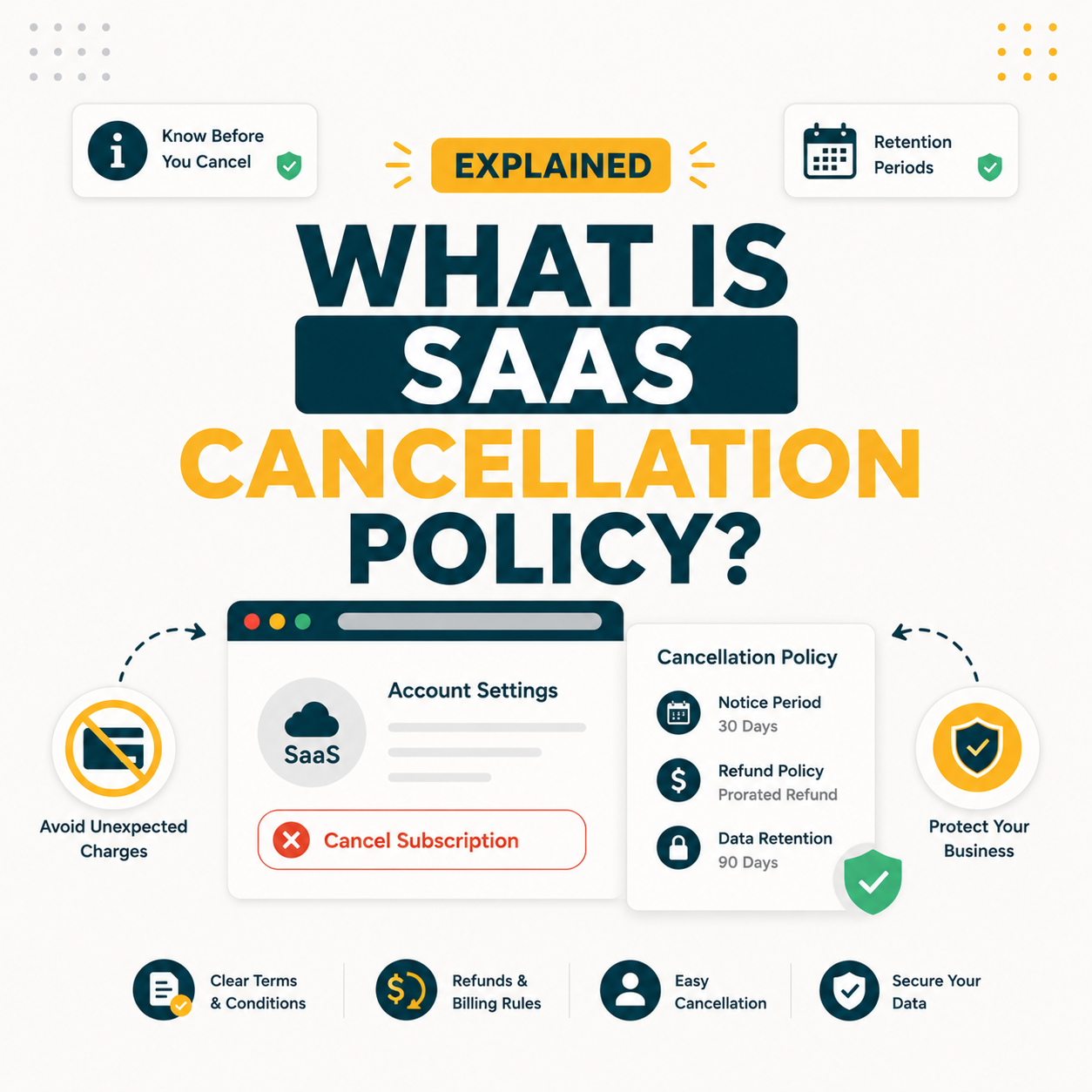
A SaaS subscription cancellation policy is the contract clause that defines when subscribers can terminate service, claim refunds, and retrieve data. Most B2B vendors specify three terms: a notice period (typically 30 days), a pro-rated refund window (0 to 30 days), and a data portability clause. Understanding these rights before signing prevents billing surprises and protects SDR budgets when teams need to pivot tools.
What Is SaaS Subscription Cancellation Policy? Core Definition for B2B Sales and Marketing Teams
A SaaS subscription cancellation policy is the formal contract clause that determines what happens when a customer stops paying for software. It specifies three things: whether a refund applies, how much notice is required, and how long data remains accessible. Policies differ substantially between monthly and annual billing cycles, with annual plans carrying significantly tighter exit windows.
Cancellation policies exist as a subset of a broader subscription agreement, but they carry disproportionate financial consequences. A buyer who misses the refund window on a $299/month annual plan forfeits $3,588 in unused credits. For SDR teams managing five or more tools, that figure multiplies quickly. The policy governs access, refunds, data, and API token validity: understanding each element protects budget before signing, not after.
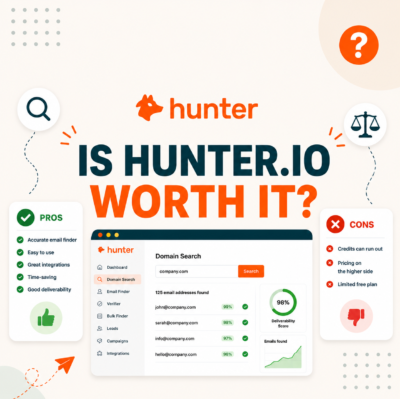
For a full breakdown of how one leading email finder handles these terms, see our Hunter.io Email Finder review for context.
Source: General SaaS industry terms. Data portability legal basis: GDPR Article 20 (EU 2016/679).
“…a buyer’s right to rescind a purchase within a specified period of time.”
Wikipedia, Right of Withdrawal
The right-of-withdrawal principle underpins most modern SaaS cancellation frameworks. B2B software vendors adapt it contractually, meaning the specific window and refund mechanics vary by vendor and billing cycle rather than following a universal standard.
How Does SaaS Subscription Cancellation Policy Actually Work? The Technical Mechanism Explained
A SaaS cancellation policy activates at the moment a customer requests service termination. The mechanism flows through five sequential stages: notice submission, billing calculation, refund determination, data preservation window, and account closure. Each stage has defined timelines that vary by vendor, but the core logic applies universally across B2B email finder, CRM, and outbound tools. For how this plays out with a real vendor, see the Hunter.io refund policy explained.
- Notice Submission: Customer submits the cancellation request through the vendor dashboard or support email. Most vendors acknowledge within 24 to 48 hours and trigger the policy clock from that timestamp.
- Billing Period Calculation: The system calculates remaining paid days in the current billing cycle. Monthly plans cancel immediately at period end; annual plans calculate remaining months and determine pro-rated balance against the refund eligibility window.
- Refund Eligibility Check: The policy applies the refund window test. Most B2B SaaS vendors offer zero to 30 days for pro-rated refunds on annual plans. Outside that window, no credit applies regardless of remaining subscription months.
- Data Preservation Window: The customer retains read or export access to account data for 30 to 90 days post-cancellation. GDPR Article 20 mandates data portability for EU-based subscribers; US vendors typically honor a 30-day export window voluntarily.
- Account Closure: Credentials deactivate, API tokens expire, and team member access ends. Vendor data deletion proceeds on a separate timeline governed by the privacy policy, typically 30 to 180 days after the access closure date.
Each of these five stages runs sequentially. Buyers who skip the data export stage during step four lose access to verified contact lists, domain search results, and campaign history permanently once account closure executes.
What Are the Top 5 Use Cases for SaaS Subscription Cancellation Policy in B2B Sales?
SaaS cancellation policies become critical at five key decision points in the B2B sales cycle: budget reviews, stack consolidation exercises, project completions for agency clients, accuracy benchmarking results that disappoint, and startup fundraising rounds that trigger a full tool audit. Teams that understand policy terms ahead of time negotiate better commitments and avoid sunk-cost billing cycles.
Five use cases below show where SaaS cancellation policy knowledge directly impacts a B2B team’s budget and outreach continuity.
- Budget Review Reallocation: Finance teams cancel annual plans before renewal dates during Q4 budget reviews, recovering pro-rated credits for reallocation to higher-priority outbound tools or headcount.
- Agency Project Completion: Agencies cancel client-funded SaaS subscriptions at project end, recouping unused credits and avoiding carry-over billing on accounts that no longer serve active campaigns.
- Tool Stack Consolidation: RevOps teams eliminate redundant email finder or verification tools after stack audits, relying on cancellation policy terms to time exits and minimize overlap billing across duplicate capabilities.
- Accuracy Test Failure: SDRs cancel tools whose deliverability bounces exceed 3% after a 500-email accuracy test, citing performance evidence when requesting refunds within the vendor’s stated window.
- Fundraising-Driven Audit: Startups preparing for Series A conduct full SaaS audits and cancel non-essential tools. Cancellation policy terms determine which tools exit first based on refund eligibility and data risk.
“Cancel anytime, no hidden fees, no cancellation penalties.”
Hunter.io, Pricing Page
Transparency in cancellation terms functions as a competitive signal. Vendors who lead with clear exit terms reduce purchase friction for SDR teams that have been burned by restrictive policies on previous tools.
What Are the 5 Limitations of SaaS Subscription Cancellation Policy Every Buyer Should Know?
SaaS cancellation policies protect vendors as much as buyers. Five structural limitations reduce a buyer’s flexibility: short refund windows that expire before dissatisfaction fully surfaces, auto-renewal clauses that reset annual commitments, non-transferable credit policies, restrictive data export timelines, and ambiguous force majeure clauses that void refund eligibility under broadly defined circumstances.
- Short Refund Windows: Most annual plan refunds require claims within 14 to 30 days of payment, before meaningful accuracy testing can complete on a live campaign against a real ICP contact list.
- Auto-Renewal Traps: Annual subscriptions renew automatically unless canceled 30 to 60 days before the renewal date, a cutoff that arrives before most teams complete their annual tool performance reviews.
- Non-Transferable Credits: Unused verification credits and search credits rarely carry forward past the billing year or transfer to a new account, creating permanent value loss at the moment of cancellation.
- Limited Data Export Windows: Some vendors restrict data export access to 30 days post-cancellation, insufficient for teams migrating large contact databases of 10,000+ contacts to a new CRM or outreach platform.
- Force Majeure Refund Voids: Vague force majeure clauses allow vendors to deny refunds during defined service disruptions, including outages that directly degraded campaign deliverability during the refund-eligible period.
“Hunter.io’s transparent pricing structure makes it straightforward to evaluate both entry costs and exit costs before committing to an annual plan.”
Growth Hack Suite, Hunter.io Email Finder Review
Knowing these five limitations ahead of evaluation narrows the field to vendors whose exit terms match actual usage patterns. Monthly plans suit project-based teams; annual pricing rewards SDR teams that can verify accuracy within the refund window.
Top 5 Tools Compared by SaaS Subscription Cancellation Policy Approach: Hunter, Apollo, Snov, ZeroBounce, Instantly
Email finder and verification tools differ significantly in how they structure cancellation terms. Hunter.io leads with transparent monthly-cancel-anytime flexibility and a documented 30-day pro-rated window on annual plans. Apollo.io and Snov.io follow similar monthly flexibility but offer stricter annual exit terms. ZeroBounce and Instantly.ai offer pay-as-you-go and monthly-first models that reduce subscription lock-in risk altogether.
Source: Vendor pricing and terms pages (Hunter.io, Apollo.io, Snov.io, ZeroBounce, Instantly.ai). Policies current as of Q2 2026; verify with vendor before signing annual plan.
Hunter.io’s 30-day refund window and 90-day data export period offer the most buyer-favorable exit terms in this comparison, giving SDR teams a full month to validate accuracy before losing refund eligibility.
How Do You Apply SaaS Subscription Cancellation Policy in 5 Steps with Hunter.io?
Applying a SaaS cancellation policy review to Hunter.io follows five steps that take under 20 minutes to complete. The process covers billing cycle identification, refund window calculation, data export initiation, credit recovery, and account closure: all accessible through the Hunter.io dashboard without support tickets or phone calls.
- Step 1, identify billing cycle: Log into the Hunter.io dashboard and navigate to Billing. Confirm whether the active plan is monthly or annual. Annual plans require attention to the renewal date, as the 30-day refund window opens at billing and not at cancellation request.
- Step 2, calculate the refund window: Count the days since the most recent renewal charge. Hunter.io honors pro-rated refunds within 30 days of the annual billing date. Beyond day 30, no refund applies regardless of remaining subscription months.
- Step 3, export all account data: Before submitting cancellation, use Hunter.io Bulk Tasks to download domain searches, email verifications, and campaign contact lists. Export processing takes 1 to 4 hours for contact sets under 10,000 entries.
- Step 4, submit cancellation request: Navigate to Billing and select Cancel Plan. Hunter.io presents a reason-collection survey, then confirms cancellation effective at the current billing period end date. No phone call or sales escalation required.
- Step 5, confirm refund processing: Monitor the registered email address for refund confirmation. Hunter.io processes eligible pro-rated credits within 5 to 10 business days, returned to the original payment method.
Hunter.io’s five-step cancellation workflow completes in under 20 minutes with no sales friction required. Teams that export data before canceling retain full contact history, and eligible pro-rated refunds reach the payment method within 10 business days.
Ready to test Hunter.io before committing to an annual plan?
Try Hunter.io Free →Free plan includes 50 credits/month. No credit card required to start.
How Has the Concept of SaaS Subscription Cancellation Policy Evolved Across the B2B Email Tool Category?
SaaS cancellation policies in 2015 were largely informal, buried in terms-of-service documents with no standardized buyer protections or timelines. GDPR adoption in 2018 forced European vendors to formalize data portability clauses and define explicit export windows. By 2022, US-based B2B software vendors began standardizing 30-day refund windows in response to SDR community pressure and increased tool-switching behavior driven by tighter outbound budgets.
The shift accelerated during 2023 and 2024 as the SaaS market matured and buyer scrutiny increased. Vendors operating in the email finder and verification category faced particular pressure: accuracy is testable within days, making a 7-day refund window commercially insufficient for buyers who needed 20 to 30 days of live campaign data to validate deliverability results against their actual ICP domain lists.
Today, cancellation policy transparency has become a differentiator. Vendors who publish clear exit terms on their pricing pages signal confidence in their product’s performance. Those who bury terms in support documentation or require sales intervention to cancel trigger avoidance behavior at the initial evaluation stage.
Modern SaaS cancellation policies reflect a decade of buyer-side pressure, regulatory evolution, and competitive differentiation. Vendors who offer clear, buyer-friendly exit terms now use policy transparency as a feature rather than a legal formality imposed by counsel.
What Are the Real Cost Implications of Implementing SaaS Subscription Cancellation Policy at SDR Team Scale?
For an SDR team of 10 using a $299/month email finder on annual billing, a single missed cancellation window costs $5,988 in unused subscription fees. At 50-person SDR team scale, where each rep operates an independent tools budget, that figure scales proportionally. Cancellation policy awareness is not a compliance exercise: it is a direct budget protection mechanism with measurable dollar impact.
per tool annually
refund window
access window
Three specific cost categories compound the impact: unused credit expiry (credits paid for but not consumed before cancellation), data re-collection cost (hours spent rebuilding contact lists if export was skipped), and duplicate billing overlap (paying two tools during a transition period when cancellation timing was not coordinated with new tool onboarding).
Cancellation policy awareness is a budget protection mechanism. SDR teams that schedule policy reviews 60 days before annual renewals avoid the largest avoidable SaaS spend category in outbound operations and eliminate duplicate billing overlap during tool transitions.
What Are the 5 Common Mistakes B2B Teams Make With SaaS Subscription Cancellation Policy?
Five mistakes account for the majority of avoidable billing losses when B2B teams cancel SaaS subscriptions. Each stems from a failure to read cancellation terms before committing to an annual plan rather than discovering those terms during a live cancellation dispute under time pressure.
- Missing the refund window: Teams delay cancellation past the 30-day refund eligibility period, forfeiting hundreds to thousands in pro-rated credits that are no longer recoverable under the signed subscription terms.
- Ignoring auto-renewal dates: Annual plan renewals process automatically unless canceled 30 to 60 days prior. Inattentive billing managers miss the cutoff during annual planning cycles and commit an additional full year of spend.
- Skipping data export before cancellation: Teams submit cancellation requests before completing a full data export. Contact lists, verification histories, and campaign results become permanently inaccessible once the account closure stage executes.
- Assuming credits transfer: Unused verification credits and search credits do not transfer to a successor account or roll forward into a new billing year. Teams that cancel with 40% of annual credits unconsumed lose that value permanently.
- Canceling during active campaigns: Canceling mid-sequence removes access to the email verifier and domain search features needed to complete follow-up steps, breaking campaign continuity and degrading reply rate data quality.
Each of these five mistakes is preventable with a 20-minute pre-cancellation checklist. Scheduling that review before submitting the request eliminates irreversible data and credit loss across every SaaS tool category in the SDR stack.
How Do SDRs, Email Marketers, and Founders Each Apply SaaS Subscription Cancellation Policy Differently?
SaaS cancellation policy applies differently depending on which team controls the subscription. SDRs focus on accuracy performance thresholds as the trigger, email marketers prioritize data portability for list migration, and founders evaluate total cost of exit as part of runway management during fundraising or operational pivots.
SDRs treat the refund window as a de-facto trial extension. A 30-day refund window after purchase effectively gives the team 30 days to run a live accuracy test against real ICP domains. If deliverability bounces exceed 3%, the policy converts the evaluation risk from a sunk cost into a recoverable credit. Apollo.io’s 14-day window cuts that evaluation period nearly in half.
Email marketers focus on data portability. A verified contact list of 5,000 B2B emails represents weeks of research effort. When switching tools, the 90-day data export window Hunter.io provides is material: it allows the team to complete list migration, de-duplicate against the new platform, and verify data integrity before the access window closes.
Founders evaluate cancellation policy as a financial risk control. During fundraising, all recurring SaaS spend is scrutinized. Monthly plans carry higher per-unit cost but zero exit penalty. Annual plans reduce monthly cost by 20 to 30% but require accurate demand forecasting. Founders who know the cancellation terms in advance model the break-even point for annual commitment against actual credit consumption rates before signing.
Each persona measures cancellation policy value differently. SDRs use it as a performance guarantee; marketers use it as a data protection mechanism; founders use it as a financial risk lever that directly affects runway calculation during high-pressure funding periods.
What Are the Best Practices for Implementing SaaS Subscription Cancellation Policy Review in 2026?
Five best practices protect B2B teams from unnecessary spending and permanent data loss during SaaS tool cancellations. Teams that implement a structured cancellation review process recover materially more value from departing tools than those who cancel reactively after a billing dispute has already escalated.
- Calendar renewal dates 90 days out: Set renewal date reminders in the team project calendar 90 days before each annual SaaS subscription renewal. This window allows proper accuracy evaluation before the refund eligibility period closes.
- Run accuracy audits at day 20: Test tool accuracy against a live ICP domain list at day 20 of the plan, 10 days before the refund window closes for most vendors. Document bounce rate results as formal evidence for the refund request.
- Export all data before canceling: Complete a full data export within the tool’s dashboard before submitting any cancellation request. Verify the downloaded file for completeness before proceeding to the cancellation step.
- Save cancellation confirmation: Archive the cancellation confirmation email and note the effective date in the team’s SaaS tracking sheet. This documentation protects against post-cancellation billing disputes.
- Request refund immediately if eligible: Submit the refund request on the same day as the cancellation submission. Waiting introduces unnecessary processing delay risk within the already tight refund window timeline.
Systematic cancellation management converts SaaS exit events from reactive emergencies into planned budget optimizations. Teams with documented review cycles spend significantly less on unused SaaS annually and carry zero risk of permanent data loss from rushed cancellation decisions.
What Industry Trends Are Reshaping SaaS Subscription Cancellation Policy Going Into Late 2026?
Three macro trends are reshaping how SaaS vendors structure cancellation terms in 2026: regulatory pressure from the EU’s Digital Markets Act, the shift toward usage-based pricing that reduces subscription lock-in by design, and AI-native competitors offering pay-per-result pricing models with no upfront commitment or cancellation complexity.
The EU Digital Markets Act, which entered enforcement in 2024, mandates that designated platform vendors provide data portability on request within 30 days. While its primary scope targets large platform gatekeepers, its provisions have created buyer expectations that now extend to mid-market B2B SaaS vendors in the email finder category. Vendors who fail to offer comparable data export terms face buyer resistance during procurement evaluations.
Usage-based pricing eliminates the subscription cancellation question entirely for many teams. ZeroBounce and similar credit-based tools have demonstrated that buyers prioritize flexibility over per-unit cost savings when accuracy is unproven. The trend is pushing subscription-first vendors like Apollo.io to introduce credit-based tiers alongside their subscription plans as a hedge against churn from buyers who reject annual commitment.
SaaS cancellation policy is becoming a competitive differentiator. Vendors with transparent exit terms gain advantage in a market where SDR teams scrutinize every line item before committing to annual plans.
SaaS Subscription Cancellation Policy: Frequently Asked Questions
Which email finder offers the best SaaS cancellation policy for SDRs?
Hunter.io offers the most buyer-favorable cancellation terms among major email finder tools in 2026. Monthly plans cancel anytime with no penalty. Annual plans include a 30-day pro-rated refund window from the billing date, a 90-day data export window post-cancellation, and no requirement for sales escalation to process the request. Apollo.io provides a 14-day window, Snov.io 14 days, and Instantly.ai only 7 days on annual billing.
How accurate are SaaS refund windows in practice?
Published refund windows are contractually binding when the cancellation request is submitted within the stated period and documentation is retained. The main accuracy risk is timing: refund eligibility is measured from the billing date, not from the cancellation submission date. A team that purchases an annual plan on May 1 has until May 30 to request a refund, regardless of when they first log in or begin testing the tool.
What is the difference between a cancellation policy and a refund policy?
A SaaS cancellation policy is the complete framework covering service termination, data access, credit expiry, and billing end date. A refund policy is a subset that addresses only the financial component: whether money is returned, how much, and within what timeframe. A vendor can have a generous cancellation policy but a restrictive refund policy, or vice versa. Reviewing both independently during tool evaluation prevents blind spots on either dimension.
How long does it take to process a SaaS cancellation with Hunter.io?
Hunter.io cancellation processes entirely through the self-service dashboard in under 10 minutes. Navigate to Billing, select Cancel Plan, complete the reason survey, and receive email confirmation within 24 hours. The cancellation becomes effective at the end of the current billing period. Refund processing for eligible annual plans takes 5 to 10 business days to return to the original payment method. No support ticket or sales call is required.
How much does a missed cancellation window typically cost a B2B team?
A missed 30-day refund window on a $299/month annual email finder plan forfeits $3,588 in remaining subscription value. For an SDR team running five tools on annual billing, cumulative exposure from missed windows across all tools can reach $15,000 to $30,000 annually. The cost compounds when duplicate billing overlap is added during tool transitions where cancellation and onboarding are not coordinated.
Will understanding cancellation terms improve outbound campaign results?
Indirectly, yes. Teams that understand refund windows use them as structured accuracy evaluation periods rather than open-ended trials. A 30-day refund window creates a deadline that disciplines the testing process: run a live campaign within 20 days, measure bounce rate and reply rate, and decide before day 30. This structured evaluation produces more accurate tool selection decisions, which directly improves long-term campaign deliverability by eliminating underperforming tools faster.
Can a team test Hunter.io free before committing to a paid plan?
Hunter.io offers a free plan with 50 credits per month at no cost, with no credit card required to activate. The free plan provides access to Domain Search, Email Finder, and Email Verifier features. Teams can validate accuracy against their ICP domain list before upgrading to a paid plan. For B2B teams processing more than 25 domains per month, the Starter at $49/month ($34 billed annually) (monthly billing) is the lowest commitment option with full cancellation flexibility.
Does Hunter.io’s cancellation policy work with standard B2B procurement processes?
Hunter.io supports standard B2B procurement workflows including invoice billing, annual contract terms, and purchase order acceptance for enterprise accounts. The cancellation process operates through the self-service dashboard, compatible with procurement teams that require documentation of the cancellation request, confirmation email, and refund timeline for internal finance records. GDPR-compliant data deletion documentation is available on request for EU-based procurement teams.
What is a SaaS subscription cancellation policy?
A SaaS subscription cancellation policy is the contractual framework that defines the conditions under which a subscriber can end a paid software subscription. It specifies the notice period required before termination, the refund eligibility window and pro-rated calculation method, the data portability provisions and export timeline, and the account closure sequence including credential deactivation and API token expiry. The policy governs the financial and operational consequences of service exit for both vendor and subscriber.
How does SaaS cancellation policy protect buyer data?
SaaS cancellation policies protect buyer data through two mechanisms: the data export window (typically 30 to 90 days post-cancellation during which the subscriber retains read and export access) and the deletion timeline (the period after which the vendor purges subscriber data from their systems under the privacy policy). GDPR Article 20 legally mandates data portability for EU subscribers. US subscribers rely on contractual provisions rather than statutory rights, making the explicit export window term critical during evaluation.
Is Hunter.io cancellation available on the free plan?
Hunter.io’s free plan does not require cancellation because it carries no payment obligation. Free accounts can be deactivated from the account settings dashboard at any time, with no cancellation notice period required. Free plan data (domain searches, saved contacts) is retained for 90 days after deactivation before deletion. Upgrading from free to a paid plan and then canceling within 30 days of the first payment activates the standard pro-rated refund policy for the paid portion of the billing cycle.
What features does a Hunter.io Starter plan cancellation policy include?
Hunter.io Starter plan cancellation policy includes: self-service cancellation through the billing dashboard with no sales escalation requirement, a 30-day pro-rated refund window for annual billing from the charge date, immediate cancellation effective at current period end for monthly billing, 90-day data export access to all domain searches and verification results, and email confirmation of cancellation within 24 hours. The policy applies identically to all paid tiers: Starter, Growth, Business, and Enterprise on monthly plans, with the 30-day refund window exclusive to annual subscriptions.
Start with Hunter.io’s free plan: no commitment, no cancellation complexity.
50 credits per month, full Email Verifier access, and self-service cancellation anytime if you upgrade.
Try Hunter.io Free →No credit card required. Free plan includes Domain Search, Email Finder, and Email Verifier.