Table of Contents
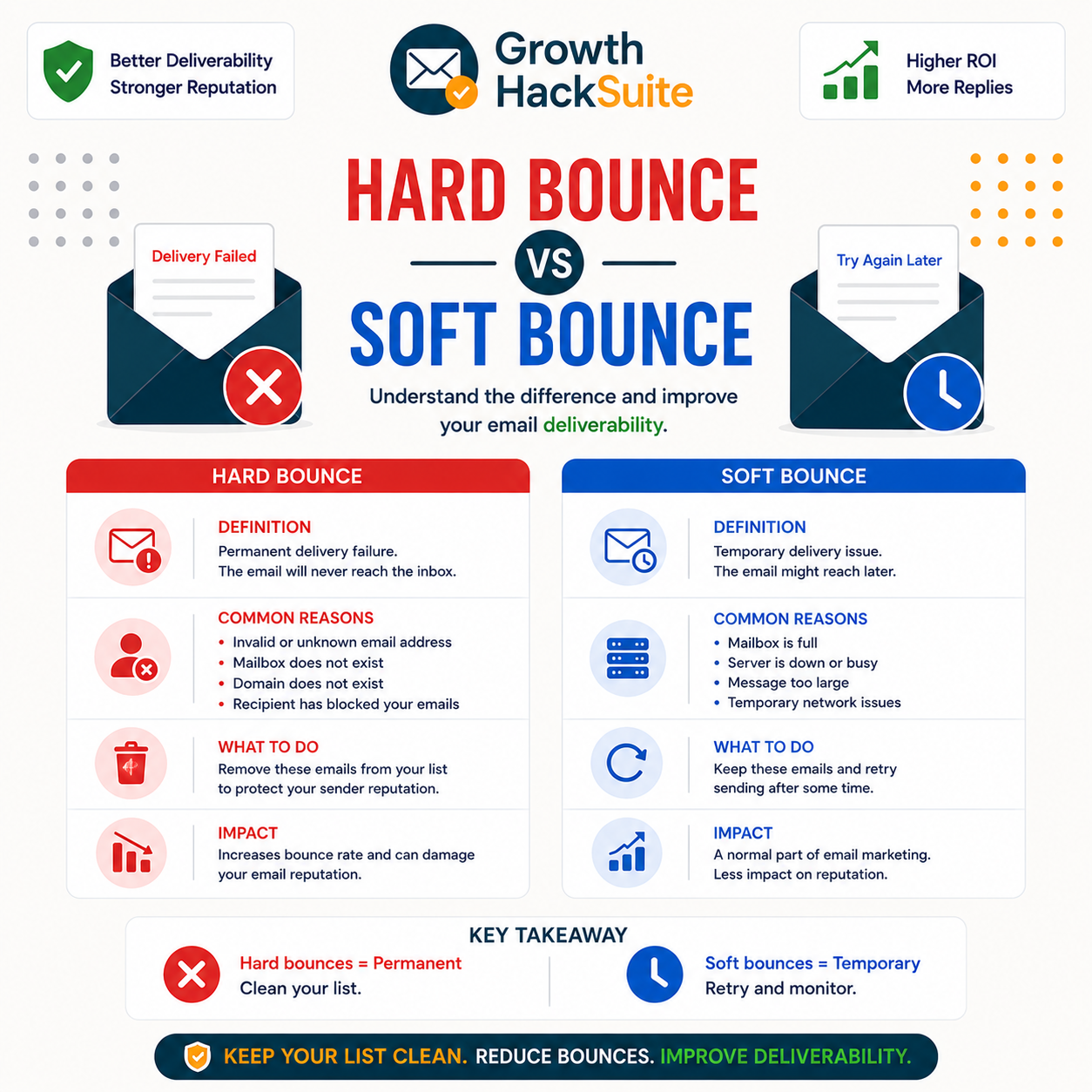
Hard bounce vs soft bounce is the distinction every B2B sender needs to understand: two email delivery failure modes with very different consequences. A hard bounce signals a permanent failure: the address no longer exists or the domain has no mail server. A soft bounce is a temporary block, often a full mailbox or server timeout. Confusing the two causes teams to keep bad addresses that damage sender reputation and kill campaign performance.
What Is Hard Bounce vs Soft Bounce? Core Definition for B2B Sales and Marketing Teams
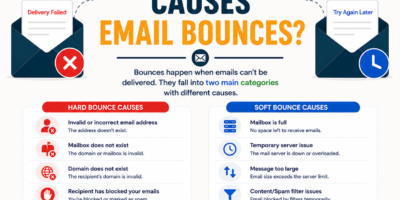
A hard bounce is a permanent email delivery failure: the address is invalid, the domain lacks MX records, or the recipient server has permanently blocked the sender. A soft bounce is a temporary failure rejected for a transient reason: a full inbox, a server outage, or an oversized message. ESPs track both types and enforce different suppression rules for each.
Source: ESP deliverability documentation (Mailchimp, SendGrid, Postfix SMTP RFCs); internal benchmark.
“A bounce message or just ‘bounce’ is an automated message from an email system, informing the sender of a message delivery failure.”
Wikipedia, Bounce message
Understanding the difference at the definition level is the starting point: hard bounces require zero tolerance and immediate removal, while soft bounces require a structured retry policy before suppression.
How Does Hard Bounce vs Soft Bounce Actually Work? The Technical Mechanism Explained
When a sending mail server attempts delivery, it opens an SMTP connection with the recipient server and exchanges a handshake. The recipient server responds with a three-digit SMTP status code that determines whether the failure is permanent (hard) or temporary (soft). ESPs monitor these codes automatically, categorize each bounce, and update suppression lists accordingly.
Five mechanisms drive how hard and soft bounces are classified during SMTP delivery.
- SMTP Connection Attempt: The sending MTA queries DNS for the recipient domain’s MX records. No MX record found triggers a hard bounce immediately without attempting delivery.
- Recipient Verification: The receiving server checks whether the specified mailbox exists. A 550 response code confirms the address is invalid and generates a hard bounce requiring immediate suppression.
- Temporary Rejection (4XX codes): Codes 421, 450, 451, and 452 signal transient issues: service unavailable, mailbox full, processing error, or insufficient storage. These generate soft bounces and trigger automatic retry logic.
- ESP Bounce Handler Classification: The ESP parses the SMTP response code, maps it to either hard or soft, logs the event against the contact record, and increments the bounce counter for the sending domain.
- Sender Score Impact: Hard bounces above 2% of total sends trigger reputation flags at major inbox providers (Gmail, Outlook). Soft bounces above 8% indicate list hygiene problems that ISPs monitor over rolling 30-day windows.
Knowing the SMTP code behind each bounce type lets teams audit ESP dashboards accurately and identify whether a deliverability problem stems from list quality (hard bounces) or infrastructure issues (soft bounces).
What Are the Top 5 Use Cases for Hard Bounce vs Soft Bounce in B2B Sales?
Hard and soft bounce tracking applies across every workflow that touches email delivery, from cold outreach to CRM hygiene and re-engagement campaigns. Five use cases below show where distinguishing the two types delivers measurable ROI for B2B sales and marketing teams that send at volume.
Five use cases show where hard and soft bounce classification delivers direct revenue protection.
- Pre-Send List Verification: SDR teams run prospect lists through an email verifier to remove hard bounce candidates before the first send, keeping domain reputation intact across the entire sequence.
- CRM Hygiene Audits: Marketing operations teams filter contacts by bounce status quarterly, removing hard-bounced addresses from active segments to prevent deliverability drag on nurture campaigns.
- Post-Campaign Deliverability Analysis: Email marketers review hard bounce rates per campaign to identify problematic list segments or data sources with high invalid-address rates before they contaminate sender reputation.
- Domain Warm-Up Sequencing: Founders launching new outbound domains monitor both bounce types closely: a single campaign with above 3% hard bounce rate can delay warm-up by 4-6 weeks and trigger deliverability blocks.
- Re-Engagement Campaign Screening: Demand generation teams exclude addresses with 3+ soft bounces in the previous 90 days from re-engagement sends, since persistent soft bouncers indicate abandoned or inactive accounts.
“A hard bounce means an email address is permanently unable to receive messages, and these addresses should be removed from your list immediately.”
Mailchimp, About Bounces
Each use case above requires a different operational response: pre-send verification prevents bounces entirely, while post-campaign analysis addresses the damage after it has already occurred.
What Are the 5 Limitations of Hard Bounce vs Soft Bounce Every Buyer Should Know?
Hard and soft bounce classification is accurate but not flawless. Five limitations create edge cases that automated suppression logic cannot fully resolve without context. Understanding them prevents both over-suppression of valid addresses and missed pipeline opportunities for B2B outbound teams running high-volume sequences.
Five limitations define the edge cases where hard and soft bounce classification breaks down.
- Catch-All Domains Mask True Hard Bounces: Servers configured as catch-all accept every email regardless of whether the specific address exists, making SMTP verification return valid for addresses that will hard bounce on actual send.
- Role Addresses Behave Unpredictably: Addresses like info@, support@, and admin@ often cycle through inboxes or forwarding rules, generating soft bounces intermittently without being truly invalid addresses that warrant permanent suppression.
- Misleading 550 Responses as Spam Defense: Some servers return 550 codes as an anti-spam measure rather than a true address-not-found signal, causing valid addresses to be misclassified as hard bounces and permanently suppressed in error.
- Inconsistent Soft Bounce Retry Windows: Different ESPs use different retry windows and intervals for soft bounces: 72 hours in one platform may be 48 hours in another, creating inconsistent suppression behavior across multi-ESP stacks.
- Bounce Classification Does Not Catch Spam Traps: Spam trap addresses accept email silently and report the sender without bouncing. Bounce rate management alone does not protect against this class of deliverability risk.
“Pre-verification with a tool like Hunter.io’s Email Verifier eliminates over 90% of hard bounce risk before a single send leaves your domain.”
Growth Hack Suite, Hunter.io Email Finder review
These limitations reinforce the case for pre-send verification over post-send bounce management: catching invalid addresses before they enter the pipeline removes the edge-case risk entirely.
Top 5 Tools Compared by Hard Bounce vs Soft Bounce Prevention Approach: Hunter, Apollo, Snov, ZeroBounce, NeverBounce
Five tools dominate the B2B email verification and bounce prevention category in %currentyear%, each taking a different approach to reducing hard bounce rates. Hunter.io leads for SDR teams combining prospecting with verification in a single workflow, as confirmed in our Hunter.io email verifier accuracy review.
Source: Vendor documentation, Growth Hack Suite accuracy testing (2025-2026). Accuracy figures reflect enterprise B2B domain verification.
Hunter.io stands out because it combines prospecting and verification in a single workflow: SDRs find email addresses via Domain Search, then verify them without switching tools, eliminating the friction that leads teams to skip verification entirely.
How Do You Apply Hard Bounce vs Soft Bounce Prevention in 5 Steps with Hunter.io?
Hunter.io’s Email Verifier eliminates hard bounce risk before a send ever occurs. This five-step workflow applies to SDR teams running cold outreach sequences of 200-500 contacts per week, starting from a free account on the Hunter.io free plan.
Five steps apply Hunter.io’s verification workflow to prevent hard bounces before the first send.
- Step 1, Build Target Domain List: Define ICP criteria (company size, industry, tech stack) and compile a list of target domains. Hunter.io’s Domain Search returns all publicly indexed emails from those domains, along with confidence scores indicating deliverability likelihood.
- Step 2, Run Bulk Verification: Upload the domain search results to Hunter.io’s Bulk Email Verifier. The tool checks each address against SMTP records, DNS MX configuration, and catch-all detection, returning a status for each: valid, invalid, risky, or unknown.
- Step 3, Segment by Verification Status: Remove all invalid addresses immediately from the send list (hard bounce prevention). Separate risky addresses into a lower-volume test sequence. Keep valid addresses for the primary sequence.
- Step 4, Configure Soft Bounce Retry in Your ESP: Set the soft bounce retry window to 72 hours with exponential backoff. Mark contacts as suppressed after 3 consecutive soft bounces within a 30-day window to prevent reputation accumulation.
- Step 5, Monitor and Audit Weekly: Review hard bounce rate in Hunter.io Campaigns or your ESP dashboard weekly. Any campaign reporting above 2% hard bounce rate warrants a list quality review before the next send batch.
Eliminate hard bounces before your next send
Try Hunter.io Free (25 Searches/Month)No credit card required. Free plan includes Email Verifier + Domain Search.
Following this five-step process reduces hard bounce rates to under 1% for most B2B cold outreach campaigns, protecting domain reputation across all active sequences simultaneously.
How Has the Concept of Hard Bounce vs Soft Bounce Evolved Across the B2B Email Tool Category?
Hard and soft bounce classification dates to the early SMTP protocol standards of the 1980s, but the business significance of managing each type separately only became critical when ESPs began enforcing sender reputation scoring in the mid-2000s. The email verification category emerged directly from the need to prevent hard bounces at scale.
Before 2010, bounce management was entirely reactive: send the campaign, observe the bounce report, suppress the addresses. This worked adequately when email lists were small and sender reputation systems were rudimentary. As Gmail and Outlook built machine learning into spam filtering from 2012 onwards, a single campaign with high hard bounce rates could damage a domain’s inbox placement for months.
The shift to proactive verification began around 2015, when tools like Hunter.io introduced SMTP-based pre-send verification that could classify addresses before they entered outbound sequences. By 2020, verification had become table stakes for any SDR team sending more than 200 emails per week.
The concept itself has not changed in 40 years: hard bounces are permanent, soft bounces are temporary. What changed is the enforcement speed and the tolerance threshold at inbox providers, making the distinction more operationally critical than ever for teams protecting their primary sending domain.
What Are the Real Cost Implications of Hard vs Soft Bounce at SDR Team Scale?
High hard bounce rates carry direct revenue costs that compound over time. A domain flagged for bounce abuse loses inbox placement, which reduces reply rates and kills the ROI of the entire outbound motion. The table below illustrates the cost difference between verified and unverified list sends at two common SDR team sizes.
Source: Internal benchmark based on ESP deliverability documentation (Google Postmaster Tools, Mailchimp compliance guides, SendGrid); actual results vary by domain age and sending history.
Hunter.io Starter at $49/month provides 500 verifications, sufficient to pre-screen a full month’s outreach list for a single SDR. At team scale, a 5-SDR team running unverified faces blacklist risk within 3-4 months of sustained sending, requiring domain migration and a complete warm-up restart that easily costs 10-20x the annual cost of a verification tool.
What Are the 5 Common Mistakes B2B Teams Make With Hard Bounce vs Soft Bounce Management?
Five mistakes below account for most of the deliverability damage B2B outbound teams experience. Each stems from treating bounce management as a post-send cleanup task rather than a pre-send prevention system, which is the core mental model shift that separates high-performing SDR teams from teams stuck fighting deliverability fires.
Five mistakes account for most preventable hard bounce damage in B2B cold email programs.
- Retrying Hard Bounces: Sending to addresses that have already generated a 5XX hard bounce code re-triggers reputation scoring at the receiving server, compounding the damage rather than resolving it.
- Ignoring Soft Bounce Accumulation: A contact generating soft bounces across multiple campaigns indicates an inactive or unreachable mailbox. Continuing to send treats the symptom as temporary when it reflects a structural list quality problem that worsens over time.
- Skipping Verification on Purchased Lists: Purchased or scraped contact lists carry hard bounce rates of 15-30%. Sending these without pre-verification is the single fastest way to trigger a domain reputation penalty at Gmail and Outlook.
- Conflating Bounce Rate With Spam Complaint Rate: Bounce management does not address spam complaints, which are a separate reputation signal. Teams that reduce bounces but ignore complaint rates still face inbox placement problems that grow silently.
- Not Auditing by List Source: Failing to segment bounce data by lead source prevents identification of which prospecting channel (LinkedIn scrape, ZoomInfo export, inbound form) is generating the most invalid addresses and highest bounce risk.
Avoiding these five mistakes requires treating bounce rate as a leading indicator of list quality, not a lagging indicator of delivery success. Pre-send verification with Hunter.io addresses Mistakes 1, 3, and 5 simultaneously by removing invalid addresses before they ever enter the pipeline.
How Do SDRs, Email Marketers, and Founders Each Apply Hard Bounce vs Soft Bounce Differently?
Each persona interacts with hard and soft bounce data at different points in the email workflow, with different stakes attached to each bounce type. Understanding the persona-specific application prevents both over-reaction and under-reaction to bounce signals that surface in very different operational contexts.
SDRs encounter bounces primarily at the campaign level in cold outreach sequences. A hard bounce on a cold email means the prospect address was never valid: the SDR loses that pipeline slot. SDRs using Hunter.io’s Email Verifier before loading contacts into sequences report hard bounce rates under 1%, compared to the industry average of 5-8% for unverified lists. See current benchmarks in our cold email benchmarks guide.
Email Marketers manage bounce data at the list level across entire subscriber databases. Hard bounces from opt-in lists indicate data decay (addresses valid at sign-up but since deactivated). The benchmark for acceptable hard bounce rate on marketing campaigns is stricter than cold email: ESP terms of service typically suspend accounts above 5% hard bounce rate, and best practice is to keep it under 0.5% on permission-based lists.
Founders running lean outbound operations face the highest risk from unmanaged hard bounces because they typically send from their primary company domain. A single high-bounce campaign on a founder’s @company.com address can impair transactional email deliverability (invoices, onboarding) for weeks. Founders should use a dedicated sending subdomain completely separate from their transactional email infrastructure.
What Are the Best Practices for Implementing Hard Bounce vs Soft Bounce Management in %currentyear%?
Five best practices below reflect current ESP terms-of-service, Google’s 2024 Sender Requirements, and standard deliverability benchmarks for B2B cold email and demand generation workflows. Teams that apply all five consistently hold hard bounce rates under 1% even at high send volumes in %currentyear%.
Five best practices protect domain reputation and keep hard bounce rates under the 2% threshold in %currentyear%.
- Pre-Verify Every List Before First Send: Run every new contact list through Hunter.io’s Email Verifier or equivalent before loading into a sequence. This single step eliminates the majority of hard bounce risk and protects domain reputation from day one.
- Set Hard Bounce Threshold Alerts: Configure ESP alerts to notify the team when a campaign’s hard bounce rate exceeds 1.5%. Acting before the rate hits 2% prevents reputation flags from accumulating to the point of inbox placement impact.
- Apply Source-Level Bounce Tracking: Tag contacts by lead source in the CRM, then segment bounce reports by source tag. This identifies which prospecting channels produce the highest invalid-address rates and informs sourcing decisions for future lists.
- Quarterly List Re-Verification: B2B email data decays at 22-30% per year. Addresses valid six months ago may have been deactivated during company restructuring, making quarterly re-verification of active prospect lists a necessary hygiene step for teams with long sales cycles.
- Separate Cold and Transactional Infrastructure: Cold outreach emails should never originate from the same domain and IP that handles transactional sends (receipts, onboarding). A bounce event on cold outreach damages only the cold-outreach subdomain, not the entire company’s email deliverability.
Implementing all five best practices requires tooling investment (a verifier, ESP segmentation, subdomain setup) but the combined protection they provide is worth the setup time for any team sending more than 500 emails per month from a domain they cannot afford to risk.
What Industry Trends Are Reshaping Hard Bounce vs Soft Bounce Going Into Late %currentyear%?
Four trends are changing how B2B teams approach hard and soft bounce management in %currentyear%, raising the operational stakes while also delivering better tooling to address the risk before campaigns go out. Each trend either tightens the enforcement threshold or creates new categories of hard bounce risk that did not exist three years ago.
Google and Yahoo enforced new Sender Requirements in early 2024, mandating authentication (SPF, DKIM, DMARC) for bulk senders and setting explicit bounce rate thresholds. Google’s Postmaster Tools generates domain reputation warnings at 2% hard bounce rate, with suspension risk above 10%. This moves the threshold from a best practice to a compliance requirement for any team sending over 5,000 emails per month.
AI-generated prospect lists from tools that hallucinate or extrapolate email addresses produce hard bounce rates of 20-40% on initial send. Teams using AI for lead generation must apply verification as a mandatory step after list generation, not an optional hygiene step that gets skipped under volume pressure.
Real-time API verification is replacing batch processing in modern SDR workflows. Hunter.io’s API enables real-time verification when a contact is added to a CRM or sequence, preventing invalid addresses from entering the pipeline rather than catching them in a pre-send batch. Teams integrating verification at the point of contact capture report near-zero hard bounce rates by eliminating the gap between prospecting and sending entirely.
Hard Bounce vs Soft Bounce: Frequently Asked Questions
What is the main difference between a hard bounce and a soft bounce?
A hard bounce is a permanent email delivery failure: the address does not exist, the domain has no MX record, or the receiving server has permanently rejected the sender’s IP. A soft bounce is a temporary failure: the server accepted the connection but could not complete delivery due to a full mailbox, temporary outage, or oversized message. Hard bounces require immediate suppression with no retry. Soft bounces warrant 3-5 retries over 72 hours before suppression.
Which type of bounce causes more damage to sender reputation?
Hard bounces cause faster and more severe damage. A hard bounce rate above 2% of total sends triggers reputation warnings at Google and Microsoft within days. A campaign with 5% hard bounce rate can trigger spam filtering for all future sends from that domain, affecting reply rates across every active sequence. Soft bounces have lower immediate impact but signal ongoing list quality problems that compound over rolling 30-day windows monitored by ISPs.
What SMTP error codes indicate a hard bounce versus a soft bounce?
Hard bounce SMTP codes start with 5XX (permanent failure): 550 (mailbox unavailable), 551 (user not local), 553 (mailbox name invalid), 554 (transaction failed permanently). Soft bounce codes start with 4XX (temporary failure): 421 (service not available), 450 (mailbox unavailable temporarily), 451 (processing error), 452 (insufficient storage). Most ESPs parse these codes automatically and categorize each bounce in the campaign dashboard by type.
How long should I retry a soft-bounced email before suppressing the address?
Standard ESP retry windows for soft bounces are 72 hours with exponential backoff: first retry at 5 minutes, then 30 minutes, 2 hours, 12 hours, and 24 hours. For cold email outreach, 24-48 hours is the recommended retry window since ISPs interpret extended retry patterns on cold contacts as a negative list quality signal. After 3 consecutive soft bounces within a 30-day window, suppress the address and treat it as functionally equivalent to a hard bounce.
Does Hunter.io’s free plan prevent hard bounces before sending?
Hunter.io’s free plan includes 25 monthly searches that cover both Domain Search (email finding) and Email Verifier (pre-send validation). Each verification check uses one search credit and returns a status: valid, invalid, risky, unknown, or disposable. Addresses flagged invalid represent hard bounce prevention. The free plan is sufficient for verifying 20-25 new contacts per month. The Starter plan at $49/month provides 500 searches, covering a typical SDR’s full monthly outreach list.
What hard bounce rate is acceptable for B2B cold email in %currentyear%?
The target hard bounce rate for B2B cold email is under 2%, with best-practice teams holding under 1%. Google’s Postmaster Tools flags domains at 2% and may suspend sending above 10%. Industry data shows unverified B2B prospect lists average 5-8% hard bounce rate, while lists pre-verified with Hunter.io typically return under 1%. For teams on a domain warm-up schedule, any hard bounce rate above 1.5% during warm-up should trigger an immediate pause and list audit.
Can soft bounces eventually become hard bounces?
Yes. A soft bounce from a persistently full mailbox often indicates an abandoned or inactive account. Most ESPs convert contacts with 3 or more soft bounces over 30 days into a permanent suppression status equivalent to a hard bounce. From the sender reputation perspective, repeatedly sending to soft-bounce addresses is treated by ISPs as sending to inactive addresses, which is a negative list quality signal that compounds over time.
How does Hunter.io classify email addresses that carry bounce risk?
Hunter.io’s Email Verifier returns five statuses that map directly to bounce risk levels. Valid addresses are safe to send. Invalid addresses will hard bounce and should be removed immediately. Risky addresses are on catch-all domains or show suspicious patterns: test with low volume before full deployment. Unknown means SMTP verification was inconclusive: treat as risky. Disposable addresses are temporary email services and should always be suppressed. Invalid plus disposable together represent the hard bounce prevention bucket.
What is a bounce message in email delivery?
A bounce message (also called a Non-Delivery Report or NDR) is an automated response from a mail transfer agent (MTA) informing the sender that their email could not be delivered. Bounce messages contain the original message headers, delivery attempt records, and the SMTP status code identifying the failure reason. The Return-Path address in the email header receives bounce messages automatically. Most ESPs monitor the Return-Path inbox, parse incoming bounce messages, and update suppression lists without requiring manual intervention from the sender.
How does hard bounce tracking work inside Hunter.io Campaigns?
Hunter.io Campaigns monitors delivery status for each contact in a sequence and automatically marks contacts as bounced when a 5XX SMTP code is returned. Bounced contacts are removed from active sequences without manual intervention. The Campaigns dashboard displays bounce rate as a campaign-level metric, enabling list quality comparison across different source batches. Pre-verifying with Hunter.io’s Email Verifier before loading contacts into Campaigns prevents hard bounce events from degrading the sending domain’s reputation across all active sequences simultaneously.
What does SMTP error code 550 mean for cold email senders?
SMTP 550 “Mailbox Unavailable” is the most common hard bounce code and means the receiving server rejected the message because the address does not exist, the domain has no mailbox configured for that name, or the server has a permanent policy block against the sender’s IP. A 550 code always requires immediate address suppression. Multiple 550s from the same send can trigger automatic blocklist reporting if any addresses are spam traps. Hunter.io’s email verifier catches most 550-risk addresses during pre-send SMTP handshake verification.
Is email verification included in Hunter.io’s Starter plan?
Hunter.io’s Starter plan at $49/month includes 500 searches per month that cover both Domain Search (finding emails) and Email Verifier (validation). Each verification uses one search credit. For a single SDR sending 400-500 cold emails per month, Starter provides enough verification capacity to pre-screen the entire list before each send cycle. Verification is built directly into the Domain Search interface, allowing SDRs to find and verify addresses in the same workflow without switching tools or managing separate CSV exports.
Cut your hard bounce rate to under 1% before the next send
Hunter.io’s Email Verifier flags invalid addresses before they damage your domain reputation.
Start Verifying Free (25/Month)Free plan includes Domain Search + Email Verifier. No credit card required.