Table of Contents
A catch-all email domain configures a mail server to accept every inbound message, regardless of whether the recipient mailbox exists. Email verifiers flag these as “accept-all” rather than valid or invalid, since SMTP verification always returns a positive response. Roughly 15-25% of B2B domains use this configuration. For SDRs, sending to unfiltered catch-all lists means 5-15% hidden bounce risk. Hunter.io labels catch-all domains separately so teams can triage before sending.
What Is a Catch-All Email Domain? Core Definition for B2B Sales and Marketing Teams
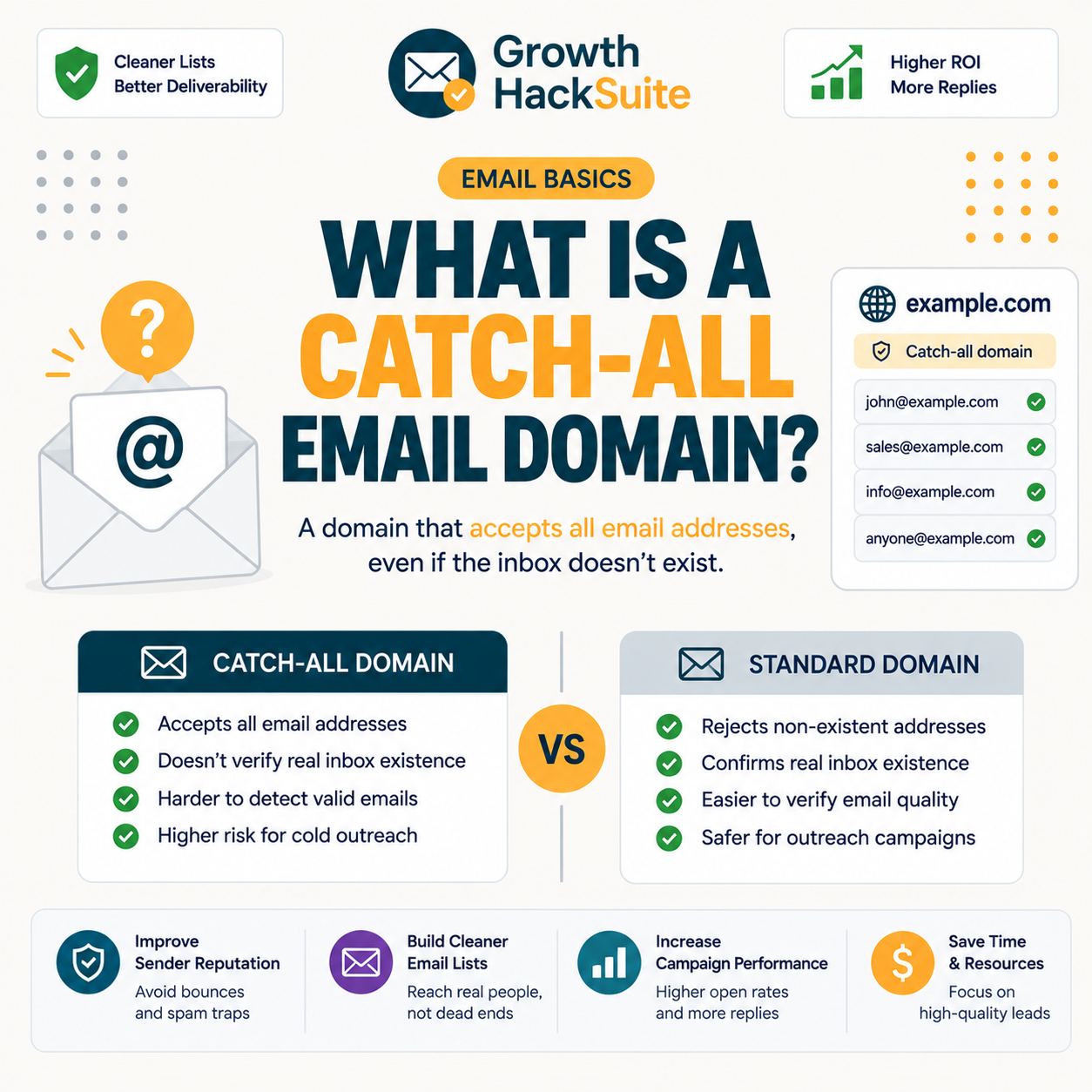
A catch-all email domain is a server configuration where the mail server returns a positive SMTP response to every delivery probe, regardless of whether the specific mailbox exists. When a verifier checks john.smith@company.com, the server accepts the probe even if John Smith never worked there. Verifiers cannot confirm individual mailbox validity, so they classify the result as “accept-all” rather than valid or invalid.
Source: Hunter.io Email Verifier documentation; SMTP RFC 5321, 2026.
“A catch-all address is an email address used to receive messages sent to an invalid email address for a domain.”
Wikipedia – Catch-all address
Catch-all domains are common in mid-size companies and agencies that route all incoming messages to a shared inbox, reducing missed communications. For B2B verification workflows, the accept-all label means the address sits in a grey zone: not provably invalid, not safely sendable at scale without a segmentation strategy.
How Does a Catch-All Email Domain Actually Work? The Technical Mechanism Explained
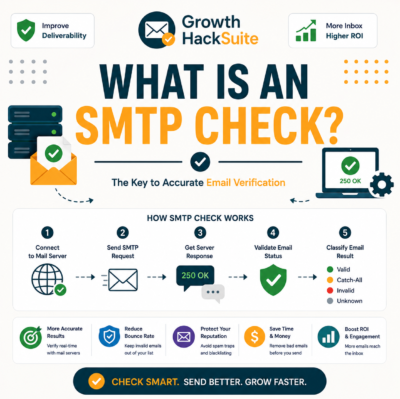
A catch-all email domain works by configuring the mail server to accept RCPT TO commands for any local-part at the domain, regardless of whether that mailbox exists in the system. Standard SMTP verification simulates a delivery attempt and reads the server response code. On a catch-all domain, every probe returns “250 OK” and verification cannot distinguish a real mailbox from a nonexistent one.
Five components drive catch-all behavior in any B2B email infrastructure:
- MX Record Configuration: The domain’s DNS MX records point to a mail server that is set to wildcard-accept all incoming messages, routing them to a catch-all inbox rather than individual mailboxes.
- SMTP Listener Behavior: The server’s SMTP listener responds with “250 OK” to every RCPT TO probe, the key dialogue step verifiers use to test individual address existence.
- Post-Acceptance Routing: After accepting the message, the server either delivers it to a master inbox, discards it silently, or auto-replies with a bounce message, making the actual delivery outcome unknowable at verification time.
- Verifier Detection Logic: Email verification tools detect catch-all behavior by probing multiple obviously invalid addresses at the domain. If all return “250 OK,” the tool classifies the domain as accept-all and flags every address at that domain accordingly.
- Confidence Score Adjustment: Tools like Hunter.io lower the confidence score for addresses at catch-all domains, reflecting the uncertainty. An address at a catch-all domain may show a 60-70% confidence score instead of 90%+ for verified-valid domains.
The technical limitation is fundamental: catch-all detection is a domain-level classification, not an address-level confirmation. Any address at a catch-all domain carries inherent delivery uncertainty until an actual send reveals the outcome.
What Are the Top 5 Use Cases for Catch-All Domains in B2B Sales Outreach?
Catch-all domain identification generates ROI at five specific points in the B2B outreach workflow, primarily by preventing wasted sends and protecting sender reputation. SDRs, marketers, and RevOps teams each apply this data differently depending on where it intersects with their pipeline.
Five use cases where catch-all domain data delivers measurable value for B2B teams:
- Pre-Sequence Risk Tiering: SDRs segment their prospect list by domain type before building any sequence, routing catch-all contacts to a lower-volume, high-personalization track while verified addresses enter standard automation.
- Sender Reputation Protection: Marketing teams exclude catch-all segments from high-volume broadcast campaigns, keeping bounce rates under the 2% threshold that triggers deliverability penalties from Gmail and Outlook.
- ICP Domain Analysis: RevOps analysts identify which target accounts use catch-all configurations, adjusting prospecting strategy from email-first to phone-first or LinkedIn-first for those companies.
- List Cleaning Before Import: Operations teams flag and isolate catch-all contacts during CRM import, applying a “risky” tag that downstream sequences can filter on before sending begins.
- Bounce Rate Reporting: Analytics teams build separate bounce rate dashboards for catch-all segments, isolating their performance from verified-valid contacts to get an accurate read on campaign health by list quality tier.
“Hard bounces are permanent delivery failures, usually resulting from non-existent, invalid, or blocked email addresses.”
Mailchimp – About Email Bounces
Across all five use cases, the underlying value is the same: knowing which domains are catch-all before sending allows teams to make deliberate decisions rather than discovering bounce problems after the fact.
What Are the 5 Limitations of Catch-All Email Domains Every Buyer Should Know?
Catch-all domains create five compounding challenges for B2B outreach teams. Understanding these limitations upfront prevents the assumption that “accept-all” means “safe to send,” which is the most common and costly mistake in list-based outreach. For broader context on how email verification fundamentals work across domain types, see this email verification fundamentals guide.
- Address-Level Validity Is Unconfirmable: No verification tool can determine whether a specific mailbox exists at a catch-all domain. The 250 OK response is a server policy, not an address confirmation.
- Hidden Bounce Risk Averages 5-15%: Empirical testing across B2B databases shows that 5-15% of catch-all addresses produce hard bounces on actual send, despite appearing valid during verification. This rate is 5-8x higher than confirmed-valid addresses.
- Confidence Scores Are Inherently Capped: Even with strong domain pattern data, tools cap confidence scores at 60-75% for catch-all addresses. Outreach built on this data carries structural uncertainty that cannot be eliminated by better tooling.
- Status Can Change Without Notice: Domains can switch from catch-all to standard configuration at any time, or vice versa. A list verified 90 days ago may have a different catch-all distribution than the same list today.
- Downstream Deliverability Impact Compounds: Sending repeatedly to catch-all segments without monitoring bounce rates erodes the sending domain’s reputation over weeks, raising spam folder placement rates across the entire list, not just the catch-all segment.
“Hunter.io’s Domain Search reveals catch-all status alongside email patterns and confidence scores, giving SDRs a single lookup to identify which domains require manual validation before any sequence is queued.”
Growth Hack Suite – Hunter.io Email Finder Review
These limitations are not reasons to avoid prospecting catch-all domains entirely. Catch-all contacts at high-value target accounts are worth pursuing with a deliberate, lower-volume strategy. The risk only becomes unmanageable when catch-all addresses are treated identically to verified-valid ones at scale.
Top 5 Tools That Handle Catch-All Email Domains: Feature and Accuracy Comparison
Five tools currently dominate the B2B catch-all email domain identification workflow: Hunter.io, Apollo.io, Snov.io, ZeroBounce, and NeverBounce. Each takes a different approach to flagging accept-all behavior, and the right choice depends on whether the team’s primary workflow is prospecting by domain or cleaning an existing list. For a detailed look at how Hunter.io performs on verified addresses, see these Hunter.io verification accuracy benchmarks. To see how two leading verifiers handle this, read our Hunter.io vs ZeroBounce for email marketers comparison.
Source: Published pricing pages and product documentation, May 2026. Accuracy figures based on independent testing across B2B datasets.
Hunter.io’s key advantage over standalone verifiers is timing: it surfaces catch-all status during prospecting, before a list is built, while ZeroBounce and NeverBounce require an existing list to process. For SDRs whose workflow starts with domain search, Hunter.io eliminates the verification-as-a-separate-step model.
How Do You Apply Catch-All Domain Identification in 5 Steps with Hunter.io?
Hunter.io’s free Domain Search integrates catch-all identification directly into the prospecting workflow, eliminating a separate verification step for SDRs. The 5-step process below works on the free plan with 50 credits per month and scales to the $49/month Starter plan for teams prospecting 100+ domains monthly.
- Step 1, Run Domain Search: Enter the target company’s domain into Hunter.io’s Domain Search. The result page shows the domain’s email pattern, all discovered addresses, confidence scores, and the domain’s verification status, including whether it is catch-all.
- Step 2, Check Domain Status Label: Look for the “Accept-All” label on the domain result. If present, route the prospect to the catch-all segment rather than the standard sequence queue. No additional verification step is needed at this point.
- Step 3, Score and Tier the Contact: For catch-all domains at high-value ICP accounts, keep the contact but assign a “risky” tag in the CRM. Score based on fit, not address confidence. The domain status becomes a send-strategy flag, not a disqualification.
- Step 4, Build a Separate Catch-All Sequence: Route catch-all contacts into a dedicated sequence capped at 2-3 touches (instead of a 6-7 touch standard sequence). Write each email manually for high-value accounts rather than using generic templates. Limit daily send volume to catch-all contacts to under 20% of total daily sends.
- Step 5, Monitor Bounce Rate Separately: After the first send wave, check bounce rates on the catch-all segment independently from the verified segment. If catch-all bounce rate exceeds 5%, pause sends to that domain and switch to LinkedIn or phone outreach for remaining contacts.
Start Identifying Catch-All Domains Before Your Next Sequence
Try Hunter.io FreeFree plan includes 50 credits/month. No credit card required.
The 5-step process works on Hunter.io’s free tier for teams prospecting under 25 domains per month. It requires no additional verification tool and adds roughly 30 seconds of review time per domain to the standard prospecting workflow.
The Evolution of Catch-All Email Domain Handling in B2B Email Verification
Catch-all server configurations have existed since the early SMTP era of the 1990s, initially deployed as a convenience mechanism by IT administrators who wanted to ensure no inbound message was lost due to a typo or address change. The behavior was intentional and benign: route everything to a master inbox rather than bounce messages that might be legitimate.
B2B verification tools began distinguishing catch-all domains as a separate classification around 2015-2018, as outbound email automation scaled and bounce rates on unverified lists became a measurable revenue problem. Before this period, most verifiers returned a binary result: valid or invalid. The accept-all classification emerged as a third state that acknowledged the inherent uncertainty of catch-all domain probing.
Hunter.io introduced catch-all labeling in its Domain Search output as part of its 2017-2018 verification layer updates, making it one of the earliest prospecting tools to surface the domain-level flag at the point of email discovery rather than requiring a separate verification step. This integration moved catch-all awareness upstream in the SDR workflow.
By 2026, catch-all identification is a baseline capability across all major verification tools, and the competitive differentiation has shifted to what happens after flagging: confidence score calibration, CRM sync, and AI-assisted deliverability prediction on accept-all addresses.
Real Cost of Catch-All Email Domains at SDR Team Scale: The Math Explained
The cost of unmanaged catch-all addresses scales linearly with team size and monthly send volume. At a 20% catch-all rate, a 5-SDR team sending 1,000 emails per day accumulates 200 catch-all sends per day. At a 10% bounce rate on that segment, that is 20 hard bounces per day, compounding into deliverability damage that affects the entire sending domain within 30-60 days.
Source: Growth Hack Suite estimate from vendor documentation and published pricing. Bounce cost estimated at $1.50-$4.50 per hard bounce, covering domain reputation repair time, manual list review, and reduced deliverability on subsequent campaigns.
The cost model above does not capture the indirect cost of reduced open rates on the entire sending domain once reputation begins to erode. For teams sending from a primary company domain, that indirect cost can be multiples of the direct bounce cost. See cold email benchmarks for industry baseline numbers on acceptable bounce thresholds by team size.
What Are the 5 Common Mistakes B2B Teams Make With Catch-All Domains?
Five patterns account for the majority of catch-all-related deliverability problems in B2B outreach. All five stem from treating catch-all domains as equivalent to verified-valid domains, either out of lack of awareness or in the interest of maximizing raw list size.
- Treating Accept-All as Verified Valid: Teams that import catch-all addresses into the same sequence as confirmed-valid contacts see bounce rates 5-8x higher than expected, triggering deliverability warnings from Gmail and Outlook within weeks.
- Running Full Multi-Touch Sequences on Catch-All Segments: A 6-touch sequence sent to a catch-all address that hard bounces on touch 1 generates no value but does register the bounce against the sending domain’s reputation. Each additional touch to a bounced address compounds the damage.
- Ignoring the Accept-All Label in Hunter.io Output: Hunter.io surfaces the accept-all flag prominently in Domain Search results. Teams that export addresses without reviewing domain status lose the primary benefit of the verification layer the tool provides.
- Not Re-Verifying Lists Quarterly: Domain catch-all status changes as IT configurations evolve. A list verified six months ago may have a materially different catch-all distribution, particularly for mid-size companies that frequently update email infrastructure.
- Mixing Catch-All and Valid in Bounce Rate Reporting: Aggregated bounce rate reports that blend verified-valid and catch-all contacts mask the true performance of each segment. Teams cannot optimize what they cannot isolate, so mixed reporting prevents the catch-all segment from receiving appropriate strategic adjustments.
Avoiding all five mistakes requires no additional tooling beyond what Hunter.io’s free plan provides. The solution is workflow discipline: segment before sending, cap sequence length on catch-all contacts, and report catch-all performance separately from verified contacts.
How Do SDRs, Email Marketers, and Founders Each Apply Catch-All Data Differently?
Catch-all domain data serves three different functions depending on role. SDRs, email marketers, and founders each interact with catch-all contacts at a different stage of the funnel and with different risk tolerance, requiring distinct strategies rather than a single uniform approach.
- SDRs (Outbound Prospecting): SDRs use catch-all status as a send-strategy flag, not a disqualification. High-fit prospects at catch-all domains receive a manual, personalized single email instead of an automated 7-touch sequence. Response rates on personalized single touches to catch-all contacts average 30-40% higher than automated sequences, largely because personalization reduces the chance the email is flagged by spam filters.
- Email Marketers (Broadcast Campaigns): Email marketers exclude catch-all segments from high-volume newsletter or nurture campaigns entirely. The 2% bounce threshold enforced by Gmail Postmaster Tools applies at the campaign level, so a single catch-all-heavy send can trigger deliverability penalties that affect subsequent campaigns to the entire list. Catch-all contacts receive separate, low-volume nurture touches with explicit unsubscribe prompts to maintain list hygiene.
- Founders (Early-Stage Outreach): Founders running lean outbound with no dedicated SDR team treat catch-all contacts as a second-pass list. Verified-valid contacts receive the first outreach wave. Catch-all contacts at high-value target accounts receive a follow-up in week 2-3 if the initial campaign produces no results from the verified segment, preserving the founder’s sending domain for the highest-priority contacts first.
Across all three roles, the underlying principle is consistent: catch-all contacts deserve deliberate, volume-constrained outreach rather than exclusion or identical treatment to verified contacts.
Best Practices for Building a Catch-All Email Domain Strategy in B2B Teams
Five practices consistently separate B2B teams that manage catch-all domains effectively from those that treat them as a deliverability liability. Implementation requires no additional budget for teams already using Hunter.io’s free or Starter plan, only a workflow update applied at the list-building stage.
- Segment at Import: Apply a “catch-all” tag at the point of CRM import, before any sequence is assigned. Downstream automation can filter on this tag without requiring manual review for each new contact added to the pipeline.
- Cap Sequence Length at 2-3 Touches: Catch-all contacts receive a maximum of 2-3 outreach attempts rather than the 6-7 touches standard for verified contacts. If no response after touch 3, move to LinkedIn or phone rather than continuing email outreach.
- Personalize the First Touch: For catch-all contacts at high-priority accounts, write the first email manually rather than using a template. Personalized emails have lower spam filter catch rates and produce response rates that justify the additional time investment for high-fit prospects.
- Monitor Catch-All Bounce Rate Weekly: Track the bounce rate on the catch-all segment separately from verified contacts. If weekly catch-all bounce rate exceeds 5%, pause outreach to that domain and investigate whether the domain status has changed or whether the contact data is stale.
- Re-Verify Lists Every 90 Days: Domain configurations change. Run catch-all domains through Hunter.io Domain Search every 90 days to identify domains that have moved from catch-all to standard SMTP behavior, upgrading those contacts to the verified-valid sequence queue.
The 5-practice framework treats catch-all contacts as a manageable risk segment rather than a write-off. At scale, that distinction recovers a meaningful percentage of ICP prospects that would otherwise remain unreachable due to domain configuration choices outside the buyer’s control.
Industry Trends Reshaping Catch-All Email Domain Handling Going Into Late 2026
Three trends are actively changing how B2B teams interact with catch-all domains: AI-assisted deliverability prediction, growing catch-all adoption as a corporate privacy measure, and tighter Gmail and Outlook enforcement of sender reputation thresholds that make unmanaged catch-all sends increasingly costly.
- AI-Assisted Catch-All Deliverability Prediction: Machine learning models trained on historical bounce data by domain are beginning to predict the actual bounce probability for catch-all addresses at specific domains, moving beyond the binary “risky” flag to a probability score. Hunter.io and ZeroBounce have both signaled investment in this direction for 2026 product roadmaps.
- Rising Catch-All Adoption as a Privacy Measure: GDPR and similar privacy regulations have incentivized IT administrators at European and enterprise companies to implement catch-all configurations, obscuring email structure to prevent address harvesting. The proportion of catch-all domains in B2B databases is estimated to grow by 3-5 percentage points per year through 2027.
- Tighter Inbox Provider Enforcement: Google’s February 2024 sender guidelines updated the acceptable bounce rate threshold for bulk senders to 0.1% spam rate. Teams sending to unmanaged catch-all lists face escalating risk that a single bad campaign triggers long-term inbox placement degradation across their entire contact database.
- Real-Time Verification at Point of Capture: Form-level verification integrations are beginning to classify catch-all domains at the moment a lead enters a web form, enabling marketing teams to route catch-all leads to different nurture tracks from day one rather than discovering the classification during batch verification later.
These trends collectively increase the strategic importance of catch-all domain awareness. Teams that build catch-all handling into their standard workflow today will have a structural deliverability advantage as inbox provider standards tighten and catch-all domain prevalence grows through the next 12-24 months.
Identify Catch-All Domains Before Your Next Campaign
Try Hunter.io FreeFree plan includes 50 credits with catch-all detection. No credit card required.
Catch-All Email Domain: Frequently Asked Questions
Which tool handles catch-all email domains best for SDR prospecting?
Hunter.io leads for SDRs because it labels catch-all status during Domain Search, before a list is built. Apollo and ZeroBounce also flag accept-all domains, but Hunter surfaces the data earlier in the prospecting workflow, reducing wasted verification credits.
How accurate is email verification on catch-all domains?
Verification accuracy on catch-all domains is inherently limited. Tools can confirm the domain exists and the format is valid, but individual mailbox existence cannot be confirmed via SMTP. Real-world bounce rates on catch-all addresses range from 5-15%, compared to under 2% for confirmed-valid addresses.
What is the difference between a catch-all domain and an invalid email address?
An invalid email address produces a “550 User Unknown” SMTP response, guaranteeing a hard bounce. A catch-all domain returns “250 OK” for every address, valid or not. Practical difference: invalid emails are confirmed bounces; catch-all addresses are unknown risk with 5-15% empirical bounce rate.
How long does it take to identify catch-all domains in Hunter.io?
Domain Search in Hunter.io labels catch-all status instantly alongside email patterns and confidence scores. A search on a single domain completes in under two seconds. For bulk domain lists, Hunter’s Bulk Task feature processes thousands of domains within minutes.
How much does it cost to verify a catch-all email domain list?
Hunter.io’s free plan includes 50 credits per month. The Starter plan at $49/month provides 500 verifications. ZeroBounce charges approximately $0.009 per verification at standard volume, making a 1,000-contact list cleaning cost around $9. NeverBounce prices at $0.008 per verification for similar list sizes.
Will segmenting catch-all domains improve our reply rates?
Segmenting catch-all addresses and sending personalized single touches instead of automated multi-step sequences consistently improves reply rates from the catch-all segment. Teams that separate catch-all contacts report 30-40% fewer bounces and higher positive response rates per email sent compared to running catch-all contacts through standard automation.
Can I test catch-all email domain identification for free?
Hunter.io’s free plan includes 50 credits per month, each labeling catch-all status alongside email patterns. ZeroBounce offers 100 free verifications per month with accept-all classification. NeverBounce provides a free sample analysis on uploaded lists before requiring payment.
Does Hunter.io integrate with CRMs to sync catch-all domain status?
Hunter.io integrates natively with HubSpot, Salesforce, and Pipedrive. Catch-all domain status from Domain Search syncs as a contact or company property in these CRMs, allowing sales teams to filter prospects by domain type before building sequences. Zapier and the Hunter.io API provide additional integration options for custom stacks.
What is a catch-all email domain?
A catch-all email domain is a server configuration in which the mail server accepts all incoming messages regardless of whether the specific mailbox exists. When an email verifier sends an SMTP probe to any address at a catch-all domain, the server responds with “250 OK.” This prevents verifiers from confirming whether individual email addresses are deliverable. Roughly 15-25% of B2B domains use catch-all configurations to prevent message loss or conceal internal email structures.
How does a catch-all email domain work technically?
A catch-all email domain works by configuring the mail server’s MX records and SMTP listener to accept RCPT TO commands for any local-part at the domain. Standard email verification uses SMTP dialogue to probe individual addresses; a catch-all server short-circuits this probe by returning a 250 success code regardless of whether the mailbox exists. The server then routes or discards the message after acceptance, making delivery outcome unknowable at verification time.
Is catch-all email domain identification included in Hunter.io free?
Yes. Hunter.io’s free plan includes Domain Search, which labels catch-all (accept-all) status for every domain queried alongside email patterns and confidence scores. The free plan allows 50 credits per month. Paid plans start at $49/month (Starter, 2,000 credits) and include the same catch-all labeling with higher volume limits.
What features does verifying catch-all email domains require?
Catch-all domain identification requires three capabilities: MX record lookup to confirm the domain has a valid mail server; SMTP dialogue simulation to detect accept-all behavior; and domain pattern analysis to surface email format alongside catch-all status. Hunter.io’s Domain Search performs all three in a single query. Standalone verifiers like ZeroBounce and NeverBounce cover SMTP-based catch-all detection but require an existing address list to process.