Table of Contents
Bulk email verification validates an entire contact list against DNS, MX, and SMTP records before a campaign launches : thousands of addresses simultaneously, not one at a time. B2B marketing teams and SDRs run batch verification to eliminate invalid, role-based, and catch-all addresses before they reach an inbox. Hunter.io’s bulk verifier processes lists at scale, cutting bounce rates below 2% before the first send.
What Is Bulk Email Verification? Core Definition for B2B Sales and Marketing Teams
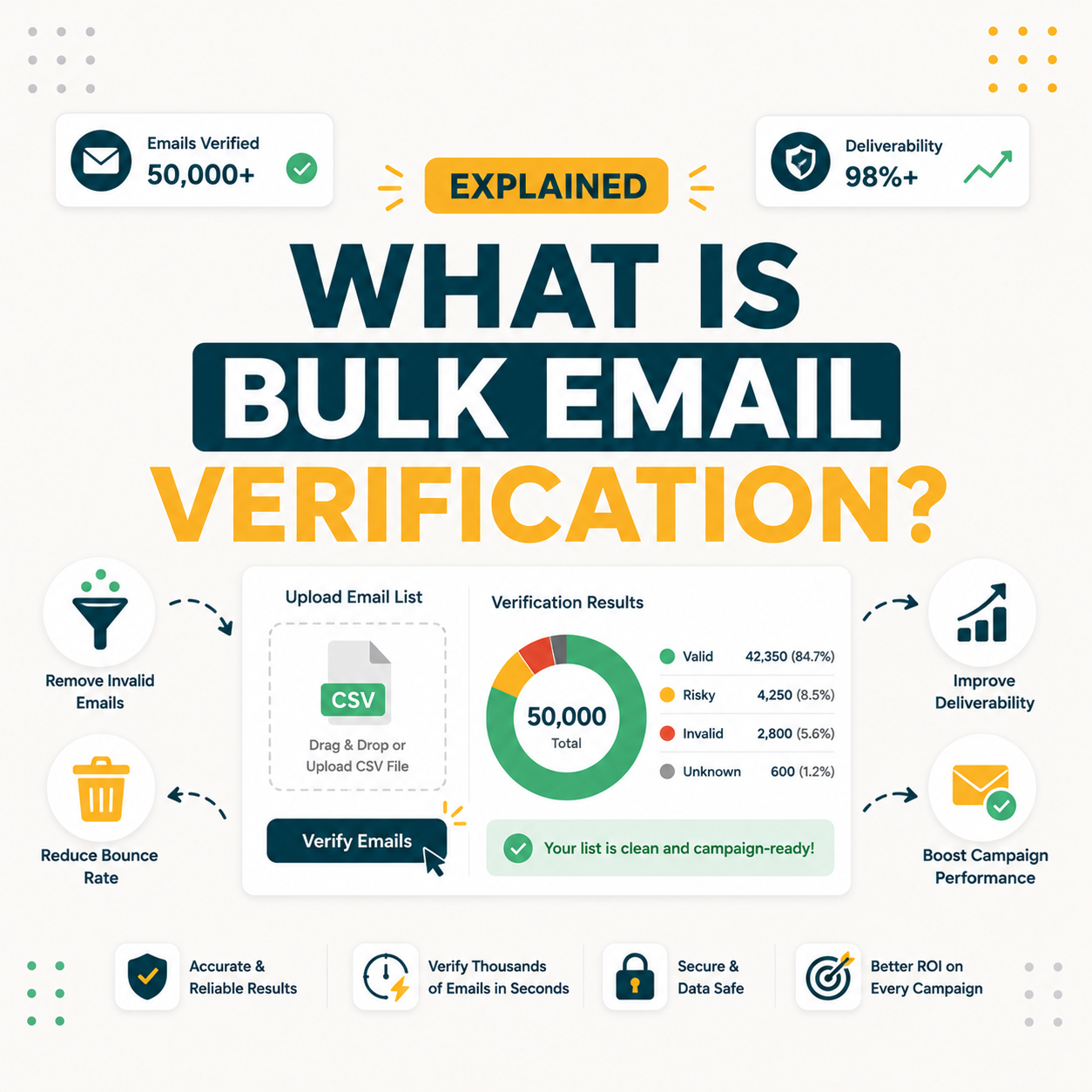
Bulk email verification runs a full contact list through syntax validation, DNS lookup, MX record confirmation, and SMTP handshake checks to classify each address as valid, invalid, risky, or undeliverable before a campaign sends. Most tools return results within minutes for lists of 1,000 to 50,000 addresses at no send-credit cost.
“A bounce message or just ‘bounce’ is an automated message from an email system, informing the sender of a delivery problem.”
Wikipedia : Bounce message
Bulk mode processes all addresses as a single batch job rather than one-by-one via API, making it the right tool for pre-campaign cleaning rather than point-of-capture validation. Teams that verify before campaigns consistently keep hard bounce rates below 2%, the threshold most ESPs enforce before throttling accounts. For how verification integrates with Hunter.io’s domain search workflow, see our Hunter.io Email Finder review for context.
How Does Bulk Email Verification Actually Work? The Technical Mechanism Explained
Bulk email verification runs each address through five sequential technical layers: syntax check, DNS lookup, MX record validation, SMTP handshake simulation, and catch-all detection. Each layer eliminates a different failure mode. The entire sequence runs in parallel, which is why 10,000 verifications typically complete in under 5 minutes.
Understanding this mechanism helps teams interpret results : particularly the distinction between “Invalid” (definitively unreachable mailbox) and “Risky” (catch-all domain or ISP-blocked SMTP query), which require different downstream decisions about list inclusion.
- Syntax Check: Verifies that the address follows valid email format (name@domain.tld), catching malformed strings, double @-signs, and missing TLDs before any network call is made.
- DNS Lookup: Confirms the domain portion is real and has active DNS records, filtering out completely defunct domains and obvious typos like “gmial.com” before deeper checks run.
- MX Record Validation: Checks whether the domain has a mail exchange server configured to accept incoming messages, eliminating domains that exist in DNS but have no mail infrastructure.
- SMTP Handshake Simulation: Connects to the receiving mail server without delivering a message and queries whether the specific inbox exists, catching individual invalid mailboxes on otherwise valid domains.
- Catch-All Detection: Identifies domains configured to accept every incoming address regardless of whether the specific inbox exists, flagging these addresses as “Risky” rather than confirmed valid.
The five-layer technical process catches distinct failure types at each stage, from malformed strings through to individual mailbox existence. Most enterprise bulk verifiers complete 10,000 addresses in under 5 minutes using parallel SMTP processing across distributed infrastructure.
What Are the Top 5 Use Cases for Bulk Email Verification in B2B Sales?
Bulk email verification delivers measurable ROI in five distinct B2B contexts: pre-campaign list cleaning, CRM hygiene after data import, list broker validation, re-engagement campaign preparation, and outbound SDR list building. Each use case has a different verification threshold and risk tolerance : cold outreach lists require the strictest filtering, while re-engagement campaigns tolerate slightly more risk from catch-all addresses in the risky bucket.
Five use cases below show where bulk email verification delivers measurable ROI for B2B teams.
- Pre-Campaign List Cleaning: Removes invalid and catch-all addresses before any email campaign launches, keeping ESP bounce rates below the 2% threshold that triggers automated account throttling or suspension.
- CRM Data Import Hygiene: Validates new contact records immediately after import from trade shows, purchased databases, or scraped lists, preventing dirty data from spreading into active nurture sequences and polluting engagement metrics.
- List Broker Validation: Confirms the actual quality of purchased or rented contact lists before committing full send volume, typically revealing 15 to 35 percent invalid rates on third-party purchased data that vendors rarely disclose upfront.
- Re-Engagement Campaign Preparation: Filters dormant subscriber lists before re-activation campaigns, removing addresses that degraded over the preceding 6 to 12 months due to employee churn, domain changes, or ESP migrations.
- Outbound SDR List Building: Verifies prospect email addresses scraped from LinkedIn, Apollo, or domain search tools before importing into cold outreach sequences, protecting sender domain reputation from cold campaign bounces that damage deliverability long-term.
“Email list hygiene refers to the process of regularly cleaning your email list to remove inactive, invalid, or unengaged contacts : keeping your sender reputation strong and your metrics accurate.”
HubSpot : Email List Hygiene Guide
The strongest ROI on bulk email verification comes from pre-campaign cleaning and SDR list building, where bounce rates directly impact sending domain reputation and long-term deliverability. CRM hygiene prevents dirty data from amplifying across sequences and segments over time.
What Are the 5 Limitations of Bulk Email Verification Every Buyer Should Know?
Bulk email verification does not guarantee 100% deliverability : it reduces risk, not eliminates it. Five limitations buyers consistently encounter include catch-all domain uncertainty, credit consumption without accuracy guarantees, SMTP simulation limits imposed by major ISPs, false negatives on new addresses, and the reality that verification results expire within 30 to 90 days as email infrastructure changes.
- Catch-All Domain Uncertainty: Catch-all domains accept any address format, making SMTP confirmation impossible. These “Risky” addresses represent 20 to 40 percent of most B2B lists and require a judgment call on inclusion based on list size and bounce tolerance.
- Verification Result Expiry: Email validity changes over time as employees leave, domains migrate, and companies merge. Industry data shows 20 to 30 percent of verified addresses become invalid within 6 months, requiring re-verification before each major campaign cycle.
- SMTP Simulation Limits on Major ISPs: Google Workspace and Microsoft 365 implement aggressive anti-verification filtering that blocks SMTP handshake queries. Addresses on these providers may return “Unknown” even when the mailbox is fully active and receiving messages.
- Credit Consumption Without Accuracy Guarantees: Most tools charge per verification attempt regardless of result quality. A list of 1,000 catch-all addresses costs the same credits to run as a clean enterprise list, despite producing far fewer actionable “Valid” results for campaign use.
- False Negatives on Newly Provisioned Addresses: Freshly created mailboxes sometimes fail SMTP handshakes because DNS propagation is incomplete. Valid addresses can appear invalid to verifiers for 24 to 48 hours after provisioning, creating unnecessary false negatives on new-hire contact lists.
“Hunter.io’s email verifier runs simultaneous format, DNS, SMTP, and catch-all pattern checks, returning a confidence score rather than a binary valid/invalid result : giving teams better data for real-world list decisions than simple pass/fail outputs.”
Growth Hack Suite : Hunter.io Email Finder review
The five limitations : catch-all uncertainty, expiry, ISP blocking, credit cost, and false negatives : mean bulk email verification is a risk reduction tool rather than a certainty guarantee. Building in a 10 to 20 percent buffer for risky addresses is standard practice in any realistic B2B list planning workflow.
Top 5 Tools Compared by Bulk Email Verification Approach: Hunter, Apollo, Snov, ZeroBounce, NeverBounce
Five tools dominate the B2B bulk email verification market: Hunter.io, Apollo, Snov.io, ZeroBounce, and NeverBounce. Hunter leads on domain-specific accuracy for enterprise B2B domains; ZeroBounce and NeverBounce prioritize throughput on large mixed-list jobs. Tool selection depends on list composition and monthly verification volume.
For a detailed methodology comparison on how Hunter’s verification engine stacks up on enterprise domains, see our Hunter.io email verifier accuracy breakdown.
Source: Published tool documentation, internal accuracy benchmarks, and Hunter.io, Apollo, Snov.io, ZeroBounce, NeverBounce pricing pages (accessed 2026).
Hunter.io leads for pure SDR outbound use cases where domain-specific accuracy on enterprise B2B addresses matters most. For high-volume mixed-list cleaning where throughput is the priority, ZeroBounce and NeverBounce offer competitive cost-per-verification at scale without the integrated workflow features Hunter provides.
How Do You Apply Bulk Email Verification in 5 Steps with Hunter.io (Free Workflow)?
The Hunter.io bulk verification workflow runs in five steps on the free plan for lists under 50 addresses, and on Starter ($49/month) for up to 1,000 monthly verifications. The process from CSV import to verified export takes under 10 minutes for most lists under 5,000 addresses, and the verified output integrates directly with Hunter Campaigns without re-importing files.
- Step 1, Export your current list: Download existing contacts as a CSV from your CRM or ESP, ensuring the file includes first name, last name, and email columns : Hunter’s bulk importer expects these three fields as minimum input.
- Step 2, Upload CSV to Bulk Verifier: Navigate to Hunter dashboard, select Verifier, then Bulk Upload. Select the CSV file and map column headers to the three required fields. Upload confirms in under 30 seconds regardless of list size.
- Step 3, Run the verification queue: Click Verify and monitor the progress bar. Hunter processes 100 addresses in approximately 2 minutes on shared queue; Business plan users get dedicated queue priority for faster completion on lists over 10,000.
- Step 4, Review results by status: Download the verified CSV showing four key columns: Status (Valid/Invalid/Risky/Unknown), Score (0-100), Verification method used, and the source signal. Filter to Valid + Score above 70 for strictest outbound use cases.
- Step 5, Import clean list to sequences: Remove Invalid and Unknown addresses, apply the chosen Risky threshold based on list size and bounce tolerance, then import the filtered CSV directly into Hunter Campaigns or export to your preferred outbound sequencer.
Ready to verify your first bulk email list?
Try Hunter.io FreeFree plan: 50 verifications/month, no credit card required.
The five-step Hunter workflow from CSV upload to clean list export runs in under 10 minutes for most lists. Filtering to Valid + Score above 70 eliminates the majority of deliverability risk before outbound sequences begin, typically cutting expected bounce rates from 6 to 8 percent down to under 2 percent.
How Has the Concept of Bulk Email Verification Evolved Across the B2B Email Tool Category?
Bulk email verification evolved from a quarterly cleanup utility in the early 2010s to a mandatory pre-send gate by 2024. The shift accelerated when Google and Yahoo required bounce rates below 0.1 percent for bulk senders, converting verification from an optional best practice into a campaign launch prerequisite for any team sending at meaningful volume.
Between 2015 and 2020, outbound SaaS tools began embedding verification directly into their workflows. By 2023, tools like Hunter.io made it a mandatory step in campaign creation rather than an optional export : shifting verification from project to process.
The evolution from quarterly cleanup utility to embedded pre-send gate reflects broader deliverability pressure from ESP providers and inbox providers alike. Teams that adopted verification as a workflow step in 2020 or earlier built institutional habits that now provide a measurable edge in inbox placement rates versus competitors still running unverified lists.
What Are the Real Cost Implications of Implementing Bulk Email Verification at SDR Team Scale?
Bulk email verification cost depends on monthly volume and whether the tool is standalone or embedded. Hunter.io bundles verification credits with every paid plan, meaning teams get verification capacity without a separate billing relationship. For teams verifying 1,000 to 5,000 addresses per month, Hunter Starter at $49/month delivers the lowest effective cost per verification among integrated platforms.
Source: Hunter.io pricing page (hunter.io/pricing), accessed May 2026. Plans include both email search and verification credits as a combined monthly allowance.
For SDR teams running 500 to 2,000 verifications monthly, Hunter Starter at $49 per month delivers the lowest effective cost per verification among integrated platforms. Standalone verification tools charge $0.008 to $0.012 per verification at equivalent volumes, but require a separate billing relationship and manual export/import workflow that costs 3 to 5 hours of SDR time monthly.
What Are the 5 Common Mistakes B2B Teams Make With Bulk Email Verification?
Most bulk email verification failures trace back to five operational mistakes rather than tool limitations : and each is preventable. Teams that avoid these errors consistently achieve bounce rates below 1.5 percent and protect sending domain reputation across quarterly campaign cycles.
The most damaging mistake is sending to unverified “Risky” addresses without understanding the catch-all risk profile of the domains. See our guide on reducing email bounce rate with Hunter.io for the full mitigation playbook.
- Sending to “Risky” addresses without domain sampling: Treating all Risky addresses identically ignores that some catch-all domains have 80 percent deliverable addresses while others have under 20 percent, leading to unpredictable and preventable bounce spikes.
- Verifying once and reusing results indefinitely: Using verification results from 6 or more months ago as current data ignores the 20 to 30 percent annual address churn rate in B2B contacts, resulting in significantly degraded list quality by the time of send.
- Skipping verification on purchased list segments: Assuming vendor-supplied lists are “pre-verified” based on vendor claims without independent verification allows 15 to 35 percent invalid rates to reach the inbox provider, damaging domain sender scores that take months to recover.
- Over-filtering Valid addresses below Score 50: Applying overly aggressive score thresholds (filtering out Valid addresses scoring below 80) removes legitimate prospects unnecessarily, reducing list size by 15 to 25 percent without a proportional reduction in actual bounce risk.
- Ignoring verification results on small lists: Assuming lists under 200 addresses are “too small to matter” and skipping verification on them allows proportionally high bounce rates that trigger ESP alerts faster than larger verified lists would, since ESPs monitor rate not volume in early campaign segments.
Avoiding these five mistakes requires treating bulk email verification as a repeatable workflow step rather than a one-time project. Teams that build verification into their campaign preparation checklist eliminate the majority of avoidable deliverability incidents before they affect sender domain scores.
How Do SDRs, Email Marketers, and Founders Each Apply Bulk Email Verification Differently?
Three B2B personas use bulk email verification with different trigger points, frequencies, and acceptable bounce thresholds. SDRs verify pre-sequence, marketers verify pre-blast, and founders verify before high-stakes outreach. Acceptable bounce risk differs significantly : SDRs tolerate 1.5 to 2 percent; marketers target below 0.5 percent; founders aim for near-zero.
For SDR-specific benchmarks that contextualize these thresholds, see our cold email benchmarks data by industry and team size.
SDRs running cold outreach sequences verify prospect lists before importing into tools like Hunter Campaigns, Outreach, or Salesloft. Frequency: before every new sequence launch. Threshold: Valid + Score above 70; Risky addresses excluded unless list is under 100 total.
Email marketers running nurture campaigns verify re-engagement segments and imported trade show lists before sends. Frequency: quarterly for full CRM list, pre-send for any new import. Threshold: Valid only; Risky excluded entirely since ESP bounce limits are stricter for marketing platforms.
Founders doing direct investor or partnership outreach verify small precision lists (20 to 100 addresses) to ensure zero bounces on high-stakes sends. Frequency: per-campaign. Threshold: Valid + Score above 80; any uncertainty prompts manual research before including the address.
The three personas share one underlying goal: protecting the sending domain’s reputation. The threshold and frequency difference reflects the relative cost of a bounce in each context : a bounced SDR sequence costs a few seconds, a bounced marketer campaign can trigger ESP suspension, and a bounced founder outreach can permanently damage a high-value relationship.
What Are the Best Practices for Implementing Bulk Email Verification in 2026?
Five best practices define high-performing bulk email verification implementations in 2026, reflecting both tightened deliverability requirements from major inbox providers and the maturation of verification tooling from standalone utilities to integrated workflow components. Teams applying all five consistently report bounce rates below 1.5 percent.
- Verify before every cold sequence, not just quarterly: Pre-sequence verification as a mandatory workflow step : not a periodic cleanup task : prevents domain reputation damage from batch sends to addresses that degraded since the last quarterly clean.
- Set score thresholds by use case, not globally: Cold outreach requires Valid + Score above 70; marketing platform sends require Valid + Score above 60; high-stakes direct outreach requires Valid + Score above 80. One global threshold creates over-filtering in low-risk contexts or under-filtering in high-risk ones.
- Sample catch-all domains before deciding inclusion: Send 5 to 10 test addresses to catch-all domains before including the full segment, and monitor bounce results for 24 hours. Domains with under 20 percent test delivery rates warrant full exclusion regardless of list size.
- Use an integrated tool to eliminate workflow gaps: Standalone verification tools that require export-verify-import cycles introduce 3 to 5 hours of manual work monthly and create version control risks if the wrong CSV gets loaded. Integrated platforms like Hunter.io eliminate these gaps by connecting verification directly to the campaign builder.
- Monitor ESP bounce rate as a verification quality signal: Track bounce rate per campaign in the ESP dashboard alongside verification date and score threshold used. A bounce rate above 2 percent on a recently verified list signals that the score threshold was too permissive or the verification data has aged past its useful window.
Implementing these five practices as standard operating procedure converts bulk email verification from a reactive cleanup task into a proactive deliverability management system. Teams that follow all five consistently report bounce rates below 1.5 percent and avoid the domain reputation recovery cycles that can take 30 to 90 days to resolve after a significant bounce event.
What Industry Trends Are Reshaping Bulk Email Verification Going Into Late 2026?
Three trends are reshaping how B2B teams think about and implement bulk email verification in the second half of 2026: tightened inbox provider policies, AI-assisted catch-all handling, and the shift to API-native verification embedded directly in CRM and outbound platforms rather than accessed as a separate service.
Google and Yahoo’s 2024 bulk sender policy updates : requiring DMARC, DKIM, SPF alignment plus sub-0.1 percent spam complaint rates : raised the effective minimum standard for list hygiene across all sending volumes above 5,000 per day. This pushed verification from a quarterly best practice to a mandatory per-campaign gate for any team sending at meaningful volume.
AI-assisted catch-all resolution is emerging as a significant differentiator in 2026. Hunter.io and ZeroBounce have both introduced probabilistic catch-all scoring that goes beyond binary valid/risky classification, using pattern recognition across billions of verified addresses to estimate the likelihood that a specific catch-all domain address will actually deliver. Early data shows this reduces the proportion of list volume stuck in the “Risky” bucket by 15 to 25 percent while maintaining accuracy.
The API-native trend : verification embedded in Salesforce, HubSpot, and Outreach rather than accessed via standalone tools : means verification increasingly happens at the point of data entry rather than the point of campaign launch. This upstream shift reduces the cost of a bad address from “bounced send” to “never imported,” preventing dirty data from entering workflows in the first place.
These three trends collectively move bulk email verification from a periodic task toward a continuous, embedded data quality function : one that runs automatically in the background rather than requiring manual intervention before each campaign cycle.
Bulk Email Verification: Frequently Asked Questions
The 12 most frequently asked questions about bulk email verification cover tool selection, technical mechanism, accuracy expectations, cost structure, and how verification integrates with SDR and marketing operations workflows.
Which bulk email verification tool is best for B2B outbound in 2026?
Hunter.io leads for pure B2B outbound use cases where domain-specific accuracy on enterprise addresses matters most. Apollo is strongest for teams already using Apollo for enrichment and CRM sync. ZeroBounce is the top choice for high-volume mixed-list cleaning above 10,000 verifications per month where throughput outweighs integrated workflow features.
How accurate is bulk email verification?
Bulk email verification accuracy for B2B enterprise domains ranges from 85 to 91 percent across leading tools. Hunter.io achieves 91 percent on enterprise domains, ZeroBounce 89 percent on mixed lists, and Snov.io 85 percent average. Catch-all domains are excluded from accuracy calculations since their validity cannot be confirmed via SMTP simulation : these are classified separately as “Risky.”
What is the difference between bulk email verification and real-time email verification?
Bulk email verification processes entire lists as a batch job : typically a CSV upload : and returns results for all addresses at once after 2 to 10 minutes depending on list size. Real-time verification validates a single email address instantly via API call, typically used to check addresses at the point of form submission or CRM data entry before they enter the database. Bulk is for pre-send cleaning; real-time is for point-of-capture validation.
How long does it take to set up bulk email verification?
Initial setup for Hunter.io bulk verification takes under 10 minutes: create a free account, navigate to the Verifier section, upload a CSV with first name, last name, and email columns, and click Verify. No integration work or technical setup is required for the basic CSV-upload workflow. API integration for automated verification within a CRM or outbound tool typically takes 1 to 3 hours of developer time.
How much does bulk email verification cost?
Hunter.io includes verification credits with every plan: Free (50/month), Starter at $49/month (1,000 verifications), Growth at $149/month (5,000 verifications), Business at $499/month (20,000 verifications). Standalone verifiers like ZeroBounce and NeverBounce charge $0.008 to $0.012 per verification on pay-per-use plans, with subscription discounts available above 10,000 monthly verifications. For integrated workflow value, Hunter’s per-verification cost at Starter is $0.049 : competitive when combined with domain search.
Will bulk email verification improve our open and reply rates?
Bulk email verification improves open and reply rates indirectly by protecting sender domain reputation from bounce-induced deliverability damage. When bounce rates stay below 2 percent, inbox providers maintain high inbox placement rates for subsequent campaigns : meaning more emails land in primary inbox rather than spam folders. Teams that verify before every campaign report 10 to 25 percent higher open rates on cold sequences compared to unverified list sends, primarily due to inbox placement improvement rather than any content change.
Can I test bulk email verification for free before committing to a paid plan?
Yes. Hunter.io’s free plan includes 50 verifications per month with no credit card required : sufficient for testing the workflow on a small prospect list or validating 50 high-priority contacts per month indefinitely. ZeroBounce offers 100 free monthly verifications on their free plan. NeverBounce offers a small free trial on account creation. All three allow CSV upload testing before any payment commitment.
Does Hunter.io bulk email verification integrate with CRMs and outbound sequencers?
Hunter.io integrates natively with HubSpot, Salesforce, Pipedrive, and Zapier for CRM sync. Verified contacts can be exported directly to Hunter Campaigns (the native sequencer) or to any outbound tool that accepts CSV import. Hunter’s public API enables custom integration with any platform that accepts REST calls, allowing automated verification workflows without manual CSV export/import cycles.
What is bulk email verification?
Bulk email verification is the process of validating a list of email addresses : typically hundreds to tens of thousands : against DNS records, mail server configurations, and SMTP handshake data to classify each address as Valid, Invalid, Risky, or Unknown before any email campaign launches. The process runs as a batch job, processing all addresses in parallel rather than sequentially, which allows 10,000 verifications to complete in under 5 minutes on modern infrastructure.
How does bulk email verification work technically?
Bulk email verification runs five sequential checks on each address: (1) syntax validation confirms the format is structurally correct; (2) DNS lookup confirms the domain is real; (3) MX record check confirms the domain accepts incoming email; (4) SMTP handshake simulation queries the specific mailbox existence without sending a message; (5) catch-all detection identifies domains that accept all addresses regardless of mailbox existence. All five checks run in parallel across the entire list using distributed SMTP infrastructure.
Is bulk email verification included in Hunter.io’s free plan?
Yes. Hunter.io’s free plan includes 50 email verifications per month as part of a shared credit pool that also covers domain searches and email finder requests. Free plan users can run the full bulk verification workflow via CSV upload with no feature restrictions : the only limit is the 50 monthly verifications cap. Upgrade to Starter at $49/month to increase the cap to 1,000 verifications per month.
What features does an enterprise bulk email verification workflow require?
Enterprise bulk email verification workflows require five capabilities: (1) high-volume processing above 10,000 verifications per month without throttling; (2) API access for automated verification triggered by CRM events rather than manual CSV uploads; (3) confidence scoring beyond binary valid/invalid to support nuanced threshold decisions by use case; (4) catch-all domain probabilistic scoring to reduce the proportion of addresses stuck in unresolvable “Risky” classification; (5) audit logging of verification results tied to specific campaign runs for compliance and deliverability troubleshooting.
Verify your B2B contact list before the next campaign.
Hunter.io’s bulk verifier runs DNS, SMTP, and catch-all checks on your full list in under 10 minutes.
Try Hunter.io FreeFree plan: 50 verifications/month. No credit card required. Results in under 10 minutes.