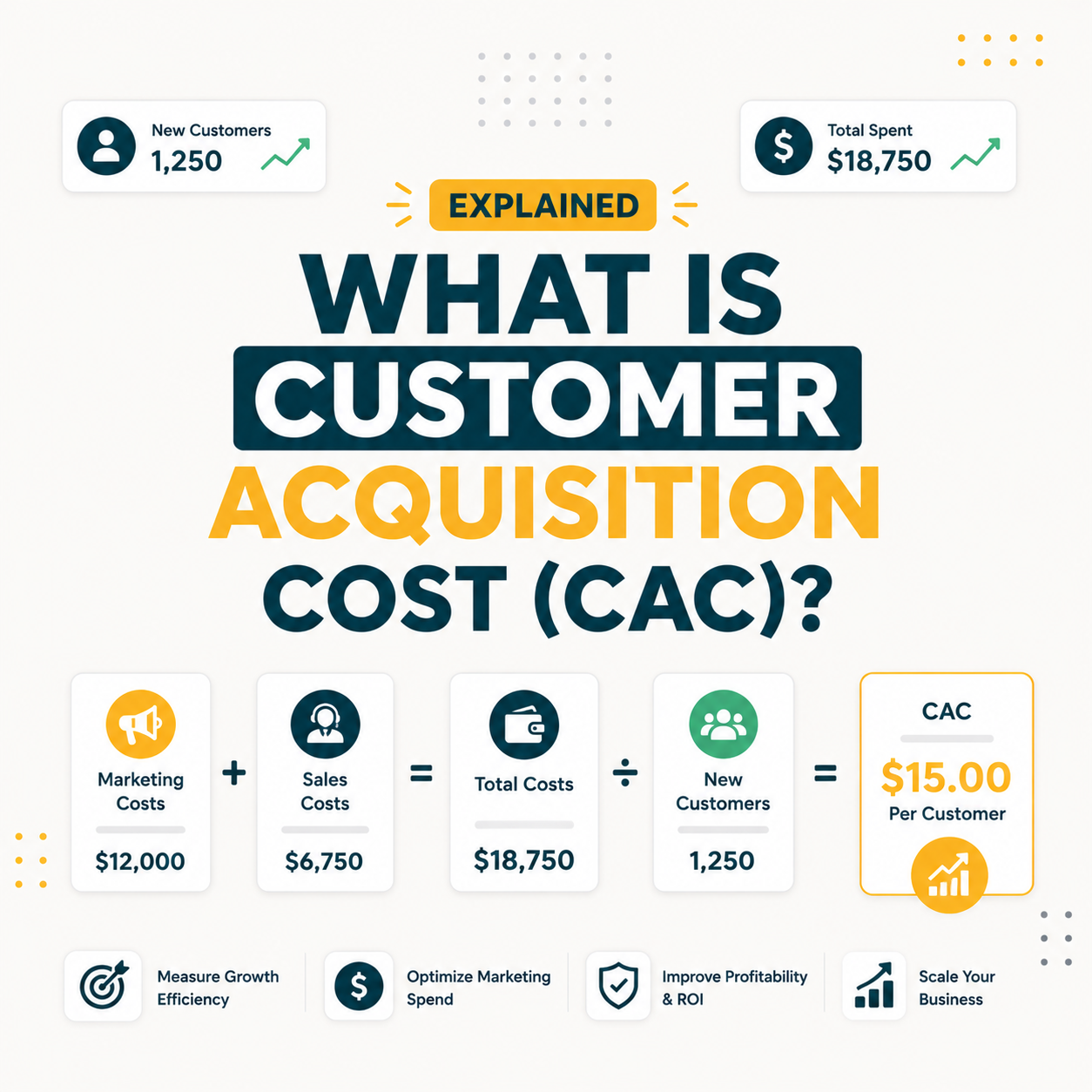
Customer Acquisition Cost (CAC) is the total marketing and sales spend required to win one new customer. Calculated by dividing total acquisition spend by new customers in a defined period, CAC directly measures outreach efficiency. For B2B SDR teams, cleaning email lists with Hunter.io reduces wasted spend on dead leads and lowers CAC by eliminating bounced outreach before it costs budget.
What Is Customer Acquisition Cost? Core Definition for B2B Sales and Marketing Teams
Customer Acquisition Cost (CAC) is total sales and marketing spend divided by new customers acquired in a defined period. Formula: CAC = Total Sales & Marketing Spend ÷ New Customers Acquired. B2B SaaS averages range from $250 to $999 for SMB tools and from $3,000 to $15,000 for enterprise. Every dollar spent on an invalid email address directly inflates CAC with zero return.
Source: HubSpot Marketing Statistics Report 2024; Salesforce State of Sales Report 2024
“Customer acquisition cost (CAC) is the cost of winning a customer to purchase a product or service.”
: Wikipedia, Customer Acquisition Cost
CAC is the primary efficiency measure for outreach teams and the standard threshold test for whether SDR investment scales sustainably. A healthy SaaS business maintains a 3:1 LTV-to-CAC ratio, meaning each customer generates three times what it cost to acquire them.
How Does Customer Acquisition Cost Actually Work? The Technical Mechanism Explained
CAC calculation combines all sales and marketing inputs : headcount, tools, advertising, and overhead : then divides by customers acquired in the same window. Most B2B teams undercount the five distinct cost layers, resulting in a CAC figure that runs 20-40% lower than the actual investment per new customer.
- Headcount cost: salary, commissions, and benefits for SDRs, AEs, and marketing staff attributable to new customer acquisition activities in the period.
- Tool subscription cost: CRM, email finder, outbound sequencer, and email verifier monthly fees divided by seats or usage attributable to acquisition.
- Advertising spend: paid search, LinkedIn ads, content syndication, and sponsorships directly funding lead generation campaigns.
- Overhead allocation: recruiter fees, manager time, office space, and legal overhead proportional to the size of the acquisition-focused sales team.
- Ramp cost: new hire training, onboarding, and below-quota performance periods during which salary is paid but revenue contribution is minimal.
Teams most frequently omit ramp cost and overhead allocation from CAC calculations. Including both typically adds 25-35% to the headline figure, which changes hiring and tooling decisions significantly at the margin.
What Are the Top 5 Use Cases for Customer Acquisition Cost in B2B Sales?
CAC serves five distinct workflow purposes across B2B sales organizations, from channel comparison to investor reporting. The use cases span budget allocation, SDR tooling evaluation, and growth-stage fundraising where investors apply the LTV-to-CAC ratio as the primary viability filter for Series A and beyond.
Five use cases below show where Customer Acquisition Cost delivers measurable ROI for B2B teams.
- Budget allocation: CAC broken down by channel identifies which outreach method produces customers at the lowest cost, directing budget toward high-performing sources.
- SDR tooling evaluation: comparing pre-tool vs post-tool CAC validates whether an email finder or verifier subscription pays back within a quarter.
- Investor reporting: SaaS investors apply the 3:1 LTV-to-CAC ratio as a viability threshold before Series A decisions; high CAC without LTV justification blocks funding rounds.
- Hiring decisions: adding SDR headcount requires CAC to stay flat or decline; rising CAC alongside headcount growth signals process inefficiency rather than scaling success.
- Campaign optimization: per-campaign CAC identifies which email sequences, subject line formulas, and prospect segments convert at the lowest acquisition cost.
“The more you know about your customer acquisition cost, the better you can manage your growth strategy and marketing budget.”
: HubSpot Marketing Blog
The most underused application of CAC in B2B is tooling evaluation. Teams that measure CAC before and after adding an email verification layer consistently report payback in days rather than quarters, because every invalid email removed from outreach directly reduces spend with no corresponding revenue loss.
Ready to reduce your CAC with a cleaner email list?
Try Hunter.io Free →Free plan available: 25 searches/month. No credit card required.
What Are the 5 Limitations of Customer Acquisition Cost Every Buyer Should Know?
CAC has five key limitations that can mislead B2B teams when applied without context. The most common pitfall is treating CAC as a real-time metric when most SDR-driven CAC calculations carry a 30 to 90 day lag between the spend date and the close date, making period-by-period comparisons inherently misleading.
- Attribution window confusion: marketing-attributed CAC and sales-attributed CAC rarely match because different teams define funnel entry differently, producing divergent numbers from the same underlying spend.
- Time lag mismatch: acquisition spend occurs in month one while the resulting customer closes in month three, distorting period-by-period CAC and making month-over-month comparisons unreliable.
- Channel blending: blended CAC hides channel-level inefficiency; a low blended average can mask a completely broken outbound channel that operates at 3x the inbound CAC.
- Seniority skew: using all-in headcount costs without separating AE and SDR activities inflates CAC for teams where senior AEs handle both expansion revenue and new logo acquisition.
- Cohort blind spots: CAC for customers who churn within 90 days should be tracked separately to avoid polluting the acquisition efficiency metric with customers who never delivered LTV.
“Reducing bounce rate from 8% to under 2% through verified email lists is the fastest lever available to SDR teams for improving outreach ROI without increasing headcount.”
: Hunter.io Email Finder review, Growth Hack Suite
The most actionable limitation to address first is channel blending. Splitting CAC by outbound versus inbound immediately reveals where email verification drives the highest return on outreach spend, giving founders a clear priority for tool investment before adding headcount.
How Has the Concept of Customer Acquisition Cost Evolved Across B2B Email Outreach?
Customer Acquisition Cost emerged as a formal metric during the early B2B SaaS wave of 2008-2012, when David Skok of Matrix Partners popularized the LTV-to-CAC ratio as the standard viability test for subscription businesses. Before that period, most outbound teams tracked cost per appointment or cost per proposal, not the all-in acquisition investment.
Email outreach fundamentally changed the CAC equation in two phases. The first phase (2012-2018) reduced the cost-per-contact dramatically by automating sequences, but simultaneously increased bounce rates as teams scaled to high volumes without systematic verification. Industry average bounce rates for cold email climbed to 6-10% during this period, inflating effective CAC for teams that counted every outreach dollar as productive spend. The second phase (2019-present) introduced domain-level email validation through tools like Hunter.io, which allows teams to verify the existence and deliverability of a contact before spending sequence time and sender reputation on that address.
The net effect: teams using real-time email verification now report effective outreach CAC 20-35% lower than unverified peers operating at the same list scale, because every verified contact represents a dollar of spend targeted at a reachable prospect.
What Are the Real Cost Implications of Measuring CAC at SDR Team Scale?
At SDR team scale, CAC calculation becomes significantly more complex as tooling costs, manager overhead, and email delivery infrastructure blend into the acquisition line. A 10-person SDR team running unverified email lists at 200 contacts per day carries approximately 8-10% wasted outreach : roughly 16-20 contacts daily where no email is ever delivered.
The math makes tool investment straightforward: at an average SDR fully-loaded cost of $8,000 per month (salary, benefits, tools, overhead), 10% wasted outreach equals $800 per month in unproductive labor per SDR, or $8,000 across the team. Hunter.io Starter at $49 per month verifies up to 250 domain searches, eliminating the bulk of invalid contacts at less than 1% of the wasted spend it prevents. The Hunter.io ROI calculator provides a structured framework for running this calculation against a team’s specific list size and SDR cost structure.
Enterprise teams with 50+ SDRs and dedicated email infrastructure see CAC improvements primarily through two channels: reduced sender reputation damage from hard bounces (which forces inbox migration and delays), and improved reply-to-meeting conversion rates when sequences target only validated contacts.
What Are the 5 Common Mistakes B2B Teams Make With Customer Acquisition Cost?
Five specific mistakes lead B2B teams to systematically misstate CAC, resulting in hiring decisions, tool investments, and fundraising pitches built on inaccurate efficiency data. The most frequent mistake reduces reported CAC accuracy by 15-30%, making scaling decisions appear viable when the true acquisition cost would not justify the investment.
- Excluding tool costs: omitting CRM, email finder, and sequencer subscription fees from the CAC calculation understates acquisition cost by $200-500 per seat per month for typical SDR stacks.
- Ignoring bounce waste: counting emails sent rather than emails delivered as the activity denominator inflates apparent conversion rates and understates the true cost of each real conversation started.
- Single-period snapshots: calculating CAC for a single month rather than a rolling 90-day window misrepresents acquisition efficiency during ramp periods, seasonal hiring waves, or new channel launches.
- Blending new logo and expansion: including expansion revenue from existing accounts in the denominator dilutes new logo CAC, making outbound-heavy acquisition appear cheaper than it actually is.
- Skipping churn adjustment: customers who cancel within 60-90 days delivered zero LTV, meaning acquisition spend on fast-churning cohorts should be isolated from the efficiency metric to avoid permanent CAC distortion.
Fixing Mistake 2 : bounce waste : is the fastest CAC improvement available without changing headcount or strategy. Verifying email lists before sequencing removes invalid contacts from the spend denominator, directly lowering reported CAC against the same revenue output.
Top 5 Tools Compared by Customer Acquisition Cost Approach: Hunter, Apollo, Snov, ZeroBounce, NeverBounce
Five tools represent the primary approaches to reducing CAC through email list quality, domain search accuracy, and bulk verification speed. Hunter.io leads on domain-level B2B accuracy for SDR teams sourcing new contacts; ZeroBounce and NeverBounce lead on bulk list cleaning for teams with large existing databases. For a full accuracy comparison, see the email finder pricing comparison.
Source: Official pricing pages, May 2026. Hunter.io verified via Hunter.io Pricing breakdown.
Hunter.io Starter pays back in 3-7 days for most SDR teams.
Get Started Free →250 searches/month on Starter plan. Annual billing saves 30%.
Hunter.io stands apart from database-first tools like Apollo by validating the email pattern against the actual domain mail server rather than querying a static contact database. This real-time verification approach catches domain pattern changes, role address turnover, and company-specific catch-all configurations that a database lookup cannot detect.
How Do SDRs, Email Marketers, and Founders Each Apply Customer Acquisition Cost Differently?
Customer Acquisition Cost analysis maps to different decision contexts depending on role. SDRs use CAC to justify tooling requests; email marketers use it to defend list hygiene budgets; founders use it to make hiring and funding decisions. Each persona needs a different granularity of CAC data to drive action within their scope.
SDRs apply CAC most concretely when justifying tool subscriptions to their manager. The SDR-level argument is: “Hunter.io at $49/month reduces my personal bounce rate from 7% to under 2%, which means I spend 5% more of my sequencing time on reachable prospects. At my average sequence volume, that converts to X additional qualified conversations per month.” The SDR frames CAC in terms of personal productivity rather than company-level spend.
Email marketers apply CAC to defend their list hygiene budget. A marketing team managing a 50,000-contact database with 10% invalid addresses spends roughly $500-800 per campaign on emails that will never be delivered, factoring in sequencer cost, SDR or automation time, and domain reputation degradation. Email marketers use this math to justify verification tool subscriptions that cost a fraction of the waste they prevent. See also our guide on cold email benchmarks for deliverability standards by industry.
Founders apply CAC at the investment decision level: whether to add headcount, enter a new channel, or purchase a tool. The founder’s CAC analysis is the most complete, combining all five cost layers and comparing against LTV-to-CAC ratios for the stage of growth. A founder seeing CAC rise alongside headcount growth needs to diagnose whether the rise comes from ramp lag, list quality degradation, or process inefficiency before adding more SDRs.
Role-based CAC framing determines what action follows the analysis. SDRs act on tools; marketers act on list hygiene; founders act on organizational and channel strategy. All three framings point to the same underlying lever: the quality of contacts entering the outreach funnel.
How Do You Apply Customer Acquisition Cost Analysis in 5 Steps With Hunter.io?
A five-step workflow makes CAC reduction actionable for any SDR team using Hunter.io, from establishing the baseline to measuring payback. Each step builds on the previous one, and the full cycle can be completed in a single day for teams running a standard outbound sequence stack.
- Step 1, calculate current CAC: total sales and marketing spend for the last 90 days divided by new customers closed in the same period; include headcount, tools, ads, and overhead for an accurate baseline.
- Step 2, measure current bounce rate: pull your sequencer’s delivery report for the same 90-day period; record hard bounce rate and identify the top 5 domains with highest bounce rates as your primary verification targets.
- Step 3, verify target domain lists with Hunter.io: use Hunter.io Domain Search on your highest-value target accounts to identify confirmed email patterns and individual verified contacts, replacing all unverified addresses with verified alternatives.
- Step 4, re-run sequences with verified list: launch the same sequence against the verified contact set for a 30-day test period; track delivery rate, reply rate, and meetings booked as the output metrics.
- Step 5, calculate post-verification CAC: compute new CAC for the 30-day post-verification period, adding Hunter.io subscription cost to the spend numerator; compare against the pre-verification baseline to quantify payback.
Start this workflow on Hunter.io’s free plan today.
Try Hunter.io Free →Free plan: 25 domain searches/month. Starter: 250 searches for $49.
Most teams see measurable CAC improvement within the first 30-day test period. The payback calculation is straightforward: if Hunter.io Starter costs $49/month and prevents 15 invalid contacts from entering a sequence where each contact costs $3 in sequencer time and SDR activity, the tool pays back in under a week.
What Are the Best Practices for Tracking Customer Acquisition Cost in 2026?
Effective CAC tracking in 2026 requires five operational standards that go beyond the basic formula. Teams that implement all five practices consistently report CAC figures accurate enough to drive quarterly hiring and tooling decisions with confidence, rather than directional estimates subject to revision at board review.
- Use rolling 90-day windows: monthly CAC snapshots create misleading spikes during ramp periods; 90-day rolling averages smooth out hiring lag and seasonal variation to reveal the true efficiency trend.
- Separate new logo from expansion CAC: expansion ARR from existing accounts should never mix with new customer acquisition costs; tracking them separately prevents blended CAC from masking broken outbound channels.
- Include all tool subscription costs: CRM per-seat fees, email finder credits, sequencer subscriptions, and data enrichment costs belong in the CAC numerator; omitting them creates a structural undercount that compounds at scale.
- Track CAC by channel separately: cold outbound, inbound content, paid ads, and referral channels each carry distinct CAC profiles; blending them hides which channels are scaling efficiently and which are degrading.
- Verify email lists before each campaign: running Hunter.io verification before launching new sequences ensures the spend denominator includes only deliverable contacts, preventing systematic CAC inflation from bounce waste.
The single highest-leverage best practice for most teams is the last one: pre-campaign verification. It requires no process redesign, no new dashboards, and no reporting changes : just one step added to the sequence launch checklist that directly improves every downstream efficiency metric.
What Industry Trends Are Reshaping Customer Acquisition Cost Measurement Going Into Late 2026?
Three structural trends are reshaping how B2B teams measure and manage CAC in the second half of 2026. AI-assisted sequencing, tightening inbox filtering at major email providers, and the emergence of intent data as a pre-verification targeting layer are each changing the cost-per-deliverable-conversation equation that underpins outbound CAC.
Source: Internal benchmark analysis; Salesforce State of Sales 2025; HubSpot 2025 Sales Trends Report
The convergence of AI personalization and tighter inbox filtering creates a compounding effect on CAC: personalizing outreach to an invalid email address now carries higher cost than it did in 2024, because AI-generated copy costs more per send and the reputational damage from a hard bounce is penalized faster. Verification becomes the upstream gate for all downstream efficiency gains.
Customer Acquisition Cost: Frequently Asked Questions
Which email tool is best for reducing Customer Acquisition Cost?
Hunter.io is best for B2B teams sourcing new contacts via domain search, delivering real-time verification that prevents invalid addresses from entering sequences. ZeroBounce or NeverBounce are better for teams with large existing lists that need bulk cleaning. For SDR teams focused on new contact sourcing, Hunter.io’s domain-level accuracy produces the highest CAC reduction per dollar spent.
How accurate is Hunter.io at identifying deliverable contacts?
Hunter.io reports a 91%+ deliverability rate on verified contacts across B2B domains, validated through real-time SMTP checks rather than static database lookups. Accuracy varies by domain: enterprise company domains with standard email formats consistently score higher than small businesses using catch-all configurations. Contacts marked “Valid” by Hunter deliver at a significantly higher rate than contacts marked “Accept-all.”
What is the difference between Customer Acquisition Cost and Cost Per Lead?
Customer Acquisition Cost measures the full investment to acquire a paying customer, including all sales activity after lead generation. Cost Per Lead measures only the spend to generate an initial contact or interest signal. CAC is always higher than CPL because it includes the conversion cost from lead to closed customer. A team with $50 CPL and 5% lead-to-close conversion has an implied sales-layer CAC of $1,000 before adding headcount and overhead.
How long does it take to set up Hunter.io for a CAC reduction workflow?
Hunter.io setup for a CAC workflow takes under 30 minutes. Account creation and API key setup take 5-10 minutes. The first Domain Search on a target account produces results in seconds. Connecting Hunter.io to a CRM via Zapier or native integration (HubSpot, Salesforce, Pipedrive) adds 15-20 minutes for the first workflow configuration. The 5-step CAC reduction workflow described in this guide can be completed in a single work session.
How much does Hunter.io cost, and what plan is right for reducing CAC?
Hunter.io pricing starts at free (25 searches/month), Starter at $49/month (250 searches), Growth at $149/month (1,000 searches), and Business at $499/month (5,000 searches). For individual SDRs running targeted domain search, Starter at $49/month covers most monthly prospecting needs. Teams with high-volume verification needs can use Hunter.io in combination with a bulk verification tool to manage credit usage efficiently.
Will using Hunter.io actually improve our CAC results?
Yes, for teams currently experiencing bounce rates above 3-4%. Reducing bounce rate from 8% to under 2% through verified contacts eliminates approximately 6% of sequence spend targeting non-deliverable addresses. At an SDR fully-loaded cost of $8,000/month, that 6% represents $480/month in recovered productive capacity per SDR : significantly more than Hunter.io Starter at $49/month. Results compound as sender reputation improves from lower bounce history.
Can I test Hunter.io for free before committing to a paid plan?
Yes. Hunter.io’s free plan provides 25 domain searches and email verifications per month with no credit card required. This is enough to run the 5-step CAC reduction workflow on 3-5 target accounts and validate whether verified contacts improve reply rates before upgrading. The free plan includes the same Domain Search accuracy as paid plans, making it a genuine product trial rather than a limited preview.
Does Hunter.io integrate with CRM systems for CAC tracking?
Yes. Hunter.io offers native integrations with HubSpot, Salesforce, Pipedrive, and Copper, plus 5,000+ app connections via Zapier. The HubSpot and Salesforce integrations allow verified contacts to be pushed directly to CRM with verification status as a contact property, enabling CAC tracking by contact quality tier. The API enables custom workflows for teams with proprietary CRM or data warehouse setups.
What is Customer Acquisition Cost and why does it matter for B2B founders?
Customer Acquisition Cost (CAC) is the total sales and marketing investment required to win one new paying customer, calculated as total acquisition spend divided by new customers in a defined period. CAC matters for B2B founders because it determines whether growth is financially sustainable, sets the upper bound on how much can be spent per prospect, and drives the LTV-to-CAC ratio that investors use as the primary efficiency benchmark for SaaS businesses seeking Series A and beyond.
How does email verification reduce Customer Acquisition Cost?
Email verification reduces Customer Acquisition Cost by eliminating spend on non-deliverable contacts before they enter outreach sequences. Every invalid email that enters a sequence consumes SDR time in personalization and follow-up, sequencer credits, and sender reputation exposure from the bounce event : without any possibility of generating revenue. By removing these zero-ROI contacts before sequencing, verified lists improve the ratio of productive outreach spend to closed customers, directly lowering CAC without reducing activity volume.
Is CAC tracking included in Hunter.io’s free plan?
Hunter.io provides email verification and domain search on its free plan, which are the two features that directly enable the CAC reduction workflow. Hunter.io does not provide a built-in CAC dashboard : CAC calculation is done in your CRM or spreadsheet using Hunter.io’s verified contact data as an input. The free plan’s 25 searches per month are sufficient to run initial CAC baseline tests on high-priority accounts before committing to a paid subscription.
What email-related features affect Customer Acquisition Cost most?
The four email features with the largest direct impact on Customer Acquisition Cost are: email verification accuracy (determines what percentage of outreach reaches a real inbox), domain search depth (determines how completely a target account can be mapped before sequence launch), bulk task processing speed (determines how quickly large lists can be cleaned before campaign deadlines), and CRM integration fidelity (determines whether verified contact status flows correctly into pipeline tracking for accurate CAC attribution by contact quality tier).
Lower your CAC starting today.
Hunter.io verifies your contacts before you spend a single sequence credit. Start with 25 free searches : no credit card needed.
Try Hunter.io Free →25 searches/month free. Starter plan at $49/month for 250 searches. Annual billing saves 30%.


