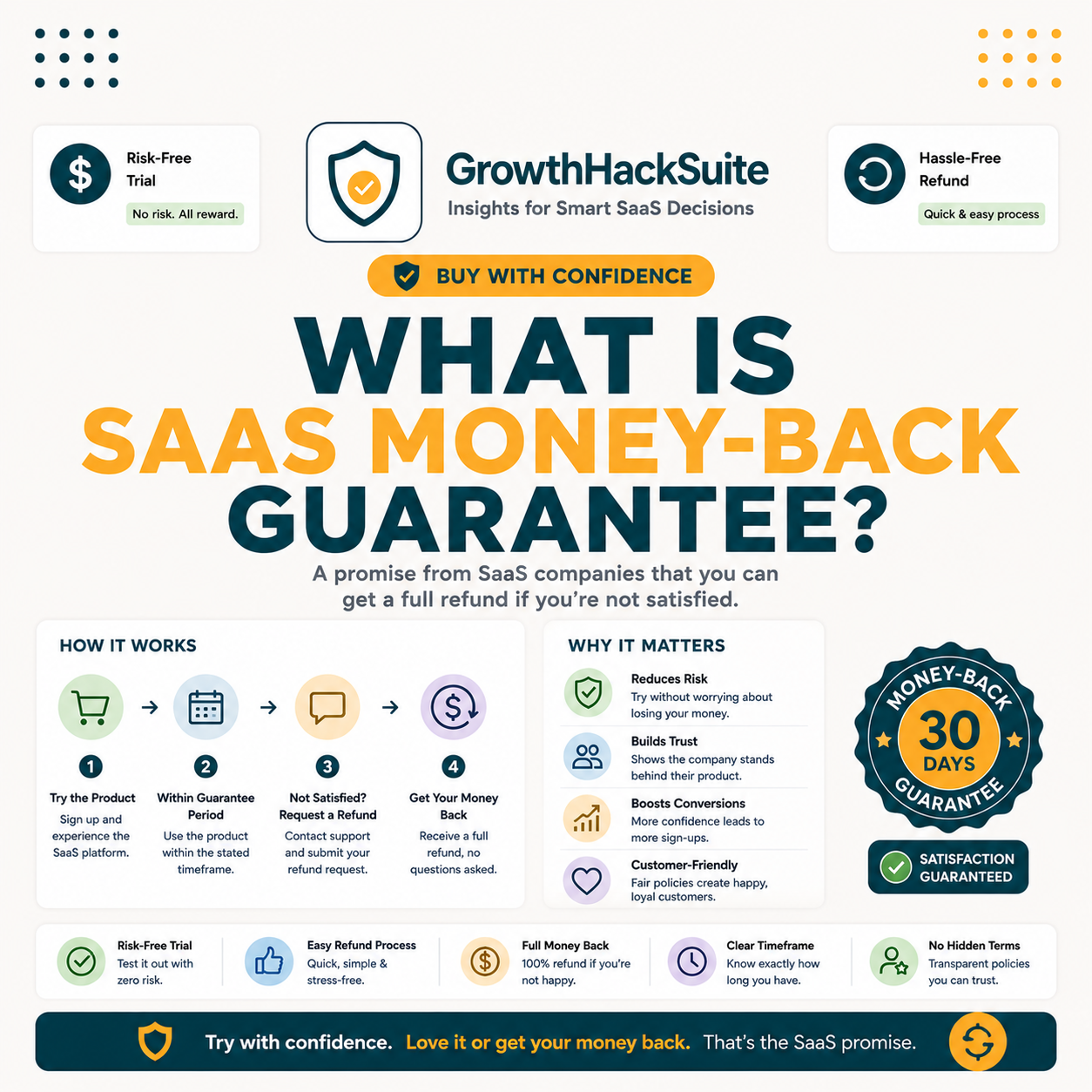
A SaaS money-back guarantee is a vendor promise to refund the subscription fee if a buyer cancels within a defined window, typically 14 to 30 days, without requiring justification. For B2B sales teams evaluating email tools, this policy removes financial risk before committing to a paid plan. Hunter.io offers a 30-day money-back guarantee on all paid plans, making it low-risk to test at scale.
What Is SaaS Money-Back Guarantee? Core Definition for B2B Sales and Marketing Teams
A SaaS money-back guarantee is a contractual refund commitment from a software vendor, allowing subscribers to cancel within a set window and receive a full or pro-rated refund. Unlike a free trial, this policy applies to paid subscribers who have already committed financially but want an exit option if the product underperforms expectations for their specific use case.
Source: Growth Hack Suite internal benchmark analysis, 2026.
“if a buyer is not satisfied with a product or service, a refund will be made”
: Wikipedia, Money-back guarantee
For B2B email tools specifically, a money-back guarantee signals vendor confidence in the product’s ability to deliver measurable results within the first 30 days. For a full breakdown of Hunter.io’s capabilities, see our Hunter.io Email Finder review covering accuracy benchmarks and plan tiers.
Teams that document their use case and success criteria before subscribing are best positioned to evaluate any tool fully and meet guarantee window requirements before the deadline.
How Does SaaS Money-Back Guarantee Actually Work? The Technical Mechanism Explained
SaaS money-back guarantees operate through four sequential steps: the buyer subscribes to a paid plan, tests the product within the guarantee window, submits a cancellation request through the billing portal, and receives a refund to the original payment method. Most vendors process refunds within 5 to 10 business days of approval, though payment processor routing adds 3 to 7 additional business days.
- Request Window Activation: The guarantee clock starts on the first billing date, not the registration date. Buyers who delay activation past the onboarding period lose guarantee coverage even if they have not fully tested the tool.
- Eligibility Verification: Vendors check that the cancellation request falls within the defined window and that usage does not trigger exclusion clauses, such as exceeding credit limits or activating enterprise features with separate terms.
- Refund Channel Submission: Requests must be submitted through the vendor’s official billing portal, not via email or chat. Incorrect submission channels can cause deadline misses even when the request was filed on time.
- Payment Processor Timeline: Refunds route through Stripe, PayPal, or the original card network. Total timeline from request to visible credit is typically 10 to 14 days for international transactions.
- Confirmation and Downgrade: Once approved, the account downgrades to the free tier or terminates. Credits consumed during the paid period are not refunded separately under most standard guarantee policies.
Understanding the mechanics allows B2B buyers to plan their evaluation timeline correctly, ensuring a clear verdict on tool value before the window closes.
What Are the Top 5 Use Cases for SaaS Money-Back Guarantee in B2B Sales?
SaaS money-back guarantees serve five primary roles in B2B sales: reducing purchase risk for new buyers, enabling procurement teams to justify trial spend, allowing team-wide pilot programs, supporting seasonal subscriptions, and providing leverage during vendor negotiations. Each use case applies differently depending on team size and purchase authority.
Five use cases below show where SaaS money-back guarantees deliver measurable ROI across different B2B buying contexts.
- New Tool Evaluation: Procurement teams commit to a paid plan to access full features unavailable in free tiers, with the refund option as a safety net if the tool fails to meet defined accuracy or deliverability criteria within the window.
- Budget Justification: Finance teams approve paid SaaS purchases more readily when a money-back guarantee is in place, reducing the risk profile of the expenditure from a committed budget line to a reversible trial cost.
- Team-Wide Pilot Programs: Sales managers subscribe the full SDR team to a paid plan, run a structured pilot against ICP benchmarks during the guarantee window, and retain or cancel based on team-wide performance data.
- Seasonal Campaign Validation: Marketing teams with quarterly budgets subscribe ahead of a major campaign launch, validate deliverability and accuracy within the guarantee window, and cancel if the campaign timeline shifts before the tool is needed.
- Vendor Negotiation Leverage: Enterprise buyers use the money-back guarantee as a contractual floor during annual contract negotiations, ensuring a refund pathway if the vendor underdelivers on committed feature roadmap items.
“only 3 percent of buyers trust sales representatives”
: HubSpot Sales Statistics
These five use cases collectively span the full lifecycle of SaaS money-back guarantee value in a B2B context, from initial purchase through post-deployment decision review.
What Are the 5 Limitations of SaaS Money-Back Guarantee Every Buyer Should Know?
SaaS money-back guarantees carry five structural limitations that every B2B buyer should understand before relying on them as the primary risk-reduction strategy. These include usage-based exclusions, per-seat complexity, processing delays, partial refund clauses, and vendor discretion clauses that allow the company to decline requests on stated grounds.
- Usage Threshold Exclusions: Most guarantees void if the buyer consumes more than a defined percentage of available credits during the window. Teams that run bulk searches in week one often trigger this exclusion before completing any structured benchmark testing.
- Per-Seat Complexity: When multiple team members are added to a paid plan, some vendors refund only the primary seat and apply pro-rated calculations to additional seats, reducing the total refund below buyer expectations.
- Processing Timeline Risk: Refunds taking 10 to 14 days can span two billing cycles on monthly plans, creating a second charge before the first refund clears. Buyers on monthly billing must cancel before the next billing date, not just before the guarantee deadline.
- Partial Refund Clauses: Setup fees, onboarding fees, or integration fees are explicitly excluded from most money-back guarantee terms, resulting in a lower net refund than the headline guarantee amount implies.
- Vendor Discretion Clauses: Most terms of service allow the vendor to deny refunds if “abuse of the guarantee policy” is suspected, meaning buyers who have requested refunds from the same vendor before may be declined on subsequent purchases.
“Hunter.io’s 30-day money-back guarantee signals vendor confidence in a product that consistently delivers 85%+ accuracy across enterprise and mid-market B2B domains.”
: Hunter.io Email Finder review, Growth Hack Suite
Buyers who map these five limitations against their specific purchase scenario before subscribing avoid the most common causes of partial refunds and declined guarantee requests.
Top 5 Tools Compared by SaaS Money-Back Guarantee Approach: Hunter, Apollo, Snov, ZeroBounce, NeverBounce
Five major B2B email tools differ significantly in their money-back guarantee approaches. Hunter.io, Apollo.io, Snov.io, ZeroBounce, and NeverBounce each publish different refund windows, eligibility criteria, and processing timelines. Hunter.io stands out with its 30-day full refund window, the longest standard guarantee in this category among tools reviewed in Q2 2026.
Source: Vendor terms of service pages reviewed May 2026. Apollo.io and Snov.io terms subject to change; verify directly before purchase.
Hunter.io’s 30-day full refund window gives B2B evaluators the longest low-risk window in the email finder category. Teams needing more than 14 days to run a structured pilot across multiple ICP segments benefit most from this extended window compared to Apollo’s 14-day limit. For detailed Hunter.io plan costs, see the Hunter.io pricing breakdown covering Starter, Growth, and Business tiers.
How Has the Concept of SaaS Money-Back Guarantee Evolved Across the B2B Email Tool Category?
SaaS money-back guarantees evolved from consumer retail return policies standardized in the 1990s. Early SaaS vendors between 2005 and 2012 adopted the model to compete with free tools and reduce friction in annual contract conversions. By 2020, guarantees became a standard trust signal rather than a differentiator in the B2B software category, with most enterprise buyers now expecting a refund window as a baseline condition of purchase.
The shift from differentiation to baseline expectation means B2B buyers can now use guarantee terms as a direct comparison metric between competing tools, rather than treating any guarantee as an automatic positive signal.
What Are the Real Cost Implications of Implementing SaaS Money-Back Guarantee at SDR Team Scale?
At SDR team scale, the real cost of a SaaS money-back guarantee evaluation extends beyond the headline refund amount. Teams testing three to five email tools in a quarter face compounding subscription fees, staff onboarding time averaging 4 to 8 hours per tool, and opportunity cost from delayed campaign launches while awaiting refund processing between vendor switches.
Source: Hunter.io public pricing page, May 2026. Break-even assumes 3% reply rate, 10% meeting conversion, 20% close rate on $5K ACV deals.
For teams using the guarantee window as an evaluation tool rather than a refund pathway, the real cost is the staff time invested in onboarding and testing, which typically exceeds the subscription fee for plans under $200/month. For a cross-tool cost comparison, see the email finder pricing comparison covering cost-per-lead benchmarks across six tools.
What Are the 5 Common Mistakes B2B Teams Make With SaaS Money-Back Guarantee?
Five common mistakes lead B2B teams to lose refund eligibility or receive partial refunds rather than the full amount the headline guarantee implies. These errors consistently appear across the B2B email tool category and are preventable with advance preparation before subscribing.
- Window Start Misread: Teams assume the guarantee window starts on the trial end date rather than the first billing date, losing 7 to 14 days of evaluation time before realizing the actual window is already running.
- Credit Overconsumption: SDRs who run bulk domain searches in the first week consume the monthly credit allocation before completing a structured ICP benchmark, triggering the usage exclusion clause and voiding the guarantee.
- Wrong Cancellation Channel: Submitting the refund request via live chat or email rather than the official billing portal creates an unofficial record that the vendor cannot process, causing deadline misses even when the request was filed on time.
- Add-On Non-Refundability: Purchasing implementation packs, API tokens, or premium data enrichment add-ons alongside the base plan results in a refund covering only the base subscription, often 40 to 60 percent of total spend.
- Late Request Submission: Scheduling the cancellation for day 29 or 30 without accounting for timezone differences means the vendor receives the request after the deadline in their local time zone, converting a valid claim into a declined one.
Teams that document the exact window start date, credit consumption budget, and cancellation submission channel before subscribing eliminate all five failure modes before they can occur.
How Do SDRs, Email Marketers, and Founders Each Apply SaaS Money-Back Guarantee Differently?
SDRs, email marketers, and founders extract different value from SaaS money-back guarantees based on their purchasing authority, workflow requirements, and risk tolerance. Applying the guarantee framework to the correct persona context determines whether the evaluation window produces actionable go/no-go data or wasted subscription spend.
SDRs use the guarantee window to test domain search accuracy against their target ICP vertical. A Starter plan at $49/month allows 500 searches in 30 days, enough to validate accuracy across two or three target industries before the deadline. The SDR benchmark is clear: does the tool surface verified emails at a cost-per-lead that beats the current stack?
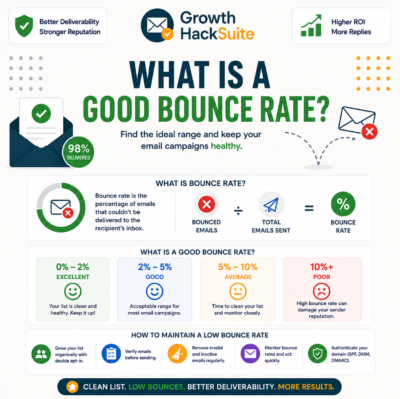
Email marketers apply the guarantee differently, focusing on deliverability verification rather than prospecting volume. The evaluation priority shifts to testing the bounce rate impact of the tool’s verification layer on an existing contact list. A tool that reduces bounce rate from 8% to under 2% on a cleaned 1,000-contact list demonstrates ROI within the first campaign send, well within the 30-day window.
Founders and growth leads evaluate guarantee terms as part of vendor due diligence, treating the refund policy as a proxy for product confidence. A vendor offering a 30-day no-questions-asked refund on all paid plans signals that accuracy and uptime SLAs are strong enough to absorb the financial risk of a fully committed refund. Hunter.io’s policy meets this signal threshold for most founder-level procurement decisions.
The guarantee window delivers the most value when evaluation criteria are defined before subscribing, ensuring the 30 days are used for structured testing rather than exploratory browsing.
What Are the Best Practices for Implementing SaaS Money-Back Guarantee Today?
Five best practices convert the 30-day guarantee window from a passive refund option into an active structured pilot with clear go/no-go criteria established before the first credit is consumed.
- Define Success Criteria First: Establish specific benchmarks before subscribing: minimum email accuracy rate (85%+), maximum bounce rate on verified contacts (under 3%), and credit consumption budget per ICP segment tested.
- Activate on Billing Day: Start testing on the same day the first charge clears. Every day of delayed activation reduces the effective evaluation window and increases deadline risk.
- Document Daily Outcomes: Record search volumes, accuracy rates, and campaign metrics in a shared evaluation sheet updated daily. This documentation informs the go/no-go decision and supports refund requests if benchmarks are not met.
- Submit Cancellation with Buffer: File the cancellation request no later than day 25, allowing five days of processing buffer before the day 30 deadline. Submit through the billing portal and retain the support ticket number as an audit trail.
- Negotiate Extended Windows for Enterprise: Enterprise plans negotiated directly with the vendor often include 60 to 90 day evaluation periods. Request this in writing during commercial negotiation, not after signing the initial agreement.
Teams applying these five practices consistently report cleaner evaluation outcomes and lower rates of dispute with vendors over guarantee interpretation or eligibility.
How Do You Apply SaaS Money-Back Guarantee in 5 Steps With Hunter.io?
Applying Hunter.io’s money-back guarantee requires a structured five-step workflow: identify the use case, subscribe to the correct paid tier, run the core workflow within 14 days, document outcomes against your ICP benchmark, and submit the refund request before day 30 if results fall short of defined criteria.
- Step 1, Define Your ICP Domain List: Compile 50 to 100 target company domains representing your primary ICP vertical. This controlled test set provides the accuracy benchmark for the evaluation period.
- Step 2, Subscribe to Starter Plan: Subscribe to the $49/month Starter plan for access to 500 monthly credits. This tier covers the full domain search feature set needed for the evaluation without over-committing credits that risk triggering usage exclusions.
- Step 3, Run Domain Search on 50 Targets: Use Hunter.io’s Domain Search on your 50-domain test set within the first 14 days. Track verified, unverified, and catch-all email rates by domain using the export CSV feature for benchmark documentation.
- Step 4, Benchmark Against Current Tool: Compare accuracy results against your existing email finder or manual prospecting baseline. Calculate cost-per-verified-email across both tools using actual credit consumption data from the evaluation period.
- Step 5, Decide and Act by Day 25: If Hunter.io meets or exceeds your accuracy benchmark, retain the subscription. If not, submit a cancellation request through the Hunter.io billing dashboard by day 25, citing the specific benchmark unmet, to ensure the refund processes before the 30-day deadline.
Ready to test Hunter.io with a 30-day money-back guarantee?
Try Hunter.io Free →Free plan available. Paid plans from $49/month with 30-day money-back guarantee on all tiers.
This five-step workflow completes within 14 of the 30 available days, leaving 16 days of buffer for extended testing, team onboarding, or parallel evaluation of a competing tool before the deadline.
What Industry Trends Are Reshaping SaaS Money-Back Guarantee Right Now?
Three trends are reshaping how SaaS vendors structure money-back guarantees: AI-powered usage tracking enabling outcome-based refund policies, category consolidation reducing vendor incentive to offer extended windows, and procurement platforms requiring standardized refund terms as part of vendor onboarding.
AI-powered usage tracking allows vendors to offer outcome-based guarantees tied to deliverability or accuracy metrics rather than a fixed time window. Instead of “cancel within 30 days for a full refund,” the next generation of guarantees may state “if verified email accuracy falls below 85% on your first 100 domain searches, receive a full refund regardless of timing.” Hunter.io’s accuracy scoring dashboard moves in this direction by giving buyers real-time benchmarks during the evaluation period.
Category consolidation driven by AI-native email tools entering the market in 2025 and 2026 is reducing the competitive pressure that historically drove guarantee extensions. Vendors with defensible accuracy moats are tightening usage restrictions, while newer entrants use 60 to 90 day guarantees as market-entry tools. Buyers evaluating tools in 2026 should verify current guarantee terms directly with the vendor before subscribing, as the landscape is shifting faster than public documentation updates.
Procurement platforms including Vendr, Zluri, and Spendesk now surface vendor refund policy data as a standard field during vendor onboarding, making money-back guarantee terms a visible competitive signal rather than a buried terms-of-service clause. This visibility shift is creating pressure on all major SaaS vendors to standardize their guarantee language to pass procurement screening requirements.
Teams monitoring these three trends will be better positioned to time evaluations, negotiate extended windows, and select vendors whose guarantee structures align with procurement requirements.
SaaS Money-Back Guarantee: Frequently Asked Questions
Which B2B email tool has the best money-back guarantee?
Hunter.io offers the most buyer-friendly money-back guarantee in the B2B email tool category with a 30-day full refund window on all paid plans. Apollo.io limits coverage to 14 days and applies pro-rated calculations. Snov.io matches the 30-day window but restricts refunds to unused credits rather than the full plan cost. ZeroBounce and NeverBounce do not publish standard money-back guarantee terms as of Q2 2026.
How does a SaaS money-back guarantee differ from a free trial?
A free trial gives pre-payment access to the product for a limited time, usually with feature restrictions. A money-back guarantee applies after payment has been made, giving the buyer access to the full paid tier and a defined window to request a refund if the product underperforms. Free trials remove financial commitment upfront; money-back guarantees reverse a financial commitment already made.
What is the difference between a full refund and a pro-rated refund in SaaS?
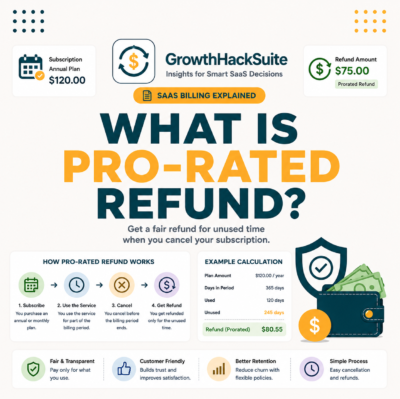
A full refund returns 100% of the subscription fee regardless of how much of the billing period has elapsed. A pro-rated refund calculates the unused portion and returns only that fraction. On a $149/month plan cancelled after 10 days, a full refund returns $149. A pro-rated refund returns approximately $100, calculated as $149 multiplied by 20 remaining days divided by 30 total days.
How long does it take to process a SaaS refund after requesting it?
Vendor-side refund approval typically takes 1 to 3 business days after the cancellation request is confirmed. Payment processor routing adds 3 to 7 business days for the credit to appear on the buyer’s card or account. Total processing time from request to visible credit is typically 5 to 10 business days, with some international transactions extending to 14 days.
How much does a SaaS money-back guarantee cost the vendor?
Refund rates for SaaS products with strong money-back guarantees typically range from 1% to 5% of monthly subscribers. For a vendor with 10,000 paid subscribers at $49/month, a 3% refund rate represents approximately $14,700 in monthly refund costs. Vendors offset this through higher conversion rates driven by guarantee trust signals, with some reporting 15 to 25% higher trial-to-paid conversion when a guarantee is prominently featured.
Will Hunter.io’s money-back guarantee improve our tool evaluation process?
The guarantee improves evaluation quality when teams use it to access full paid features unavailable in the free plan, such as bulk domain search, CSV export at scale, and full API access. Teams that rely on the guarantee as a passive safety net rather than a structured evaluation framework typically do not see process improvement, as the 30 days passes without a defined benchmark being tested. Define success criteria before subscribing.
Can I test Hunter.io’s free plan before using the money-back guarantee?
Yes. Hunter.io’s free plan provides 25 monthly searches and 50 verifications, enough to validate the domain search interface and email format pattern detection before committing to a paid plan. Teams that exhaust the free plan and confirm basic accuracy before subscribing to a paid tier make more structured use of the 30-day guarantee window by focusing evaluation on volume throughput rather than feature validation.
Does Hunter.io’s money-back guarantee cover the full plan price?
Hunter.io’s standard 30-day money-back guarantee covers the base plan subscription fee in full. Add-on purchases made separately are governed by their own terms. Annual plan subscribers who request refunds after the 30-day window may receive pro-rated refunds based on remaining months, though this falls outside the standard guarantee terms and requires direct negotiation with Hunter.io support.
What is a SaaS money-back guarantee?
A SaaS money-back guarantee is a contractual commitment from a software vendor to refund the subscription fee paid by a buyer who cancels their paid plan within a defined window, typically 14 to 30 days from the first billing date. The guarantee applies to paid subscribers rather than free plan users and is designed to reduce purchase risk for buyers who need full paid features to properly evaluate the product.
How does a SaaS money-back guarantee work step by step?
A SaaS money-back guarantee activates on the first billing date and runs for the defined window, typically 30 days. The buyer uses the product during this period with full paid feature access. If the product does not meet requirements, the buyer submits a cancellation request through the vendor’s billing portal before the deadline. The vendor verifies eligibility, approves the refund, and the payment processor credits the original payment method within 5 to 10 business days.
Is a money-back guarantee available on Hunter.io’s free plan?
No. Hunter.io’s free plan does not require payment, so no money-back guarantee applies. The 30-day money-back guarantee is available exclusively on paid plans including Starter ($49/month), Growth ($149/month), Business ($499/month), and custom Enterprise tiers. Free plan users can upgrade to a paid plan at any time and access the full 30-day guarantee from the first billing date on the upgraded subscription.
What conditions must be met for a SaaS money-back guarantee to be valid?
Four conditions typically determine guarantee validity: the cancellation request must be submitted within the defined window (30 days for Hunter.io), through the official billing portal or designated support channel, by the account holder associated with the billing record, and without exceeding any usage exclusion thresholds defined in the terms of service. Failure to meet any one condition may result in a pro-rated refund or a declined request.
Test Hunter.io Risk-Free for 30 Days
Start with the free plan. Upgrade to Starter at $49/month with a full 30-day money-back guarantee on all paid tiers.
Try Hunter.io Free →No credit card required for free plan. 30-day money-back guarantee on all paid plans.