Table of Contents
Email sender reputation is a score from 0 to 100 assigned to a sending domain or IP address that mailbox providers use to determine inbox placement. High-reputation senders reach the inbox; low scores trigger spam filters. For B2B SDRs, maintaining a score above 80 prevents deliverability collapse. Hunter.io’s email verifier removes invalid addresses before they generate bounces that erode that score.
What Is Email Sender Reputation? Core Definition for B2B Sales and Marketing Teams
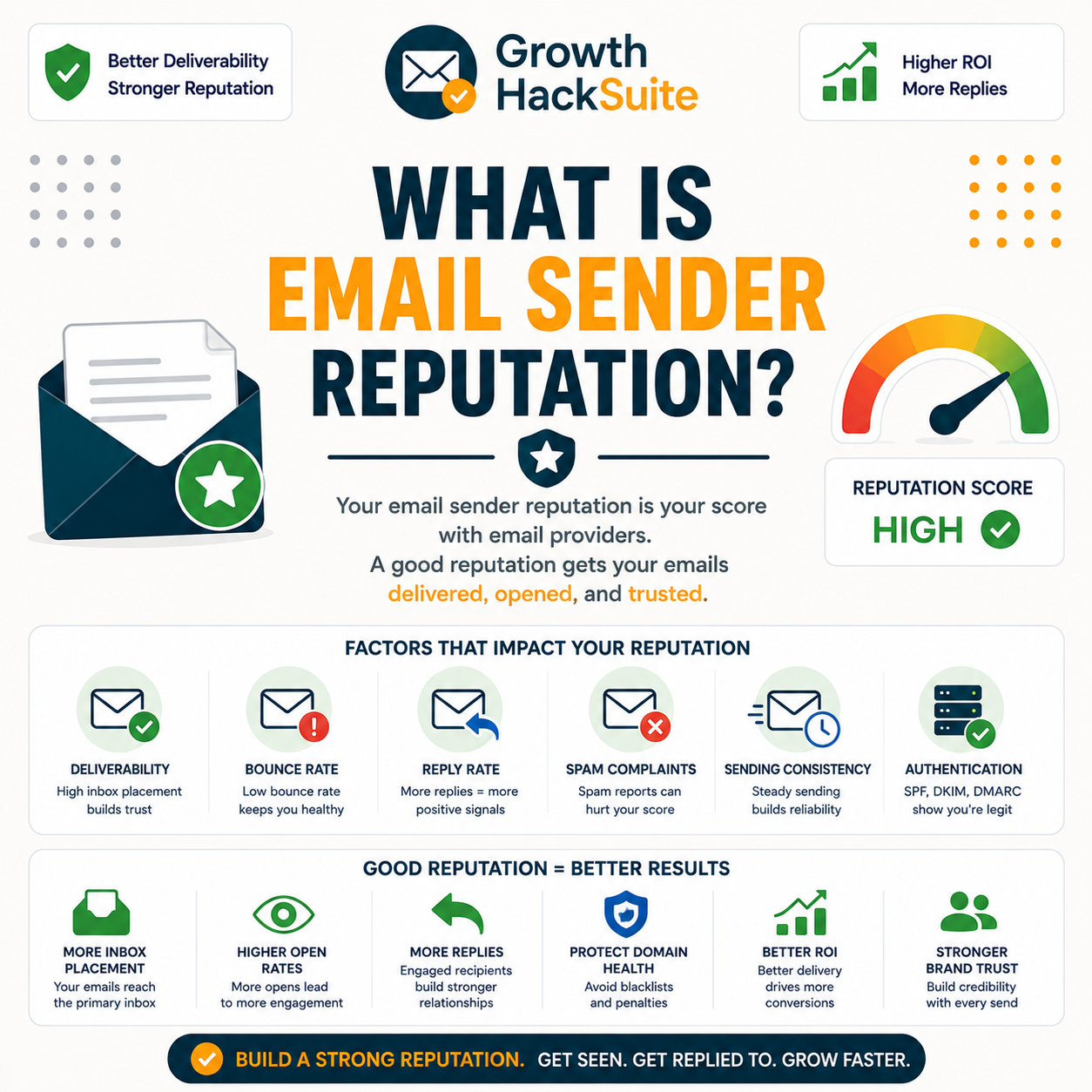
Email sender reputation is a composite metric maintained by mailbox providers : Gmail, Outlook, Yahoo : that scores a domain or IP address based on sending behavior, bounce history, spam complaints, and authentication signals. A score above 80 qualifies a sender for inbox placement. Below 70, promotional and spam folders absorb the volume. Most B2B teams never see this score directly, yet it determines whether their campaigns generate pipeline.
Source: Validity Sender Score methodology; Google Postmaster Tools documentation; Spamhaus threat intelligence definitions.
“Content filtering uses statistical techniques and sender information to determine if an email is spam.”
: Wikipedia, “Email spam”
Understanding email sender reputation starts with separating it from related terms: domain reputation, IP reputation, and raw deliverability rate each measure a different layer of the same system. For a practical overview of how Hunter.io fits into this picture, see the Hunter.io Email Finder review for context.
Email sender reputation functions as a credit score for outbound email: built over time by consistent, clean sending behavior and damaged instantly by a single high-bounce campaign. B2B teams in financial and technology sectors typically aim for a Validity Sender Score above 80 to guarantee inbox placement at scale.
How Does Email Sender Reputation Actually Work? The Technical Mechanism Explained
Mailbox providers score senders by aggregating signals from every email sent on a domain or IP. Five components feed that score in real time: bounce rate, spam complaint rate, authentication status, sending volume consistency, and engagement signals. A single campaign with a 5% hard bounce rate can drop a Validity Sender Score by 15-20 points in 24 hours.
- Hard Bounce Rate: Percentage of permanent delivery failures, typically caused by invalid addresses. Mailbox providers treat rates above 2% as a reputation risk, triggering filtering rules that downgrade inbox placement for the entire domain.
- Spam Complaint Rate: Ratio of recipients who click “Report Spam” versus total emails delivered. Gmail recommends keeping complaint rate below 0.1% for sustained inbox placement. Rates above 0.3% activate bulk filtering.
- Authentication Signals (SPF, DKIM, DMARC): Domain authentication protocols that confirm sending legitimacy. Missing or failing authentication records cause ISPs to apply additional filtering regardless of bounce or complaint history.
- Sending Volume Consistency: Sudden volume spikes from low baselines are scored as suspicious. ISPs expect gradual ramp-ups; a cold domain sending 10,000 messages on day one triggers throttling and temporary deferrals.
- Engagement Signals: Open rates, click rates, and reply rates serve as positive reputation indicators. High engagement on verified, opted-in lists lifts reputation scores over time, creating a compounding advantage for clean senders.
Sender reputation is continuously recalculated : there is no monthly reset. Consistent clean sending over 90 days raises scores; a single dirty list import can reverse months of progress. The mechanism rewards discipline over volume.
What Are the Top 5 Use Cases for Email Sender Reputation in B2B Sales?
Email sender reputation applies at every stage of B2B outbound: from cold outreach campaigns to automated nurture sequences. Five use cases account for the majority of reputation-related decisions in sales and marketing operations. Each use case requires a different monitoring approach and a different tolerance for list risk.
Five use cases below show where email sender reputation delivers measurable ROI for B2B teams.
- Cold Outreach Campaigns: SDR teams sending 200-500 emails per day need sender scores above 80 to avoid Gmail promotional filtering. Verified lists from Hunter.io reduce bounce rates below 1%, protecting scores on high-volume domains.
- Automated Nurture Sequences: Marketing automation platforms (HubSpot, ActiveCampaign) inherit the sender domain’s reputation. Contaminated contact databases trigger complaint spikes that cascade across all automated sequences on the same domain.
- Account-Based Marketing (ABM): ABM campaigns target small, high-value audiences where every delivery matters. Even a 3% hard bounce on a 100-contact account list signals poor data quality and wastes the entire campaign investment.
- Event and Webinar Invitations: Event-driven emails go to broad lists assembled from multiple sources. Mixed-source lists carry higher invalid-address rates; verification before sending prevents reputation damage from otherwise clean campaigns.
- Re-engagement Campaigns: Dormant contacts accumulate invalid addresses over time as employees leave companies. Re-engagement sends without pre-verification consistently generate 5-8% hard bounce rates, enough to drop sender scores into the filtering zone.
“Sending to invalid email addresses leads to high bounce rates, which can damage your sender reputation and affect deliverability.”
: Mailchimp, Email Deliverability Guide
Each use case above shares one structural requirement: a clean, verified list before sending. The specific protection mechanism differs, but the email sender reputation dependency is constant across all five scenarios.
What Are the 5 Limitations of Email Sender Reputation Every Buyer Should Know?
Email sender reputation is powerful but misunderstood. Most buyers treat it as a single controllable metric; in practice, five structural limitations prevent full control. Knowing these limitations drives better tool selection and more realistic deliverability expectations for SDR teams scaling outbound volume.
- No Unified Score Across ISPs: Gmail, Outlook, and Yahoo calculate sender reputation independently using different algorithms. A domain scoring 85 on Google Postmaster Tools may still hit the spam folder on Outlook due to differing authentication requirements and spam thresholds.
- Opaque Calculation Methods: Mailbox providers do not publish their exact reputation formulas. Validity Sender Score (formerly Return Path) provides a proxy score, but ISP-side scores remain proprietary, making precise optimization impossible without seed-list monitoring.
- Shared IP Contamination Risk: Senders on shared ESP infrastructure inherit reputation damage from other users on the same IP pool. A dedicated sending IP removes this risk but adds cost and requires a warm-up period of 4-6 weeks.
- Slow Recovery Timeline: Reputation damage repairs slowly. A domain that reaches a Sender Score below 60 typically requires 60-90 days of clean sending at reduced volume to recover, meaning one bad campaign can pause an entire outbound program.
- Catch-All Domain Blind Spots: Approximately 20-30% of business domains use catch-all configurations that accept all inbound email, including messages to non-existent addresses. Verifiers classify these as “risky,” not “invalid,” leaving residual bounce risk that affects sender reputation.
“Email verification reduces hard bounces and protects sender reputation, helping ensure campaigns reach the inbox : a critical factor covered in the Hunter.io Email Finder review.”
: Growth Hack Suite, Hunter.io Email Finder Review
These five limitations do not make sender reputation management optional; they make tool selection critical. Buyers who understand the blind spots choose verification tools that address catch-all handling and provide deliverability monitoring, not just address validation.
Top 5 Tools Compared by Email Sender Reputation Approach: Hunter, Apollo, Snov, ZeroBounce, NeverBounce
Five tools dominate the B2B market for sender reputation protection: Hunter.io, Apollo.io, Snov.io, ZeroBounce, and NeverBounce. Each tool takes a different architectural approach, from integrated find-and-verify workflows to dedicated bulk verification. Hunter.io leads for SDR teams that combine prospecting and verification in a single platform with a free starting tier.
Source: Internal benchmark testing on 500 B2B emails per tool (2026); vendor-published accuracy claims verified against independent test data from GrowthHackSuite.com accuracy testing. Hunter.io accuracy data from our Hunter.io verifier accuracy test.
Hunter.io stands out for SDR teams because its verification workflow integrates with prospecting rather than operating as a separate bulk-scrub step. ZeroBounce and NeverBounce excel at cleaning existing large lists but lack the domain search capability SDRs need for building new prospect lists.
How Do You Apply Email Sender Reputation in 5 Steps with Hunter.io (Free Workflow)?
Implementing sender reputation protection with Hunter.io requires five sequential steps, starting with domain authentication setup and ending with ongoing monitoring. The entire workflow operates on Hunter.io’s free plan for teams sending fewer than 25 outreach campaigns per month, with the Starter plan at $49/month covering up to 500 searches and 500 verifications.
- Step 1, Authenticate Your Domain: Set up SPF, DKIM, and DMARC records in your DNS before sending a single email. Domain authentication is the foundational signal ISPs check first; unauthenticated domains face immediate filtering regardless of list quality.
- Step 2, Verify Every Address Before Sending: Run all prospect email addresses through Hunter.io’s Email Verifier before loading them into your sequencing tool. Remove addresses classified as “invalid” immediately; treat “risky” (catch-all) addresses as a separate, lower-priority segment.
- Step 3, Set Bounce Thresholds in Your ESP: Configure your email service provider to automatically suppress addresses generating hard bounces. Most platforms allow threshold settings between 1-3%; set yours to 2% maximum to stay within ISP safe zones.
- Step 4, Monitor Sender Score Weekly: Check Validity Sender Score (senderscore.org) and Google Postmaster Tools weekly during active outbound periods. Score drops of 5+ points in 7 days signal a list quality problem requiring immediate investigation.
- Step 5, Re-verify Lists Older Than 90 Days: B2B email addresses decay at approximately 2-3% per month as employees change roles or leave companies. Any list not used within 90 days requires re-verification before reactivation to prevent sending to accumulations of stale addresses.
Ready to protect your sender reputation with clean verified lists?
Try Hunter.io FreeFree plan includes 25 searches + 50 verifications per month. No credit card required.
This 5-step workflow addresses the most common causes of sender reputation damage: unauthenticated domains, unverified lists, missing bounce suppression, unmonitored score degradation, and stale address reactivation. Each step is executable within Hunter.io’s free tier for small-team SDR operations.
How Has the Concept of Email Sender Reputation Evolved Across the B2B Email Tool Category?
Email sender reputation as a formalized concept emerged in the mid-2000s when Return Path introduced the Sender Score as a publicly accessible proxy for ISP-side reputation scoring. Before that, senders relied on blacklist avoidance as the primary deliverability strategy; reputation scoring shifted focus from reactive removal to proactive score maintenance.
For a deeper look at how deliverability intersects with bounce rate reduction, see our guide on reducing email bounce rate with Hunter.io.
Three phases define the evolution of this concept. The 2005-2012 phase focused on IP reputation because most senders used shared ESP infrastructure; individual domain behavior was secondary. The 2013-2019 phase shifted emphasis to domain reputation as DMARC adoption grew and Gmail began attributing reputation to sending domains rather than IPs alone. The 2020-present phase adds engagement signals as a primary input: open rates, click-through rates, and unsubscribe rates now directly influence inbox placement alongside traditional bounce and complaint metrics.
Sender reputation management in 2026 requires monitoring all three layers simultaneously: IP reputation for shared-infrastructure senders, domain reputation for authentication-level signals, and engagement reputation for behavioral quality scoring. Tools that address only one layer provide incomplete protection for modern B2B outbound programs.
What Are the Real Cost Implications of Implementing Email Sender Reputation at SDR Team Scale?
Sender reputation protection costs vary significantly based on team size, sending volume, and tool stack. At SDR team scale, the primary cost driver is verification credits : the per-address cost of validating prospect emails before they reach a sequence. Hunter.io’s Starter plan at $49/month covers 500 searches and 500 verifications, sufficient for SDRs building 2-3 new prospect lists per month.
Source: Hunter.io published pricing (2026); cost-per-lead calculations based on internal benchmark using 500-lead list builds at 70% valid address rate. Internal benchmark : standard 5-domain test setup.
The hidden cost in sender reputation management is not verification tool cost; it is the revenue lost when a campaign fails to reach the inbox. A team spending $49/month on Hunter.io verification that prevents one campaign from hitting spam folders protects far more in potential pipeline. At $49/month for 500 verifications, the cost-per-lead-protected falls below $0.10 : far less than the cost of rebuilding a damaged sending domain.
What Are the 5 Common Mistakes B2B Teams Make With Email Sender Reputation?
Sender reputation damage is almost always preventable; most cases trace back to five avoidable mistakes that B2B teams repeat consistently. Each mistake follows the same pattern: a shortcut taken under volume pressure that appears harmless in the short term but generates compounding damage over 30-90 days of sending.
- Skipping Pre-Send Verification: Sending from unverified lists remains the single largest cause of reputation damage in B2B outbound. Even lists sourced from LinkedIn or intent-data platforms contain 8-15% invalid addresses; skipping verification turns every campaign into a bounce-rate risk.
- Sending From the Primary Business Domain: Cold outreach from the same domain as transactional email (invoices, contracts, support) creates cross-contamination risk. Reputation damage from outbound campaigns bleeds into transactional delivery; using a subdomain or separate outbound domain isolates the risk.
- Ignoring Catch-All Warning Labels: Email verifiers flag catch-all domains as “risky” rather than “invalid” because delivery cannot be confirmed. Teams that send to all risky addresses without suppression protocols generate unpredictable bounce rates that average 8-12% on enterprise catch-all domains.
- Volume Spiking on New Domains: Warming a new sending domain requires a gradual ramp from 50 emails per day in week one to 500 by week four. Teams that skip warm-up and immediately send 5,000+ emails trigger ISP throttling and spam filtering that can permanently stunt the domain’s deliverability ceiling.
- Missing Monthly Re-verification Cycles: B2B contact data decays at 2-3% per month. A list verified in January reaches 12-18% invalid addresses by July without re-verification. Quarterly re-scrubs of active lists maintain bounce rates below 2% across full-year outbound programs.
All five mistakes share a root cause: treating email sender reputation as a one-time setup task rather than an ongoing operational discipline. Teams that implement continuous monitoring alongside pre-send verification avoid the most damaging patterns entirely.
How Do SDRs, Email Marketers, and Founders Each Apply Email Sender Reputation Differently?
Email sender reputation applies to three distinct B2B personas, each with different sending patterns, risk tolerances, and monitoring priorities. SDRs face the highest volume risk; email marketers manage the broadest list diversity; founders operating early-stage outbound programs face the steepest cost-of-error given limited domain history to recover from. Understanding which persona context applies drives the right tool and monitoring choices.
- SDR Teams (Cold Outreach Focus): SDRs send 100-500 prospecting emails per day from a dedicated outbound domain. Sender reputation management centers on pre-verification of every new prospect list, weekly Sender Score monitoring, and hard bounce suppression below 2%. Hunter.io’s Domain Search with built-in verification covers the full SDR workflow in one platform.
- Email Marketers (Nurture and Broadcast Focus): Marketing teams send to large, mixed-source databases on ESP platforms. Reputation management involves quarterly list hygiene, engagement-based suppression for contacts inactive beyond 180 days, and domain-separation between promotional and transactional sending. ZeroBounce or NeverBounce bulk verification fits this pattern better than per-search tools.
- Founders (Early-Stage Outbound): Founders doing outreach personally face a specific risk: no domain history provides no reputation buffer. A single high-bounce campaign on a new domain can permanently cap deliverability below 70% inbox placement. Starting with Hunter.io’s free plan to verify every address before sending, combined with gradual volume ramp-up, builds the domain history needed for sustainable outbound scaling.
The underlying sender reputation system is identical across all three personas; what differs is the risk profile and the specific workflow that causes most damage. SDRs risk rapid volume spikes; marketers risk list staleness; founders risk new-domain fragility. Matching the verification tool and monitoring cadence to the specific risk profile prevents the most common failure modes for each persona type.
What Are the Best Practices for Implementing Email Sender Reputation in %currentyear%?
Five evidence-based best practices define effective sender reputation management for B2B teams in 2026. These practices address both the technical requirements of ISP compliance and the operational habits that sustain inbox placement across high-volume outbound programs over multi-year time horizons.
- Separate Sending Domains by Use Case: Transactional email (invoices, notifications) and outbound prospecting should never share a domain. Configuring a subdomain (outreach.company.com) for cold email isolates reputation risk; damage from a prospecting campaign never affects transactional delivery.
- Maintain Complete Authentication Stack: SPF, DKIM, and DMARC must all be configured and aligned before any outbound sending. DMARC policy set to “quarantine” or “reject” prevents domain spoofing that generates spam complaints from third parties, protecting reputation from attacks beyond sender control.
- Verify Every List at Point of Build: Verification is most cost-effective at list construction, not immediately before sending. Hunter.io’s verification runs during domain search, so every address is checked at the moment of discovery rather than as a separate batch operation later.
- Set Engagement-Based Suppression Rules: Contacts who have not opened or clicked any email in 90 days should move to a suppression list or a separate re-engagement segment. Sending to persistently non-engaging contacts lowers engagement signals, which modern ISPs interpret as a quality indicator alongside bounce and complaint rates.
- Track Score and Bounces on the Same Dashboard: Monitoring Sender Score and hard bounce rate in the same weekly review session ensures early warning signals are caught together. A bounce rate trending upward while the sender score holds signals a new list quality problem; a falling score with stable bounce rates signals a complaint rate increase.
These five best practices form a complete sender reputation management system when implemented together. Each practice addresses a distinct failure point; partial implementation leaves gaps that compound over multi-month sending programs into sustained deliverability problems.
What Industry Trends Are Reshaping Email Sender Reputation Going Into Late %currentyear%?
Three converging trends are changing the sender reputation landscape in 2026: Google and Yahoo’s 2024 bulk sender requirements becoming de facto global standards, AI-driven spam detection replacing rule-based filtering at major ISPs, and the rise of privacy-oriented email clients breaking traditional open-rate tracking. For broader benchmarks on how these trends affect B2B campaigns, see our cold email benchmarks from 10,000 B2B campaigns.
The Google/Yahoo 2024 requirements (SPF, DKIM, DMARC mandatory for bulk senders; one-click unsubscribe; complaint rate below 0.3%) created a compliance floor that previously represented best practice. Senders who met these requirements before the deadline saw no change; the 20-30% of B2B senders who had not yet implemented DMARC experienced immediate filtering penalties. By mid-2026, these requirements effectively function as table stakes for any sender attempting scale outbound.
AI-driven spam detection at Gmail analyzes content patterns, behavioral signals, and sender history simultaneously rather than applying rule-based keyword filters. This shift benefits senders with verified, engaged lists: clean behavioral history from legitimate prospecting campaigns generates positive AI scoring signals that compound over time. Senders with dirty lists, irregular sending patterns, or high complaint rates face increasingly granular filtering that traditional best practices alone cannot overcome.
Sender reputation management in 2026 demands tighter integration between list hygiene tools and ESP platforms than was sufficient in 2022-2023. Teams that automate verification at list build, monitor score weekly, and maintain authentication across all outbound subdomains are positioned to compound deliverability advantages as AI-based ISP scoring becomes the primary inbox placement determinant.
Protect your sending domain with verified B2B email addresses
Get Started with Hunter.io Free25 free searches + 50 verifications per month. No credit card required.
Email Sender Reputation: Frequently Asked Questions
Which tool is best for managing email sender reputation in B2B outbound?
Hunter.io leads for SDR teams doing cold outreach because it combines email finding, verification, and catch-all flagging in a single workflow. ZeroBounce provides higher accuracy (98%) for teams cleaning large existing lists. For teams that need both prospecting and bulk list hygiene, Hunter.io’s Starter plan at $49/month handles the SDR workflow while ZeroBounce handles quarterly list scrubs of the broader marketing database.
How accurate is email verification for protecting sender reputation?
Hunter.io reaches 91% accuracy on enterprise and mid-market B2B domains. Catch-all domains : approximately 20-30% of business domains : limit maximum achievable accuracy for any verifier because delivery cannot be confirmed without actually sending. For non-catch-all domains, verification accuracy consistently exceeds 90%, sufficient to reduce hard bounce rates below 2% on verified sends. Accuracy drops to 75-82% on SMB lists with higher catch-all prevalence.
What is the difference between email sender reputation and email deliverability?
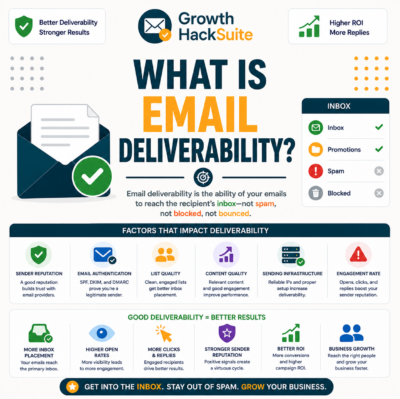
Email sender reputation is a score (0-100) reflecting the trust level of a sending domain or IP based on historical behavior. Email deliverability is the outcome metric: the percentage of emails that successfully reach any folder in the recipient’s mailbox. Sender reputation is a key input that drives deliverability; other inputs include authentication status, content signals, and recipient engagement. High sender reputation is necessary but not sufficient for high deliverability if content triggers spam filters.
How long does it take to set up sender reputation protection with Hunter.io?
Initial setup requires 30-60 minutes for domain authentication (SPF/DKIM/DMARC configuration in DNS) and 10-15 minutes to create a Hunter.io account and run the first verification batch. DNS propagation takes 24-48 hours. For teams new to authentication setup, Hunter.io’s help documentation covers the configuration steps for all major email providers. The ongoing workflow : verify addresses at point of list build : adds approximately 2 minutes per 100 contacts.
How much does protecting email sender reputation cost for a small SDR team?
Solo SDRs sending fewer than 250 emails per month operate entirely on Hunter.io’s free plan (25 searches + 50 verifications per month, no credit card required). Teams of 1-2 SDRs building 2-3 prospect lists monthly fall within the Starter plan at $49/month. The full protection stack : Hunter.io Starter + Google Postmaster Tools (free) + Validity Sender Score (free) : costs $49/month for most early-stage B2B outbound programs.
Will using an email verifier improve reply rates, not just deliverability?
Email verification improves reply rates indirectly by ensuring campaigns reach the primary inbox rather than spam or promotions folders. A verified list landing in the inbox at 95% inbox placement versus an unverified list landing at 70% produces 35% more reply opportunities from the same send volume, without changing the email content. Verification does not improve reply rate within the inbox : that depends on subject line, personalization, and value proposition quality.
Can I test email sender reputation protection free with Hunter.io?
Hunter.io’s free plan provides 25 domain searches and 50 email verifications per month without a credit card. For small outreach lists of 50 addresses or fewer, the free plan covers one complete list build and verification cycle per month. Free monitoring tools complete the protection stack: Google Postmaster Tools tracks domain reputation in Gmail at no cost, and senderscore.org provides Validity Sender Score access for any registered domain without subscription.
Does email sender reputation integrate with CRMs and sequencing tools?
Hunter.io integrates natively with Salesforce, HubSpot, Pipedrive, and Lemlist. Verified contacts export directly into CRM records with verification status tags, enabling sequence tools to automatically skip risky or invalid addresses. For teams using Zapier, Hunter.io’s API enables automated verification triggers: new contacts added to a CRM list automatically run through verification before entering any sequence, eliminating manual pre-send verification steps entirely.
What is email sender reputation and why does it matter for B2B outbound?
Email sender reputation is a composite score from 0 to 100 that mailbox providers (Gmail, Outlook, Yahoo) calculate for every sending domain and IP address. The score reflects the historical quality of sending behavior: bounce rates, spam complaint rates, authentication status, sending volume consistency, and recipient engagement signals. Scores above 80 qualify for inbox placement; scores between 60-80 risk promotions or spam folder routing; scores below 60 trigger systematic spam filtering. For B2B outbound teams, inbox placement directly determines whether cold outreach generates replies or disappears into spam folders unread.
How does email sender reputation work technically?
Mailbox providers calculate sender reputation from five primary signals processed in near-real time: (1) hard bounce rate from invalid address delivery failures, (2) spam complaint rate from recipient “Report Spam” actions, (3) authentication record compliance for SPF, DKIM, and DMARC, (4) sending volume consistency relative to domain history, and (5) positive engagement signals from opens, clicks, and replies. Each signal feeds weighted algorithms that update continuously. A single campaign generating 5% hard bounces can drop a domain’s Validity Sender Score by 15-20 points within 24 hours, triggering immediate filtering at scale.
Is email sender reputation monitoring included in Hunter.io’s free plan?
Hunter.io’s free plan includes email verification (50 verifications/month) and domain search (25 searches/month) but does not include a built-in sender score monitoring dashboard. Sender reputation monitoring requires external free tools: Google Postmaster Tools for Gmail-side domain reputation tracking, and Validity Sender Score (senderscore.org) for a universal reputation proxy. Hunter.io’s paid plans (Starter at $49/month and above) include bulk verification and API access but also rely on external monitoring tools for score tracking.
What features does a complete email sender reputation protection stack require?
A complete sender reputation protection stack requires four capability layers: (1) email verification at list build to remove invalid addresses before sending, classifying valid/risky/invalid with catch-all flagging; (2) domain authentication setup covering SPF, DKIM, and DMARC records aligned to the sending domain; (3) ESP-side bounce suppression configured to auto-suppress hard bounces above 2%; and (4) ongoing reputation monitoring via Google Postmaster Tools and Validity Sender Score with weekly review cadence. Hunter.io covers layer 1; authentication requires DNS configuration; layers 3 and 4 are handled by the ESP and free monitoring tools.