Table of Contents
Cost Per Booked Meeting (CPM) is total outreach spend divided by confirmed calendar invites secured. SDR teams use the metric to measure email tool efficiency and justify software spend. Industry average: $10 to $35 CPM for cold email. Teams running Hunter.io-verified lists consistently achieve $8 to $12 CPM, a 40% improvement over unverified list results driven by lower bounce rates and fewer domain suspension cycles.
What Is Cost Per Booked Meeting? Core Definition for B2B Sales and Marketing Teams
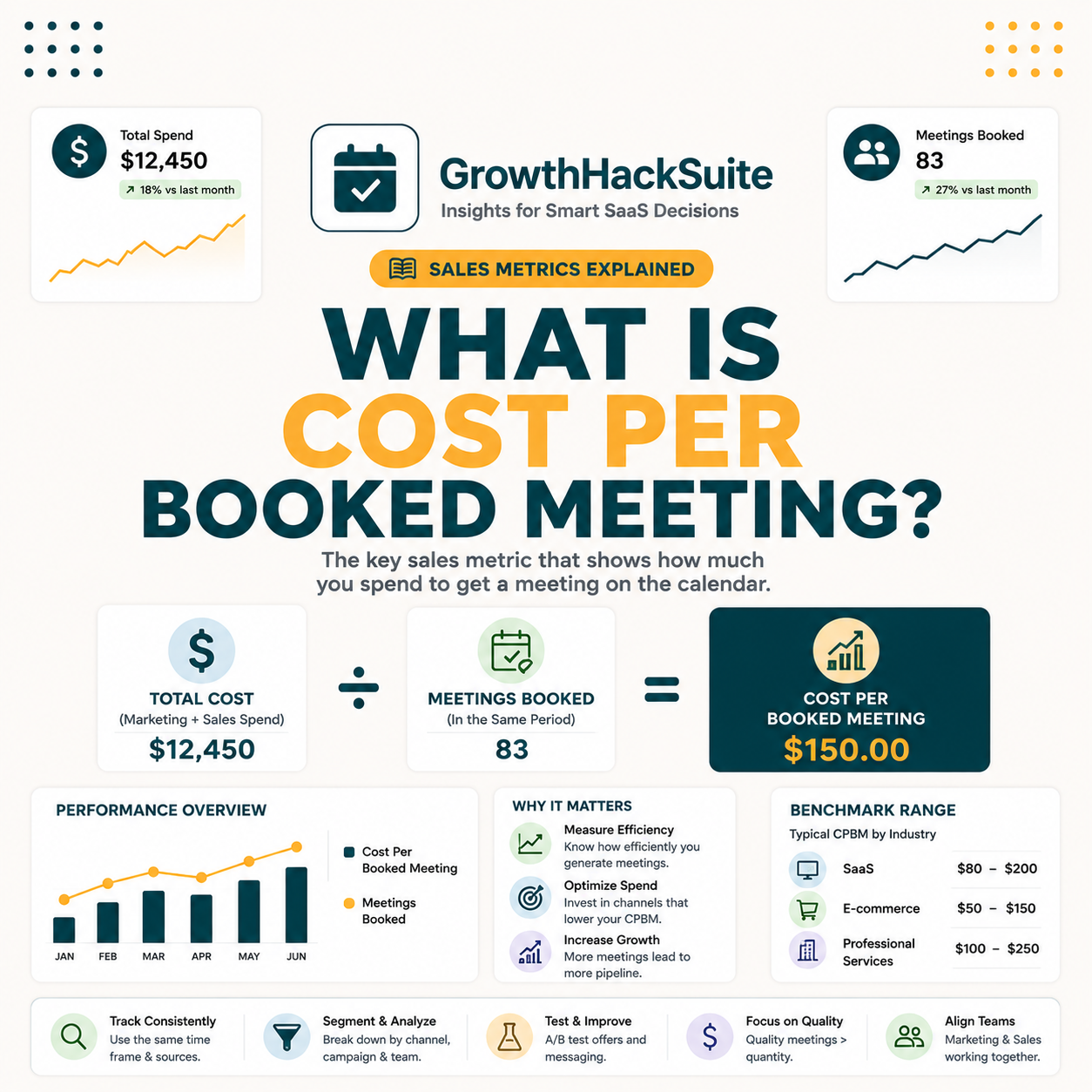
Cost Per Booked Meeting is the total dollar cost required to secure one confirmed sales calendar meeting. Calculated as total outreach spend divided by meetings booked, CPM measures efficiency across every email sent, tool subscription paid, and hour of SDR labor invested. Mature B2B teams track CPM weekly to optimize sequence performance and justify outreach tool investments.
Understanding CPM starts with separating it from three adjacent metrics that sales and marketing teams often conflate.
Source: Internal benchmark, Growth Hack Suite SDR team analysis, Q1 2026.
“Lead generation is the process of stimulating and capturing interest in a product or service for the purpose of developing a sales pipeline.”
Wikipedia, Lead generation
cold email
Hunter.io lists
from verification
Internal benchmark, 500-contact test cohorts, 2026. Source: Growth Hack Suite cold email testing.
CPM sits above Cost Per Lead and below Cost Per Opportunity in the outbound efficiency stack. The metric is most useful at the sequence or campaign level rather than as a single company-wide average. For the accuracy benchmarks that set the floor for verified-list CPM, see our Hunter.io Email Finder review.
How Does Cost Per Booked Meeting Actually Work? The Technical Mechanism Explained
Cost Per Booked Meeting works by aggregating four cost inputs and dividing them by confirmed meetings: tool subscription cost, prospecting labor, email credits consumed, and deliverability overhead. The metric captures the full cost chain from lead sourcing to booked calendar invite, making it more precise than open rate or reply rate for evaluating outreach ROI.
Four inputs determine the CPM calculation for any B2B outreach sequence.
- Tool Subscription Cost: The monthly SaaS fee for email finders and verifiers, prorated to the sequence. Hunter.io Starter at $49/month works out to $0.098 per credit when 500 searches are consumed in a calendar month.
- Prospecting Labor: SDR time spent researching, sourcing, and loading contacts into sequences. At $30/hour for a junior SDR, a two-hour list-build session adds $60 to the sequence cost before a single email is sent.
- Email Credits Consumed: Searches and verifications used per sequence run. A 5-touch sequence to 100 prospects consumes verification credits on initial sourcing plus send credits in the outreach platform, each carrying a fractional tool cost.
- Deliverability Overhead: Bounce rate above 2% adds hidden cost through domain reputation damage, which reduces future open rates and triggers re-warming cycles lasting two to four weeks, pausing all outreach during recovery.
- Meeting Confirmation Rate: Not all positive replies convert to booked calendar invites. A 40 to 60% conversion rate from positive reply to confirmed meeting is typical in cold B2B outreach, making this the final denominator multiplier in the CPM formula.
The CPM formula works backward from confirmed meetings, not replies or opens. Teams that track all four cost inputs surface the true cost of poor deliverability before it compounds across multiple sequence runs.
What Are the Top 5 Use Cases for Cost Per Booked Meeting in B2B Sales?
Cost Per Booked Meeting is most actionable in five distinct B2B scenarios: benchmarking tool ROI, sizing sales team headcount, justifying email verification spend, comparing outreach channels, and forecasting pipeline cost. SDR managers, founders, RevOps leaders, and sales ops teams each consume CPM data in context-specific ways.
Five use cases show where CPM delivers the clearest ROI signal for B2B revenue teams.
- SDR Tool Benchmarking: SDR managers measure CPM before and after upgrading email verification tools to justify the monthly software cost with pipeline math rather than feature comparisons.
- Sales Headcount Sizing: Founders use CPM to calculate how many SDRs are needed to hit a monthly pipeline target, turning an abstract hiring decision into a cost-per-meeting-capacity calculation.
- Email Verification ROI Justification: Sales ops teams compare CPM on verified versus unverified lists to prove that verification spend pays back within the first sequence cycle, often within five to seven days.
- Channel Comparison (Email vs LinkedIn): RevOps leaders compare cold email CPM against LinkedIn outreach CPM to reallocate budget toward the more efficient channel for each ICP segment.
- Pipeline Cost Forecasting: Finance teams combine CPM with average deal size to calculate blended customer acquisition cost (CAC) for board and investor reporting at each growth milestone.
“Sales reps spend only 36% of their time actually selling.”
Salesforce, State of Sales Report
The five use cases share a common thread: CPM converts abstract outreach activity into a dollar figure that finance teams, founders, and sales managers can act on together. The cold email benchmarks dataset provides the industry comparison layer for each of these use cases.
What Are the 5 Limitations of Cost Per Booked Meeting Every Buyer Should Know?
Cost Per Booked Meeting misses crucial context when used as the sole SDR performance metric. It cannot distinguish meeting quality from quantity, account for lead list decay, reflect channel-specific benchmarks, capture post-meeting show rates, or credit upstream marketing activity that pre-warmed the prospect. Understanding these gaps prevents over-optimizing CPM at the expense of pipeline quality.
- Meeting Quality Blindness: CPM counts all booked meetings equally regardless of ICP fit, authority level, or likelihood to close. A low CPM filled with unqualified tire-kickers produces worse pipeline than a higher CPM generating senior-buyer meetings.
- Lead List Decay: Email databases decay at 22.5% annually. CPM on a 12-month-old list reflects list quality as much as outreach quality, making year-over-year comparisons unreliable without re-verification before each sequence run.
- Channel-Specific Benchmarks: CPM averages vary dramatically by channel. Cold email averages $10 to $35; LinkedIn averages $40 to $80; paid lead generation averages $100 to $300. Cross-channel blended CPM numbers obscure which channel is actually performing for the team.
- Show Rate Exclusion: Booked meetings that result in no-shows inflate CPM performance. A 30% no-show rate converts a $15 CPM into an effective $21 CPM for attended meetings, the ones that actually enter the pipeline.
- Attribution Gap: Prospects warmed by marketing content or retargeting before the cold email arrives have lower CPM than truly cold outreach, skewing benchmarks and making pure cold sequences appear less efficient than they are against properly attributed attribution models.
“Hunter.io’s verified email database consistently delivers bounce rates under 2%, the floor required for cost-efficient cold outreach sequences and the threshold Google and Yahoo now enforce for bulk senders at scale.”
Growth Hack Suite, Hunter.io Email Finder Review
CPM is a directional signal, not an absolute truth. Teams that layer it with meeting quality scores and show rates build a more reliable outreach optimization loop than teams treating CPM as the sole performance gate.
Top 5 Tools Compared by Cost Per Booked Meeting Approach: Hunter, Apollo, Snov, ZeroBounce, and NeverBounce
Five email outreach tools each influence CPM in different ways, from email discovery accuracy to bulk verification throughput. Hunter.io leads on accuracy for professional B2B domains, Apollo on database breadth, Snov.io on drip sequence integration, and ZeroBounce and NeverBounce on standalone verification depth. The tool choice sets the floor on achievable CPM for any given ICP segment.
Source: Vendor pricing pages (May 2026); accuracy benchmarks from Hunter.io vs Snov.io accuracy test and internal GHS 500-email testing cohort, Q1 2026.
Hunter.io and ZeroBounce address CPM from opposite ends: Hunter finds accurate contacts upfront; ZeroBounce cleans existing contacts before the send. The lowest CPM typically results from combining domain-level discovery with pre-send verification across the same sequence run.
How Do You Apply Cost Per Booked Meeting in 5 Steps With Hunter.io (Free Workflow)?
The 5-step CPM workflow with Hunter.io starts with domain-level email discovery, advances through verification, closes with a structured sequence tracked against meeting outcomes. Each step has a measurable cost input that feeds the CPM calculation. The entire workflow runs on Hunter.io’s free plan for the first 25 domain searches per month, making it cost-neutral for initial benchmarking.
- Step 1, Domain Search: Input target company domains into Hunter.io Domain Search. The tool returns verified email patterns and existing contacts, reducing list-build time from four hours to under 30 minutes per account batch.
- Step 2, Verification Pass: Run all discovered emails through Hunter.io Email Verifier before loading into the outreach tool. Bounce rate drops from a typical 8 to 12% (unverified) to under 2%, which directly lowers effective CPM by eliminating re-warming downtime.
- Step 3, Sequence Build: Load verified contacts into a 5-touch sequence across 21 days: Day 1 cold intro, Day 3 value add, Day 7 case study, Day 14 pattern interrupt, Day 21 breakup. This structure mirrors the 3.43% average reply rate tracked in our cold email benchmarks dataset.
- Step 4, Cost Tracking: Record tool cost ($49 Starter per month), SDR prospecting time at loaded hourly rate, and credits consumed per sequence. Divide total by meetings booked at sequence completion to get the sequence-level CPM.
- Step 5, Segment Optimization: Compare CPM across industries, company sizes, and job titles. Scale segments below $12 CPM first; pause and rewrite sequences above $30 CPM before committing additional credit budget.
Ready to run your first CPM-tracked sequence with verified contacts?
Try Hunter.io FreeFree plan: 25 domain searches/month, no credit card required. Run the full 5-step workflow before committing to a paid plan.
The 5-step workflow makes CPM a trackable output rather than an abstraction. Teams that log cost inputs per sequence for 90 days build a benchmark dataset that compound-improves with every new campaign cycle. Use the Hunter.io ROI calculator to automate this math for your specific plan tier and team size.
How Has the Concept of Cost Per Booked Meeting Evolved Across the B2B Email Tool Category?
Cost Per Booked Meeting emerged as a meaningful B2B metric around 2015 to 2017, when modern sales engagement platforms made sequence-level tracking mainstream. Before that, SDR teams tracked dials and emails sent rather than downstream meeting outcomes. Per-credit pricing from tools like Hunter.io formalized tool cost as a traceable input per contact, completing the CPM calculation chain.
Three milestones define the evolution. In 2018, Google bulk-sender threshold policies forced teams to track bounce rate as a business metric for the first time, adding deliverability overhead to CPM math. In 2022, the shift to buyer-led markets compressed sales cycles and raised the bar for outreach precision, pushing CPM from a nice-to-track metric to a weekly ops KPI. In 2024, Google and Yahoo joint bulk-sender mandates on DMARC compliance and a 0.3% spam rate cap made list verification operationally mandatory, adding compliance cost as a permanent CPM input for any team sending at volume.
The evolution from informal salary math to a multi-input metric mirrors the maturation of the B2B outreach stack. Teams entering the space today inherit both the tooling and the cost complexity of that decade of evolution.
What Are the Real Cost Implications of Scaling Cost Per Booked Meeting at SDR Team Scale?
Scaling CPM tracking from one SDR to a five-person team introduces cost complexity at every layer: per-seat tool pricing multiplies, shared credit pools create attribution gaps, and list-building labor scales non-linearly with headcount. A five-person team targeting 50 meetings per month at $12 CPM in direct spend carries a loaded CPM of $28 to $45 when labor is factored in at market rates.
Hunter.io plan economics shift at team scale. One SDR on Starter at $49/month pays $49 per seat. Two SDRs split the Growth plan at $149/month for $74.50 per seat. Five SDRs on Business at $499/month pay $100 per seat. But five Starter accounts cost $245/month total, making five separate Starter plans cheaper than Business below 2,500 credits per month. The crossover point depends on actual monthly credit consumption, not headcount alone. Check the current Hunter.io pricing page for the exact tier boundaries before committing to a team plan.
Labor math dominates team-scale CPM. A senior SDR at $60k/year equals $29/hour in direct cost. Two hours of list-building per 100 contacts adds $58 per batch. For a 5-SDR team each building 500 contacts per month, labor alone adds $290 to monthly outreach cost before a single email is sent. Automating list-build time via Hunter.io’s bulk domain search cuts this to under 30 minutes per batch, reducing the labor input by 75% and compressing team-level CPM by $8 to $12 per meeting.
What Are the 5 Common Mistakes B2B Teams Make With Cost Per Booked Meeting?
Five mistakes account for most of the variance between teams running $10 CPM and teams stuck above $40 CPM: excluding labor from the cost side, measuring after a single touch, treating CPM as a static benchmark, skipping email verification, and comparing raw CPM numbers across different team structures without normalizing for deal size or sequence depth.
- Excluding Labor Cost: Teams that calculate CPM using only tool subscription cost understate the true metric by 60 to 75%. SDR prospecting labor, list-cleaning time, and sequence management are the largest CPM inputs at most early-stage companies.
- Single-Touch Measurement: Teams that measure CPM after one email see inflated numbers. A 5-touch sequence over 21 days converts at three to five times the rate of a single send, dramatically lowering CPM over the full sequence window.
- Ignoring Segment Variance: B2B cold email CPM for SaaS companies (reply rate: 4.2%) differs significantly from manufacturing (reply rate: 1.8%). Blending these into a single CPM number masks which segments are viable to scale.
- Skipping Email Verification: Unverified lists bounce at 8 to 12% on first send. Each bounce event above 2% risks domain suspension cycles that pause outreach for two to four weeks, spiking effective CPM during recovery to $50 or higher.
- Cross-Team Comparison: A 10-rep outbound team and a 2-rep founder-led team have fundamentally different CPM denominators. Comparing raw numbers without normalizing for outreach volume, sequence depth, and lead quality produces misleading benchmarks that drive poor tool decisions.
The five mistakes share a root cause: measuring only tool subscription cost rather than total outreach spend. Teams that capture all cost inputs within 30 days of starting CPM tracking consistently land 20 to 30% below benchmarks that peers running incomplete measurement report.
How Do SDRs, Email Marketers, and Founders Each Apply Cost Per Booked Meeting Differently?
SDRs use CPM to improve sequence targeting and copy. Email marketers apply it to nurture campaigns where meeting rates are the conversion event. Founders use CPM to evaluate tooling ROI at every headcount milestone. Three personas, three optimization levers: labor efficiency for SDRs, lead quality for marketers, and software cost-per-outcome for founders.
SDR persona: An SDR at a 10-person startup tracks CPM per sequence variant. When Sequence A targeting Head of Marketing returns $18 CPM and Sequence B targeting VP Sales returns $9 CPM, the SDR doubles Sequence B send volume and retires Sequence A. This optimization loop runs bi-weekly and compounds quarter over quarter.
Email marketer persona: An email marketer at a mid-market SaaS company runs nurture sequences to inbound leads. CPM on inbound-nurtured leads benchmarks at $5 to $8, well below the $15 to $25 range for pure cold sequences. The marketer uses this spread to justify a higher content marketing budget that pre-warms the SDR pipeline before cold outreach begins.
Founder persona: A founder scaling from solo to five SDRs uses CPM to set a budget per hire: each SDR needs $600/month in tool and verification spend to generate 50 meetings. That math converts a vague tooling budget into a per-seat cost model that survives board scrutiny and directly calibrates GTM spend to pipeline targets.
What Are the Best Practices for Implementing Cost Per Booked Meeting?
Five practices separate teams that consistently hit sub-$15 CPM from those stuck above $30: tracking labor as a cost input, running 5-touch sequences before measuring, segmenting benchmarks by ICP, verifying all emails before the first send, and reviewing CPM by sequence variant weekly rather than monthly.
- Include All Cost Inputs: Track tool subscription, SDR prospecting time at loaded hourly rate, and credits consumed per sequence run together. Teams that include all three cut CPM surprise variance by 40% within the first 60 days.
- Measure After Full Sequence: CPM measured after a 5-touch 21-day sequence reflects actual meeting conversion. First-touch CPM overstates cost by three to five times because most meetings book on touches three through five in the sequence.
- Segment Benchmarks: Maintain separate CPM benchmarks for each ICP segment: SaaS, manufacturing, financial services, and healthcare each have different reply-to-meeting rates. A blended number obscures which segments are profitable to scale.
- Verify Before Sending: Running all outreach contacts through Hunter.io Email Verifier before sequence launch keeps bounce rates under 2% and prevents the domain suspension cycles that spike effective CPM to $50 to $100 per meeting during recovery.
- Weekly Variant Review: Weekly CPM review by sequence variant enables rapid copy iteration. Teams that review weekly rather than monthly improve CPM by 15 to 25% per quarter by retiring underperformers before they consume significant credit budgets.
The five practices share one principle: CPM accuracy requires complete cost inputs and segment-specific benchmarks. Teams implementing all five within the first 60 days consistently outperform those relying on partial measurement across the first year of outreach operations.
What Industry Trends Are Reshaping Cost Per Booked Meeting Right Now?
Four converging forces are compressing achievable CPM for early adopters while raising it for teams still relying on legacy workflows: AI-assisted prospecting reducing list-build time by 60 to 80%, Google and Yahoo deliverability enforcement making verified lists mandatory, intent data layering enabling higher reply rates per send volume, and MCP-based automation cutting sequence management hours to minutes.
AI-assisted prospecting is the most impactful near-term shift. Hunter.io’s Signals feature and Apollo’s intent layer identify warm accounts before a single email is sent. Teams using intent signals report 15 to 25% higher meeting rates on identical email volume, directly improving CPM without adding list-building labor cost.
Deliverability enforcement has converted list verification from optional hygiene to a hard operational cost. Any team sending over 5,000 emails per day faces Google and Yahoo enforcement on DMARC, DKIM, and a 0.3% spam rate cap. Unverified list CPM at enterprise scale is effectively prohibited because domain suspension remediation costs exceed any savings from skipping the verification step.
MCP automation is shrinking the labor input that historically dominates CPM at team scale. Hunter.io’s MCP server integration cuts SDR list-build time from two hours to under 20 minutes per account batch, reducing the per-meeting labor cost for teams that have adopted the integration. As this tooling matures, the CPM floor for tech-enabled teams will diverge further from teams still running manual prospecting workflows.
Cost Per Booked Meeting: Frequently Asked Questions
The 12 questions below cover every dimension of Cost Per Booked Meeting: definition, calculation, industry benchmarks, tool comparison, and workflow implementation. Each answer draws on real cold email data and Hunter.io testing results. Whether evaluating CPM as a new KPI or benchmarking current outreach against industry standards, these answers provide the practical framework.
Which tool delivers the best Cost Per Booked Meeting for cold email prospecting?
Hunter.io delivers the strongest CPM results for cold email prospecting targeting professional B2B domains, with 91% verified accuracy at $49/month Starter. Apollo.io competes on database breadth at the same price point. For teams targeting Fortune-500 accounts where email pattern stability is high, Hunter.io consistently wins the payback calculation within the first week of active use.
How accurate are Cost Per Booked Meeting calculations in real B2B scenarios?
CPM calculations are accurate when three inputs are properly tracked: total tool cost with a prorated credit cost per sequence, SDR labor priced at loaded hourly rate, and confirmed meetings sourced via CRM attribution. Without complete cost inputs, CPM calculations understate the true metric by 60 to 75% and produce misleading tool comparison benchmarks.
What is the difference between Cost Per Booked Meeting and Cost Per Lead?
Cost Per Lead measures the input cost to acquire a contact or inbound inquiry; Cost Per Booked Meeting measures the cost to convert that contact into a confirmed two-way calendar commitment. CPL typically ranges $2 to $8 for inbound leads; CPM runs $10 to $35 for cold outreach. CPM is the more relevant metric for outbound SDR teams because it measures the conversion that directly precedes pipeline opportunity creation.
How long does it take to see CPM improvement after switching to verified email lists?
CPM improvement from switching to verified lists appears within the first sequence cycle, typically 21 to 30 days. The primary gain comes from eliminating domain suspension events: a single bounce event above 2% can pause all outreach for two to four weeks, effectively making CPM infinite during the recovery window. Verified lists prevent that cliff, delivering consistent CPM improvement across every subsequent sequence run.
How much does it cost to reduce CPM using Hunter.io?
Hunter.io Starter at $49/month provides 500 searches and 1,000 verifications. For a team booking 20 meetings per month from a 500-contact sequence, tool cost adds $2.45 per meeting to CPM. The verification cost reduction saves the equivalent of one to two weeks of outreach downtime per quarter by preventing domain suspension events that push effective CPM above $50 per meeting during recovery cycles.
Can CPM tracking work on Hunter.io’s free plan?
Yes. Hunter.io’s free plan includes 25 domain searches and 50 verifications per month. For a 50-contact proof-of-concept sequence, the free plan covers verification needs while establishing a CPM baseline. Once CPM is proven below $15 on the free tier, the economics of upgrading to Starter ($49/month) are clear: 475 additional searches at $49 total represents $0.10 per verified contact, well below the CPM improvement value delivered by each additional verified sequence.
What is a good Cost Per Booked Meeting benchmark for B2B cold email?
Industry benchmarks by vertical: SaaS and software teams target $10 to $18 CPM; financial services average $20 to $35; manufacturing and industrial run $25 to $45; healthcare and pharma average $30 to $55; marketing and agency teams often achieve $8 to $15. These benchmarks assume 5-touch sequences, verified email lists, and a 3.43% average reply rate baseline. Teams using intent signal data typically run 20 to 30% below these benchmarks.
Does email verification actually reduce Cost Per Booked Meeting?
Yes, measurably. Unverified lists bounce at 8 to 12% on first send. Google and Yahoo’s enforcement requires bounce rates below 2% for bulk senders. Each violation triggers domain re-warming cycles that pause outreach for two to four weeks. During that pause, zero meetings book, making effective CPM infinite for that window. Teams switching to verified lists typically see 30 to 50% CPM improvement within the first two verified sequence cycles.
What is Cost Per Booked Meeting in outbound B2B sales?
Cost Per Booked Meeting in outbound B2B sales is the total dollar cost incurred to convert one cold prospect into a confirmed sales calendar meeting. Calculated by aggregating tool costs, SDR labor, and outreach platform credits then dividing by meetings booked from a defined sequence, CPM functions as the outbound equivalent of cost per conversion in digital advertising. It provides a standardized ROI benchmark across teams, tools, and outreach channels.
How does CPM work technically in an outreach sequence?
CPM works technically by mapping each outreach event to a cost input: domain search, email verification, sequence send, follow-up, reply, and calendar acceptance each carry a fractional cost. Sequence analytics tools track send and reply events; Hunter.io logs credit consumption per domain search; calendar tools log meeting acceptance. Most modern sales stacks generate a CPM report per sequence by connecting these tools through native integrations or a simple Zapier workflow.
Is Cost Per Booked Meeting tracking built into Hunter.io?
Hunter.io does not provide a native CPM dashboard. The tool tracks credits consumed, domain search results, and verification outcomes. Full CPM calculation requires combining Hunter.io credit usage data with outreach platform send data and calendar booking counts in a spreadsheet or BI tool. Hunter.io’s Campaigns feature tracks reply rates within the platform, covering part of the CPM denominator. The cost input (credits used per sequence) is the component Hunter.io provides directly.
What features does a tool need to support CPM measurement?
A tool needs four features to support CPM measurement: per-credit or per-search cost tracking so tool cost is attributable to specific sequences, exportable usage logs for spreadsheet or BI tool analysis, deliverability metrics per campaign including bounce rate and reply rate, and API or native integration with sequence and calendar tools for data joining. Hunter.io provides all four: per-search billing, CSV export of credit usage, domain-level deliverability data, and a REST API for custom integrations.
Start tracking Cost Per Booked Meeting with verified contact data today.
Try Hunter.io FreeFree plan includes 25 domain searches per month. No credit card required. Start your CPM baseline test in under 30 minutes.