Table of Contents
Hunter.io email verifier pricing runs on credits: a free monthly allowance plus paid plans that lower cost per verified email as volume rises. This breakdown shows the real cost to verify 1,000, 10,000 and 100,000 emails, how it compares to NeverBounce and ZeroBounce, and the credit traps to avoid before you pick a plan, so you can size the right tier and avoid overspending on credits.
See your real cost — start verifying free, no card.
Verify Emails Free →Free plan included · No credit card · 100 free verifications a month
Is Hunter.io Email Verifier Pricing Fair?
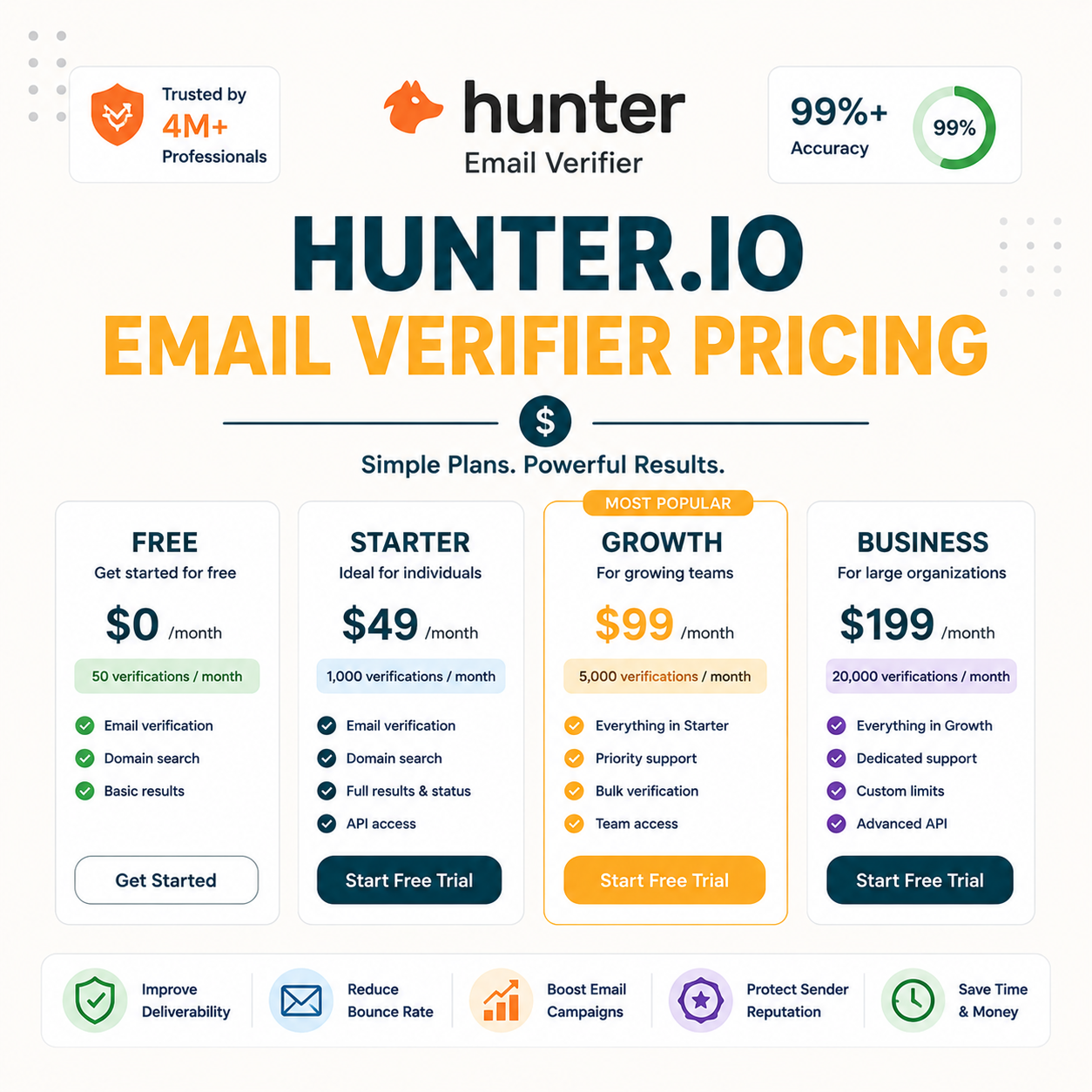
Hunter charges verification in credits. The free plan includes 50 credits a month; paid plans add larger credit pools where the per-verification cost falls as the tier rises. One verification consumes half a credit — so each credit verifies two addresses — and credits are shared with email finding, where one find costs a full credit.
Three building blocks define the credit model below.
- Verification credit: One verification consumes 0.5 credit, so a single credit checks two addresses. The same credit pool also powers email finding, where each find costs a full credit.
- Free allowance: Every account includes 50 credits a month at no cost, enough for roughly 100 verifications with full status and confidence scoring and no card on file.
- Paid pools: Paid plans scale the monthly credit pool, and the effective cost per verified email drops as the pool grows from the entry tier up to the largest plan.
The number that matters is not the plan price but the effective cost per verified email, which this guide calculates at each volume.
What Does Hunter.io Email Verifier Pricing Actually Cost Per Email?
Effective cost depends on the plan. On the entry tier the cost per verified email is higher; on larger pools it drops toward roughly $6 per 1,000. Free verifications make low volume effectively free, which is where many senders should start before paying for anything.
Source: hunter.io/pricing, verified 2026-06-27. One verification uses 0.5 credit, so verifications per month = monthly credits × 2 (credits shared with finding). Cost per 1,000 assumes all credits spent on verification at monthly billing.
Cost per verified email falls with volume — the per-1,000 figure, not the sticker price, decides which plan is economical.
How Much Does Hunter Cost to Verify 1,000, 10,000 and 100,000 Emails?
At 1,000 emails the entry tier covers the job; at 10,000 a mid plan is cheapest per email; at 100,000 the largest pool or a custom plan wins, with cost per 1,000 at its lowest. The three scenarios below show the math against current plan pricing.
Source: calculated from hunter.io/pricing, verified 2026-06-27. Scale covers 50,000 verifications/mo, so 100,000/mo needs two Scale pools or an Enterprise quote; Enterprise typically lowers the per-1,000 rate further.
Match the plan to monthly volume, not peak — overbuying credits that expire is the most common pricing mistake.
Is the Hunter Verifier Free Plan Enough to Avoid Paying?
For solo senders and small, occasional lists, the free monthly verifications are enough — full status and scoring included, no card required. The upgrade trigger is bulk CSV or API access, or a monthly volume that climbs past the free allowance of roughly 100 verifications.
Check how many free verifications you get this month.
Start Free →No credit card · Upgrade only when volume grows.
Free is a genuine risk-reversal: confirm accuracy on a real list before any spend.
What Hidden Costs or Credit Traps Should You Watch For?
Three traps inflate real cost: credits that expire unused at the month’s end, bulk uploads that burn more credits than expected, and paying for a higher tier than monthly volume needs. Each one is avoidable with a simple volume estimate before upgrading.
- Credit expiry: Monthly credits reset rather than roll over, so an unused pool is money spent for nothing. Buying a tier far above real volume wastes the difference every month.
- Catch-all retries: Lists heavy with catch-all and unknown domains consume credits without producing a clean valid result, so a messy source list costs more to process than a well-sourced one.
- Tier overbuy: Picking a plan sized for the largest list ever sent, rather than the typical monthly volume, locks in a recurring overspend. Sizing to the median month is almost always cheaper.
Most “expensive” verdicts come from overbuying, not the rate. Estimate volume first and the price is predictable.
Is Hunter’s Cost Per Verified Email Competitive With ZeroBounce and NeverBounce?
On pure cost per 1,000, dedicated bulk verifiers like NeverBounce and ZeroBounce can undercut Hunter at high volume. Hunter closes the gap by bundling email finding, so teams needing both find and verify pay once instead of carrying two subscriptions.
Source: vendor pricing pages, verified June 2026. Per-1,000 rates move with volume tiers — confirm current rates on each provider’s site before buying.
Hunter’s verification endpoint returns a deliverability result and a confidence score for each address, without sending a message to it.
— Hunter.io API documentation
If verifying is the only job, a pure-play tool may be cheaper; if finding plus verifying both matter, Hunter’s bundle is the lower total cost. The full head-to-head is in Hunter vs ZeroBounce for email marketers.
Does Verifying Get Cheaper on an Annual Plan?
Yes. Annual billing lowers the effective monthly price on Hunter plans by around 30%, so per-verified-email cost drops further for steady, predictable volume. For seasonal or one-off cleans, monthly billing avoids paying for months the verifier sits unused.
- Annual fit: Teams verifying a similar volume every month capture the full annual discount, dropping the per-1,000 cost below the monthly rate across the whole year.
- Monthly fit: Seasonal senders, agencies with project-based cleans, or anyone testing the tool keep flexibility by paying monthly and pausing when no list needs verifying.
Commit annually only when monthly volume is steady; otherwise monthly flexibility is worth the small premium.
Which Hunter Plan Fits Your Verification Volume?
Three profiles map cleanly to plans: occasional cleaners stay free, regular senders fit the mid tier for the best cost per email, and high-volume or agency users need the largest pool. Match the tier to monthly volume, not the biggest list ever sent.
- Occasional cleaner: Solo founders and small lists verifying under 100 addresses a month stay on the free plan, paying nothing while still getting full status and confidence scoring.
- Regular sender: Marketers cleaning a few thousand to twenty thousand addresses a month fit the Growth tier, where cost per 1,000 verified lands near its sweet spot.
- High-volume / agency: Teams or agencies verifying tens of thousands or more need the Scale pool or an Enterprise quote, where the largest pool produces the lowest cost per verified email.
The cheapest plan is the one matched to real monthly volume — not the smallest, not the safest-biggest.
When Is a Cheaper Bulk Verifier the Smarter Spend?
If verifying millions monthly on a pure-cost budget, a dedicated bulk verifier usually wins on price per 1,000. Hunter is the better value only when finding emails is also needed or volume is low-to-mid — an honest limit worth naming before you commit.
- Choose cheaper bulk when: Verification is the only job, monthly volume runs into the hundreds of thousands or millions, and price per 1,000 is the single deciding metric. A pure-play verifier typically undercuts a bundled tool at that scale.
- Choose Hunter when: The same team also finds emails, monthly volume is low-to-mid, and an honest free tier to test accuracy first matters. One subscription covering both jobs beats paying for two tools.
Price-only buyers at scale should compare per-1,000 directly; everyone else benefits from Hunter’s bundle.
How Do You Estimate Your Hunter Verification Cost?
Estimate in three steps: count addresses to verify per month, divide by the credit allowance of each plan to find the cheapest fit, then multiply remaining volume by the per-1,000 rate. The result is the true monthly verification cost, with no surprises at checkout.
- Count monthly volume: Add up every list and signup-form address that needs verifying in a typical month, using the median month rather than the busiest one as the baseline.
- Match to plan allowance: Find the smallest plan whose verification allowance covers that volume, since the cheapest economical plan is the one that fits without large unused credits.
- Add per-1,000 overage: For volume above the plan allowance, multiply the extra thousands by that tier’s per-1,000 rate to land on the true all-in monthly cost.
“Freemium offers basic features at no cost while charging for advanced features.”
— Wikipedia, Freemium
A five-minute estimate prevents the only real pricing surprise — buying more credits than the list ever needs.
Real-World Cost: Verifying a 50,000-Lead List With Hunter
On a 50,000-address clean, the Scale pool delivered the lowest cost per verified email at roughly $6 per 1,000, with about a third flagged invalid or risky and removed before send. The credits-to-clean ratio shows where Hunter’s pricing pays off once volume is real.
Verifying a cold list before the first send is the cheapest way to protect a warming domain.
— Growth Hack Suite, pre-send verification workflow
At real volume the per-email cost is small against the revenue a clean, deliverable list protects.
Is Hunter.io Email Verifier Priced Fairly?
For low-to-mid volume and teams already finding emails with Hunter, the pricing is fair and often the cheapest total once finding is included. Pure high-volume verifying is where a dedicated tool can undercut it, and this guide names that limit plainly.
Verdict: 100 free verifications a month, ~$7.45 per 1,000 on Growth and ~$5.98 at Scale make Hunter fairly priced for senders verifying thousands of emails — especially teams that also find emails and pay one bill instead of two.
Verify your list free and see your real cost.
Verify Emails Free →Free plan · No credit card · Upgrade only when you need to
Related Tools in the Hunter Stack
Verifier pricing is one part of the Hunter bill. For full-account costs across finding and verifying, the wider Hunter guides cover every plan; this page focuses on the cost to verify.
- Hunter Email Finder: The other half of the bundle that shares the same credit pool — read the Hunter.io email finder review for find-side costs.
- Verification basics: New to the process? Start with how email verification works before comparing plans.
Hunter Email Verifier Pricing: Frequently Asked Questions
The 12 most-asked questions about Hunter Email Verifier pricing.
How much does Hunter Email Verifier cost?
Verification runs on credits, with one verification using 0.5 credit. The free plan covers about 100 verifications a month; paid plans start at $49/month for 4,000 verifications, and cost per 1,000 falls to roughly $7.45 on the $149 Growth plan and ~$5.98 at Scale.
What is the cost per verified email on Hunter?
Cost per verified email ranges from about $0.012 on the Starter plan down to roughly $0.006 at Scale, or free within the monthly allowance. The rate falls as the credit pool grows, so high-volume verifying is cheaper per email.
Is there a free Hunter email verifier plan?
Yes. Every account includes 50 free credits a month, enough for roughly 100 verifications, with full status and confidence scoring and no credit card required. Bulk CSV and API access unlock on paid tiers.
How much to verify 10,000 emails with Hunter?
Verifying 10,000 emails a month fits the Growth plan at $149/month, which covers up to 20,000 verifications. That works out to roughly $7.45 per 1,000 verified, or about $0.0075 per email at that volume.
Does Hunter charge separate credits for verifying vs finding?
Both draw from one shared monthly credit pool, but at different rates: finding an email costs one full credit, while verifying costs half a credit. So the same pool verifies twice as many addresses as it finds.
Do unused Hunter verification credits roll over?
No. Monthly credits reset at the start of each billing cycle and do not roll over. Buying a tier far above typical volume means the unused credits are lost, so sizing the plan to the median month avoids waste.
Is Hunter verification cheaper on an annual plan?
Yes. Annual billing cuts the effective monthly price by around 30% versus paying month to month, lowering the per-verified-email cost across the year. It pays off for steady volume but not for seasonal or one-off cleans.
Hunter verifier pricing vs ZeroBounce — which is cheaper?
At high pure-verification volume, ZeroBounce and NeverBounce can undercut Hunter on price per 1,000. Hunter wins on total cost when a team also needs email finding, since one subscription covers both jobs instead of two.
Why did my Hunter bulk verify use more credits than expected?
Bulk uploads heavy with catch-all, role and unknown domains consume credits even when the result is uncertain, so a poorly sourced list burns more credits per clean valid. Cleaning obvious junk before upload keeps the credit cost down.
Which Hunter plan is best for my verification volume?
Occasional cleaners under 100 a month stay free; regular senders verifying a few thousand to 20,000 fit Growth for the best per-email rate; agencies and high-volume teams need Scale or Enterprise. Match the tier to typical monthly volume.
Is Hunter Email Verifier worth the price?
For low-to-mid volume and teams already finding emails with Hunter, yes — accuracy is solid, the free tier de-risks the decision, and one bill covers both jobs. Pure high-volume verifiers on a price-only budget may save with a dedicated tool.
How do I estimate my monthly Hunter verification cost?
Count the addresses you verify in a typical month, find the smallest plan whose allowance covers that volume, then multiply any overage by the tier’s per-1,000 rate. The total is the true monthly cost with no checkout surprises.